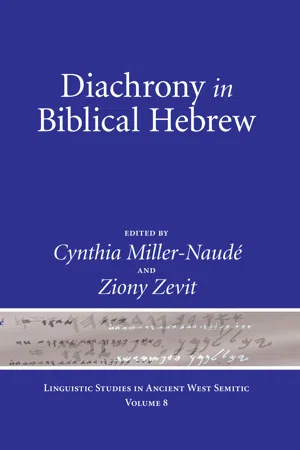
Diachrony in Biblical Hebrew is an indispensable publication for biblical scholars, whose interpretations of scriptures must engage the dates when texts were first composed and recorded, and for scholars of language, who will want to read these essays for the latest perspectives on the historical development of Biblical Hebrew. For Hebraists and linguists interested in the historical development of the Hebrew language, it is an essential collection of studies that address the language's development during the Iron Age (in its various subdivisions), the Neo-Babylonian and Persian periods, and the Early Hellenistic period. Written for both "text people" and "language people," this is the first book to address established Historical Linguistics theory as it applies to the study of Hebrew and to focus on the methodologies most appropriate for Biblical Hebrew and Aramaic. The book provides exemplary case studies of orthography, lexicography, morphology, syntax, language contact, dialectology, and sociolinguistics and, because of its depth of coverage, has broad implications for the linguistic dating of Biblical texts. The presentations are rounded out by useful summary histories of linguistic diachrony in Aramaic, Ugaritic, and Akkadian, the three languages related to and considered most crucial for Biblical research.
- 545 pages
- English
- PDF
- Available on iOS & Android
eBook - PDF
Diachrony in Biblical Hebrew
About this book
Information
Table of contents
- COVER Front
- Copyright Page
- Table of Contents
- Introduction
- Chapter 1: Diachrony in Biblical Hebrew: Linguistic Perspectives on Change and Variation
- Chapter 2: Methodological Issues in the Dating of Linguistic Forms Considerations from the Perspective of Contemporary Linguistic Theory
- Chapter 3: Biblical Hebrew as a Diachronic Continuum
- Chapter 4: Diachrony in Biblical Hebrew and a Theory of Language Change and Diffusion
- Chapter 5: Detecting Development in Biblical Hebrew Using Diachronic Typology
- Chapter 6: Historical Linguistics and Biblical Hebrew
- Chapter 7: Dwelling on Spelling
- Chapter 8: The Third-Person Masculine Plural Suffixed Pronoun -mw and Its Implications for the Dating of Biblical Hebrew Poetry
- Chapter 9: The Kethiv/Qere אוִה, Diachrony, and Dialectology
- Chapter 10: Discerning Diachronic Change in the Biblical Hebrew Verbal System
- Chapter 11: The Archaic System of Verbal Tenses in“Archaic” Biblical Poetry
- Chapter 12: Diachronic Syntactic Studies in Hebrew Pronominal Reciprocal Constructions
- Chapter 13: Syntactic Aramaisms as a Tool for the Internal Chronology of Biblical Hebrew
- Chapter 14: The “Linguistic Dating of Biblical Texts” Comments on Methodological Guidelines and Philological Procedures
- Chapter 15: The Evolution of Literary Hebrew in Biblical Times The Evidence of Pseudoclassicisms
- Chapter 16: Signs of Late Biblical Hebrew in Isaiah 40–66
- Chapter 17: Language Variation, Discourse Typology, and the Sociocultural Background of Biblical Narrative
- Chapter 18: Northern Hebrew through Time:From the Song of Deborah to the Mishnah
- Chapter 19: Diachrony in Biblical Hebrew Lexicography and Its Ramifications for Textual Analysis
- Chapter 20: Outline of Aramaic Diachrony
- Chapter 21: Diachrony in Ugaritic
- Chapter 22: Diachrony in Akkadian and the Dating of Literary Texts
- Chapter 23: Not‑So‑Random Thoughts on Linguistic Dating and Diachrony in Biblical Hebrew
- Index
Trusted by 375,005 students
Access to over 1.5 million titles for a fair monthly price.
Study more efficiently using our study tools.
Frequently asked questions
Yes, you can cancel anytime from the Subscription tab in your account settings on the Perlego website. Your subscription will stay active until the end of your current billing period. Learn how to cancel your subscription
No, books cannot be downloaded as external files, such as PDFs, for use outside of Perlego. However, you can download books within the Perlego app for offline reading on mobile or tablet. Learn how to download books offline
Perlego offers two plans: Essential and Complete
- Essential is ideal for learners and professionals who enjoy exploring a wide range of subjects. Access the Essential Library with 800,000+ trusted titles and best-sellers across business, personal growth, and the humanities. Includes unlimited reading time and Standard Read Aloud voice.
- Complete: Perfect for advanced learners and researchers needing full, unrestricted access. Unlock 1.5M+ books across hundreds of subjects, including academic and specialized titles. The Complete Plan also includes advanced features like Premium Read Aloud and Research Assistant.
We are an online textbook subscription service, where you can get access to an entire online library for less than the price of a single book per month. With over 1.5 million books across 990+ topics, we’ve got you covered! Learn about our mission
Look out for the read-aloud symbol on your next book to see if you can listen to it. The read-aloud tool reads text aloud for you, highlighting the text as it is being read. You can pause it, speed it up and slow it down. Learn more about Read Aloud
Yes! You can use the Perlego app on both iOS and Android devices to read anytime, anywhere — even offline. Perfect for commutes or when you’re on the go.
Please note we cannot support devices running on iOS 13 and Android 7 or earlier. Learn more about using the app
Please note we cannot support devices running on iOS 13 and Android 7 or earlier. Learn more about using the app
Yes, you can access Diachrony in Biblical Hebrew by Cynthia Miller-Naudé,Ziony Zevit in PDF and/or ePUB format, as well as other popular books in History & Ancient History. We have over 1.5 million books available in our catalogue for you to explore.