Can you get lost in a crowd? It is polite to stare at people walking past on the street? What differentiates the city of daylight and the nocturnal metropolis? What connects walking, philosophy and the big toe? Can we save the city - or ourselves - by taking the pavement?
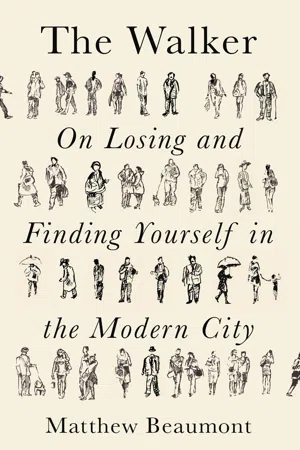
There is no such thing as the wrong step; every time we walk we are going somewhere. In a series of riveting intellectual rambles, Matthew Beaumont retraces a history of the walker from Charles Dicken's insomniac night rambles to wandering through the faceless, windswept monuments of the neoliberal city including Edgar Allen Poe, Andrew Breton, H G Wells, Virginia Woolf, Jean Rhys and Ray Bradbury. As the author shows, the act of walking is one of escape, self-discovery, disappearances and potential revolution, and explores the relationship between the metropolis and its pedestrian life.
- 336 pages
- English
- ePUB (mobile friendly)
- Available on iOS & Android
eBook - ePub
About this book
Information
1
Convalescing
Edgar Allan Poe’s
‘The Man of the Crowd’
‘The Man of the Crowd’
In his ‘Meditations of a Painter’, composed in 1912, the Italian painter Giorgio de Chirico narrated the mysterious but at the same time perfectly ordinary experience that had inspired his famous sequence of metaphysical cityscapes, commencing with the Enigma of an Autumn Afternoon (1910):
One clear autumnal morning I was sitting on a bench in the middle of the Piazza Santa Croce in Florence. It was of course not the first time that I had seen this square. I had just come out of a long and painful intestinal illness, and I was in a nearly morbid state of sensitivity. The whole world, down to the marble of the buildings and the fountains, seemed to me to be convalescent. In the middle of the square rises a statue of Dante draped in a long cloak, holding his works clasped against his body, his laurel-crowned head bent thoughtfully earthward. The statue is white marble, but time has given it a gray cast, very agreeable to the eye. The autumn sun, warm and unloving, lit the statue and the dark façade. Then I had the strange impression that I was looking at all these things for the first time, and the composition of my picture came to my mind’s eye.1
This is a classic modernist epiphany. Life itself, condemned to a state of deadening repetition, especially in the routine spaces of the city, is apprehended as if for the first time. Earlier in the ‘Meditations’, de Chirico cites Schopenhauer’s dictum that, in order to have ‘immortal’ ideas, ‘one has but to isolate oneself from the world for a few moments so completely that the most commonplace happenings appear to be new and unfamiliar, and in this way reveal their true essence’.2
In the incident in the Piazza Santa Croce, the everyday is redeemed by what de Chirico calls ‘the enigma of sudden revelation’.3 Several of his canvases from the 1910s revisit this ‘primal modern scene’, as Marshall Berman might put it.4 In The Mystery and Melancholy of a Street (1914), to take one example, a sudden silence seems to have descended on the city, softly flooding the most commonplace sights with some unidentifiable spiritual significance. The end of an ordinary day assumes the form of an ominous interruption. It is as if a mysterious curfew has been imposed on the city, less because of some specific threat of destruction than because of a generalized anxiety about death.
This city, as Walter Benjamin might have put it, ‘looks cleared out, like a lodging that has not yet found a new tenant’;5 or like one from which an old tenant has for nameless reasons been expelled. Its unsettling atmosphere is objectified in the sinister silhouette that falls across the piazza from the right-hand side of the composition, menacing the fragile, fairy-tale innocence of the child that scampers up the street with a hoop. With its blank colonnades and its baked, eerily featureless surfaces, the city is at once a desert and a labyrinth. The poet John Ashbery, an admirer of de Chirico, has suggestively referred to his ‘agoraphobia-inducing piazzas’.6
In The Mystery and Melancholy of a Street, as in other paintings by de Chirico at this time, the city has become the implausible setting for what Marx once referred to, at least according to Benjamin, as ‘socially empty space’.7 Looking at it, the spectator experiences a creeping sense of agoraphobic panic, one that perhaps mimics de Chirico’s fear of fainting in the street, which he documented in his memoirs, and his neurotic habit, as a consequence, of sticking close to walls as he gropes through the city. ‘In the noisy street,’ he reflects in the ‘Meditations’, ‘catastrophe goes by.’8 So too, it seems, in the silent street.

The Mystery and Melancholy of a Street 1914 (oil on canvas) by Giorgio de Chirico.
The dreamlike stasis of The Mystery and Melancholy of a Street evokes the faint, residual delirium of someone recovering from, say, an intestinal illness. The city de Chirico imagines in this composition is a physiological phenomenon, a physical extension of the painter’s embodied consciousness. Its colonnades, streets and open spaces, in contrast to contemporary cities celebrated for their arterial freedom, themselves seem susceptible to a kind of intestinal inhibition that impedes uncomplicated movement, notwithstanding the absence of human throng. The city itself is in a state of preternatural sensitivity.
So, the painting depicts what Benjamin called ‘the infirmity and decrepitude of this great city’.9 But it also depicts the city’s capacity to be regenerated or reborn through the contractions that gently convulse it.
Though often overlooked, the most striking aspect of de Chirico’s autobiographical anecdote in the ‘Meditations’ is the emphasis on his convalescent state, and on the concomitant fact that the ‘whole world’ feels to him as if it, too, is convalescent.
In addition to de Chirico’s personal experience of recovering from intestinal illness, it is surely possible to detect the celebrated influence of Nietzsche on his thinking in this respect. As a young man, de Chirico was a fanatical reader of Nietzsche, and he consciously applied to painting what he called the ‘Nietzschean method’, which involved ‘see[ing] everything, even man, in its quality of thing’.10 This is an aesthetic in which ‘metaphysical revelation’, to frame it in the art historian Ara Merjian’s terms, ‘sits within the limits of physical reality.’11 The convalescent – for whom ‘all things have a new taste’, as Nietzsche puts it in Twilight of the Idols (1889), and who waits in expectancy – is perhaps the ultimate embodiment of the Nietzschean method.12 For the convalescent, the enigmatic thingness of the things to which he relates is readily apparent.
It is reasonable to assume that, in affirming convalescence as a regime of the senses, de Chirico was recalling the regenerative role played by the convalescent in Nietzsche’s philosophy. In Human, All Too Human (1878), for example, Nietzsche details what he calls ‘another step onward in convalescence’; that is, the moment when ‘the free spirit again approaches life, slowly, of course, almost recalcitrantly, almost suspiciously.’ He opens himself up to ‘feeling and fellow-feeling’, and to the world around him:
He almost feels as if his eyes were only now open to what is near. He is amazed and sits motionless: where had he been, then? Those near and nearest things, how they seem to him transformed!13
Nietzsche’s description reads like a snapshot of de Chirico on that clear autumnal morning when he sat on a bench in the middle of the Piazza Santa Croce in Florence. Or, more precisely, de Chirico appears to be acting out Nietzsche’s prescription.
Perhaps the painter was also thinking of a crucial section on the concept of the ‘eternal return’ in Thus Spoke Zarathustra (1885), where Nietzsche devoted a section to ‘The Convalescent’. There, Zarathustra’s animals coax him from the cave where he has lain for ‘seven days, with heavy eyes’, telling him, in a beautiful formulation, that ‘all things want to be [his] physicians!’ When in the course of his conversation with the animals Zarathustra recalls his sickness, and his ‘disgust at man’, they interrupt him: ‘Speak no further, convalescent!’ they command, ‘but go out to where the world awaits you like a garden.’14 In the Piazza Santa Croce the city waits for de Chirico like a garden, even if in its fallen state it is at once a desert and a labyrinth.
In a later retrospective account of the factors that shaped his ‘Pittura Metafisica’, entitled ‘Some Perspectives on My Art’ (1935), de Chirico confirmed that the important canvases he painted in Paris between 1912 and 1915, which were shaped by a visit to Turin in 1911, ‘owe[d] a great deal to Friedrich Nietzsche, whom I read passionately at the time’. ‘His Ecce Homo [1888],’ de Chirico specified, ‘written in Turin shortly before he succumbed to madness, greatly helped me understand the city’s peculiar beauty.’ The peculiar beauty of Turin, he continued, resided in its autumnal quality:
Autumn, as it revealed Turin to me and as Turin revealed it to me, is joyful, although certainly not in a gaudy, dazzling way. It’s something huge, at once near and distant; a great peacefulness, great purity, rather closely related to the joy felt by a convalescent finally cured of a long and painful illness.15
De Chirico had previously identified convalescence with the melancholic atmosphere and muted affects of autumn – the season’s distinctive Stimmung – in his elusive novel Hebdomeros (1929). There he declares that ‘summer is a malady, it’s all fever and delirium and exhausting perspiration’, whereas ‘autumn is convalescence, after which life begins (winter)’.16 As his evocation of the ‘clear autumnal morning’ in the Piazza Santa Croce indicates, de Chirico’s paintings are autumnal in this precise sense. They consciously evoke the space and time of convalescence, a delicate state of suspension and transition between two opposed modes of being. Convalescence is a heightened condition of openness or receptiveness to the world, in which traces of fever dissolve in a consciousness characterized by a feeling of preternatural calm.
Either from fear or from a reckless happiness, the child in The Melancholy and Mystery of a Street dances a little desperately up the street with her hoop. She is a displaced, perhaps idealized image of the convalescent painter’s frail openness to re-experiencing the concussions and the percussive rhythms of the city. In ‘Some Perspectives on My Art’, de Chirico portrayed the artist’s experience of an ‘inspiration’ or ‘revelation’ as ‘like a child being handed a toy’: ‘The likeness between the joy of the artist touched by a revelation and that of the child surprised by a present depends, I believe, on the fact that both joys are pure.’17
In the literature on convalescence as an aesthetic, if I can put it like that, which dates back to the Romantics, and specifically to Coleridge in a rural context and Baudelaire in an urban one, the convalescent’s experience of his or her environment is often compared to that of the child. Such a delicate, almost helpless responsiveness or susceptiveness to life, and to its forgotten sensations, has something of the child’s brittle innocence: ‘I had the strange impression that I was looking at all these things for the first time,’ de Chirico comments on his convalescence.
The ‘nearly morbid state of sensitivity’ evoked by de Chirico in his ‘Meditations of a Painter’, associated as it is with the aftermath of a long illness, situates the artist within a tradition that I want to characterize, in a deliberately Baudelairean formulation, as that of the convalescent as hero of modernity. As de Chirico’s anecdote announces, the convalescent, and particularly the male convalescent, who is for social reasons less physically restricted than the female, less confined to the domestic domain, is in spite of his infirmity and decrepitude not necessarily confined to the sickroom.
I am especially interested in the moment when the urban convalescent, notwithstanding his frail nerves, takes his first, reckless steps in the city from which he has been temporarily exiled, and experiences a sense of freedom at once tentative and abrupt. The streets, which the convalescent approaches cautiously, still a little feverishly, at first perhaps as an observer who must half-protect himself from the impact of the city, are the site of his groping re-engagement with everyday life.
Occupying some indeterminate space between health and illness – even, in his residual feverishness, between reason and unreason – the convalescent is at once acutely sensitive to his environment and oddly insulated from it. ‘The body after long illness is languid, passive, receptive of sweetness, but too weak to contain it,’ wrote Virginia Woolf in Jacob’s Room (1922).18 The convalescent is both alive to the life that continues around him, and dead to it. He is at the same time calm and restless, contemplative and thoughtless.
In Sons and Lovers (1913), D. H. Lawrence also narrated an epiphanic moment in which the whole world seems convalescent. ‘In convalescence,’ the narrator comments, after describing an attack of bronchitis, ‘everything was wonderful.’19 The world has been renewed. As in de Chirico’s contemporaneous moment of revelation, the distinctive state of convalescence releases the young protagonist Paul Morel’s sense of the pictorial qualities of everyday sights, albeit in the country rather than the city. Seated in bed in his sickroom, he abstractedly concentrates on the wintry view through the window, where snowflakes cling to the pane for a moment and are gone.
In convalescence, as in the Baudelairean conception of spleen explored by Benjamin, ‘time is reified: the minutes cover a man like snowflakes.’20 From Paul’s convalescent perspective, the land suddenly comes to seem like a landscape; that is, detached from its instrumental functions, the countryside is spontaneously rendered aesthetic. In this scene, the architrave effectively functions as a picture-frame, and the deep snow outside acts as a blank canvas: ‘Away across the valley the little black train crawled doubtfully over the great whiteness.’21 In de Chirico’s paintings from this period, too, black trains that creep against the background are symbolic of an industriousness, indeed an industrialism, from which the convalescent feels gratefully exempt.
In the context of an urban convalescence, the aesthetics of the city and its anaesthetics are inseparable. The convalescent is thus an excellent instance of what Benjamin called ‘the law of the dialectic at a standstill’ – a social being whose immobility itself incarnates the characteristic ambiguities of everyday life in a metropolitan city.22 As someone cautiously emerging from the state of isolation associated with sickness, and experiencing in consequence a process of more or less reluctant re-socialization, he is a graphic instance of the metropolitan relationship between the individual and society, the private and the public.
As an aesthetic archetype, furthermore, the convalescent is precisely situated on the cusp of Romanticism and Modernism, both of which, I am assuming, are politico-cultural responses to capitalist modernity. Convalescence is one of the means by which, in an industrial society and in the increasingly uniform, utilitarian culture associated with it, the subject’s body obeys the injunction, characteristic of both Romanticism...
Table of contents
- Cover Page
- Halftitle Page
- Title Page
- Copyright Page
- Dedication
- Contents
- Introduction: Lost and Unlost Steps
- 1. Convalescing
- 2. Going Astray
- 3. Disappearing
- 4. Fleeing
- 5. Wandering
- 6. Collapsing
- 7. Striding, Staring
- 8. Beginning
- 9. Stumbling
- 10. Not Belonging
- Afterword: Walking in London and Paris at Night
- Acknowledgements
- Notes
- Index
Trusted by 375,005 students
Access to over 1.5 million titles for a fair monthly price.
Study more efficiently using our study tools.
Frequently asked questions
Yes, you can cancel anytime from the Subscription tab in your account settings on the Perlego website. Your subscription will stay active until the end of your current billing period. Learn how to cancel your subscription
No, books cannot be downloaded as external files, such as PDFs, for use outside of Perlego. However, you can download books within the Perlego app for offline reading on mobile or tablet. Learn how to download books offline
Perlego offers two plans: Essential and Complete
- Essential is ideal for learners and professionals who enjoy exploring a wide range of subjects. Access the Essential Library with 800,000+ trusted titles and best-sellers across business, personal growth, and the humanities. Includes unlimited reading time and Standard Read Aloud voice.
- Complete: Perfect for advanced learners and researchers needing full, unrestricted access. Unlock 1.5M+ books across hundreds of subjects, including academic and specialized titles. The Complete Plan also includes advanced features like Premium Read Aloud and Research Assistant.
We are an online textbook subscription service, where you can get access to an entire online library for less than the price of a single book per month. With over 1.5 million books across 990+ topics, we’ve got you covered! Learn about our mission
Look out for the read-aloud symbol on your next book to see if you can listen to it. The read-aloud tool reads text aloud for you, highlighting the text as it is being read. You can pause it, speed it up and slow it down. Learn more about Read Aloud
Yes! You can use the Perlego app on both iOS and Android devices to read anytime, anywhere — even offline. Perfect for commutes or when you’re on the go.
Please note we cannot support devices running on iOS 13 and Android 7 or earlier. Learn more about using the app
Please note we cannot support devices running on iOS 13 and Android 7 or earlier. Learn more about using the app
Yes, you can access The Walker by Matthew Beaumont in PDF and/or ePUB format, as well as other popular books in Literature & Literary Criticism History & Theory. We have over 1.5 million books available in our catalogue for you to explore.