Our world is facing an enormous and unprecedented challenge. The migration crisis affects nearly eighty million people and represents a humanitarian catastrophe. How can we ignore the suffering of men, women, and children who are forcibly displaced worldwide?
The book, Changing Stories, helps the reader to reflect on the migration crisis from a biblical perspective. It evaluates refugee ministry ongoing initiatives among the world’s most vulnerable people. Additionally, it analyzes the refugee ministry that the Arsenal Hill Presbyterian Church is developing with refugees from Syria, Iraq, the Congo, and Vietnam. The analysis uses as a framework the Best Practices for Christian Ministry among Forcibly Displaced People document proposed by the Refugee Highway Partnership (RHP).
Throughout the book, the author answers the following questions:
•How complex is the current migration crisis?
•What does the Scripture say about displaced people?
•What are some of the available tools for a refugee ministry?
•How does a refugee ministry look in a local church?
•What are some of the best practices for a refugee ministry?
The book tells many stories of refugees from different backgrounds, which will help you hear voices representing hundreds of thousands of refugees who go unheard.
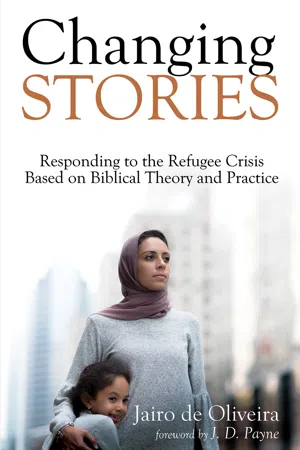
eBook - ePub
Changing Stories
Responding to the Refugee Crisis Based on Biblical Theory and Practice
- 170 pages
- English
- ePUB (mobile friendly)
- Available on iOS & Android
eBook - ePub
Changing Stories
Responding to the Refugee Crisis Based on Biblical Theory and Practice
About this book
Information
Topic
Theology & ReligionSubtopic
Christian Ministry1
Each Person Has a Story
God loves each of us as if there were only one of us.
—Augustine of Hippo
On September 2, 2015, an appalling image shocked the world: that of a dead migrant child on a beach. Aged only two years, this Syrian boy, named Alan,1 had drowned in the Mediterranean Sea and washed up on the Bodrum peninsula of southern Turkey. He died during a tragic attempt to leave the Middle East with his family. They’d been hoping to reach Europe by boat before traveling to Canada.
Alan’s dead body, limp and lifeless, lapped by waves on the beach, directed fresh attention to the refugee crisis. Photographs of the boy wearing a red T-shirt, blue shorts, and dark shoes, lying face-down in the sand, made international headlines. This tragic incident sent a message to the whole world that the refugee crisis is a serious matter. In fact, it is life and death. For many, this small Syrian boy embodied the drama of thousands of refugees escaping from persecution, war, or violence. Especially, those who continue to die after putting themselves at the mercy of precarious vessels to cross the sea.
Although the focus was placed on Alan, due to the graphic image, his death was not the only causality in this disastrous attempt to cross the Mediterranean. Sadly, his four-year-old brother, Ghalib, his mother, Rehanna, and nine other refugees died in that unfortunate event.2
On that Wednesday, Alan’s family left the Turkish coast on an inflatable boat without appropriate life vests. Their flimsy rubber dinghy had a maximum occupancy of eight people, but it was carrying sixteen refugees. Only five minutes after they had set off for to the Greek island of Kos, a fierce storm blew over them. High waves broke against the overloaded boat. The frightened captain jumped into the sea in despair. Abdullah, Alan’s father, tried to control the rubber dinghy with devastating consequences.
Some people may ask, “Why would refugees pay smugglers high sums of money to sneak them into Europe, navigate dangerous waters in unsecured boats, and expose the lives of themselves and family (including young children) to extreme risks?” Indeed, as Kurdi comments, “It may be impossible to comprehend unless you’ve lived the life of a refugee.”3
Alan was a member of a Kurdish family. Because of his Kurdish origins, he became well-known as Alan Kurdi. The Kurds are the world’s largest ethnic group without a country. They make up thirty million people living on the territory shared among Syria, Iraq, Iran, and Turkey. Kurds have been struggling to claim the right to have their own land for several decades. The troubling reality is that Alan and his family already come from a people group that has been scattered in different countries and is emblematic of the refugee crisis.
Abdullah, Rehanna, Ghalib, and Alan were fleeing the Islamic State of Iraq and al-Sham. Their city, Kobani, in the Aleppo Governorate, was under siege by ISIS from September 2014 to January 2015. As a result, most neighborhoods were destroyed, and more than 160,000 people fled, fearing the ISIS fighters.
At first, the family did not intend to migrate. When forced to leave Kobani, they began moving between various cities in northern Syria in hopes of escaping the war. When they felt it was no longer safe to stay within the Syrian territory, they decided to cross the border. The family settled in Turkey, but they loved Syria and returned to Kobani at the beginning of 2015. Nevertheless, in June 2015, ISIS attacked the city again, and it became a battleground. They opted to take refuge in Turkey a second time. Life in Turkey was not easy for them, however. Their best option seemed to be to try to get to Europe and then to Canada, where they had family members living as immigrants.
This Kurdish family was longing for what most people desire in life. All they wanted was to cross the sea in their search to find peace, safety, a home, and a future. But their dream to live a better life sank with that boat on the Mediterranean.
After burying his wife and two children, Alan’s father declared he wanted to go back to Syria. He did not wish to return because the war had stopped or because Syria had become a safe place to live. He changed his mind because the death of his family caused the loss of his dream. Abdullah’s grief was so deep that he gave up his vision to find a better life in the West.
Unfortunately, Alan, his brother, his mother, and nine other refugees who drowned on that crossing attempt were not the last refugees to die while fighting to live. In 2019 alone, UNHCR estimated that 1,336 people perished in similar circumstances.4 In almost all cases, their deaths rarely never make the international news, and we don’t get a chance to hear their stories, but their blood is crying out. There remains much to be done to address the greatest humanitarian crisis of our modern history. Together, we can see these stories change.
The migration crisis continues to force people out of their homeland in different parts of the world—people who share our humanity, our dreams, and aspirations. Refugees are humans like us who are enduring unimaginable suffering as a result of war, violence, persecution, food insecurity, climate change, infectious diseases (such as COVID-19), and many other factors. More than ever before, the international community must make every effort to guarantee their right to live and to live fully as people created in the image of God (Gen 1:27), unique and priceless.
God is at Work
The current migration crisis involves people whose lives have turned upside-down as a result of the human rights violations they have experienced. Pain, suffering, trauma, disappointment, abuse, and exploitation follow them as they strive to carry on and rebuild their lives in unfamiliar contexts. As Sam George suggests, nobody can fully access all the terrible consequences related to the forcible displacement experience that refugees undergo: “Who will ever know the countless men, women, and children who drowned in the depths of the Mediterranean Sea or were buried in the deserts of Syria or Iraq? How could anyone assess the incalculable abuse and trauma refugees have suffered at the hands of violent gangs and border security forces as they sought shelter?”5
Although we are dealing with a tremendous challenge, unlike anything we have seen in the world, we must keep perspective and realize that nothing happens outside of God’s intent and sovereignty. God knows everything, including each detail of our lives, “the very hairs of your head are all numbered” (Luke 12:7). Besides, nothing, good or bad, happens by accident, but by God’s will, “Who can speak and have it happen if the Lord has not decreed it? Is it not from the mouth of the Most High that both calamities and good things come?” (Lam 3:37–38). Additionally, God reigns over everything, and the world is under his control: “The Lord reigns! He is clothed in majesty; the Lord is clothed, and he is girded with strength. Indeed, the world is well established, and cannot be shaken” (Ps 93:1, ISV).
If we believe in the sovereignty of God, then we must conclude that these movements of people across the earth are not accidental. The migration crisis happens by God’s permission and in harmony wit...
Table of contents
- Title page
- Foreword
- Acknowledgments
- Abbreviations
- Introduction
- Chapter 1: Each Person Has a Story
- Chapter 2: God’s Story
- Chapter 3: The Current Story
- Chapter 4: Their Story
- Chapter 5: Back Story
- Chapter 6: Improving Your Story
- Chapter 7: Your Story
- Appendix 1
- Appendix 2
- Appendix 3
- Appendix 4
- Bibliography
Trusted by 375,005 students
Access to over 1.5 million titles for a fair monthly price.
Study more efficiently using our study tools.
Frequently asked questions
Yes, you can cancel anytime from the Subscription tab in your account settings on the Perlego website. Your subscription will stay active until the end of your current billing period. Learn how to cancel your subscription
No, books cannot be downloaded as external files, such as PDFs, for use outside of Perlego. However, you can download books within the Perlego app for offline reading on mobile or tablet. Learn how to download books offline
Perlego offers two plans: Essential and Complete
- Essential is ideal for learners and professionals who enjoy exploring a wide range of subjects. Access the Essential Library with 800,000+ trusted titles and best-sellers across business, personal growth, and the humanities. Includes unlimited reading time and Standard Read Aloud voice.
- Complete: Perfect for advanced learners and researchers needing full, unrestricted access. Unlock 1.5M+ books across hundreds of subjects, including academic and specialized titles. The Complete Plan also includes advanced features like Premium Read Aloud and Research Assistant.
We are an online textbook subscription service, where you can get access to an entire online library for less than the price of a single book per month. With over 1.5 million books across 990+ topics, we’ve got you covered! Learn about our mission
Look out for the read-aloud symbol on your next book to see if you can listen to it. The read-aloud tool reads text aloud for you, highlighting the text as it is being read. You can pause it, speed it up and slow it down. Learn more about Read Aloud
Yes! You can use the Perlego app on both iOS and Android devices to read anytime, anywhere — even offline. Perfect for commutes or when you’re on the go.
Please note we cannot support devices running on iOS 13 and Android 7 or earlier. Learn more about using the app
Please note we cannot support devices running on iOS 13 and Android 7 or earlier. Learn more about using the app
Yes, you can access Changing Stories by Jairo de Oliveira in PDF and/or ePUB format, as well as other popular books in Theology & Religion & Christian Ministry. We have over 1.5 million books available in our catalogue for you to explore.