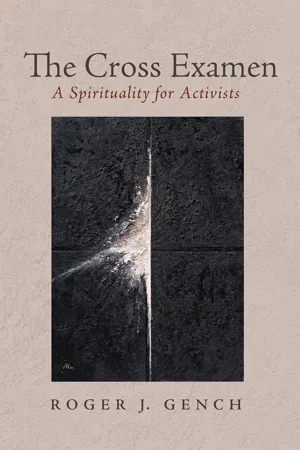
This volume explores the essential relationship between spirituality and activism in conversation with a political theology of the cross. The author contends that contemplative practice and activism bear the same cruciform footprint and are integrally connected, for the cross of Jesus Christ reveals both the brokenness in our lives and the corresponding brokenness in the world; it also discloses the God who is always (and already) bringing resurrection and life out of the death-tending ways of our world. The cross and resurrection expose other crosses, large and small, that litter the landscape of our world and of our personal and corporate lives, as well as places where God’s resurrecting power is at work, bringing life out of death and establishing footholds for the unfolding of the new creation. The volume engages Paul’s Letter to the Galatians and new scholarly readings of it as a rich resource for reflection on these matters and explores the fruit of the Spirit as political virtues that empower communal participation in God’s restorative work in the world. Providing new angles of vision on both the cross and the apostle Paul, the book expands and enlivens reflection on spirituality and activism as profound and generative resources for contemporary faith and practice.
- 144 pages
- English
- ePUB (mobile friendly)
- Available on iOS & Android
eBook - ePub
About this book
Information
Topic
Theology & ReligionSubtopic
Biblical StudiesPart I
Foundations for Cruciform Spirituality
1
The Spiritual Power of the Cross
Then the soldiers led him into the courtyard of the palace (that is, the governor’s headquarters); they called together the whole cohort. And they clothed him in a purple cloak; and after twisting some thorns into a crown, they put it on him. And they began saluting him, “Hail, King of the Jews!” They struck his head with a reed, spat upon him, and knelt down in homage to him. After mocking him, they stripped him of the purple cloak and put his own clothes on him. Then they led him out to crucify him. . . .
It was nine o’clock in the morning when they crucified him. The inscription of the charge against him read, “The King of the Jews.” And with him they crucified two bandits, one on his right and one on his left. Those who passed by derided him, shaking their heads and saying, “Aha! You who would destroy the temple and build it in three days, save yourself, and come down from the cross!” In the same way the chief priests, along with the scribes, were also mocking him among themselves and saying, “He saved others; he cannot save himself. Let the Messiah the King of Israel, come down from the cross now, so that we may see and believe.” Those who were crucified with him also taunted him. (Mark 15:16–20, 25–32; emphasis mine)
The crucifixion of Jesus, at its base level, was a painful public humiliation—a brutal use of political power intended to draw others into its spell. The Gospel of Mark’s account of the crucifixion of Jesus highlights the public and political nature of Jesus’ humiliation on the cross in particularly graphic ways, repeatedly emphasizing the political mockery of Jesus: soldiers ridicule him in the courtyard of the governing authority; passersby deride him, shaking their heads at him; religious authorities mock him; and even those crucified with him taunt him. Given the political diminution of Jesus on the cross, it is little wonder that theologian James Cone discerned a correspondence between Jesus’ cross and the lynching tree (in a book that bears this title)—as the lynching tree also was and is a public and political symbol of power and denigration.1
Paradoxically, just as the early Christians turned the cross, a symbol of Caesar’s power, into a symbol of God’s unconquered love, Cone points out that the cross, for black people, also came to function as “God’s critique of power—white power—with powerless love, snatching victory out of defeat.”2 For Cone, “the cross and the lynching tree represented the worst in human beings and at the same time ‘an unquenchable ontological thirst’ for life that refuses to let the worst determine our final meaning.”3 In like manner, I would maintain that the cross of Jesus represents the humiliating, dehumanizing abuse of power anywhere and everywhere it is exercised (on however large or small a scale)—a place where such abuse is exposed as not the way of God (indeed, as the antithesis of God) in the world, and yet a place where God seeks to bring resurrection, healing, and justice at the very places of brokenness. This is what I call a political theology of the cross—i.e., an understanding of the cross that discerns its exposure of public abuses of power (as well as the personal ramifications of such abuse) embodied in regimes of power, as well as its disclosure of how God in the risen Christ is empowering resurrection (resistance, disruption, and transformation) at the very sites of abuse. Such a theology is grounded in our earliest biblical witnesses, such as the Gospel of Mark’s narrative of Jesus’ crucifixion, noted above. It is also reflected in the Apostle Paul’s understanding of the cross, as we will see. Paul berated the Galatians: “You foolish Galatians! Who has bewitched you? It was before your eyes that Jesus Christ was publicly exhibited as crucified!” (Gal 3:1). It may seem an odd thing to say to Galatian believers in Asia Minor who were not present in Judea on the occasion of Jesus’ crucifixion; but Pauline scholar Davina Lopez makes an astute observation about this verse: “Paul’s Galatians did not see Jesus’ crucifixion, but they did not have to. There were plenty of examples before everyone’s eyes (in real life, in stone, on coins) of capture, torture, bondage and execution of others in the name of affirming Rome’s universal sovereignty through domination.”4 Thus, in Galatians 3:1, Paul gives expression to a political theology that sees the cross of Jesus as exposing other crosses, large and small all around us. Theologian Shawn Copeland notes a similar phenomenon during the era of African American enslavement wherein the refrain from the spiritual—“Were you there when they crucified my Lord?”—was intended to confront all who heard these words with their own complicity in public crucifixions in their own time and place.5
Moreover, a political theology of the cross finds expression in confessional documents like the Nicene Creed. Indeed, in his fine introduction to political theology (Christ and the Common Life), theologian Luke Bretherton points out that the inclusion of the phrase “crucified under Pontus Pilate” in this early creed represents the judgment of God on all local political orders that engage in tyrannical and exploitative practices. Accordingly, the crucifixion, resurrection, and ascension “expose the limits of their power and their fear of their own limits. In contrast to Pilate, and in him all worldly authorities of which he is a type, the resurrection and ascension unveil the deepest and only life-giving source of power: the power of the Spirit. The Spirit brings calm out of storms, health out of disease, and resurrection out of death.”6 In my view, this is a quintessential expression of the political theology of the cross. There are, to be sure, myriad ways of understanding the cross and resurrection in the Bible and Christian tradition,7 but a political theology of the cross is a particularly fruitful way of connecting spirituality and engagement with the world, as we will see.
In sum, what do I have in mind when I use the symbol of the cross? Ernest Hemingway once wrote: “The world breaks everyone and afterward many are strong in the broken places.”8 Let me paraphrase Hemingway to define the cross: The world crucifies everyone, yet God in Christ is always active in the world seeking to bring life out of the broken places. The cross has two important dimensions: it entails both crucifixion and resurrection, so let me elaborate on each.
Crucifixion
When I speak of crucifixion, I am referring both to a historical reality and also to a symbol for the abuse of power. The historical reality is that Jesus was crucified, and his crucifixion was an instrument of state terrorism that the Roman Empire used to force their subjects into submission.9 The intention of crucifixion was to break the will of conquered and oppressed peoples and to impose law and order. New Testament scholar Neil Elliott likens Roman crucifixion to the obscene spectacle that government-sponsored death squads made of massiv...
Table of contents
- Title Page
- Acknowledgments
- Introduction
- Part I Foundations for Cruciform Spirituality
- Chapter 1: The Spiritual Power of the Cross
- Chapter 2: The Cross Examen
- Part II
- Chapter 3: Galatians and Cruciform Spirituality
- The Fruit of the Spirit as Political Virtues
- Chapter 4: Love: The Foundational Fruit of the Spirit
- Chapter 5: Joy: The Second Political Virtue of the Spirit
- Chapter 6: Peace: The Third Political Fruit of the Spirit
- Chapter 7: Patience: The Fourth Political Fruit of the Spirit
- Chapter 8: Kindness: The Fifth Political Fruit of the Spirit
- Chapter 9: Generosity or Doing Good: The Sixth Political Fruit of the Spirit
- Chapter 10: Faithfulness: The Seventh Political Fruit of the Spirit
- Chapter 11: Gentleness: The Eighth Political Fruit of the Spirit
- Chapter 10: Self-Control: The Final Political Fruit of the Spirit
- Epilogue
- Appendix A: Practicum on Engaged Spirituality
- Epilogue
- Appendix
Trusted by 375,005 students
Access to over 1.5 million titles for a fair monthly price.
Study more efficiently using our study tools.
Frequently asked questions
Yes, you can cancel anytime from the Subscription tab in your account settings on the Perlego website. Your subscription will stay active until the end of your current billing period. Learn how to cancel your subscription
No, books cannot be downloaded as external files, such as PDFs, for use outside of Perlego. However, you can download books within the Perlego app for offline reading on mobile or tablet. Learn how to download books offline
Perlego offers two plans: Essential and Complete
- Essential is ideal for learners and professionals who enjoy exploring a wide range of subjects. Access the Essential Library with 800,000+ trusted titles and best-sellers across business, personal growth, and the humanities. Includes unlimited reading time and Standard Read Aloud voice.
- Complete: Perfect for advanced learners and researchers needing full, unrestricted access. Unlock 1.5M+ books across hundreds of subjects, including academic and specialized titles. The Complete Plan also includes advanced features like Premium Read Aloud and Research Assistant.
We are an online textbook subscription service, where you can get access to an entire online library for less than the price of a single book per month. With over 1.5 million books across 990+ topics, we’ve got you covered! Learn about our mission
Look out for the read-aloud symbol on your next book to see if you can listen to it. The read-aloud tool reads text aloud for you, highlighting the text as it is being read. You can pause it, speed it up and slow it down. Learn more about Read Aloud
Yes! You can use the Perlego app on both iOS and Android devices to read anytime, anywhere — even offline. Perfect for commutes or when you’re on the go.
Please note we cannot support devices running on iOS 13 and Android 7 or earlier. Learn more about using the app
Please note we cannot support devices running on iOS 13 and Android 7 or earlier. Learn more about using the app
Yes, you can access The Cross Examen by Roger J. Gench in PDF and/or ePUB format, as well as other popular books in Theology & Religion & Biblical Studies. We have over 1.5 million books available in our catalogue for you to explore.