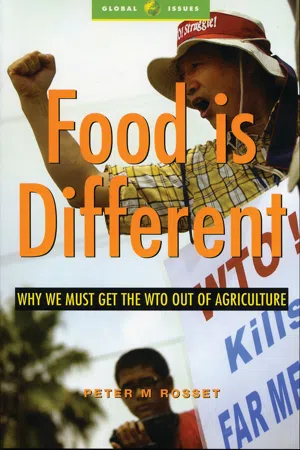
Why does our global food system gives us expensive, unhealthy and bad-tasting food, where we pay more for packaging and long-distance shipping than we do for the food itself? Why do farmers and peasants from around the world lead massive protests each and every time the World Trade Organization meets?
Peter Rosset explains how the runaway free trade policies and neoliberal economics of the WTO, American government and European Union kill farmers, and give us a food system that nobody outside of a small corporate elite wants. This essential guide sets out an alternative vision for agricultural policy, taking it completely out of the WTO's ambit. Food is not just another commodity, to be bought and sold like a microchip, but something which goes to the heart of human livelihood, culture and society.
- English
- ePUB (mobile friendly)
- Available on iOS & Android
eBook - ePub
I
Trade Negotiations and Trade Liberalization
Trade Negotiations and Trade Liberalization
World trade negotiations geared toward agreements and treaties for ‘trade liberalization’ have been taking place continually since 1986, with the inauguration of the Uruguay Round of negotiations in the framework of the General Agreement on Tariffs and Trade (GATT), which became the World Trade Organization in 1995. Since the founding of the WTO the negotiations have been highlighted by a series of ‘Ministerial meetings’ where major decisions are supposed to be made by the highest level of government officials (especially trade and/or finance ministers). These meetings have been failures – on their own terms – almost as often as they have been successful. Differences over the regulation of agricultural trade and farm subsidies played central roles in the most publicized of the failures, in Seattle in 1999 and in Cancún, Mexico, in 2003. On the other hand, in 2004 a partial agreement on some agricultural issues paved the way for an agreement at the 2005 Hong Kong Ministerial to continue negotiating, on the basis of damaging concessions by Third World countries and weak promises by the United States and Europe. This essentially saved the WTO from outright collapse, allowing stalled negotiations to restart.18
Trade liberalization is the process of removing barriers to trade. The idea is to liberate trade and thus market forces from the taxes and regulations that hinder them – and government subsidies that distort them – creating incentives for businesses everywhere to produce more to take advantage of more easily accessible foreign markets. This is expected to generate more economic activity, jobs, and growth. According to the theory of ‘comparative advantage’ – that some countries are good at producing one thing (like cars), while other are good at producing another (like coffee) – every country is supposed to benefit from freer trade. This is less than clear in practice however, and a global controversy has emerged as to whether we are on the right track or not.
Barriers to trade are any policy measures that alter – or ‘distort’ – the uninhibited flow of trade. Typical barriers ‘protect’ domestic production from the competition of cheap imports, and thus are called ‘protectionism’. Barriers can take the form of tariffs (taxes on imports), but there are many other forms; as a group they are called non-tariff barriers (NTBs). Non-tariff barriers can be import quotas, local content requirements, production subsidies and price supports (because they make local products more competitive than unsubsidized imports), export subsidies (because they confer an artificial advantage on foreign products in importing countries), and a myriad of others. Many NTBs are difficult to identify at first. Even health and quality standards and labelling requirements can act as barriers, as can rules orienting governments to purchase locally or to support local or minority-owned businesses.
When governments remove barriers to trade (like import tariffs and quotas), they are ‘opening’ their markets to foreign competitors. The risk they take is that domestic producers may be driven out of business if the imports are too cheap. If that is because the same good can be produced more cheaply elsewhere because of ‘pure’ comparative advantage – climatic conditions, for example – then theory postulates it would be better in any event to be producing something else, where the home country has a ‘true’ comparative advantage. The problem is that in the real world, as we shall see, cheaper products are rarely cheaper because of ‘pure’ comparative advantage, but rather because of ‘distortions’ like subsidies, according to popular misconception, or more usually, because of the effects of market concentration and misguided government policies. And comparative advantage at home, for a typical Third World country, may be nothing more than a lower-paid, more exploited workforce.
Historical context
As we examine the issues behind this global controversy, we do well to keep in mind the historical context of trade liberalization. World economic history has long been characterized by cycles – or pendulum swings – between freer trade and protectionism. Swings toward trade liberalization are sometimes referred to as ‘economic integration’ – as in ‘integrating the economies of Canada, the US and Mexico via NAFTA’ – and the most recent swing has been dubbed ‘economic globalization’.
It would be erroneous to presume that integration and globalization have never happened before. The clearest historical example is that of European colonialism, in which the economies of the colonies were integrated into the increasingly global economies of Europe. That ‘swing’ ended during the last century in the period marked by the two world wars, when a combination of war, national independence of former colonies, and economic nationalism reversed a century of trade liberalization. This ushered in an era of relative protectionism, which was to be reversed again in the 1970s and 1980s.
In the 1970s, businesses in the United States and Europe began to confront crises brought on by rising wages at home and excess productive capacity. In other words, they now found themselves with the ability to produce more than home markets could absorb. They needed access to Third World markets to move their excess production. This brought the issue of protectionism by Third World governments to the fore, precisely at the same time as these same Southern governments became enmeshed in the debt crisis. This set the stage for the renegotiation of the debt in venues like the World Bank and the International Monetary Fund (IMF), where both Southern and Northern countries were represented.
Structural adjustment: precursor to trade agreements
The ‘South’ wanted debt restructuring, and the ‘North’ wanted greater access to Southern markets. The solution was debt restructuring conditioned upon the adoption of Structural Adjustment Packages (SAPs) by Southern governments. A central feature of these SAPs was trade liberalization, including the slashing of import tariffs and quotas, steep cuts in domestic subsidies, and the start of across-the-board privatization of state services and enterprises.19 The heyday of SAPs began in the late 1970s and continued into the early 1990s. When we examine the impacts on Third World economies to date of trade liberalization, we cannot really separate the effects of liberalization through SAPs from the effects of liberalization through the WTO, NAFTA, or other trade agreements, as we shall see in the Mexico and Africa examples below. A central complaint of Southern governments in contemporary trade negotiations is that of ‘asymmetry’ – that they have already opened their markets unilaterally to a significant extent under SAPs, and now they are being pushed to engage in another round of tariff cuts via the WTO. Even if these are to be the same percentage cuts for Northern and Southern countries, or even if they give a slight advantage to the South, they will not erase already existing imbalances created by SAPs and by colonial legacies.
From GATT to the Uruguay Round and the WTO
Over the latter part of that period the central fulcrum for further trade liberalization shifted from debt negotiations to trade agreements and treaties. This began by giving more substance to GATT, which was originally negotiated in 1948 to shape the post-Second World War economy by regulating tariffs and other trade regulations. However, it had little power of enforcement, only addressed trade in goods (as opposed to trade in services, intellectual property rights like patents and copyrights, government purchasing policies, etcetera), and a significant part of the world’s nations were not GATT signatories. Also notable was the exclusion of agriculture from GATT because of food security concerns.20
This was to change with the Uruguay Round, a series of trade talks which lasted from 1986 to 1994, and which expanded the rules of international trade to cover services, intellectual property and agriculture. A trade ‘round’ is the name given to series of negotiations where countries try to reach agreements on trade issues such as tariff reduction. The WTO was created during the Uruguay Round.
The WTO began life in 1995 as a new global commerce agency, transforming the old GATT into an enforceable global trade code. The stated objectives of the WTO include ‘raising standards of living, ensuring full employment and a large and steadily growing volume of real income and effective demand, and expanding the production of and trade in goods and services’, in other words, economic development based on the market. This means that WTO agreements are meant to introduce free market principles into international trade, via two basic mechanisms: (1) reducing trade barriers; and (2) applying nondiscriminatory rules (stronger countries should not have special advantages over weaker countries). An additional important principle, at least in theory, is special consideration for developing countries. The WTO recognizes ‘that there is need for positive efforts designed to ensure that developing countries, and especially the least developed among them, secure a share in the growth of international trade commensurate with the needs of their economic development’.21
Every two years, give or take, the WTO holds its Ministerial meetings. At these meetings key decisions are taken regarding the future path of the WTO. Between Ministerials, ongoing negotiations continue within the so-called ‘built-in agenda’, which includes agriculture, services and intellectual property rights. The ongoing negotiations on trade in agricultural and food products are carried out under the rubric of the evolving Agreement on Agriculture (AoA), though there are also many non-AoA issues – like intellectual property, competition, investment and government procurement policies – that also impinge on agriculture.
Key recent events: agriculture is gumming up the works22
A lot of media attention, public debate, and protest has been focused on trade negotiations in recent years, especially surrounding the series of key events summarized here. It is notable, among all the controversy and failed summits, how central a role differences over agricultural trade issue have played in gumming up the works. Food and agriculture have proved to be the most significant stumbling blocks along the way to re-structuring the global trading system.
1994 – NAFTA enters into effect
The first day of 1994 marked the entry into effect of the North American Free Trade Area, a treaty that integrates the economies of Canada, the US and Mexico. In many ways NAFTA is the model trade agreement, including, as do other agreements, directly trade-related issues like import tariffs and quotas, but also many less directly trade-related issues like investment, and competition between domestic and foreign firms. NAFTA is the model of what the US and the EU are seeking – but have not yet achieved – in the WTO, of what the US wants from the proposed Free Trade Area of the Americas (FTAA), and of what the US has achieved in more recent bilateral and regional agreements with Chile, Central America (CAFTA), and others. NAFTA is often considered to be the ‘laboratory’ in which to study the anticipated effects of agreements that are still being negotiated (WTO, FTAA) or have just been signed (CAFTA). While NAFTA did open Mexico to a wave of foreign investment, it has been its negative impacts on rural peoples that have most thrown trade liberalization into question. Most spectacularly, 1 January 1994 was also marked by the rebellion of the Zapatistas in Chiapas, Mexico, who called NAFTA ‘a death sentence for the indigenous people of México’, because of its anticipated consequences for poor farmers.
1999 – The WTO Seattle Ministerial
The Third Ministerial of the WTO was held in in Seattle in 1999 amid massive demonstrations with tens of thousands of people taking to the streets against the policies of the WTO. This was the key event that put the issue of the impacts on globalization in the public eye. The Ministerial was supposed to make major advances on agricultural trade and intellectual property rights (essentially extending US-style patents and copyrights around the world), among other topics, but the talks collapsed as the combined result of the street demonstrations and differences between the US and EU on agriculture, as well as between the North and the South on agriculture, intellectual property, and the transparency of the process itself (77 countries walked out on the last day).
2001 – the WTO Doha Ministerial
The next Ministerial was held in 2001 in the Persian Gulf State of Qatar – a country which does not allow significant public protest or demonstrations. One again the negotiators reached no specific agreements, though the start of the Doha Round of negotiations was declared. In this new ‘Development Round’, the South agreed to consider adding ‘new issues’ to the WTO agenda – expanding its mandate to less directly trade-related topics – in exchange for the North agreeing that the WTO should give more attention to the concern of the South that trade liberalization, as practised so far, was already damaging their national economies (in other words, there should be more options for ‘special’ or ‘differential’ treatment for poor countries).
2002 – FTAA negotiations in Quito
Between Doha and the Fifth Ministerial, held in Cancún, Mexico in September 2003, no significant progress was made in negotiating any outstanding issues, neither in the WTO nor in the other major forum of trade negotiations, the proposed Free Trade Area of the Americas. In 2002 in Quito, Ecuador, agricultural trade issues, accompanied by massive street protests by organizations of farmers and indigenous people, blocked significant advances in negotiation toward the FTAA. As we have seen, after failing to reach agreement with Latin American trade mini...
Table of contents
- Cover
- About the author
- Title
- Copyright
- Contents
- List of Tables, Figures and Boxes
- List of Abbreviations
- Acknowledgments
- Prologue
- Foreword
- Introduction: Trade versus Development?
- 1 Trade Negotiations and Trade Liberalization
- 2 Key Issues, Misconceptions, Disagreements and Alternative Paradigms
- 3 Dumping and Subsidies: Unraveling the Confusion
- 4 The Impacts of Liberalized Agricultural Trade
- 5 Alternatives for a Different Agriculture and Food System
- Conclusion: Another Food System is Possible
- Special Topics
- Notes
- Bibliography
- Index
Trusted by 375,005 students
Access to over 1.5 million titles for a fair monthly price.
Study more efficiently using our study tools.
Frequently asked questions
Yes, you can cancel anytime from the Subscription tab in your account settings on the Perlego website. Your subscription will stay active until the end of your current billing period. Learn how to cancel your subscription
No, books cannot be downloaded as external files, such as PDFs, for use outside of Perlego. However, you can download books within the Perlego app for offline reading on mobile or tablet. Learn how to download books offline
Perlego offers two plans: Essential and Complete
- Essential is ideal for learners and professionals who enjoy exploring a wide range of subjects. Access the Essential Library with 800,000+ trusted titles and best-sellers across business, personal growth, and the humanities. Includes unlimited reading time and Standard Read Aloud voice.
- Complete: Perfect for advanced learners and researchers needing full, unrestricted access. Unlock 1.5M+ books across hundreds of subjects, including academic and specialized titles. The Complete Plan also includes advanced features like Premium Read Aloud and Research Assistant.
We are an online textbook subscription service, where you can get access to an entire online library for less than the price of a single book per month. With over 1.5 million books across 990+ topics, we’ve got you covered! Learn about our mission
Look out for the read-aloud symbol on your next book to see if you can listen to it. The read-aloud tool reads text aloud for you, highlighting the text as it is being read. You can pause it, speed it up and slow it down. Learn more about Read Aloud
Yes! You can use the Perlego app on both iOS and Android devices to read anytime, anywhere — even offline. Perfect for commutes or when you’re on the go.
Please note we cannot support devices running on iOS 13 and Android 7 or earlier. Learn more about using the app
Please note we cannot support devices running on iOS 13 and Android 7 or earlier. Learn more about using the app
Yes, you can access Food is Different by Peter M. Rosset in PDF and/or ePUB format, as well as other popular books in Economics & Political Economy. We have over 1.5 million books available in our catalogue for you to explore.