Celebrated as a beacon of democracy and reconciliation, many people in South Africa continue to live in severe poverty, particularly in the Eastern Cape Province. Backed by the United Nations Development Programme, the Eastern Cape's provincial government consequently launched an historically ambitious programme – the Provincial Growth and Development Plan – aimed at tackling the province's poverty, unemployment and inequality over a ten-year period in a radical policy overhaul.
Drawing on the author's first-hand engagement with the planning process, Development Planning in South Africa is an empirically rich study that utilises a strategic-relational approach to explore the ways in which this unprecedented challenge was negotiated and eventually undermined by the South African state.
The first work of its kind, the book provides an indispensable micro-level study with profound implications for how state power is understood to be organised and expressed in state policy. Relevant beyond South Africa to policy implementation in both developing and developed states globally, the book is essential reading for students and scholars of government studies, political economy, development, policy studies and social movements.
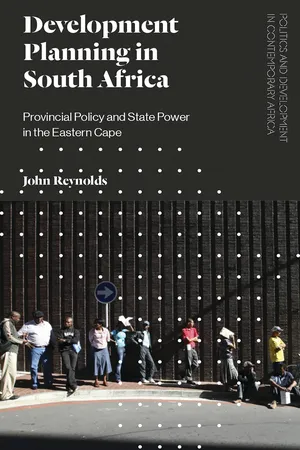
eBook - ePub
Development Planning in South Africa
Provincial Policy and State Power in the Eastern Cape
- 288 pages
- English
- ePUB (mobile friendly)
- Available on iOS & Android
eBook - ePub
Development Planning in South Africa
Provincial Policy and State Power in the Eastern Cape
About this book
Information
1
The state and state policy: a theoretical perspective
As shown in the previous chapter, the adoption of the PGDP as the overarching policy framework of the Eastern Cape Provincial Government did not lead to the achievement of many of its objectives. It was not just that the PGDP was not implemented as planned, which would not be particularly surprising, given the complex links between planning and implementation. What concerned me was the scale of underachievement, particularly by a provincial government under the executive control of a former liberation movement, the ANC, in partnership with the SACP and COSATU. What was needed was an understanding of the way in which the promise of the PGDP had been hollowed out not just during implementation, but during the process of its development. What was at issue was the way in which this policy development process had unfolded, and what it showed about the limits of policy challenge within the South African state.
What I found useful in thinking through the PGDP process was to think of the state not as a unified agent, but as the primary terrain on which power is contested and organised. This terrain is not a tabula rasa, however, but is located within a particular social and historical context that has implications for the strategic possibilities for the exercise of power. The ways in which power is exercised and organised also shape social relations and the strategic selectivities in terms of which power can be organised in future. For me, this perspective is most coherently expressed in Jessop’s (2008) strategic-relational approach, which “starts from the proposition that the state is a social relation” (Jessop, 2008: 1). This approach is valuable not only because it provides an abstract explanatory framework for ways in which power is exercised and organised, but because it is oriented towards concrete-specific analyses of the shifting boundaries between the state and society, of the relationship between state power and power exercised at a distance from the state, and of the links between social relations and state forms.
I consider policy as the discursive form in which the organisation of state power is expressed. Considered at the level of discourse, policy is linked not only to other policies, but also to a range of views of the world, and all of these (other policies and views of the world) arise in social contexts and affect those contexts. But, as Pierson (2005) argues, policy is more than just a moment of choice or the outcome of rational selection by strategic actors. Although agency does shape policy content, it is exercised on a strategically selective terrain, i.e. it operates in terms of strategic possibilities and constraints (Jessop, 2008), or, put differently, it operates in institutional settings that are located in time and are subject to path-dependent processes (Pierson, 2004). This means that although the content of policies reflect, at a discursive level, the organisation of power, power is not uniformly distributed through the state, and is exercised within a field of power where it can be countered and has unintended or unanticipated consequences. The material outcomes of policy emerge from the exercise of power in relation to the strategic selectivities of the state, and policy development and implementation alter the strategic possibilities for future policy and state action.
This means that, in the context of this book, the PGDP has to be considered not only in relation to other key policies of relevance to the content of the PGDP, but also to the particular form of the South African state in its social and historical context. Analysis of the PGDP process within this larger context allows one to avoid the dangers of snapshot perspectives (cf. Pierson, 2005), and to understand the particular materiality of the outcomes of the development and implementation of the PGDP. Although I pay detailed attention to the process of development of the PGDP, I do this with knowledge of its outcomes and in relation to the socio-historical context within which the process arose and in which implementation occurred. This chapter provides a theoretical grounding for that analysis, which, in Chapter 2, includes consideration of the structure of the post-apartheid South African state, of the shifting boundaries between the state, as “a distinct ensemble of institutions and organisations whose socially accepted function is to define and enforce collectively binding decisions on a given population in the name of their ‘common interest’ or ‘general will’” (Jessop, 2008: 9), and society, and of key state policies.
The state and state power
In the introduction, I provided evidence of continued poverty, unemployment and inequality in the Eastern Cape, despite the PGDP and more than a decade since the transition to a constitutional democracy, and despite the ANC winning substantial majorities in all post-apartheid elections. This situation raises questions about the nature of state power and the links between the actions of the state and the economy. Such questions take on particular force when one considers the historical links between the territory now called the Eastern Cape and the development of South African capitalism, as explored in Chapter 2.
Although one can have better or worse kinds or varieties of capitalism (cf. Esping-Andersen, 1990; Padayachee, 2013a), inequality is fundamental to capitalist relations of production, which are built on exploitation. In modern capitalism, increasing numbers of people are cast to the periphery of economic activity with little hope of formal employment or access to the means of production, and capital assumes ever more complicated forms (cf. Harvey, 2010). Ultimately, those in employment and those in what might be called the surplus population are linked in relation to the nexus of exploitation, as argued by Alexander, Ceruti, Motseke, Phadi and Wale (2013) in their study of class in Soweto, South Africa’s largest township. They describe the employed, the underemployed and the unemployed in Soweto as constituting a differentiated proletarian unity, portions of which mobilise in terms of particular means and ends (e.g. strikes aimed at changing conditions of work, or barricades aimed at effecting changes in basic service provision), but remaining in relationships of mutual dependence and shared benefit from victories in struggle and shared loss in defeat.
Key to understanding capitalist social formations and the capitalist state is viewing class in relational terms (cf. Wright, 1985 and 1997; Przeworski, 1985). Classes are not the only groupings into which people are organised or even potentially organised, but describe the ways in which people are organised in relation to the nexus of exploitation at the core of capitalism. Social groups, including classes, are organised, disorganised and reorganised on an on-going basis, and the dynamic of their relationships with each other, i.e. the struggle between them, is a key social dynamic at the core of any given social formation. Under capitalism, where market relations encroach on an increasing range of areas of human interaction, the understanding of class relations, in complex relation to other forms of group organisation, take on a key importance. For Przeworski (1985: 71), “class formation is an effect of the totality of struggles in which multiple historical actors attempt to organize the same people as class members, as members of collectivities defined in other terms [e.g. Catholics, French-speakers, Southerners, etc.], sometimes simply as members of the ‘society’”.
It is when considering the domains in which class struggles are played out, and considering the state as primary amongst those domains, that the link between the state and the economy becomes clearer. The state is not an autonomous domain or a unified agent that intervenes in the economy but, rather, the primary domain in which social relations of production are shaped. Poulantzas (1978: 128–129) expressed this as follows: “The (capitalist) State should not be regarded as an intrinsic entity: like ‘capital’ [capitalism], it is rather a relationship of forces, or more precisely the material condensation of such a relationship among classes and class fractions, such as this is expressed within the State in a necessarily specific form [emphasis in the original]”.
Poulantzas (1978: 36), just like Gramsci (2007: 75, 310), sometimes drew the boundaries of the state so widely that aspects of what is often called civil society (e.g. the church) were included within its ambit, but it makes for greater analytical clarity to consider class and other social struggles within the domain of the state and at a distance from the state – or within political society and civil society – while acknowledging the interactions between these domains (cf. Therborn, 1978; Jessop, 2008).
However, a view of class relations (or social relations more broadly) as condensed in the state, but of the state as one amongst a number of domains within which class or other social struggles occur, constitutes a paradox. Jessop (2008: 7) expresses this as follows:
On the one hand, it [the state] is just one institutional ensemble among others within a social formation; on the other, it is peculiarly charged with overall responsibility for maintaining the cohesion of the social formation of which it is merely a part. Its paradoxical position as both part and whole of society means that it is continually called upon by diverse social forces to resolve society’s problems and is equally doomed to generate “state failure” since many of society’s problems lie well beyond its control and may even be aggravated by attempted intervention.
The particular complexities of the relationship between the South African state and other institutional ensembles, civil society in particular, are explored further in Chapter 2.
The concentration of class relations in the state does not mean that class relations are visible in the structure or personnel of the state. It also does not mean that there is some grand conspiracy in terms of which deals are made that are to the benefit of particular classes; although influence by social groups is sought and gained, the process of organisation of social relations is far more subtle than that. For one, class domination is hidden; in the words of Poulantzas (1976: 188):
The capitalist state presents this peculiar feature, that nowhere in its actual institutions does strictly political domination take the form of a political relation between the dominant classes and the dominated classes. In its institutions everything takes place as if the class struggle did not exist.
This is particularly apparent in the liberal democratic state form, which is structured in terms of formal legal equality, which mirrors the apparent equality of market relations, and outcomes appear to be the result of multiple individual transactions, just like in market relations. What attracts people to participate in democratic processes is the promise of indeterminate outcomes, which holds out the possibility that participation could result in outcomes that are beneficial to those who participate (cf. Przeworski, 1985).
However, even if one accepts that the state is a social relation, that it is the primary site for the organisation of power, that it is charged with the maintenance of the cohesion of the social formation, and that, in its democratic form, the state holds the promise of realisation of diverse outcomes, how are capitalist social relations reproduced, and can power be organised in such a way that relations of production are radically changed, for example to socialism? The notion of the National Democratic Revolution (NDR), which has been a key component of the ideology that has bound the Tripartite Alliance together (cf. Wolpe, 1988), and has been a key discourse supporting ANC hegemony (cf. Hart, 2013), promised that South African social relations would be changed radically through a two-stage revolution through which state power would first be won by the Alliance, followed by the establishment of socialism via democratic means. The second stage of the revolution, the transition to socialism, has continually been deferred to the future and, as Wolpe (1988) pointed out, was not universally accepted by all in the ANC even during the anti-apartheid struggle. Has the delay in the radical transformation of South African social relations been a matter of limited political will? Even if radical transformation was to be delayed as per the NDR thesis, why has neoliberalism taken such a strong hold in South Africa? These questions are explored further in Chapter 2, in the context of the analysis in this chapter.
Explanations relying on the operation of a power bloc under the hegemony of the dominant class are not entirely satisfactory, particularly if, in the state, “everything takes place as if the class struggle does not exist” (Poulantzas, 1976: 188). To accept the notion of a power bloc without relying on the existence of conspiracies or deals, one has to view the power bloc as depicting the particular configuration of classes and clas...
Table of contents
- Cover
- About the book
- About the author
- Title
- Copyright
- Contents
- Figures and tables
- Acknowledgements
- Abbreviations
- Introduction
- 1. The state and state policy: a theoretical perspective
- 2. The post-apartheid South African state and economy
- 3. Overview of the provincial growth and development planning process
- 4. Provincial government political priorities 2002–2004
- 5. Preparing for the writing of the PGDP Strategy Framework
- 6. Development of the PGDP Strategy Framework
- 7. Developing PGDP programmes and gearing for implementation
- Conclusion
- Notes
- References
- Index
- Series titles
Trusted by 375,005 students
Access to over 1.5 million titles for a fair monthly price.
Study more efficiently using our study tools.
Frequently asked questions
Yes, you can cancel anytime from the Subscription tab in your account settings on the Perlego website. Your subscription will stay active until the end of your current billing period. Learn how to cancel your subscription
No, books cannot be downloaded as external files, such as PDFs, for use outside of Perlego. However, you can download books within the Perlego app for offline reading on mobile or tablet. Learn how to download books offline
Perlego offers two plans: Essential and Complete
- Essential is ideal for learners and professionals who enjoy exploring a wide range of subjects. Access the Essential Library with 800,000+ trusted titles and best-sellers across business, personal growth, and the humanities. Includes unlimited reading time and Standard Read Aloud voice.
- Complete: Perfect for advanced learners and researchers needing full, unrestricted access. Unlock 1.5M+ books across hundreds of subjects, including academic and specialized titles. The Complete Plan also includes advanced features like Premium Read Aloud and Research Assistant.
We are an online textbook subscription service, where you can get access to an entire online library for less than the price of a single book per month. With over 1.5 million books across 990+ topics, we’ve got you covered! Learn about our mission
Look out for the read-aloud symbol on your next book to see if you can listen to it. The read-aloud tool reads text aloud for you, highlighting the text as it is being read. You can pause it, speed it up and slow it down. Learn more about Read Aloud
Yes! You can use the Perlego app on both iOS and Android devices to read anytime, anywhere — even offline. Perfect for commutes or when you’re on the go.
Please note we cannot support devices running on iOS 13 and Android 7 or earlier. Learn more about using the app
Please note we cannot support devices running on iOS 13 and Android 7 or earlier. Learn more about using the app
Yes, you can access Development Planning in South Africa by John Reynolds in PDF and/or ePUB format, as well as other popular books in Social Sciences & Development Economics. We have over 1.5 million books available in our catalogue for you to explore.