This vital new collection presents new Marxist-Feminist analyses of Capitalism as a gendered, racialized social formation that shapes and is shaped by specific nature-labour relationships. Leaving behind former overtly structuralist thinking, Marxist-Feminist Theories and Struggles Today interweaves strands of ecofeminism and intersectional analyses to develop an understanding of the relations of production and the production of nature through the interdependencies of gender, class, race and colonial relations.
With contributions and analyses from scholars and theorists in both the global North and South, this volume offers a truly international lens that reveals the the vitality of contemporary global Marxist-Feminist thinking, as well as its continued relevance to feminist struggles across the globe.
eBook - ePub
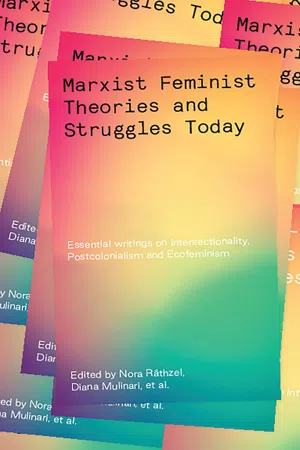
Marxist-Feminist Theories and Struggles Today
Essential writings on Intersectionality, Postcolonialism and Ecofeminism
- 384 pages
- English
- ePUB (mobile friendly)
- Available on iOS & Android
eBook - ePub
Marxist-Feminist Theories and Struggles Today
Essential writings on Intersectionality, Postcolonialism and Ecofeminism
About this book
Information
PART I
CONCEPTUALISING
1 | STANDPOINT THEORY*
Cynthia Cockburn
Standpoint theory is an epistemology, an account of the evolution of knowledge and strategies of action by particular collectivities in specific social relations in given periods. As a concept, standpoint derives from Karl Marx’s exegesis of class relations in capitalism. The historical development of capitalism as a mode of production involved the disintegration of feudal hierarchies and their gradual replacement by a new class system. In the last few pages of volume three of Capital, Marx writes:
We have seen that the continual tendency and law of development of the capitalist mode of production is more and more to divorce the means of production from labour, and more and more to concentrate the scattered means of production into large groups, thereby transforming labour into wage-labour and the means of production into capital. (Marx 1959: 885)1
Thus, though landowners remained in existence in the new era as a third class, it was the proletariat and the bourgeoisie – dynamic, mutually dependent, locked in antagonism – which were definitive of capitalism.
In his historical materialist analysis of capitalism, Marx stressed that the realities of life in the new mode of production shaped the consciousness of the individuals experiencing it. In The German Ideology he and Engels wrote: ‘Life is not determined by consciousness, but consciousness by life’ (Marx and Engels 1970: 47). Their distinctive understanding was that ‘definite individuals who are productively active in a definite way enter into … definite social and political relations’ (ibid.: 46). They continue in this vein,
The social structure and the State are continually evolving out of the life-process of definite individuals, but of individuals, not as they may appear in their own or other people’s imagination, but as they really are; i.e. as they operate, produce materially, and hence as they work under definite material limits, presuppositions and conditions independent of their will. (Ibid.: 46)
So too do awareness, understanding and theory evolve. Individuals ‘developing their material production and their material intercourse, alter, along with this their real existence, their thinking and the products of their thinking’ (ibid.: 46).2
* This chapter was first published in Marxism and Feminism, edited by Shahrzad Mojab and published by Zed Books, 2015.
This theme in Marx’s work was later developed by Georg Lukács. In History and Class Consciousness, Lukács addresses Marx’s account of, as he puts it, ‘the special position of the proletariat in society and in history, and the standpoint from which it can function as the identical subject-object of the social and historical process of evolution’ (Lukács 1968: 149).3 He continues with a quotation from Marx and Engels’ The Holy Family,4 in which they represent the class relation as follows.
The property-owning class and the class of the proletariat represent the same human self-alienation. But the former feels at home in this self-alienation and feels itself confirmed by it; it recognises alienation as its own instrument and in it possesses the semblance of a human existence. The latter feels itself destroyed by this alienation and sees in it its own impotence and the reality of an inhuman existence. (Cited in ibid.: 149)
As a consequence, Lukács himself continues, while class interests ‘keep the bourgeoisie imprisoned within this immediacy’, they force the proletariat to go beyond it, to become ‘conscious of the social character of Labour’. It is ‘only in the proletariat that the process by which a man’s achievement is split off from his total personality and becomes a commodity leads to a revolutionary consciousness’. For the working class, therefore, recognizing the dialectical nature of its existence is, Lukács says, ‘a matter of life and death’ (ibid.: 164, 171). It necessarily pitches the class into struggle with its rulers. In this, the Marxian understanding of class standpoint can be heard to echo Hegel’s account of the development of self-consciousness in which he employs the allegory of the ‘master’ and the ‘servant’, necessarily precipitated into existential conflict in which the stake is annihilation of self or other (Hegel 1977).5
One effect of class domination, therefore, is the emergence of a distinctive proletarian ‘standpoint’, or, as we might say today, a proletarian ‘take’ on life. What is more, because the view from below is capable of revealing ‘the immanent contradictions’ in the capitalist mode of production, the practical class consciousness of the proletariat has the revolutionary potential to disrupt the given structure, the unique ‘ability to transform things’ (Lukács 1968: 197, 205). Antonio Gramsci, also writing in the early twentieth-century tradition of ‘Western Marxism’, shared this understanding of class consciousness. Observing the capability of western European capitalist classes to sustain their rule over a potentially insurgent working class by hegemony – that is to say by culturally generated consent rather than coercion – he saw the potential for proletarian revolutionary thought to grow, find adherents among other elements in civil society, and eventually achieve counter-hegemonic capability, challenging the sway of ruling-class ideology (Gramsci 1971).6
The gendering of standpoint theory
Women do not feature in Marx’s account of the creation of surplus value, the heart of his economic theory. Lukács and Gramsci for their part also seem to have conceived of the proletariat as male. They use masculine nouns and pronouns in referring to it, and rarely allude to female workers or female family members of male workers. In fact, the unthinking assertion of masculinity is sometimes so emphatic as to be laughable. Thus Lukács celebrating the proletarian achievement: ‘From this standpoint alone does history really become a history of mankind. For it contains nothing that does not lead back ultimately to men and to the relations between men’ (Lukács 1968: 186). Nonetheless, in the 1970s some feminist socialist thinkers began to see the usefulness of Marxist standpoint theory for understanding forms of thought emerging from women’s exploitation and oppression in a patriarchal sex-gender order.
Dorothy Smith and Nancy Hartsock both began work on this theme in the 1970s, and published more substantial analyses in the following decade. In her major work The Everyday World as Problematic: A Feminist Sociology, Smith reprised the theme of earlier essays (Smith 1974, 1981), describing the ‘brutal history of women’s silencing’ by authoritative male discourse. This marginalization of women’s experience and thought she represented as part of ‘the relations of ruling’, a concept that, as she defined it, ‘grasps power, organization, direction, and regulation as more pervasively structured than can be expressed in traditional concepts provided by the discourses of power’. It reflects, she says, ‘the dynamic advance of the distinctive forms of organizing and ruling contemporary capitalist society, and the patriarchal forms of our contemporary experience’ (Smith 1987: 3). Where was the sociology in which women would ‘talk back’ to power from the perspective of their everyday experience? Smith set out to make good the lack by creating ‘a way of seeing, from where we actually live, into the powers, processes, and relations that organize and determine the everyday context of that seeing’ (ibid.: 9). Referring explicitly to Marx’s use of Hegel’s parable of master and servant, Smith saw parallels between ‘the claims Marx makes for a knowledge based in the class whose labour produces the conditions of existence, indeed the very existence, of a ruling class, and the claims that can be made for a knowledge of society from the standpoint of women’ (ibid.: 79).
Similarly Nancy Hartsock, in an article on which she began work in 1978, brought a historical materialist approach to the understanding of ‘the phallocratic institutions and ideology that constitute the capitalist form of patriarchy’ (Hartsock 1985: 231).7 She spelled out significant differences between men’s and women’s life activity. Where men have the singular role of producing goods, women as a sex produce both goods and human beings. Unlike those of men, women’s lives are institutionally defined by the production of use-values in the home. She observed, therefore, that ‘if life itself consists of sensuous activity, the vantage point available to women on the basis of their contribution to subsistence represents an intensification and deepening of the materialist world view available to the producers of commodities in capitalism, an intensification of class...
Table of contents
- Cover
- Title Page
- Copyright Page
- Dedication
- Table of Contents
- Notes on Contributors
- Introduction
- Part I: Conceptualising
- 1 Standpoint Theory
- 2 Outside in the Funding Machine
- 3 Contradictions in Marxist Feminism
- 4 Ecofeminism as (Marxist) Sociology
- 5 The ‘Flat Ontology’ of Neoliberal Feminism
- 6 The Byzantine Eunuch: Pre-Capitalist Gender Category, ‘Tributary’ Modal Contradiction, and a Test for Materialist Feminism
- 7 Reading Marx Against the Grain: Rethinking the Exploitation of Care Work Beyond Profit-Seeking
- Part II: Production
- 8 Marx and Social Reproduction Theory: Three Different Historical Strands
- 9 The Best Thing I Have Done is to Give Birth; the Second is to Strike
- 10 Women in Small-Scale Fishing in South Africa: An Ecofeminist Engagement With the ‘Blue Economy’
- 11 The ‘Crisis of Care’ and the Neoliberal Restructuring of the Public Sector: A Feminist Polanyian Analysis
- 12 Gender Regimes and Women’s Labour: Volvo Factories in Sweden, Mexico, and South Africa
- Part III: Religions and Politics
- 13 Religious Resistance: A Flower on the Chain or a Tunnel Towards Liberation?
- 14 A Marxist-Feminist Perspective: From Former Yugoslavia to Turbo-Fascism to Neoliberal Postmodern Fascist Europe
- 15 Feminism, Antisemitism, and the Question of Palestine/Israel
- Part IV: Solidarities
- 16 Women in Brazil’s Trade Union Movement
- 17 Argentinean Feminist Movements: Debates From Praxis
- 18 Marxist Feminism for a Global Women’s Movement Against Capitalism
- 19 Marxist/Socialist Feminist Theory and Practice in the Usa Today
- 20 Solidarity in Troubled Times: Social Movements in the Face of Climate Change
- Index
Trusted by 375,005 students
Access to over 1.5 million titles for a fair monthly price.
Study more efficiently using our study tools.
Frequently asked questions
Yes, you can cancel anytime from the Subscription tab in your account settings on the Perlego website. Your subscription will stay active until the end of your current billing period. Learn how to cancel your subscription
No, books cannot be downloaded as external files, such as PDFs, for use outside of Perlego. However, you can download books within the Perlego app for offline reading on mobile or tablet. Learn how to download books offline
Perlego offers two plans: Essential and Complete
- Essential is ideal for learners and professionals who enjoy exploring a wide range of subjects. Access the Essential Library with 800,000+ trusted titles and best-sellers across business, personal growth, and the humanities. Includes unlimited reading time and Standard Read Aloud voice.
- Complete: Perfect for advanced learners and researchers needing full, unrestricted access. Unlock 1.5M+ books across hundreds of subjects, including academic and specialized titles. The Complete Plan also includes advanced features like Premium Read Aloud and Research Assistant.
We are an online textbook subscription service, where you can get access to an entire online library for less than the price of a single book per month. With over 1.5 million books across 990+ topics, we’ve got you covered! Learn about our mission
Look out for the read-aloud symbol on your next book to see if you can listen to it. The read-aloud tool reads text aloud for you, highlighting the text as it is being read. You can pause it, speed it up and slow it down. Learn more about Read Aloud
Yes! You can use the Perlego app on both iOS and Android devices to read anytime, anywhere — even offline. Perfect for commutes or when you’re on the go.
Please note we cannot support devices running on iOS 13 and Android 7 or earlier. Learn more about using the app
Please note we cannot support devices running on iOS 13 and Android 7 or earlier. Learn more about using the app
Yes, you can access Marxist-Feminist Theories and Struggles Today by Khayaat Fakier, Diana Mulinari, Nora Räthzel, Khayaat Fakier,Diana Mulinari,Nora Räthzel in PDF and/or ePUB format, as well as other popular books in Social Sciences & Higher Education. We have over 1.5 million books available in our catalogue for you to explore.