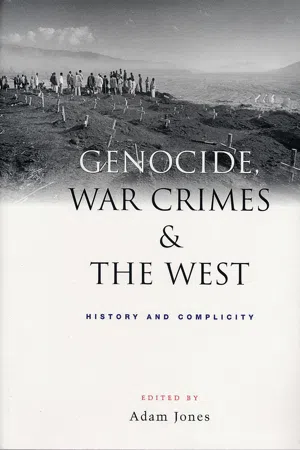
Genocide and war crimes are increasingly the focus of scholarly and activist attention. Much controversy exists over how, precisely, these grim phenomena should be defined and conceptualized. Genocide, War Crimes & the West tackles this controversy, and clarifies our understanding of an important but under-researched dimension: the involvement of the US and other liberal democracies in actions that are conventionally depicted as the exclusive province of totalitarian and authoritarian regimes.
Many of the authors are eminent scholars and/or renowned activists; in most cases, their contributions are specifically written for this volume. In the opening and closing sections of the book, analytical issues are considered, including questions of responsibility for genocide and war crimes, and institutional responses at both the domestic and international levels. The central section is devoted to an unprecedentedly broad range of original case studies of western involvement, or alleged involvement, in war crimes and genocide.
At a moment in history when terrorism has become a near universal focus of public attention, this volume makes clear why the West, as a result of both its historical legacy and contemporary actions, so often excites widespread resentment and opposition throughout the rest of the world.
- English
- ePUB (mobile friendly)
- Available on iOS & Android
eBook - ePub
About this book
Information
PART I
Overview
1
Introduction: History and Complicity
Adam Jones
In April 2001, convicted mass murderer Timothy McVeigh – about to die in the first US federal execution in 150 years – sent a letter to a Fox News correspondent seeking ‘to explain … why I bombed the Murrah Federal Building in Oklahoma City,’ killing 168 people. He referred to his terrorist action as ‘a retaliatory strike’ and ‘counterattack’ for the FBI attack against the Branch Davidians at Waco, Texas. But McVeigh then took a surprising analytical leap, turning to ‘identifiable pattern[s] of conduct’ by the US government in the international sphere:
borrowing a page from US foreign policy, I decided to send a message to a government that was becoming increasingly hostile, by bombing a government building and the government employees within that building who represent that government. Bombing the Murrah Federal Building was morally and strategically equivalent to the US hitting a government building in Serbia, Iraq, or other nations…. Based on observations of the policies of my own government, I viewed this action as an acceptable option. From this perspective, what occurred in Oklahoma City was no different than what Americans rain on the heads of others all the time, and subsequently, my mindset was and is one of clinical detachment.1
There is no reason, of course, to question depictions of McVeigh as a murderous thug. His letter nonetheless raised some pertinent questions. Why was McVeigh’s murderous thuggery and ‘free-lance fanaticism’ (Morrow, 2001) viewed as egregious and indefensible, indeed meriting the death penalty, while wholesale thuggery by his government tends to be seen as politics as usual? And was McVeigh’s ‘mindset … of clinical detachment’ any worse than the criminality and amorality that had turned the United States into the world’s leading ‘rogue state’? (See Huntington, 1999; Blum, 2001.2)
Around the time McVeigh’s letter was released, one long-buried, state-sponsored crime was making global headlines. Bob Kerrey, a former US senator and Democratic presidential candidate who later headed the New School University in New York, acknowledged that on 25 February 1969 he had led a commando unit of Navy Seals in an attack on the South Vietnamese coastal village of Thanh Phong. The Seals’ primary task was ‘kidnap or assassination missions, looking to eliminate Vietcong leaders from among the local population’ (Vistica, 2001). Accounts differ as to what happened when the team arrived in the hamlet. According to Kerrey, the Seals came across a ‘hooch’ (house) that had not appeared in intelligence reports. ‘We’ve got some men here, we have to take care of them,’ Kerrey said he was told by members of his team. That meant collective killing: ‘Standard operating procedure was to dispose of the people we made contact with. Kill the people we made contact with, or we have to abort the mission.’ Kerrey said he took no part in these initial killings. The team moved on to another cluster of dwellings, where, according to Kerrey, it came under fire, which was returned. Twelve hundred rounds of US ammunition later, Kerrey said he made a terrible discovery. In the ‘hooches,’ ‘I was expecting to find Vietcong soldiers with weapons, dead. Instead I found women and children.’
Other testimony, though, suggested an even more grisly, and systematic, slaughter of civilians. Kerrey’s Navy Seal comrade Gerhard Klann claimed that Kerrey had been fully aware that the unit’s eventual victims were civilian women and children, and had given the order anyway to mow them down in cold blood. ‘Klann says that Kerrey gave the order and the team, standing between 6 and 10 feet away, started shooting – raking the group with automatic-weapons fire for about 30 seconds. They heard moans, Klann says, and began firing again, for another 30 seconds. There was one final cry, from a baby.’ In response, Kerrey claimed that even if Klann’s account were true, the actions were defensible. ‘Under the unwritten rules of Vietnam, we would have been justified [in killing civilians even] had we not been fired upon. You were authorized to kill if you thought that it would be better…. We were instructed not to take prisoners’ (Vistica, 2001).
The US media and public response to Kerrey’s confession was striking: ‘many Americans seem[ed] quicker to sympathize with the former war hero [Kerrey] and to lament the “horror of war” rather than focus on the real issues of crime and justice’ (Goldhagen and Power, 2001). Time magazine emphasized not the victims of the US attack, but the ‘private agonies’ and ‘aching experience’ of ‘physically and psychically scarred veterans like Kerrey,’ for whom ‘the war is never quite over’ (McGeary and Tumulty, 2001).
Amidst the conservative bluster and liberal commiseration, a few commentators and organizations did call for a thorough investigation of Kerrey’s alleged crimes, and the backdrop of US-sponsored atrocities – perhaps genocide – against which they occurred. For Human Rights Watch, Kerrey’s revelations suggested that US military units ‘may have directly violated the Fourth Geneva Convention of 1949 and resulted in “grave breaches” of that Convention, or war crimes.’ The organization called for US Defense Secretary Donald Rumsfeld ‘to initiate without delay a full and independent investigation to establish whether during the Vietnam War certain U.S. military policies, orders and practices … constituted or led directly to the commission of war crimes by U.S. forces’ (Human Rights Watch, 2001). Bruce Shapiro, writing in Salon (Shapiro, 2001), called for the establishment of a South African-style ‘truth commission’ to investigate US war crimes in Vietnam. ‘Suppressed atrocity,’ Shapiro wrote, ‘haunts not just its victims and shadows not just its perpetrators, but distorts the political life of entire societies.’
The broader debate over Vietnam, after a decade or more of jingoistic posturing, re-crystallized around the figure of former US Secretary of State Henry Kissinger (see the chapters in this volume by Mario Aguilar, Steven Jacobs, and Suhail Islam and Syed Hassan). Kissinger, and the administrations he served, were directly or indirectly responsible for some of the bloodiest crimes of the post-World War II era. They included the sustained US bombing campaigns against peasant societies in Vietnam, Cambodia, and Laos; the Indonesian invasion of East Timor in December 1975, which rapidly assumed genocidal dimensions; and the West Pakistani assault on what was shortly to become independent Bangladesh, in 1970–71, a more gigantic slaughter still. On a smaller scale, but at a cost of thousands more lives, Kissinger encouraged, aided, and abetted the military coup that overthrew the democratically elected government of Salvador Allende in Chile in 1973.
Kissinger has retained a considerable cachet within the United States, as evidenced by his appointment to head the commission struck to investigate the events of 11 September 2001. (Kissinger accepted but subsequently withdrew, citing possible conflicts of interest.) A growing number of voices, however, have called for him to play a very different role: that of prisoner in the dock. The case for arraigning Kissinger for war crimes and crimes against humanity was made most prominently, and pithily, by the British journalist Christopher Hitchens, whose two-part series for Harper’s magazine was subsequently published as a slender book, The Trial of Henry Kissinger (Hitchens, 2001). In the present work, three authors take diverse approaches to the Kissinger case, and consider its implications for the volume’s central themes.
The United States was not the only Western country to play host to such controversies as a new century began.
In France, Paul Aussaresses, a former general in the Algerian war (1954–62), brazenly acknowledged that during the war ‘he and his “death squad” tortured and killed twenty-four prisoners with the full knowledge and backing of the French government.’ That government, said Aussaresses, ‘was regularly informed about, and tolerated the use of, torture, summary executions and forced displacements of people’ (Agence France-Presse, 2001; see Raphaëlle Branche’s chapter in this volume). Aussaresses was unrepentant about his involvement in the crimes. French President Jacques Chirac, who served in the army in Algeria, declared himself ‘horrified’ by the revelations; Chirac called for the general to be stripped of his Légion d’honneur and face military sanctions. Observers noted that the general’s account, ‘and [his] insistence that he is unrepentant, have reopened deep wounds from the most painful chapter of France’s colonial past and revived a divisive debate over whether those responsible should or can be brought to trial’ (Agence France-Presse, 2001).
In the end, Aussaresses was put on trial – but for ‘complicity in justifying war crimes,’ not for the crimes themselves, which were covered by a 1962 amnesty. In January 2002, Aussaresses was found guilty, and fined $6,500 – ‘a sentence so trivial that it served only to underline the fact that his deeds were exempt from punishment, and that France had little interest in revisiting the past’ (Shatz, 2002). Nonetheless, the public re-examination of a past grown stale was surely preferable to a blanket of silence – not least for those who had been on the receiving end, or their survivors, as Mariner notes:
Without a doubt, relatives of the thousands of suspects who were ‘disappeared’ during Algeria’s independence conflict must take some satisfaction in seeing a French court formally condemn the French army’s abusive practices, even if, from their perspective, the judgment is more than forty years late. The court’s official acknowledgment that the abuses committed by the French in Algeria were war crimes and, as such, unjustifiable in any circumstances, marks an important step forward. Although much has been written about the systematic use of torture during the war, France has never apologized for its army’s conduct, nor have French officials shown much interest in sanctioning an official reexamination of the period. (Mariner, 2002)
In Belgium, government authorities and intellectuals finally began to reckon with the country’s often tawdry, sometimes genocidal, colonial past. The empire’s ‘heart of darkness’ was in Congo, where independence in 1960 was followed by the murder of the country’s leading nationalist figure, Patrice Lumumba. In February 2002 the Belgian government, which had ‘steadfastly denied any involvement until new evidence collected by a parliamentary commission confirmed the direct role of Belgian agents in carrying out and covering up the murder,’ admitted its participation in Lumumba’s assassination, and formally apologized (Riding, 2002; see Thomas Turner’s chapter in this volume).
According to the New York Times, ‘the motivation for the crime was to avoid losing control over Congo’s resources.’ Decades earlier, a similar preoccupation with the vast territory – seventy-five times larger than Belgium itself – had prompted Belgian King Leopold to seize Congo as his personal property, turning it into the grotesquely misnamed ‘Congo Free State.’ Between 1885 and 1908, millions of Congolese males were conscripted into forced labor, and driven deep into the jungle to gather rubber for export. The ‘rubber terror’ inflicted a staggering death toll on the laborers, and their protracted – or permanent – separation from wives and families exacerbated the demographic holocaust. Adam Hochschild’s 1997 book King Leopold’s Ghost exposed for a global public the astonishing scale and savagery of the killing; he estimated the overall toll (direct deaths plus demographic decline owing to the lowered birth rate) as approaching ten million Congolese (Hochschild, 1998).
In response to the furor that Hochschild’s work generated in Belgium, the Royal Museum for Central Africa announced ‘the first far-reaching review of Belgium’s colonial past.’ The initiative ‘raises the broader question of a country’s continuing responsibility for unsavory [!] actions carried out in its name generations or even centuries earlier. These range from promotion of the slave trade and annexation of territories to colonial repression and ransacking of natural resources’ (Riding, 2002). Stated museum director Guida Gryseels: ‘It is a reality which touches the deepest part of the Belgian soul. We rea...
Table of contents
- Cover
- Title
- Copyright
- Contents
- Part I: Overview
- Part II: Genocide, War Crimes and the West
- Part III: Truth and Restitution
- Part IV: Closing Observations
- About the Contributors
- Index
- Notes
Trusted by 375,005 students
Access to over 1.5 million titles for a fair monthly price.
Study more efficiently using our study tools.
Frequently asked questions
Yes, you can cancel anytime from the Subscription tab in your account settings on the Perlego website. Your subscription will stay active until the end of your current billing period. Learn how to cancel your subscription
No, books cannot be downloaded as external files, such as PDFs, for use outside of Perlego. However, you can download books within the Perlego app for offline reading on mobile or tablet. Learn how to download books offline
Perlego offers two plans: Essential and Complete
- Essential is ideal for learners and professionals who enjoy exploring a wide range of subjects. Access the Essential Library with 800,000+ trusted titles and best-sellers across business, personal growth, and the humanities. Includes unlimited reading time and Standard Read Aloud voice.
- Complete: Perfect for advanced learners and researchers needing full, unrestricted access. Unlock 1.5M+ books across hundreds of subjects, including academic and specialized titles. The Complete Plan also includes advanced features like Premium Read Aloud and Research Assistant.
We are an online textbook subscription service, where you can get access to an entire online library for less than the price of a single book per month. With over 1.5 million books across 990+ topics, we’ve got you covered! Learn about our mission
Look out for the read-aloud symbol on your next book to see if you can listen to it. The read-aloud tool reads text aloud for you, highlighting the text as it is being read. You can pause it, speed it up and slow it down. Learn more about Read Aloud
Yes! You can use the Perlego app on both iOS and Android devices to read anytime, anywhere — even offline. Perfect for commutes or when you’re on the go.
Please note we cannot support devices running on iOS 13 and Android 7 or earlier. Learn more about using the app
Please note we cannot support devices running on iOS 13 and Android 7 or earlier. Learn more about using the app
Yes, you can access Genocide, War Crimes and the West by Adam Jones in PDF and/or ePUB format, as well as other popular books in Politics & International Relations & International Relations. We have over 1.5 million books available in our catalogue for you to explore.