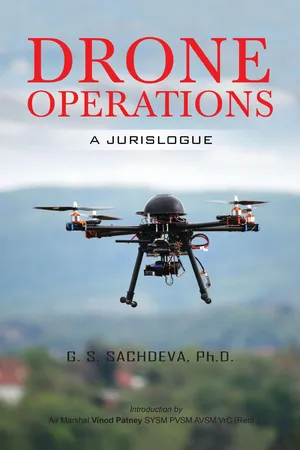
Unmanned aerial systems, popularly known as drones, have been in the news for all sorts of reasons—good and bad. The media has focussed equally on them for their use in hunting down terrorists and quickly eliminating them, as also for the inadvertent killing of innocent civilians and collateral damage to private property. Infringement of sovereignty is another pertinent area of international concern. Though historically associated with military missions, drones are increasingly proving their utility for internal security and disaster management. Lately, civilian and commercial uses are also proliferating. Indeed, drones have truly become a versatile flying platform.As an aerial machine, drones have started encroaching upon the common-user air space and are striving to integrate their operations with manned military aircraft and civil airliners. The problems of air traffic management and compliance of safety measures are formidable while civil and commercial uses infringe upon personal privacy and property rights. Third-party liability is another important issue for settlement. Comprehensive regulations to handle incumbent problems are not yet in place even as drones are racing ahead in technological development and operational mandates.This book will find interested audience among managers of aviation and air space, as well as persons from the Air Forces worldwide. It will also be of relevance to practising lawyers on air litigation, scholars of air law, as well as the aware layman.
- 202 pages
- English
- ePUB (mobile friendly)
- Available on iOS & Android
eBook - ePub
About this book
Information
Print ISBN
9789383649440
Edition
11
Prologue
Drones, generally the military version of Unmanned Aerial Vehicles (UAV)1, have been in the news these days courtesy the US military operations in Afghanistan which at times got territorially extended to the Northwest tribal frontier and other areas of Pakistan in pursuit of the fight against terrorism. The US had earlier made good use of drones in the Vietnam War and in the two Iraq Wars, and in Yemen; while Israel effectively used these in military roles for surveillance, etc over Syria. These have also become equally fashionable for diverse peaceful and commercial uses among the European countries e.g. the UK, Germany and the Benelux countries2 as also on other continents.
Indeed, drones3 have rapidly transformed into a multi-purpose platform; almost on the verge of supplanting many roles that conventional manned aircraft or piloted helicopters used to perform exclusively and gallantly. The drone has since technologically developed into a full-fledged weapon system of warfare by its own advantage and merit. Drones come in various sizes, and with varying speeds, endurance and stages of automation to suit civil and commercial requirements. Yet the UAVs, bereft of the pilot’s capacity to scan the ambience, his presence of mind and controlling intelligence, his vital onboard decision-making and flexibility in operation, possible in manned platforms, can never totally replace the latter.
While drones have already been tested and tried, and are currently in use in many countries, there are, however, some doubts about the legality of their operations under the existing air laws, and hesitance to integrate these in the air space with other conventional air traffic. The technology has established itself very well and has come to stay. It can now neither be reversed nor can proliferation of its utilities be stunted; its military uses are well proven and the numbers of combat drones (UCAVs) are growing at an unprecedented rate. In due course, the civilian usage of drones will also diversify from domestic policing to humanitarian disaster management to aerial sensing and surveillance to commercial usage for home deliveries to positioning of relief in inaccessible areas under natural calamities. Their convenience and utility are likely to endear them worldwide and the numbers of drones will multiply exponentially. So we need to find a proper solution to tackle the dilemma rather than denigrate or reject the contemporary technological applications. The latter option would be outright regressive and least desirable. The former option deserves to be scholarly debated and earnestly pursued with equanimity in approach, and speed to match the urgency.
The drone, known as an Unmanned Aerial Vehicle (UAV), is also called an Unmanned Aircraft System (UAS) or Unmanned Combat Aerial Vehicle (UCAV) or Remotely Piloted Aerial System (RPAS, as more popularly known in the European countries) because of its unique specific characteristic that there is no pilot in the aircraft though, of course, there are distance-operators remote-controlling its flight from the designated base. For this reason, drones are also called pilotless aircraft and it is this peculiarity of the machine that posits it in variance with the applicability provisions under the Chicago Convention.4 The Convention vouchsafes state sovereignty in national space yet it primarily regulates navigation of piloted civil aircraft. Further, the deployment of drones by the US, either to quell terrorism or for military operations on foreign territories, whether for defence tactics or humanitarian purposes, is apparently in violation of the germane laws and the UN Charter;5 even though US President Obama has cryptically said, “Simply put, these (drone) strikes have saved lives,”6 thereby justifying their use in the service of humanity, and by implication, vindicating the legitimacy as well as legality of drone operations.
Drones are one of the newest weapon systems of warfare and have revolutionised the concepts of military strategy particularly for three reasons. First, drones are unmanned, pilotless aerial vehicles and, thus, eschew life risks to the aircrew. This advantage causes proliferation of their usage on the slightest pretext, with the slightest concerns. Second, their low cost of production and cost-effective operations make them dispensable or disposable without remorse during or after the mission, should it so become necessary. Third, drones can boldly face enemy defensive fire and will still not be deterred from the vital mission till conditions make it impossible. Therefore, for the advantages offered, the drone has turned out to be a weapon of special choice for “dull, dirty and dangerous” sorties in preference to manned platforms.
This ushers in a new trend by offering a pilotless vehicle of the least risk, but it poses an existential threat to the fraternity of pilots.7 However, this fear, though ominous and real, seems of no consequence in the foreseeable future, and the league of pilots seems safe and prosperous. Nevertheless in such supplantation, the pilots are denied the opportunity to undertake prestigious manned missions; and the adventure and glory from such uber-difficult and ultra-hazardous sorties. The sociology of war seems to be getting warped and undergoing fundamental changes where gallantry and valour are progressively losing their charismatic sheen and exemplary edge. Wars are becoming a match of asymmetry and disparity; and theatres of war are getting distanced from the air warriors. The developing situation is becoming impersonal and is losing sensitivity to humanitarian considerations. Thus, the new ethos of war is not too complimentary.
The earliest drone operations date back to the Vietnam War of the Seventies when the US forces used this contraption for reconnaissance and surveillance. Those were primitive unmanned aerial vehicles which could be programmed for a mission to loiter over the target and since they created a humming noise, they came to be called “drones.” Better versions have been used in the two Iraq Wars and, currently, modern drones that have been deployed in Afghanistan and Pakistan, have been armed with the capability to attack an object with fair precision and gory lethality. The sound of a drone arouses dread in people who run for the nearest safety shelter. Thus, drones have developed a peculiar association with military applications. But in reality, this view is no longer valid because the drone, being a multi-use technology, its civil, commercial and humanitarian adaptations are fast overshadowing its military functions.8
After a brief narrative on introductory details about UAV characteristics and uses, the book embarks upon a serious discussion on the regulations for the use of national air space by UAVs. The use of drones assumes a different character in peace-time, during conditions of hostilities, and in declared wars. These have been discussed in the light of national statutes and international treaties as well as the United Nations Charter. A comparative treatment of domestic laws has afforded the opportunity to highlight the evolution of UAV regulations and their present shortcomings in the integration of traffic for all types of aerial vehicles in the common-user air space. The next chapter has summed up the rules for the flight of UAVs in the international air space in peace-time, and third-party liability regulations for surface damage under international conventions and state customs.
The use of drones in hostile conditions is a ticklish issue. It is, therefore, natural that there happen to be differing perceptions on drone strikes, particularly in the absence of an international mandate or the consent of the attacked state. The UN Charter is nebulous and vulnerable to different interpretations. The attacking state, however, has a different argument based on an ingenious interpretation of law and not too clean logic, apart from an ostentatious display of its military prowess and hegemonistic international standing. Many scholars hold the belief that the law favours the strong. Empirically, such a comment may turn out to be true in many events and predicaments. Or, in reverse, perhaps, the weak accept the compulsions of the situation meekly or succumb to pressure for motivations, overt or covert. The majesty of the law has mostly been upheld and kept as a benchmark to evaluate the legality of drone activities.
The book contains an analysis of, and comments on, the use of UAVs under war conditions and unclear situations, but the template of International Humanitarian Law (IHL) and circumspection were the guiding principles; and the author has never shirked the voluntarily undertaken burden of responsibility towards objectivity and neutrality, even to the extent of appearing inconsistent or contradictory. The dilemma was to evaluate each situation from the circumstantial evidence and sift from overt or projected reasons in the context of the germane law; and in this regard, the bounden duty has been discharged sincerely, if not flawlessly. Subjectivity has been shunned and a balanced view presented to the reader for his personal assessment. Judgmental statements have been assiduously avoided even while discussing ethicality and morality or military accountability in the use of drones.
From the foregoing, it becomes amply clear that state practice subscribes to the use of drones for tactical advantages as well as for pragmatic reasons to mitigate loss of aircrew lives. So the option is either to appraise the existing law to cull out the legality or propose new mechanisms to adopt suitable and contemporary provisions to address challenges posed by the nascent situation and its exacerbating trend. This book explores this thesis for vindication from three aspects: first to revisit past deployments worldwide as well as the envisaged peaceful and commercial usages in the advanced countries; second, examination of the existing law to determine the legality of operations on the international plane as well as regulations governing the use of air space nationally and third, to provide a critical reality check of contemporary operations by the United States to conduct what it believes are legitimate operations, based on sound intelligence, but which have not always fulfilled its aims. On the other hand, the responses of the governments of the victim countries towards the killings of innocent non-combatants as well as collateral damage suffered to the property of civilians as third parties have naturally been resentful and deprecative. Further, as a reaction, the expression of varied shades of public opinion which often times has caused resentment and occasionally turned into outrage also becomes relevant for ethical and sociological considerations.
Apart from Afghanistan, the US has also used drones in some other countries like Vietnam, Iraq, Pakistan, Somalia and Yemen that have caused the deaths of, and injuries to, innocent civilians, and collateral damage to private property. This has raised issues relating to violation of national sovereignty and considerations under the Human Rights Covenant and International Humanitarian Law. These voices convince us that the topic is beset with controversies and mired in conflicting opinions. This impels a pedagogic analysis of the legality of drone operations in the right perspective from different angles—regulatory, legal and ethical—and for varied usages—civil, commercial and combat. There are also some apprehensions about invasion of privacy and safety considerations that deserve legitimate treatment. An objective treatise on the subject to evolve suitable recommendations for remedial actions whether through treaty negotiations or the good offices of international organisations like the International Civil Aviation Organisation (ICAO) or by the world comity at the UN is the compelling need of the hour. Therefore, the technological reality of drones must be accepted for legal resolution and that, too, urgently.
Notes
1.UAVs were first deployed by the US forces in the Vietnam War in the Seventies. These were, by modern standards, a primitive contraption that could be programmed to reach the target and loiter over there for surveillance and reconnaissance. These machines made a noise reminiscent of the humming sound of the bees and the drone and were so nicknamed. Incidentally, a drone is a male bee; specially a honeybee that is stingless and does not work for gathering nectar or pollen and produces no honey. Its only function is to mate with the queen-bee for reproduction. A drone has four wings that beat about 11,400 times per minute and its speedy movement causes the familiar or notorious buzz sound.
2.Arthur Flieger’s Aviation Newsletter, November, 2012; and later a seminar held at Amsterdam in February 2013.
3.The terms drone, UCAV, UAV, UAS, RPAS, etc. have been used interchangeably, depending upon context and relevance.
4.Refer Article 8 of the Convention.
5.Some scholars may invoke Article 51 of the Charter.
6.The Times of India, May 27, 2013.
7.To buttress this statement, it may be mentioned that in the year 2012, the US Air Force (USAF) trained more pilot-operators than ordinary jet fighter pilots.
8.Neil Jacobstein, “Drones: A 360 Degree View,” World Policy Journal, Fall 2013, pp. 14-19.
2
Preliminary Information
History of Drones/UAVs
The history of UAVs has travelled long in time and technology, competing with the then existing assorted weapon systems. The concept has moved from being a mere curiosity of yore to practical autonomous systems of modern times which are as big as the size of an airliner or literally as small as an insect. These can boast of a respectable pedigreed ancestry from the hot-air Montgolfier balloons of the 19th century that were once visibly afloat over the European skies. Despite this, their evolution has been jerky and sporadic. However, the earliest recorded use of a UAV for war-fighting occurred on August 22, 1849, when the Austrians attacked the Italian city of Venice with unmanned balloons loaded with explosives. Locating the nearest point to the target for assured success, apart from a land base, some were launched from the Austrian ship, the Vulcano.1 Once the balloons were in a vertical position over the town, their charge could be fired by electro-magnetic means so that the bombs fell in a perpendicular position and exploded on impact with the ground. This venture was only partially successful as some of these balloons were caught in a change of wind direction and were blown back over the Austrian lines.
Another use of balloons as UAVs came during the American Civil War when an inventor patented an unmanned balloon which carried an assortment of explosives that could be dropped after a time-delay fuse mechanism triggered the basket to overturn its contents. This method had its drawbacks. Air currents and weather patterns made it difficult to estimate the time period to set the fuse, and hence, the balloon was never successfully deployed. Curiously, though the balloons do not generally satisfy the modern definition of UAVs, they indicate an intelligent advance towards this concept.
By 1883, the first aerial photograph was taken using a kite, a camera and a very long string attached to the shutter-release of the camera. In 1898, this technology was put to use in the Spanish-American War, resulting in the first military aerial reconnaissance photo...
Table of contents
- Cover
- Half Title
- Title
- Copyright
- Contents
- Dedication
- Preface
- Introduction
- 1. Prologue
- 2. Preliminary Information
- 3. Uses of Unmanned Aerial Vehicles
- 4. Regulatory Provisions for National Air Space under Domestic Statutes
- 5. Drone Operations in International Air Space in Peace-Time
- 6. Drone Operations in Hostilities
- 7. Appraisal Under The United Nations Charter
- 8. Differing Perceptions on Legality
- 9. Drone Strikes In War
- 10. Ethicality and Accountability
- 11. Concluding Remarks
Trusted by 375,005 students
Access to over 1.5 million titles for a fair monthly price.
Study more efficiently using our study tools.