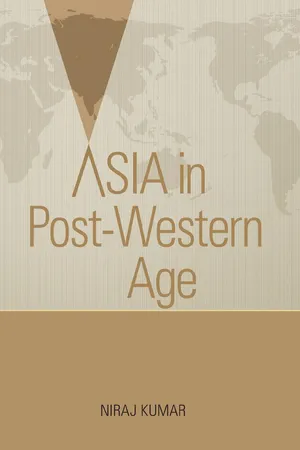
The great geopolitician, Halford J. Mackinder, had the dream that Monsoon Asia, when it grows to prosperity, will balance those who "live between Missouri and the Yenisei." In Asia in Post-Western Age, Niraj Kumar offers a vivid picture of the global distribution of material power and the emergence of three pan-regions, envisaged by German Nazi geopolitician, Karl Haushofer, fuelled by the logic of regionalised globalisation. These pan-regions will be glued by corresponding Pan-Ideas of Atlanticism, Eurasianism and Asianism. The trialectics between these three pan-regions will establish harmony and balance. The diplomacy in multipolar world will no longer be deciphered through the sports metaphor of chess, football or boxing, but the universal game of hopscotch. Asia in Post-Western Age is an indispensable interdisciplinary work about contemporary global conflicts as well as future trends, and proposes a way to establish Kant's "perpetual peace."
- 300 pages
- English
- ePUB (mobile friendly)
- Available on iOS & Android
eBook - ePub
About this book
Information
Print ISBN
9789383649242
Edition
1PART I
Change
1.ASIA IN POST-WESTERN AGE
The world has entered the Post-Western Age. The demise was drumbeated vigorously by the western masses in anticipation of an impending apocalypse. The best of minds became afflicted with a dystopic vision. The Mayan calendar was made the reference point. It was history coming full circle. Only the Spanish conquest of the New America and decimation of the native Indians fuelled the industrial revolution in Europe and subsequent ascendancy of the West as the new territory offered capital in the form of bullion and land for cash crop plantation to bypass the payment crisis. Now, the visions of those “lost natives” turned into a meme for the declining West. The World did end on December 21, 2012. But, it was the Western world-vision. Coinciding with the event, dozens of intelligence agencies based in the US prepared a strategic vision for the future under the aegis of the National Intelligence Council, Global Trends 2030: Alternative Worlds.1 This Report publicly accepted the fact that the “unipolar moment” is over and Pax Americana—the era of American ascendancy in international politics that began in 1945—is fast winding down.2 Another major think tank, Atlantic Council based in the US topped up the NIC assessment with a companion for perpetuating the limping hegemony in the post-western world, Envisioning 2030: US Strategy for a post-Western World.3 Kishore Mahbubani, Asian scholar-diplomat from Singapore has come up with his bird’s eye view of the changing power shift from the West to Asia and convergence of material aspirations world across at a time when he foresees China as the world’s largest economy within this decade, and the United States turned down from the world’s sole superpower to a Number 2 position, in his new book, The Great Convergence: Asia, the West, and the Logic of One World.4
On the other hand, there is a plethora of writings by American experts devising devious ways to perpetuate hegemony through the art of offshore-balancing, or instigating turmoil in domestic political systems in the developing Asia in the name of liberal democracy. The foremost American exponent of geopolitical (dis)ordering, Zbigniew Brzezinski is rancouring again with his new book, Strategic Vision: America and the Crisis of Global Power (2012).5 Brzezinski explores the following major questions of the new global reality:
- What are the implications of the changing distribution of global power from the West to the East, and how is it being affected by the new reality of a politically awakened humanity?
- Why is America’s global appeal waning, what are the symptoms of America’s domestic and international decline, and how did America waste the unique global opportunity offered by the peaceful end of the Cold War? Conversely, what are America’s recuperative strengths and what geopolitical reorientation is necessary to revitalise America’s world role?
- What would be the likely geopolitical consequences if America declined from its globally pre-eminent position, who would be the almost-immediate geopolitical victims of such a decline, what effects would it have on the global scale problems of the twenty-first century, and could China assume America’s central role in world affairs by 2025?6
The clamour for renewing Western primacy under American hegemony is growing wild. The Pivot Asia strategy announced by the US under which 60% of all naval assets are to be shifted to the Asia-Pacific region (APR) by AD 2020 springs from this imperial hubris. But, geopolitical ordering of nineteenth or twentieth centuries is a wide and far-flung idea in this age when power has decisively shifted back to the Asian pivot. Asia’s rise is irreversible. Asia has returned to its position of the pole star and the post-Western world is straddled with everyday news of Asia’s home-coming as numero uno in tangible and intangible things.
There is a concerted attempt to amputate Asia of its Islamic colour and valour. Asia has been downsized in western discourse to a region encompassing up to India only. The terrain of Asia keeps on shifting in western imagination. Only a few months back, “Asia” was limited merely to South-East and East Asia. India was part of South Asia. US government statistics have devised another category, Asia-8 comprising Asia-Pacific nations excluding China and Japan. Samuel P. Huntington in his paradigm of “The Clash of Civilizations” had reduced Asia into four competing civilisations—Islamic, Hindu, Confucian and Japanese (1993).7 Asia in spite of geographical unity, common belief system in human-nature continuum, and unity of purpose in the ethos of “peaceful rise” through “harmonious, inclusive development commensurate with cultural sensibility” is represented as a heterogeneous land—physically, socially and politically. While, on the other hand, the “West” is pitted as an essentialist category encompassing separated geographies extending as far as Australia, New Zealand, North America and northern Europe.8
In fact, Australia has rafted back into Asia. Australia is part of Asia. The same was echoed by Chinese thinkers like Liang Ch’i-Ch’ao who promoted the view of Yellow Australia through the fortnightly influential journal, Xinmin Congbao (The New People’s Journal) which continued publication till 1907.9 Former Australian Prime Minister Julia Gillard had realised the imperative to be part of Asia. She commissioned Australia in the Asian Century Implementation Task Force under the Department of the Prime Minister and Cabinet to prepare a White Paper on Australia in the Asian Century. The task force in its report “Australia in the Asian Century”10 has affirmed that the country’s destiny is tied to its geography. Since the West fades out of eminence, Australia is rooting for space in the Asian pivot. Gillard has launched a plan to teach every Australian student a key Asian language and to make every school have a sister-school in Asia. Singapore’s Asianist proponent Kishore Mahbubani has welcomed Australia into comity of Asia and argues that “by the logic of geography, the continent of Australia should have been populated with Asians. Instead, by an accident of history, Australia has been predominantly populated with Westerners,” but “the logic of cultural identity cannot” indefinitely “trump hard geopolitical c...
Table of contents
- Cover
- Advance Praise for the Book
- Title
- Copyright
- CONTENTS
- DEDICATION
- Preface
- Triadic Configuration: Shaping of Pan-Regions in Post-Western Age
- Part I: Change
- Part II: Trialectics
- Part III: Union
- Part IV: Harmony
Trusted by 375,005 students
Access to over 1.5 million titles for a fair monthly price.
Study more efficiently using our study tools.