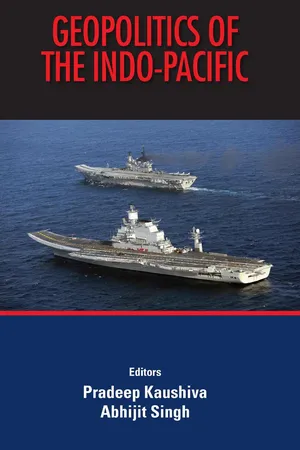
In recent years, the descriptive term 'Indo-Pacific' has entered the geo-strategic lexicon as a substitute for the more established expression 'Asia-Pacific'. Defined as an integrated strategic system that best captures the shift in power and influence from the West to the East, the concept has dominated strategic debates and discussions, gaining rapidly in currency and acceptance. Popular though the term has become, its strategic context and underlying logic are still sharply contested. While proponents of the 'Indo-Pacific' advance compelling arguments in its favour, the debate over whether it is a valid construct, is not quite settled. Consequently, it is yet to gain full acceptance among regional analysts and policy makers who appear unsure about embracing the idea without any qualifying caveats. Even so, the Indo-Pacific has emerged as a significant strategic space and a theatre of great-power competition. From a maritime security perspective, its importance as a geo-economic hub is accentuated by the growing presence of non-traditional threats. Piracy, terrorism, gun running, illegal fishing, trafficking, global warming and natural disasters represent challenges to maritime security that are inherently transnational in nature – where dynamics in one part of the system influence events in another, necessitating coordinated security operations by maritime forces and strategic relationships between stakeholder states. Papers put together in this book seek to appraise the Indo-Pacific, by examining the concept holistically, deciphering the trends that impact maritime security in the region and identifying its emerging patterns. Apart from examining the inherent logic underpinning the concept, these provide perspectives on security in the Indo-Pacific region, evaluate the strategic implications of competition, conflict and instability in the region, and bring out the operational implications of using a frame of reference that combines two contiguous albeit disparate maritime theatres.
- 138 pages
- English
- ePUB (mobile friendly)
- Available on iOS & Android
eBook - ePub
Geopolitics of the Indo-Pacific
About this book
Information
Print ISBN
9789383649099
Edition
1Section IV
Geopolitical Challenges and Non-traditional Threats
12.The “Three Geos”
Cleo Paskal
In a fast changing world, it is increasingly apparent that many of the assumptions which guided collective national security strategies are no longer true. Politically, powerful nations somehow assume other countries are allies out of habit. Their political alignment is based on experiences of the past, without really reassessing the recent actions of their allies. Economically, too, national governments tend to make financial bets based on old premises that brought them healthy returns in the past. But things have clearly changed—politically, socially, economically and even geophysically, where previously stable infrastructure is now flooding, and shifting demographics are rewriting the future of nations. The mismatch is so stark that it appears national strategies are completely out of step with new on-the-ground realities.
Take the case of China. Ten years ago, most people thought of China as the quintessential land-based power. That however began to change with former President Hu Jintao’s 2012 call to “build China into a maritime power”1—prophetical words that now seem to be coming to fruition. Not only is China today a growing maritime nation, but also an increasingly aggressive and assertive power. Capt. James Fanell, Deputy Chief of Staff for Intelligence and Information Operations, US Pacific Fleet, sums up China’s rising maritime trajectory well:
“They are taking control of maritime areas that have never before been administered or controlled in the last 5,000 years by any regime called China, and the PRC is now doing it in an area up to 900 miles from the mainland, up to dozens of miles off the coasts of other nations. In my opinion, China is knowingly, operationally, and incrementally, seizing Maritime rights of its neighbours under the rubric of a maritime history that is not only contested in the international community, but has largely been fabricated by Chinese government propaganda bureaus in order to ‘educate the populace about China’s rich maritime history’ clearly as a tool to sustain Party’s control.”2
China’s maritime reach is spreading, even into the Arctic, where geophysical changes—the retreat of Arctic sea ice and the thawing of the permafrost—are opening up new sea routes, and potentially increasing access to resources. China has one icebreaker, the Snow Dragon, and another on order; signed a free trade agreement with Iceland; is building the largest embassy in Greenland; is actively engaged in the Arctic Council; and there are an estimated 2-3 million Chinese nationals working in Siberia. China is on its way to becoming a major player in the Arctic.
Similarly, there are major changes in the international financial system. Most still assume the US dollar will remain the default international currency. However, an increasing amount of global exchange is shifting to the Renminbi (Chinese Yuan). Even old alliances are being re-examined. It is standard to think of Australia as an unquestioning, unwavering member of a strong Western alliance—one that India is considering engaging with in the Pacific. But, in 2012, a former Australian Prime Minister, Paul Keating, wrote in a comment on fellow Australian Hugh White’s book, The China Choice3 that “the debate around China has carried with it the assumption that Australia has no choice but to support American primacy in Asia against the threat of Chinese hegemony. This assumption, White says, now needs to be challenged. And I agree with him; it does.”4
These may not be the best of times, or the worst of times, but we are certainly in dynamic times. It is hard to know even how to start thinking about the new complexities. The tendency is to focus on separate silos, examining politics, economics or physical changes largely separately. But all three factors are heavily interconnected. China is interested in the Arctic because the climate is changing and opening up sea lanes and resource access. But its success in the region is a result of political leverage derived from its economic clout.
One way to start working towards comprehensive analysis is to look at the interdependent changes in all three global systems: geopolitics (for instance, the rise of Asia), geo-economics (for example, the West-cantered financial crisis), and geophysical change (including increasingly frequent extreme weather events, climate change, demographic shifts, and other physical world variabilities). Making sure that all “three geos” are assessed will at least help ensure that nothing major is missed when trying to understand how, and why, our world is changing. And what we need to do, at a minimum, to prepare for the future.
Strategic Indo-Pacific
One region where all three geos are particularly volatile is the Indo-Pacific. As the global political and economic centres of gravity shift towards Asia, and in particular the great coastal cities of the area, and the US “rebalances” to the Pacific, the land-based Asia-Pacific conceptualisation of the region is giving ground, so to speak, to the more maritime centric Indo-Pacific. As a result, the Indo-Pacific is becoming an increasingly contested and strategic zone. Given that many nations in the region contain myriad low-lying islands (Philippines, Indonesia, etc.), or have critical political and economic centres along vulnerable coastlines (Bangkok, Honolulu, Karachi, Mumbai, Singapore, Shanghai, Sydney, Tokyo, Wellington, etc.), environmental change is adding a wild card into an already unstable mix.
The Indo-Pacific is an exceptionally varied and variable area—this means that producing up-to-date regional overviews is a bit of a Sisyphean task. One challenge is that the rate of change is markedly different across the region. Generally, larger entities, such as Japan, have more inertia and are slow to change and adapt. They may tend to continue along well-established pathways until, suddenly, they are so out of alignment with regional realities, they are forced to execute an abrupt, and costly, course adjustment or risk finding themselves isolated. Meanwhile, the smaller entities, like the Small Island states of the South Pacific are more vulnerable and sensitive to change, and so need to adapt to new conditions as quickly as possible. As a result, they can act as surprisingly prescient weathervanes for seeing which way the wind is blowing.
A Geopolitical Chessboard in the South Pacific
For around 150 years, the dozen or so small island states of the Southern Pacific have acted as an echo chamber for larger geopolitical clashes centred elsewhere. The world’s battles, physical and ideological, have been imported to this seemingly remote region, distilled by distance.
In the nineteenth century, as European powers fought for primacy, their ships roamed the Pacific in a relatively leisurely grab for various islands as refuelling pitstops (for example the Germans in Samoa) or plantations (for example the British in Fiji, and the French in French Polynesia). They brought Christianity, rigid political and legal systems, new economic structures, and the English and French languages.
During World War II, the region was a key defensive position—and occasional front line—between Japan and the Allies. The lagoons of the Republic of Kiribati still cradle the broken carcasses of Japanese warplanes, and a recent tsunami uncovered another US gun emplacement on the beaches of the Kingdom of Tonga.
During the Cold War, the region was under the Western umbrella. But battles based in far away capitals were still imported and infected local politics. Fiji, for example, became a proxy battlefield for conflict between Australian pro-Soviet elements and the Australian government, resulting in a new player, China, being brought in by Canberra to Fiji. It started when pro-Moscow union leaders from Australia and New Zealand took up key roles in Fijian unions.5 According to Australian analysts Richard Herr and Anthony Bergin, Canberra then assisted China in setting up its first mission in the region, in Suva, Fiji, in 1975 “in order to use the PRC as a foil against suspected Soviet Union aspirations in the South Pacific.”6
The Southern Pacific’s role as chessboard on which others played, with relatively little attention, or sensitivity, being paid to local society, continued after the Cold War ended. With the West in a triumphalist “end-of-history” mood, many of the major global players pulled out of the region, thinking its strategic value was at an end—failing to understand its political and economic values. In 2006, for example, the UK closed its High Commissions in Kiribati, Vanuatu and Tonga, on the assumption that “five eyes” partners New Zealand and Australia would now be its “eyes and ears in the Pacific.”7
Geo-economics and Geopolitics: The Kingdom of Tonga Case Study
What happened next again echoed global trends. As the “big boys” in the West looked elsewhere, China quietly slipped in, using its economic clout and diplomatic acuity to gain strategic toeholds and change the geopolitics of the region. This is starkly illustrated in the case of the Kingdom of Tonga. Within a few months of the UK closing its High Commission in Tonga, the Canberra and Wellington-backed Tongan “pro-democracy” movement literally ran riot, burning down around 80% of the capital. Tonga, broke and desperate, turned to traditional allies Australia and New Zealand for assistance. But Canberra and Wellington want not only regime change but also governance system change, and used the opportunity to apply even more pressure. With few other options—wither India?—Tonga turned to China.
Beijing offered Tonga a Renminbi 440 million (approximate) soft loan for reconstruction, running the funds through the Export-Import Bank of China, and requiring the importation of Chinese labour. Loan recipients included some of the key power centres in Tonga, including the Wesleyan Church and the Prime Minister at the time. China had Tonga by the pocketbook. As an interesting aside, the fact that the loan was Renminbi denominated ties Tonga to that currency, and adds its voice to other loan recipients countering American and other pressures to raise the value of Chinese currency—a nice geo-economic side benefit for China.
A similar pattern is repeating all over the region. The policies of traditional partners are viewed as having failed, in some cases, even by the policymakers themselves. In 2010, the New Zealand government released an Inquiry into New Zealand’s relationship with South Pacific countries that states: “New Zealand’s development efforts have yielded disappointing results. In the twenty years since relationships with Pacific countries were last reviewed, conditions in many Pacific islands have deteriorated.”8 That deterioration has not left the countries of the Pacific more dependent on traditional allies, it has forced them to look elsewhere for partners. In many cases, that has meant China.
Using the Kingdom of Tonga as a case study, we can see how effectively China embedded itself. Tonga has a population of 100,000, few natural resources, and seemingly marginal geostrategic positioning. Yet China has devoted enormous efforts to ensuring that it has become one of Tonga’s most important partners, to the point where the Deputy Prime Minister of Tonga is on record as saying that Tonga would support China in any international fora.9 And, in July 2013, in a meeting with the Prime Minister of Tonga, Chinese Premier Li Keqiang said “Beijing would like to expand cooperation with Tonga in agriculture, fishery, new energy and tourism, as well as in global affairs.”10 What “global affairs” means, remains to be determined.
The questions are: how did China come out of nowhere to so effectively engage with Tonga, why did China do it, and are its techniques and motivations patterns that are repeating elsewhere? To begin answering these posers, it is useful to look at some details of how China engaged with Tonga.
The lines between state policy, state encouragement and “normal” business and immigration practices are very fuzzy. There is no question, however that the Chinese state looks on ethnic Chinese living abroad (even those with citizenship in other nations) as “overseas Chinese.” And there are certain expectations of the overseas Chinese. According to Dr. Jian Yang, Director of the Chinese Studies Centre at the University of Auckland, since 1978 Beijing has had four main expectations for overseas Chinese:
“They are to actively participate in Chinese modernisation, to actively promote the reunification of the Chinese nation, to actively spread Chinese civilisation, and to actively promote the friendship between China and the people all over the World.”11
All that activity can take many forms. In Tonga, China seems to have adopted a multifaceted approach to embedding itself within key Tongan structures. Some engagement may be for individual economic advancement, however given the nationalistic capitalism approach of the Chinese state, it is likely that, if necessary, those levels could also be used for Chinese state advantage.
- Decision makers: Representative of the Chinese state, or Chinese state-owned or linked industries have carefully cultivated relations with Tongan policymakers though business partnerships, official visits, favours for family members, new computers for all parliament members, and more.
- Business sector: Apart from large government-to-government deals, and deals with key members of the elite, within about ten years Chinese nationals took over about 90% of the domestic retail sector in Tonga.
- Labour sector: Large numbers of Chinese nationals came to Tonga to work on Chinese government-backed infrastructure projects.
- Bureaucracy:...
Table of contents
- Cover
- Half Title
- Title
- Copyright
- Contents
- Foreword
- Preface
- Contributors
- Section I – The Strategic Meta-narrative
- Section II – The US Rebalance: Regional Perspective
- Section III – Conflict and Cooperation in the Indo-Pacific
- Section IV – Geopolitical Challenges and Non-traditional Threats
Trusted by 375,005 students
Access to over 1.5 million titles for a fair monthly price.
Study more efficiently using our study tools.