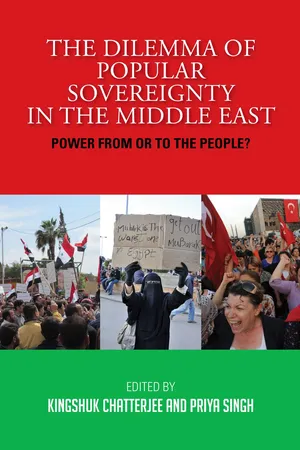
The ongoing political turmoil in the Middle East as a whole would seem to be essentially a contest between the minimalist and maximalist positions on popular sovereignty: should power merely come from, and be exercised in the name of, the people? Or, should those in power be fully accountable to the people? The dilemma warrants a closer look. The present volume comes out of an international conference held in Calcutta, India organised by the Institute of Foreign Policy Studies and the Centre for Pakistan and West Asian Studies, University of Calcutta in March 2013. This volume aims not at a definitive analysis of why what happened did happen; it aims instead at getting a sense of what was actually happening, and what is at issue.
eBook - ePub
The Dilemma of Popular Sovereignty in the Middle East: Power from or to the People?
Power from or to the People?
- 194 pages
- English
- ePUB (mobile friendly)
- Available on iOS & Android
eBook - ePub
The Dilemma of Popular Sovereignty in the Middle East: Power from or to the People?
Power from or to the People?
About this book
Information
Print ISBN
9789383649112
Edition
11. |
INTRODUCTION POWER FROM, OR TO, THE PEOPLE? |
Kingshuk Chatterjee |
In January 2011 as winds of change began to blow in the Arab world and authoritarian regimes began to appear vulnerable, observers were quick to label it as the beginning of the so-called “Arab Spring.” With at least four dictators (Ben Ali of Tunisia, Mubarak of Egypt, Abdullah Saleh of Yemen and Muammar Qadhdhhafi of Libya) toppled, and an array of reforms (in Jordan, Bahrain, Saudi Arabia) introduced, the label was able to vindicate itself quite handsomely. However, with two bitter civil wars being fought (in Libya and Syria), one of them now running into its third year, and at least one movement being ruthlessly subjugated (Bahrain); observers have begun to pronounce that the Arab Spring has turned somewhat mellow.
The turmoil in the region was being labelled ‘spring’ because it was expected to lead to the blooming of a new political era when the people would enjoy access to political power, ending the ‘winter’ of authoritarianism. However, as outfits motivated by Islamist agenda (al-Nahda in Tunisia, Ikhwan al-Muslimin, i.e. the Muslim Brotherhood, and Hizb al-Nour in Egypt) made the largest gains in the elections that followed, some crucial questions began to be raised about the character of change that the region was witnessing. As (for want of a better word) Islamists began to take measures to implement their agenda, the freedoms that had been fought for and/or taken for granted appeared under threat. The conduct of the Egyptian Ikhwan in particular, allowing acts of hostility against the Christian minority and curtailing social freedoms that even the dictatorship used to allow, made Egyptians ask: What does ‘power to the people’ actually mean? Power for what? Does a government elected by a majority of the people enjoy the authority to do whatever it pleases to the detriment of a section of the people who may or may not have voted for the government? If such a government tramples on the rights of some people, is it either necessary or desirable to allow it do so till it can be voted out of power? Can a government that tramples on, and restricts the scope of, rights of some or all of the people even claim to have any kind of legitimacy that needs be heeded, regardless of the size of the mandate they may be said to have commanded at the time when elections were held?
These questions were significant because they could cut both ways. If President Morsi and the Ikhwan were in violation of the spirit of the upheaval that toppled Mubarak, how does replacing Morsi with the military yet again square up with the spirit of 2011? If ascendancy of the Islamist political forces impaired those (Muslims and non-Muslims) who do not subscribe to the agenda, then does ascendancy of the secularists also not impair those who do not share that agenda? Were either of these agenda more legitimate than the other? If the Morsi regime had not been able to do justice to the hopes of the people who made up the crowd at Tahrir Square, should that be a good argument to keep Bashar al-Assad in power in Damascus lest Islamists gain similar ascendancy there as well? Most importantly, in situations of civil war, (as in Libya in 2011 and more particularly Syria 2011 onwards) when both sides enjoy considerable popular support, where and how does one locate legitimacy?
Admittedly, contrary to what most observers seem to think, the turmoil of the so-called “Arab Spring” is far from over – and not simply because of the civil war being waged in Syria. None of the countries that ousted authoritarian regimes have seen the successor regimes meaningfully address any of the issues that brought about the turmoil in the first place – Morsi has already been toppled, but there is no comfort zone in Tunis, Tripoli or Sanaa either. Also, where the regime could not be changed, the agenda of change has not necessarily been defeated – viz. reforms in Amman and Riyadh have not stalled; Manama is also keen on resolution of issues rather than persisting with the brutal repression that characterised its response in 2011. It is thus necessary to understand the dynamics of an ongoing process that 2011 merely initiated; it is not time yet for a post-mortem.
At the heart of the matter, not merely in the Arab world but the Middle East as a whole, seems to be the question of the nature and incidence of sovereign authority in a state. In the modern era, states have progressively tended to broaden the social basis of power. Although the manner in, and the extent to which, the social basis of power has actually been widened has tended to differ from country to country, region to region, yet the general drift towards such broadening has not been region or culture specific. As the language of politics changed in course of the 19th and 20th centuries, regimes all across the world began to conform to the cardinal benchmark – laws formulated by the government have to visibly promote the interests and well-being of the people, rather than those of an individual, a group or a section of the people. By the middle of the 20th century, it was hard to find a regime that did not establish its legitimacy to rule by means of its claim to represent the interests of the people – regardless of how such ‘interests’ and ‘people’ were defined. Popular sovereignty was here to stay.
However, there remained major ambiguities in the concept of popular sovereignty, which derived from contested understandings of the category of ‘people’ and the meaning of ‘sovereign’. Who are the ‘people’? Does the category of ‘people’ stand for a particular sort of people, or does it include everyone? How does one discern ‘interests of the people?’ Do ‘interests of the people’ connote the interests of the majority, or does a particular type of interest get prioritised in the running of the state? Either way, what of those who disagree? Do they remain included in the category of the ‘people’, or do they get excluded from the ranks of those who remain the legitimate concerns of the state?
A second and related ambiguity revolves around the question of representation. How does the government, (which is a group of individuals) represent the interests of the people, (which is a much larger group of individuals)? In a state where the cardinal institutions of representative democracy (rule of law, elected legislature, elected executive accountable to the legislature, free and independent judiciary, free press, etc.) are well entrenched, elections are accepted as the best way possible to go about resolving the issue of representation. However, when such institutions are not quite well-entrenched (viz. any source of power that is not accountable, muzzled press, dependent judiciary, etc.), it is difficult to imagine elections as a definitive resolution of the matter.
Such ambiguities have resulted in a two-fold classification of regimes in terms of their approach to the issue of popular sovereignty. The minimalist approach to popular sovereignty classifies regimes as fully authoritarian only if there is no scope for representative politics at all. Any regime that allows for representative politics qualifies as ‘electoral democracy,’1 which the minimalists argue to be the essential feature of popular sovereignty, i.e. “the people have the right to determine who governs them … and hold [the government] accountable for their actions. Democracies also impose legal limits on the government’s authority by guaranteeing certain rights and freedoms to their citizens.”2 By this yardstick, among the Middle Eastern states Iran, Israel, Lebanon and Turkey would qualify as having institutionalised democracy, and thus acknowledging the principle of popular sovereignty; Tunisia and Egypt seem to have qualified as such in 2012, and Iraq could be argued to have done so as well after holding elections (albeit under American aegis). In the maximalist parlance, though, popular sovereignty involves what is construed as a ‘proper’ democratic order, (which Freedom House calls ‘liberal democracy’) a substantial array of civic and political liberties (viz. civic equality, rule of law, freedom of speech, freedom of assembly, freedom of movement, freedom of faith, etc.) are considered indispensable for popular sovereignty to attain its fullest perfection.3 By that yardstick, none of the Middle Eastern states, Israel included, enjoys popular sovereignty.
The Arab Spring, and indeed the ongoing political turmoil in the Middle East as a whole (let us not forget the churning in Turkey, Israel and Iran on the northern, southern and eastern rims of the Arab world) would seem to be essentially a contest between the minimalist and maximalist positions on popular sovereignty: should power merely come from, and be exercised in the name of, the people? Or, should those in power be fully accountable to the people? The dilemma is considerable; and it is real. It is also unlikely to be resolved overnight – hence it warrants a closer look.
The present volume comes principally out of an international conference held in Calcutta, India by the Institute of Foreign Policy Studies and the Centre for Pakistan and West Asian Studies, University of Calcutta in March 2013. Neither the conference, nor this volume, was aimed at a definitive analysis of why what happened did happen. Both were instead at getting a sense of what was actually happening, and what is at issue. Accordingly, (and we would like to believe, appropriately), in the first cluster of essays, we have tried to bring together some first-hand experiences of the turmoil through voices from and of the region itself. The first essay is by an Indian journalist Srinjoy Chowdhury, who speaks of his experience of the momentous days of January-February 2011 at the Tahrir square – listening in to, and making sense of, what the people were saying as they went about dislodging one of the longest serving rulers in our times. The second essay by Mary Totry deals with the motivation and expectation of Arab women as they emerged equal stakeholders in the turbulence of 2011, and also the extent to which they ended in disappointment. The third essay is, so to say, from the other side of the debate as the prominent Syrian journalist Waiel Awwad mounts a passionate, if somewhat polemical, attack on the nature of the opposition forces participating in the Syrian civil war. Awwad warns us that any axiomatic assumption that the opposition forces constitute a progressive force for change would be completely wrong, and disastrous in its consequences.
The second cluster of essays deals with the question of (Islamic) identity and the manner in which it feeds into any debate on popular sovereignty in the region. Joseph Alagha deals with the question with respect to Lebanon, and argues Islamic ideology/identity is incidental to the discourse on sovereignty and not an intrinsic feature. He shows how the Hizbullah, which came to power in Lebanon before the turmoil championing sovereignty of the people, has compromised itself ideologically by supporting the Syrian regime in Damascus against the people. Mehmet Ozkan’s essay on the experience of Islamist politics in the Republic of Turkey, on the other hand, strongly argues that the ideological character of the Islamist agenda is intrinsically attuned to the question of empowering the people. Studying the context in which the Islamist constituency has grown in Turkey (and by inference, elsewhere) in the backdrop of inequitable social and political orders, Ozkan aims to provide an insight into the character of the turmoil that is now raging in the Middle East. Anita Sengupta however raises questions about the efficacy of transposing the Turkish experience as a road-map on the Arab Middle East. Indicating the particularities of the trajectory of the evolution of the discourse on politics and the permissible role of Islam within it, Sengupta makes a strong case that this is perhaps the one model which, as it stands, cannot be foisted elsewhere.
The third cluster of essays deals with the experience of three countries where (despite the absence of any discernible turmoil) the political discourse revolves as much around the question of popular sovereignty as it did in any of the other countries where it manifested in a spectacular manner. Looking at the unabashedly authoritarian Kingdom of Saudi Arabia, Mudassir Quamar argues that serious efforts are underway to dismantle the edifice of authoritarianism. He contends that the monarchy has been sensitive towards the demands of the people in response to the Arab Spring, without compromising on the state structure and the political system. In her essay on the state of Israel, Priya Singh deals with the thorny question of citizenship in the Jewish state to argue that the propensity to very narrowly define the category of citizen and its relationship with the state is impacting the notion of sovereignty there. She indicates a sense of movement and points to serious complications/ruptures and perhaps momentous transformations in the economy, politics, citizenship, religious/secular divisions, and Jewish/Arab relationships. To the extent that state of Israel as it stands today is distinctly different from the one that was formed in 1948. Kingshuk Chatterjee’s essay on Iran makes the case that unlike most other countries in the Middle East, the Islamic Republic provides much greater room for the principle of popular sovereignty. Using the popular disturbances around the disputed outcome of the 2009 Presidential elections, he argues that the demand for greater accountability of those in power has grown over time, and despite considerable resistance from the conservative elements in the body-politic, looks all set to acquire critical mass in the foreseeable future.
Notes
1.Freedom House lists four benchmarks for ‘electoral democracy’: “1)A competitive, multiparty political system”; (2) “Universal adult suffrage for all citizens”; (3) “Regularly contested elections conducted in conditions of ballot secrecy, reasonable ballot secrecy, and in the absence of massive voter fraud, and that yield results that are representative of the public will”; (4) and “Significant public access of major political parties to the electorate through the media and through generally open political campaigning. ”See Freedom House, Methodology, (New York and Washington DC: Freedom House, 2008) pp. 9-10, http://www.freedomhouse.org/template.cfm?page=351&ana_page=341&y [accessed on 9th July, 2012]
2.Michael J. Sodaro, Comparative Politics: A Global Introduction, (New York: Mc Graw Hill, 2004). p. 31.
3.For a brief but informed discussion of the minimalist and maximalist notions, see, David F.J. Campbell, “the Basic Concept for the Democracy Ranking of the Quality of Democracy” (Vienna: Democracy Ranking, 2008), http://www.democracyranking.org/downloads/basic_concept_democracy_ranking_2008_A4.pdf, accessed on 9th July, 2012.
2. | Tahrir |
Srinjoy Chowdhury |
In the war against tyrants, idealists and the impoverished are often unlikely allies. While Liberty, Equality, Fraternity once rubbed shoulders with the infamous ‘Let them eat cake’ declaration, Egypt’s Arab Spring, lacking a resident Rousseau, wasn’t short of Facebook-fuelled outrage. It wasn’t short of television cameras either – this was the story of the day. The world was watching: would a million protesting voices prevail in this latest version of David vs Goliath? Or would the Arab World’s beacon and also, one of the world’s oldest civilisations, continue to be led by a venal and vindictive dictator?
My story of Tahrir Square is that of a journalist, about the medley of voices of the Revolution, about thousands of demonstrators with one objective, one goal, one ambition—the removal of Hosni Mubarak, vice-president of Egypt for six years, and then, the country’s President for 30. It is a series of vignettes of the sights and sounds of Arab Spring’s Ground Zero.
Protest does not come easily to people. Why does a man or woman leave the comfort of his or her house, walk away from family and friends, a job (if there is one) and spend time in a Square day after day after day, not knowing when he or she will get home, come back alive, come back victorious? How resentful does one have to be to do something like this? Designed for the world’s cameras, the posters of Tahrir (liberation in Arabic), are a journey into the minds of people demanding change, people desperate for it. In their own, often crude way, the posters tell the story of revolution. One, as a statement on the sclerotic Egyptian state, without being clever or creative, had no parallel. Ten black-and-white photographs in two columns was all there was. One column had photographs of American Presidents—Ronald Reagan, George Bush, Bill Clinton, George W. Bush and Barack Obama. On their right was the same photograph of the same man: Mubarak. America went through five Presidents in 30 years. It endured Iran-Contra, the first war in Kuwait, a President’s impeachment because of an intern, 9/11, unpopular wars in Afghanistan and more economic woes. On the other hand, Egypt had only Mubarak, leading a society nowhere near a Utopia, nowhere near providing a growing, restive population of about 80 million with what it needed. Add to that the inability of the people to express themselves fully, people aware they cannot vote their leader out even if they wanted to.
Thirty years is a long time to be President, particularly if you were not democratically elec...
Table of contents
- Cover
- Title
- Copyright
- Contents
- List of Contributors
- 1. Introduction
- 2. Tahrir
- 3. Arab Women and the Arab Spring
- 4. Syria: the Last Secular Bastion in West Asia
- 5. The Interplay between Identity and Sovereignty of Middle Eastern States in Light of the Arab Uprisings: the Case of Lebanon
- 6. Islamic Politics, Arab Spring and Turkish Mode
- 7. Islam and Popular Sovereignty: The Turkish Experience
- 8. Islam, Saudi Arabia and the Question of Sovereignty
- 9. The Shift: Israel in the 1990s and Beyond
- 10. The Elusive Turmoil in Iran: The Prospect of Change in the Islamic Republic
Trusted by 375,005 students
Access to over 1.5 million titles for a fair monthly price.
Study more efficiently using our study tools.