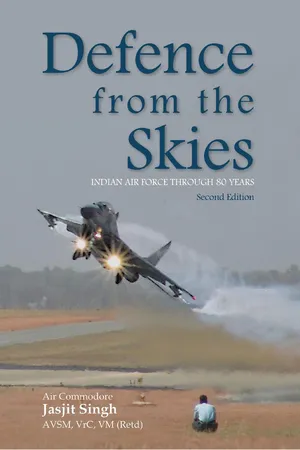
Indian Air Force now completes 80 years since it was formed as an independent component of India's armed forces. Time and again, the air force has performed magnificently even against severe odds, and built up a professional reputation that is the envy of leading air forces of the word. This volume, as the Second Edition of the earlier volume published in 2007 has been extensively revised and updated. Air Forces are unique in the sense that they are the only national military institution exclusively devoted to military operations in the aerospace continuum. The Indian Air Force is no different. But their dominant role in modern warfare, the high costs of aerospace power, and a host of other factors demand closer attention to their role in modern defence and the protection of national interests. Air Forces don't win wars by themselves; and no one in the Indian Air Force has ever claimed it. But no war can be won without them. We learnt that seminal lesson the hard way when we did not use the potent force of the IAF's combat fleet in the Sino-Indian War of 1962.It is from this perspective that this study — or rather an interpretative essay reflecting on the significant issues and events of the past 80 years — approaches the challenges the Indian Air Force faces in the coming decades. IAF combat force levels have slumped while its commitments are rapidly growing in consonance with our expanding economic and political interests well beyond our territorial boundaries.
- 300 pages
- English
- ePUB (mobile friendly)
- Available on iOS & Android
eBook - ePub
About this book
Information
Print ISBN
9789381904534
Edition
21

Birth of an
Independent Air Force
Independent Air Force

The Indian Air Force at 80 is one of the oldest, independent, continuously functioning air forces in the world today. Contrary to conventional wisdom, it was created as an independent military force, patterned on the British Royal Air Force which emerged from the erstwhile Royal Flying Corps of the British Army to become an independent component of military power in 1918. When the Indian Air Force was formally established on October 8, 1932, the few air forces of consequence in the world that were to render continuous service were the British Royal Air Force, the Royal Canadian Air Force, the Royal Australian Air Force and the South African Air Force. The US Army Air Force was in the making as a component of the US Army, as the very name implied. The German Air Force and some of the other significant air forces had been disbanded after World War I, though most of them were later recreated. The influence of the British Empire is obvious here, and so has been the model of the Royal Air Force in the formation and formative years of the Indian Air Force.
This is not surprising since the Royal Air Force (RAF) was deployed in India, ruled as it was by the British. After World War I, there were concerns about the Soviet expansion southward into Afghanistan, the frontiers of India on the northwest were turbulent, and the British rule over India was secure, but needed to be protected in the northwest. The Curzonian grand strategy had already pushed India’s frontiers as far into inhospitable regions as possible, with buffer zones and states to provide additional security to India. But an adequate frontier management policy had to be put in place to ensure the viability of new and old frontiers. And an air force was found to be a cost‐effective solution.
Among the many myths that have built up over the decades, one is that the Indian Air Force (IAF) became an independent force in 1947 when India became independent. Nothing could be farther from the truth. But even knowledgeable Indians cite the evidence of the first Commander‐in‐Chief (C‐in‐C) of independent India’s Air Force, Air Marshal Sir Thomas Elmhirst, KBE CB AFC, when he wrote years later that when asked by Prime Minister Jawaharlal Nehru to be the first Commander of the IAF, he stipulated that he would accept the post of C‐in‐C of the (Royal) Indian Air Force “if the Indian Air Force would be an independent fighting service under me as the Commander‐in‐Chief being subordinate to his (Nehru’s) Defence Minister and then only to him as Prime Minister.”1
Nehru, of course, had no difficulty in accepting this since the IAF had already been established fifteen years earlier as a separate military force (from the Army and the Navy) by due legislative order, drawing its strength from the report of the Skeen Committee on which Jawaharlal Nehru’s distinguished father, Shri Moti Lal Nehru had served as a prominent member and pressed for recruitment of Indian officers in the military.2 Nehru was aware that the Defence Minister of the emerging democratic sovereign country would completely replace the Commander‐in‐Chief of military forces in India where the Commander‐in‐Chief functioned as the de‐facto Defence Minister to the Viceroy within the framework of India being a “theatre command” of the imperial government in London which exercised overall command and control over its imperial forces through its Defence Minister and the Chiefs of Staff Committee. Equally important, perhaps, as one educated in England and a close observer of British politico‐military affairs, he was conscious of the creation of the Royal Air Force in 1918 and its functioning as such during World War II.
The US Air Force was already emerging as an independent military force, and the British dominions had separate independent air forces. Months before independence (and Elmhirst’s meeting with Nehru), an interim government of Indian political leaders had been set up in New Delhi, with Nehru as the Prime Minister and S. Baldev Singh as the Defence Minister (who was progressively taking over the responsibilities and authority of Sir Claude Auchinleck, the British C‐in‐C in India). Nehru could hardly be expected to accept a retrograde step to place the IAF (or the Indian Navy) as a subordinate Service to the Indian Army! And Elmhirst was obviously simply guarding against such a possibility.
“Indianisation” and the IAF
The Indian National Congress spearheaded the struggle for independence, non‐violent in ideological belief, but which clearly recognised that Indians would have to control the country’s military power if India had to attain and sustain independence. The focus of the Indianisation demands was to commission Indians as officers in military service so that the leadership of the armed forces would sooner rather than later pass into the hands of Indians. But the British government’s policy of making Indians eligible for the King’s Commission in infantry and cavalry from 1918 onward fell far short of the demands. The Indian Legislative Assembly passed a resolution on March 28, 1921, embodying the demand for a greater share of the commissioned ranks for Indians in all arms of the fighting forces, including the Air Force. This was reiterated in the Assembly in 1923 and 1925.
The Government of India, deferring to the growing public and political demand, constituted what was termed as the Indian Sandhurst Committee (otherwise known as the Skeen Committee after its Chairman, Lieutenant General Sir Andrew Skeen, KCB KCIE CMG, Chief of the General Staff) in June 1925 to “examine the means of attracting the best qualified youths to a military career and of giving them a suitable military education.” India was not new to aviation. In fact, aviation came to India within a couple of years of the first manned heavier than air flight of the Wright brothers in the United States. A number of Indians had served with great distinction with the British Royal Flying Corps during World War I, Lieutenant Indra Lal Roy (his nephew Subroto Mukerjee would become the first Indian to command the IAF) winning the DFC (Distinguished Flying Cross), for his exemplary performance in war, a rare honour for an Indian.
It was not surprising, therefore, that faced with such evidence, the Skeen Committee came to the firm conclusion that refusal of commissions to Indians in the Air Force was singularly indefensible in the above context. The committee recommended, among other things, that Indians should be made eligible for commissions and admitted to the RAF College, Cranwell. The proposal was accepted by the imperial government in London and the Secretary of State for Commonwealth Affairs duly conveyed this approval for the “creation of an Indian Air Force” to New Delhi in April 1928. Laying the foundations of the new independent force, the Government of India proposed the establishment of the Indian Air Force on the basic organisational and management principles of the RAF and its administrative and operational structures and procedures. It is important to note that there was no thinking of creating the new force as a component or even a corps of the Army;3 and it is equally significant to record that the air force in the United States was being considered at around this time as a regular air arm of the army to become the US Army Air Force.
But above all, it is the paper work for the creation of the IAF that tells the full story of the birth of an independent air force. The statement of the case for the proposed Air Force was forwarded by the Army Department of the Government of India to the Military Department, India Office, London, on August 14, 1930, more than two years before the IAF was established.4 There is not the slightest indication in the document of the IAF being in any way subordinated to the Indian Army. A reading of documents indicates that the emphasis was on legislation for the constitution and regulation of the proposed force to be based on the Air Force (Constitution) Act of 1917 of the British Parliament which created the legal foundations for an independent RAF the following year. The document confirms that the proposed “establishment conforms in principles to that of British Royal Air Force squadrons in India” and that the first squadron, when formed, would be given the role of army cooperation.
In a typically British way of looking into the future, the proposal to establish the IAF goes on to state, “Should any substantial change in the organisation of the military forces of this country (India) take place in the future, such as might result from the creation of a Dominion Army, the status of the Indian Air Force would be (sic) course require reconsideration in order to maintain uniformity.”5 One substantial change took place on August 15, 1947, when the armed forces of the country came under the national political leadership. Since the Indian Army would not be under a super Commander‐in‐Chief (as was the case during the colonial days) the IAF (and the Indian Navy) also would not be under such a military senapati. Instead, the responsibility and authority of the erstwhile C‐in‐C would be taken over by the elected leader appointed as the Defence Minister.
In due course, the President of the Indian republic was nominated to be the Supreme Commander of the Armed Forces as the constitutional head of the country, but not as an executive authority. But at the time of the substantial change taking place during the transfer of power, it would have been logical for Elmhirst to seek reassurance of uniformity and continuity. Unfortunately, people who argue for the pre‐independence framework for the higher military organisation, unconsciously or otherwise, are not willing to accept the reality that in a sovereign democratic state like ours, the Defence Minister must perform the functions performed in the past by the Commander‐in‐Chief in India prior to independence, but as the political executive, like the Defence Minister of the UK.
It is interesting that the Army Department of the Government of India found that the best method of training and recruiting technical airmen for the new Air Force would be to recruit them from the Indian Railway Training Establishments (no one mentioned the Indian Army workshops and engineers, etc.)! Accordingly, these would be transferred from the Indian Railways to the Indian Air Force wing of the Indian Technical and Followers Corps (of the Indian Army) to bring them under military regulations and discipline; and, hence, the name “hawai sepoys” (air soldiers) given to the earlier batches of technical airmen. They were then deputed for further training in specialist aircraft subjects at the Aircraft Depot at Karachi, established for RAF technical support. On the formation of the Indian Air Force, the Indian Technical and Followers Corps was to be incorporated into the new Service.
After the legal, administrative and operational structural issues had been duly resolved, essentially based on the functioning of the RAF over the years, the government was ready for the next steps. Accordingly, the Legislative Assembly passed the Indian Air Force Act (XIV of 1932) to create the Indian Air Force. The Act came into force on October 8, 1932, and the Governor‐General ordered the establishment of the Indian Air Force with effect from the same date, that is October 8, 1932.
The budget of the new Air Force was to be a lordly sum of Rs. 12,77,930 for the first five years.
Meanwhile, 29 of the hawai sepoys had been enrolled as apprentices and incorporated into the Indian Air Force Wing of the Indian Technical and Followers Corps in September 1931 as planned, pending the formation of the IAF, since their training period would be longer. Similarly, six Indians (H.C. Sircar, S. Mukerjee, A.B. Awan, Bhupinder Singh, Amarjeet Singh and T.N. Tandon) were selected by the Federal Public Service Commission for a two‐year course in flying training at the RAF College, Cranwell, to be followed by training with RAF establishments, and they proceeded to England in September 1930.
The first squadron of the IAF, No. 1 Squadron, was formed on April 1, 1933, with the raising of its ‘A’ Flight at Drigh Road, Karachi, with four Westland Wapiti aircraft. The squadron, when fully raised, was to be located at Ambala, alongside an RAF squadron. Flight Lieutenant C.A. Bouchier DFC, seconded from the RAF, was the first squadron Commander and a quarter century later, as a retired Air Vice Marshal, he told the Chief of the Air Staff Air Marshal Subroto Mukerjee in September 1959:
.... with my hand on my heart, I can say that .... The Indian Air Force is what it is today because of one thing only — the imagination, the courage, the loyalty and the great quality of the first little pioneer band of Indian Officers and Airmen, for they were the salt of the earth .... they have built up a great fighting service and I am terribly proud to have been associated in this wonderful achievement if only for a little while .....
“Air Control” and Air‐Land Cooperation
The 1920s was also a period when the British Empire, exhausted by the Great War, evolved what came to be known as “air control” as an efficient and economical strategy for maintaining a hold over the thinly populated but turbulent, violent tribal regions of the empire. Adequate money and manpower were simply not available for investing in full time occupation of these regions; and the people and leaders alike were tired of the enormous costs of the war and unwilling to accept the prospects of human casualties that would be involved in continuous ground operations in the tribal regions of the empire.
The Royal Air Force had only recently emerged from the control of the Army and was keen to find a justifiable peace‐time role that would help sustain it and its independence in the coming years. Air control offered such an opportunity and role, especially in the Indian Northwest Frontier and Iraq. Winston Churchill, as Secretary of State for colonies, became an ardent advocate of the air control strategy, and Hugh Trenchard, RAF Chief, embraced it enthusiastically. By mid‐1921, Trenchard and Churchill secured formal approval to police the Middle East (particularly Iraq) with a force of eight squadrons – four bomber, one fighter, one fighter‐reconnaissance, and two transport squadrons. A new role for air power was born which continues even today in the shape of air power in low intensity conflict scenarios and “no fly‐zones”; and a new mission for air‐ground cooperation also evolved in the shape of close air support as it evolved in the inter‐War years.
In substance, the air control strategy implied that instead of ground forces being deployed in strength to control the elusive armed tribal guerrillas in rough and inhospitable terrain, air power would be used for reconnaissance as well as undertaking strikes on the recalcitrant tribal hordes, while supporting mobile columns of the Army dealing with the guerrilla fighters on the ground on a selective basis, as and when required. In a way, the air control strategy was a logical extension of the theory of air power as it was emerging at that time in its promise to even defeat countries by direct attack from the air, outflanking the ground war from above. Douhet and other prophets and proponents of air power held out the promise of nations surrendering as a consequence of aerial bombardment, to undertake which command of the air itself would be a necessity.6 Air power would avoid the horrendous casualties of a ground war by then being fought with lethal weapons like the machine guns and artiller...
Table of contents
- Cover
- Half Title
- Title
- Copyright
- Dedication
- Contents
- Preface
- Introduction
- 1. Birth of an Independent Air Force
- 2. War from the East
- 3. Independence and After
- 4. Strike of the Red Dragon
- 5. Grand Slam
- 6. The Two‐Front War
- 7. The Summer of Ninety‐Nine
- 8. Keeping the Peace
- 9. Some Thoughts on the Past
- 10. Towards the Centenary
Trusted by 375,005 students
Access to over 1.5 million titles for a fair monthly price.
Study more efficiently using our study tools.