In the wake of the euphoria consequent to the Soviet space forays and the US landing on the moon, innovative space law evolved rather rapidly in just two decades and then came a stalemate. In this hasty growth of nascent space law, some gaps remained, some inadvertently due to lack of vision and some deliberately, due to lack of consensus or because half-baked concepts remained pending till the achievement of a better understanding of space phenomena or development of supportive technology. These issues have since started jumping to centre-stage and this book falls in this niche of deficiencies. A few challenges and unresolved contingencies that stare us in the face, needing to be addressed suitably, are space jurisprudence in jus cogens of space law, pointers on policy issues for India, hesitancy to incorporate international cooperation in domestic space statutes, futility of reiteration of the Convention Law in International Codes of Conduct as soft law adjuncts, absence of a legal regimen governing mining on asteroids by private enterprises, explication of the concept of Common Heritage of Mankind and modalities for sharing of benefits between nations, procedure for nomination of an astronaut as an envoy of mankind in space by name or designation to avoid confusion in the eventuality of multiple astronauts of multiple nationalities, all being at one place at the same time, et al. This book is a modest effort to help resolve issues in that direction.
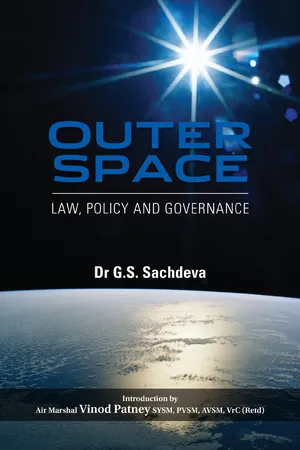
- 256 pages
- English
- ePUB (mobile friendly)
- Available on iOS & Android
eBook - ePub
About this book
Information
Print ISBN
9789381904886
Edition
11
Jus Cogens of Space Law: A Proposal*
Introduction
Space law is a nascent and as yet an evolving branch of international law. Though developed as an adjunct of international law, it has traversed a journey of centuries in just decades to ripen. Its principles have matured into customs with obligatory force to elicit voluntary abidance. It has, thus, metabolised at an accelerated rate and is now getting metamorphosed into an independent and auto-poietic system1 with a close nexus with, and cross-linkages to, other sub-systems of cognate legal regimes,2 international jurisprudence, their intertwined operations and other multiple applications.
The evolutionary process undergone by international law finds a certain degree of parallel with that of the regime of space law albeit compressed in timeframe. In just half a century, the corpus of space law has accumulated one treaty, two conventions, and two agreements, two UN Declarations and four Principles and Guidelines on important space issues.3 It is no small achievement through the endeavours of the UN Committee on Peaceful Uses of Outer Space (COPUOS) and the UN General Assembly in such a short span and on such contentious matters, considering that negotiation of treaties and conventions is a long and laborious affair. The efforts of COPUOS are continuing and deserve to be highly commended and duly supported by all participants.
Space law is gradually becoming complicated and its intrinsic complexity becomes evident as its contours gradually crystallise into new formations and its grammar becomes more distinct and communicable. However, there is no reductionist approach to criminality in space law; the bottom-line is either common survival or collective annihilation. The stakes are clear and the choices really limited. The decision, however, is of our volition and depends upon our level of sagacity. Therefore, strict adherence to space law is mandated to the international comity irrespective of their being space-farers, space-users or space-watchers.
An important international instrument called the Outer Space Treaty4 (OST) is considered the grundnorm of space law as it delineates the basic tenets for human activities and stipulates the norms of conduct for the states in outer space. Whereas international law attempts to regulate relations among a society of states, space law transforms governance into a legal order of a genuine state community.5 The difference may appear subtle yet the impact of this orientation is profound and positive. This treaty, thus, lays down the fundamental law for public order in outer space. By virtue of its universal mandate, fundamental contents and continued habitude, the OST has already gained the force of universality and assumed the status of customary law of outer space. In consequence, it is treated as legally binding even on states that are not party to the treaty or have not yet acceded to it.
Some of the salient provisions of the OST are so basic, fundamental and natural to the legal regime that these can be taken as peremptory norms of state behaviour and conduct in outer space and, hence, can logically be elevated to the pedestal of jus cogens of space law for universal obedience and impeccable compliance. A couple of examples would clarify the concept. First, outer space and the celestial bodies are free for exploration and use by all states on the basis of equality and activities here shall be carried out for the benefit, and in the interest, of all mankind. Secondly, the activities of states in exploration and use of outer space shall be carried out in accordance with international law, including the Charter of the UN, in the interest of maintaining international peace and security. Thirdly, outer space and the celestial bodies are not subject to national appropriation by claim of sovereignty, by means of use or occupation or by any other means. Of course, the earth is excluded from the celestial bodies.
It is proposed to advocate that some of the fundamental principles enshrined in the OST already comprise the customary law of outer space and these elite precepts may be acknowledged and propagated as jus cogens of space law. The author is conscious that many scholars may not wholly concur with this viewpoint and have reservations about it, yet it is humbly offered for consideration, debate and refinement.
Concept of Customary International Law
Customs are usages of a community or group of persons that are habitually and voluntarily obeyed as a ‘conditioned response’ under similar circumstances by a large number of the group. Such habitual responses evolve as a group norm, over a period of time, to acquire the force of law to ensure invariable compliance. In other words, “Customary law [is where] established usages…come to be regarded as having an obligatory character…”6 This is customary law where every member of the group feels impelled to conform and does not want to behave differently or act anti-social lest he be singled out for breach and criticism for being non-conformist even when the statute law is non-existent. Thus, customs are evidence of general practice or concensus accepted as law. Here each member has no ‘social contract’ or legal obligation to cooperate or abide, yet customary law, though soft law, has a binding force that is unimpeachable and its hold is really strong.7
In similar manner, the usages of international relations that become part of consistent state practice and over a period get emulated for adherence by other countries in common habitude of state interaction come to be accepted as customs of international relations. Some jurists have pointed out differences between customs and usages. They insist that the two terms are not synonymous and bear a distinctly different meaning in jurisprudence. To amplify the distinction, customs crystallise “when a clear and continuous habit of doing certain actions has grown up under the aegis of the conviction that these actions are, according to International Law, obligatory or right. On the other hand, international jurists speak of a usage when a habit of doing certain actions has grown without there being the conviction that these actions are, according to International Law, obligatory or right.”8
The point relating to ‘conviction’ in the obligatory nature of international custom needs amplification. International custom must meet two criteria. First, it must show acceptance of practice, “expressly recognised and accepted,” and its consistency of conduct by the states and, secondly, an implicit yet overt belief in its legal validity and compulsive character. This is a psychological element in the establishment of customary law and can be expressed as opinio juris sive necessitatus.9 It indicates a conviction of its legal obligation. However, there is a wealth of state practice that does not usually carry with it a presumption of opinio juris yet it could be deemed the settled practice of states.
Further, as these customs get universalised as natural responses under given conditions, these gain the force of normative behaviour with compulsive hold for voluntary adherence. At some stage, the customary rule gets abstracted from the individualised conduct and turns into customary international law that can euphemistically be called “World Discipline for International Relations”. The point in time when this process culminates is a matter of fact and not of theory. However, the metamorphosis is, thus, complete and the ultimate in international law is reached.
It follows, therefore, that international law is a dynamic corpus that keeps developing and changing according to variations in relational patterns and mutations in practices. In this process of transformation, new customs supersede older treaties and new treaties may replace older customs. Thus, treaties have over time gradually displaced or codified customary international law like that of the global commons or jus ad bellum. Yet vice versa is equally true because treaties are generally deficient in effectiveness for being not binding on non-parties and a majority of these lack universal ratification. Yet, most of the customary international law has sustained with durability.
Customary laws have developed in two ways. First, they “had their origin in the practice of a single [but powerful] state which was able to impose its will until the rule came to be accepted by other states without protest.”10 Many such rules, for example, relate to maritime warfare. The other method relates to “their origin in the voluntary practice of a small group of states, and being found useful and convenient, were gradually accepted by other states until the established practice became a binding rule.”11 Such rules have come into being relating to diplomatic immunity, international commerce and trade relations.
However, for hardening of an abstract rule into a concrete practice and an accepted custom, there are no deductive benchmark parameters in terms of reiterated acts of regular observance or frequency of affirmations of a particular principle to show its general acceptance. The slide from precedent to custom is gradual and subtle, with the distinctive character that the acknowledged practice acquires a manifested recognition of a lawful obligation. It seems germane to say that international law is based on the consent of states, which could be express or tacit. Customary international law carries the tacit consent of states that could be implied or expressed in conduct.12
It also becomes pertinent to highlight the importance of customary international law by alluding to its honurable reference in the Statute of the International Court of Justice annexed to the Charter of the United Nations. Article 38 in Chapter II of the Statute relating to the competence of the court states inter alia, “The Court…shall apply international customs as evidence of a general practice accepted as law.” Thus, this Article is generally recognised as a definitive statement of sources of international law. Further, to avoid the possibility of non liquet, sub-para (c) has been added after para (b) that explicitly mentions international customs. In a nutshell, international custom is a source of international law with equal importance and equal validity with treaties and pacts et al.
OST as Customary International Law
The United Nations was inspired by the great prospects opening up before mankind as a result of man’s entry into outer space and recognising the common interest of all mankind in the progress of the exploration and use of outer space for peaceful purposes, ...
Table of contents
- Cover
- Half Title
- Title
- Copyright
- Contents
- Dedication
- Preface
- Introduction
- 1. Jus Cogens of Space Law: A Proposal
- 2. Astronauts as Envoys of Mankind in Outer Space: Resolution of a Dilemma
- 3. Space Policy of India: A Few Pointers
- 4. India as Vendor of Space Utilities to Developing Countries: An Example in Cooperation
- 5. International Cooperation as Core Concept of Space Law: For Diplomacy and Confidence
- 6. Mining of Asteroids: A Legal Analysis for Effective Governance
- 7. International Code of Conduct for Activities in Outer Space: An Exercise in Futility
- Annexure A. Treaty on Principles Governing the Activities of States in the Exploration and Use of Outer Space, including the Moon and Other Celestial Bodies
- Annexure B. Agreement Governing the Activities of States on the Moon and Other Celestial Bodies (1979)
Trusted by 375,005 students
Access to over 1.5 million titles for a fair monthly price.
Study more efficiently using our study tools.