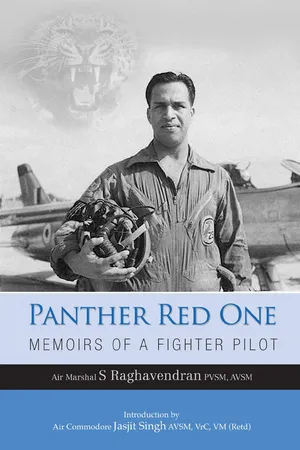
This book originally began as a series of articles, at the behest of the author's son, for the website Bharat Rakshak. As the articles flowed, the author was then persuaded by his children to expand these articles into something that more resembles a book. It was (and is) intended for his grandchildren to know about one part of their heritage—a part that will likely not recur in the family tree. It was not intended for general publication, but the children convinced the author otherwise. Perhaps the first couple of chapters could be a reader for all grandchildren of today because every family came from similar villages all over India. It also gives a feel for the motivation, and the acceptance of the environment and facilities that were far from adequate to achieve the goal of being a fighter pilot. It is more "episodic" than such works usually are, as it has been written at the age of 80, from the heart and from memory. It is hoped that you will enjoy it.
- 268 pages
- English
- ePUB (mobile friendly)
- Available on iOS & Android
eBook - ePub
About this book
Information
Print ISBN
9789381904633
Edition
1FIGHTER PILOT
1951: The First Squadron

1951 No 4 Squadron Group in Poona with Tempest. Squadron Leader Latif, later Air Chief is standing fourth from the right
My first posting came to No. 4 Squadron in Poona (as it was called then), equipped with Tempest IIAs. I reported to the Squadron on 4 January, 1951. The posting was a bag of mixed blessings. On the plus side, one could claim to be a “Squadron Pilot” implying I was ready to go to war, though only the insiders would know that I had a long way to be declared “Fully Operational” in my Log Book and in the records. Poona was a humming town; lots of restaurants and movie theatres, ample shopping, a dancing school where those who wanted to learn ballroom dancing could go (Danny’s Dancing school on East Street was very well attended), ample shopping, the first Rajendra Sinhji Institute for Defence Officers (A much patronized Club where you were automatically a member and you were charged a nominal amount in the mess bill), lots of girls willing to go out with. That last category only contained Anglo Indians and Parsis – no chaste Bharatiya Naris (Hindu women).
The negative side was that all the good things were in town, six miles away from the Mess, and the only mode of transport we could afford was the standard bicycle. The Officer’s Mess was housed in the palatial Agha Khan Palace (kind courtesy of the Agha Khan during the war), but our living quarters were the stables and servants quarters of the palace! Even that we shared, two to a miniscule room in the servants’ quarters and three or four to a room in the stables. Some of the senior officers were housed in the few rooms in the Palace but they too had to share rooms. The palace was about four miles from the squadron offices and, again, the trusty bicycle was our mode of transport. The offices were in two war time temporary barracks. These were supposed to last only five years but that had passed long ago.
One barrack housed the two flight offices, a ‘crew room’ for about fifteen or so of us, with totally inadequate seating and a room where we hung our flying overall or uniform, depending on what we had on at the time. The other barrack was the Commanding Officer (C.O.)’s domain with his office, the adjutant’s office and the Orderly Room, where the clerical and administrative staff worked. In between the two was a tea shop for our squadron and No. 3 squadron, which was housed in two similar barracks near by. The entire environment was fairly primitive, but the ingrained philosophy of Indians that we have to make do with what we have got totally blinded us to the shortcomings and we thought life was good. I wonder what today’s squadron pilots would think, if they were transported from their very comfortable settings to the one we landed in.
There were only two cars and two motorbikes among the squadron officers. The C.O. didn’t have one but he got the Jeep to commute to work and he was single. One of the two flight commanders and Hari Bhagat had cars, the latter a sporty MG. Willie Liddle and Alec Stroud had motorbikes. That was all. What a comparison to today’s state where practically everybody has a car and a two wheeler. The motor cycle count increased slowly and even I managed to buy one after a year, with a loan from the Air Force. It cost all of Rs. 2500, six months salary, and it was a unique two cylinder Douglas, with horizontally opposed cylinders. Life changed completely after I became mobile. Into town everyday, almost, and it became even better when those with transportation were shifted to an Army mess in town, on East Street, due to congestion in the Agha Khan Complex.
Training was somewhat desultory. I don’t remember seeing a chart in the flight offices, as is standard now, to track the progress on a laid down syllabus. We did get training in ‘ranging and tracking’ to understand the use of the Mk IV Gyro Gun sight but never any air combat. We did some close and battle formation but not enough of the latter. We did a certain amount of range practice with guns, rockets and practice bombs but never with live bombs. Low level circuits with pull up attacks or a low level mission with an attack on the target was never done. ‘Pop’ Bouche, the senior Flight Commander, was a taciturn, serious minded and dedicated professional who kept a close watch on our flying, especially the landings. He was a qualified Pilot Attack Instructor who looked after the initial grooming in of the new pilots. M.D. (Maisie) Khanna dealt more with the Operational Flying, or what there was of it. The squadron commander was Idris Latif (later on a much respected Chief of the Air Staff). He was followed by Koko Sarkar and later by Radhakrishnan.

1951 No 4 Squadron visiting Armament TrainingWing (ATW) in Jamnagar. My only attempt at a moustache
Six of us from our course had been posted to the squadron: Minoo Dotiwala, Guy (Mac) McKenzie, Steve Michael, Terence D’sa, Motte Chandra and me. A few months after our arrival in the end of ’50, my very good friend Steve did not return from a sortie and his crashed aircraft and dead body were found twenty miles away. The squadron seemed to be a collecting place for Sword of Honour winners from many courses and a lot of Anglo Indians. In the former category were Ram Singh, Wollen, Dotiwala, Sudhakaran and Deshpande. In the latter category were Pop Bouche, Alec Stroud, Harrington, Wollen, Jimmy Tapsall, Teddy D’souza, Willie Liddle and Arthur Turner. Sudhakaran was an extraordinarily impressive personality who was tall and very well built and was chosen by the Air Force to receive the President’s Colours when it was presented to the Air Force. Regular attendance at the Bar and lack of exercise over some years got him a large paunch and when I chastised him, at the Mess Bar in Kanpur, years later, and asked him to get in shape, his answer was “no way, I have spent too much time and money on it”.
We all had a very good time together. There were many squadron picnics; every Saturday was dance night in the R.S.I., with a live band. I didn’t drink those days but sat with friends who did. I could see that there was a lot of release of inhibitions and a feeling of enjoyment in drinking but I had a Family Tradition to uphold. Coming from a long line of South Indian Brahmins none of whom had ever joined the military and considered drinking and smoking cardinal sins, it was very difficult to be the first turncoat. Besides, I had been told about my elder brother (only thirteen months older, who was considered a paragon of virtues). He was in the Merchant Navy and when he was a cadet on board he had been ordered by his Captain to have a drink and apparently he had told him that he could not give such an order. The Captain mentioned this to my father, when he met him, and this was conveyed to the rest of the family. So, I was in a fix. Then, one day, my brother’s ship came to port in Bombay (as it was then) and he called me to visit him on board his ship, where he was a Second Officer. I went on board and, later, rummaging around his cabin, I found a lot of bottles of liquor and he passed it off by saying that he was keeping it for some of the other officers who didn’t have the space. Later on while sitting around with some of his friends and chatting, it was clear that my dear brother was definitely consuming alcohol! So, I was free to do so now! But, I didn’t go home the next day and guzzle. That was to come later.
There were three Liberator squadrons on the base, each one with about thirty officers or more, half of them navigators. Most of them seemed to be playing cards at work and again in the afternoon in their rooms. There were some senior navigators who were the leaders in this. One of the squadrons had its office and crew room building close to the runway. Their card session came to an abrupt end one day when a Tempest swung off the runway and came to a stop after have knocked down the wall of the building! Of course, they all attended the Bar in the evening and I would hang around to hear their “manly” exploits. Listening to them it was clear that they had a permanent pimp, a taxi driver in town, who they would call, when required, and go on a sortie to ‘Budhwar Peth’, the Red Light district in the heart of Poona Town. One night, rather late, they decided to go on such a mission. I was intrigued and curious, never having adventured into such activities. So, I asked them if I could go with them on an “education” visit. I was very much a virgin and had no intention of “indulging” but I wanted to see how the ‘old hands’ went about it. Soon the taxi came and we piled in and he took them to their familiar houses of ill repute. Most of them normal households in respectable parts of the town and they kept on being turned down as being ‘too late’. Finally they reached and apartment where the door was opened by a surly ‘madam’, who asked very curtly ‘What do you want?’. The leader of the mission asked “Ghana Bhajana Hoga? (Is there music and drumming here)” She answered “Ghana Wana nahin hoga, Bhajana Hoga! (there’s no music-schmusic, but there’s drumming!” The leader went in to see the fare available and decided against it and we all returned home.
In 1951, the Air Force’s Armament Training Wing (ATW) was opened in Jamnagar. As usual, the Air Force was reduced to start it with bare bones. There was the all important firing range and very little besides. Yes, of course, it had a runway and an Air Traffic Control building, which also housed the station offices and the class rooms. There was no other building! The Officers Mess was housed in two “thousand pounder” tents (fairly large ones), one as the ante room and the other as the dining hall. The kitchen was in a half baked shack at the back. All of us had to live in 240 pounder tents, four to a tent! No place to keep ones clothes. It took many years to get to a decent standard. No. 3 Squadron was the first to be punished with a ‘camp’ there and we were to be the second. The monsoon had just started. At that time Radhakrishnan was our squadron commander. Bouche had gone off to be on the staff at ATW and Timki Brar had come in as his replacement.
No.3 Squadron returned to Poona after their groundbreaking visit to the ATW, with the fury of the monsoon behind them. We were to take off the next day, with nine Tempests and we became the butt of jokes far and wide. Each day we tried to take off for one whole week! The weather would be bad at Poona or Jamnagar, our destination, or Ahmedabad, our en route refuelling stop. On two days the Squadron Commander got cold feet, when we could have gone. The Squadron Commander of No. 3 Sqn, which had come in just ahead of the monsoon, asked Radhakrishnan and the flight commanders Maisie Khanna and Timki Brar, with mock solicitude, as to whether his ‘boys’ could help by ferrying the aircraft to Jamnagar. We got similar calls from the staff at ATW, including Pop Bouche, offering help in ferrying the aircraft. We were running out of uniforms and underwear as each day we couldn’t give them for wash.
At last we took off and the weather was very bad on the way. We were in three separate groups of three aircraft, one led by Radhakrishnan with Motte Chandra and Teddy D’sa, second with Maisie Khanna, Sudhakaran and me and the third one with Timki Brar, Teddy D’souza and Jimmy Tapsall. Radhakrishnan went low below the clouds, as he was not too comfortable going through the clouds but when Maisie tried that the clouds were too low and raining. So, he signaled to me and Sudha to tuck right in and led us through thick bumpy clouds. I remembered my episode with Dhan but luckily the pitot head was on the side away from Maisie’s wing and so I had no fear even though it was bumpy. Timki did the same. All of us landed in Ahmedabad safely and found a group from Jamnagar, again solicitously asking whether they could take some of the aircraft the rest of the way. Radha took off from Ahmedabad and set course out by 90 degrees! It was cloudy and his radio was not receiving too well. The compass in the aircraft of those days had a compass ring which you set to the direction you wanted and then turned the aircraft till the grid lines on the ‘compass rose’ was aligned with the compass needle. Radha had set the ‘rose’ 90 degrees out. His wing men, Motte and D’sa were screaming at him that he was going the wrong way but he didn’t hear. So Motte (a young Pilot Officer) took the liberty of going ahead of the Commanding Officer, waggled his wings and turned to the correct direction. Radha realized his mistake and changed his setting and carried on. We were all certainly very happy that we all arrived safely without any untoward incident on 12th August, 1951.
The stay at ATW for six weeks was interesting but under miserable conditions. But we made the best of it. Jamnagar being on the west coast got the brunt of the monsoon and it rained repeatedly and heavily. The Mess area, which included the Mess tents and our living in tents, was a mud area and had no road or paved area became a quagmire. Clothes would not dry. Once we came back from flying, we were in our underclothes and ‘gum boots’. No cupboards to keep our clothes or important items. Our uniform for the day hung from a hangar hooked to one of the loops in the roof of the tent. Nothing to do in the afternoon and so we played cards for minor stakes, flash or ‘pontoon’.

1951 No 4 Squadron ATW Jamnagar - JimmyTapsall dressed in casual uniform which happened to be underwear!
In the evening everybody adjourned to the bar and those who drank did so and others like me watched. But I had reached the end of my abstinence. I was just waiting for something to push me over the edge and it came. The promotion to the rank of Flying Officer for five of us from our course came and we decided to throw a grand party. I watched the goings on till about 9 PM and then decided that it was time to try the cup that cheers. I asked Sudha as to what I should drink and he and the Flight Commander Timki Brar were only too happy to take one more innocent guy down the giddy path. They suggested Scotch. Those days, the only whisky available in the Messes was Scotch. I just couldn’t stand the smell and taste. Then they gave me rum with similar result. Then they poured some lime cordial in the rum and I could stand that. I made up for lost time and probably had about a dozen drinks under the eager eyes of my tutors, who were gleefully waiting to see me pass out or make an ass of myself. Neither of that happened. To test my lucidity, they kept asking me to repeat, “The Leith police dismisseth us”. After a while, they were the ones having a problem mouthing those words.
It was in Jamnagar that I heard one of the pithiest remarks that I ever heard. Those days seafood refrigeration was unheard of. So, lovers of prawns had to go where they were available. Jamnagar was one such place and the prawn lovers would persuade the staff to serve prawn curry often. Deb (Debu), the Bengali Station signals officer was one of them. As it was, he ate his food with great gusto but, when prawns were there, his chomping and slurping was ‘loud ad clear’. Chico Bose, a very refined Bengali instructor on the base, once turned to him and said, “Hey Debu, the food certainly sounds good today!!”
The course went well and all of us improved our marksmanship. The brilliant Sudhakaran was expected to top the Ground Subjects but it turned out to be my pleasure. No. 10 Squadron, from Barrackpore, were to follow us and it was decided by Air HQ that a detachment of us would go there to guard the eastern skies, while they were at Jamnagar. So a detachment of six of us went there directly from Jamnagar with Timki Brar as the detachment commander. Barrackpore was a tricky airfield to operate from for take off and landing for the Tempest. The runway was only two thousand yards long and there were tall coconut trees on both approaches to the runway. We had to make a steep approach and suddenly cut the throttle for a landing and almost scraped the coconuts on take off.
We would go to Calcutta often either after a few drinks in the mess or over the week end. The famous Fleury’s was a favourite haunt and we attended the New Years Ball in the famous Great Eastern Hotel. Jimmy Tapsall met his wife to be, Noreen, who was a crooner with a band. We would have to take a taxi from Barrackpore, which could not operate in Calcutta. So he would wait and we would get into a local taxi for roaming around. This is just what we did when we decided to celebrate the birthday of one of the senior pilots. We had had a few drinks in the mess when this brilliant thought came to somebody. We would pool in and gift him a woman for the evening. It was such a good idea, after a few drinks, that it was unanimously approved and the birthday boy was not averse to it.
So, off we went into town and parked in Chowringhee and found a local taxi, driven by a sardar (Sikh). We told him our mission and he was very enthusiastic about it. There were six of us piled in the taxi. We didn’t bargain for the sardar’s modality for finding a woman. He would stop in the middle of a junction of roads, including the famous Park Street and scream at the top of his voice “Oye, Kudiawale Oye”, meaning ‘Hey Pimp, where are you’. We would all be ducking in the seats. But he got results. Pimps would turn up and lead us to apartments where there would be a single girl or a madam parading her ware. But the birthday boy was not impressed with the fare served up. At one of the places Jimmy, who probably had had more than his quota, needed an aspirin and got one from the madam. Even the bubbly cabby was getting frustrated and told the pimp to get him a girl too! Then one of the ‘boys’ remembered that he had heard that Sonagachi, the ‘red light’ district of Calcutta might be the place to find ‘The One’. Our ever helpful cabby rushed off there and again gave his war cry and we were soon accosted by a pimp who took us to an apartment where a normal family was sitting around playing cards. One young girl was very good looking and seemed a good Bharatiya Nari. Most of the previous ones had been Anglo Indians. When asked, we were told that the girl in question was the one. The birthday boy was full of approval and we all waited around till he came out. We all felt that we had done well by a comrade in arms!
There was cheap rum available in Barrackpore, known as ‘Gurkha Rum” costing as little as Rs.1.50. So, everybody had a couple of bottles readily available in the rooms. When we returned to Poona, we found that the Chief Minister of Maharashtra State, Morarji Desai, had declared Prohibition in the State and he had issued orders that this equally applied to the armed forces and all canteen supplies of liquor was sealed. But the Air Force found an easy way out while waiting for the courts to decide that he could not make it apply to the Armed Forces. Liberators went regularly to Barrackpore and word would be passed around to ask for requests of Gurkha Rum, by the crate, and for advance money. The Liberators would come, heavily laden with crates of rum and everybody had their own sumptuous supply of the cup that inebriates. There were many who had not been drinking before but, because of the obnoxious embargo, started doing so.
After six weeks we came back to Poona and shortly after that, I was sent off to do the very first GCI (Ground Controlled Interceptor) course run by Chandu Gole and Abe Abraham, who had just been trained in UK (and the first radar had been set up Halwara for training). Back to the tents again. Though No. 3 Squadron, with Tempests, was on the base, some Harvard IIBs were positioned there for use for our training. Besides trying to understan...
Table of contents
- Cover
- Half Title
- Title
- Copyright
- Dedication
- Contents
- Introduction
- Preface
- Timeline
- Birds’ Eye View
- CHILDHOOD
- RIMC
- TRAINING
- FIGHTER PILOT
- WARS
- GOODBYES
Trusted by 375,005 students
Access to over 1.5 million titles for a fair monthly price.
Study more efficiently using our study tools.