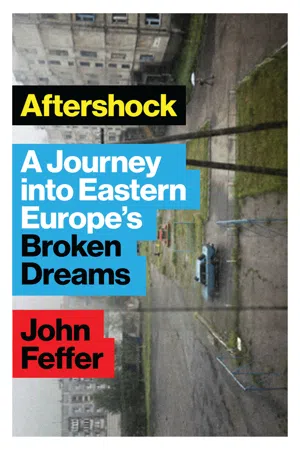
In this unique, panoramic account of faded dreams, journalist John Feffer returns to Eastern Europe a quarter of a century after the fall of communism, to track down hundreds of people he spoke to in the initial atmosphere of optimism as the Iron Curtain fell – from politicians and scholars to trade unionists and grass roots activists.
What he discovers makes for fascinating, if sometimes disturbing, reading. From the Polish scholar who left academia to become head of personnel at Ikea to the Hungarian politician who turned his back on liberal politics to join the far-right Jobbik party, Feffer meets a remarkable cast of characters. He finds that years of free-market reforms have failed to deliver prosperity, corruption and organized crime are rampant, while optimism has given way to bitterness and a newly invigorated nationalism. Even so, through talking to the region's many extraordinary activists, Feffer shows that against stiff odds hope remains for the region's future.
- 608 pages
- English
- ePUB (mobile friendly)
- Available on iOS & Android
eBook - ePub
About this book
Information
Part I
Stepping backward
1
Pyramids of Sacrifice
Jelka Zorn, a petite blonde Slovenian, was conducting ethnographic research on asylum issues for her social work degree. It was 2000. The last war of the Yugoslav succession, over the breakaway region of Kosovo, had recently ended. Yet Slovenia, in the northwest corner of the former multiethnic federation, was still dealing with people who’d fled the conflicts that accompanied the breakdown of Yugoslavia. The detention centers were crowded.
Jelka’s interest in immigration was piqued by the experience of a friend from Croatia who wanted to relocate to Slovenia. It had been relatively easy to move between republics in the communist era, but this changed when the country broke apart in the 1990s. ‘She had a terrible problem getting papers,’ Jelka told me in 2012 over tea in a café in the Slovenian capital of Ljubljana. ‘She was not a refugee. She just wanted to move here for personal reasons. I helped her with the papers. This took five or six years!’ Jelka made no effort to conceal her frustration. ‘Through her, I got to know how it is to come here from ex-Yugoslavia, how people were treated administratively, and what consequences this had for their life.’
Slovenia cultivates an image of itself as the Switzerland of the Balkans. It’s small, with an alpine landscape and a relatively prosperous population of 2 million people. Slovenians also tend to think of themselves as tolerant. That tolerance was tested by the waves of ex-Yugoslav refugees that flowed into the country in the 1990s. ‘At first, people’s reactions were very welcoming toward the refugees,’ Jelka explained. ‘But after a while this really changed. Politicians gave hostile speeches. Refugees were restricted in their movement around the town. They were kept in those centers, and only their basic needs were met. It’s terrible to treat people like this.’
Provoked by her friend’s travails and the increasingly intolerant rhetoric of politicians, Jelka decided to visit a Slovenian detention center to learn more about asylum issues. It was not an easy task. For one thing, the head of the institution was not happy to have a graduate student poking around in the center’s affairs. It only became more complicated when Jelka spoke with the resident social worker.
‘Do you want to talk with our foreigners,’ the social worker asked, ‘or foreigner foreigners?’
Our foreigners? Foreigner foreigners? What could those phrases possibly mean?
With that one visit, Jelka Zorn’s life changed completely. She’d stumbled onto a nightmare of a situation that had been going on for nearly ten years. ‘Our foreigners’ turned out to be a group of 25,000 people who had lost their citizenship from one day to the next. They had been born in many different places, but they had lived in Slovenia for most of their lives. In some cases, they had lived nowhere else. Until 1991, they considered themselves Yugoslav citizens, and that’s what it said on their passports.
When Slovenia established its own citizenship law on gaining independence in 1991, the new state promised to grant citizenship to the approximately 200,000 people from other Yugoslav republics living in the country. These prospective citizens just had to demonstrate that they had permanent residency as of 23 December 1990 (when Slovenia passed a successful referendum on independence), prove that their place of residence in Slovenia was real, and apply for citizenship by 31 December 1991. Most of the people in this category – about 170,000 – followed these procedures. Some of the rest left Slovenia.
Everyone else failed to apply for citizenship – ‘some of them owing to ignorance and confusion at the time of dissolution of SFR Yugoslavia, some owing to anti-Slovenian propaganda, some because they mixed up citizenship or nationality with ethnicity,’ explains Matevž Krivic, an asylum lawyer and former constitutional judge.1 This group of 25,000 people stayed in Slovenia, but as foreigners: ‘our’ foreigners. And when the application period for citizenship elapsed in 1992, Slovenia stripped those 25,000 people of their legal status – ‘without legal ground and without any administrative decision,’ Krivic continued, ‘even without any notification to them, simply by erasing them from the register of permanent residents of Slovenia.’2
Eight years later, when Jelka encountered them, these stateless persons remained in limbo, many of them living in a permanent state of detention. ‘The scene was really terrible at the detention center,’ Jelka remembered. ‘I had coffee with one man, and I asked him how I could help him. “You can cry with me,” he said. This shows a state of resignation, that they had nothing to hope for. They told me, “We worked here for years. We gave our best years here. Now, look where we are? Six beds to one room.”’
Perhaps the most startling aspect of what would become the scandal of the Erased was that virtually no one in Slovenia knew about it.
‘It’s quite remarkable that in a small country like Slovenia something like this could remain hidden for a decade,’ Jelka told me sadly. ‘When we started to tell students that they had to make interviews with Erased persons, they said, “But we don’t know any Erased people!” In the end, though, it turned out that everyone did know someone. This shows the level of oppression. If the Erased weren’t so oppressed, they could have gone out and talked about their situation and journalists could have written about it.’3 As it turned out, not everybody who experienced the Erasure wanted to talk about it. Jelka discovered that some people believed that talking about their situation would make it worse.
The first step for those caught in administrative purgatory was to come up with a name for themselves. Bureaucrats in the municipal offices used the term ‘erased’ – or izbrisani in Slovenian. ‘The Erased took it for themselves and changed the meaning of the word completely. It became a term of resistance and courage,’ Jelka said admiringly. ‘To identify yourself as Erased, it means that you want to reveal the conditions of the Erasure, racism, and xenophobia. So, saying that you’re Erased became a very powerful statement in 2002 and 2003. People were really brave to publicly identify as the Erased.’
One of those brave souls was Irfan Beširević.
Born in Bosnia, Irfan came to Slovenia when he was only a year old. Since then, Slovenia has been the only home he has known. At the end of 1990, a terrible car accident put Irfan in a coma. The recovery was long and painful. While he was recuperating, Slovenia declared its independence. After his extended convalescence, Irfan went to register as a citizen of the new Slovenian state only to be told, inaccurately, that he’d missed the deadline. He returned later to clear up the problem. That’s when an unfriendly neighborhood bureaucrat declared his documents expired.
‘When they made a hole in my identity card, I didn’t know what that meant,’ Irfan told me through a translator. He spoke slowly, pausing every so often to take a drag on a cigarette. ‘They told me that I was erased from the registry of permanent residents, and I had to arrange my status as a foreigner. I didn’t know what the extent of the consequences would be, not until I had health issues and I couldn’t go to the doctor because they wouldn’t treat me, not until my domestic situation worsened and I had an argument with my wife because I wasn’t earning any money and I couldn’t be an equal part of the community. Only then did I realize what the consequences would be. Without documents I couldn’t go to the doctor. Without papers, I couldn’t get a job. I went to the Red Cross, and they said they couldn’t help me because I wasn’t a refugee, I wasn’t anything, I wasn’t entitled to any help. And then all my problems started.’
Some people in Irfan’s situation, those who’d been erased from the official records, left Slovenia. The government forcibly deported others, sending quite a few directly into war zones. But many, like Irfan, stayed. They stayed with families and friends. They stayed because they knew no other home. Irfan went underground. He sometimes slept at the apartments of friends, sometimes in the park. He worked as a waiter in exchange for food and shelter. He suffered from the after-effects of the car accident as well as new ailments like thrombosis. He no longer had health insurance to pay the bills. He also constantly faced the threat of police detention. In 2002, the police finally picked him up. He came very close to being deported to Bosnia, a country he barely knew. After considerable efforts, he finally acquired Slovenian citizenship in 2004, along with health insurance and the possibility of a proper job.
When I first met Irfan in 2008, his financial situation was perilous – he’d suffered more health problems after a stint in the construction industry. At that point, the Slovenian government was resisting any effort to compensate the victims of the erasure. By the time I caught up with him again in 2012, his situation had improved considerably. He’d become the president of the Association of Self-Organized Erased. He gave interviews. He appeared on television. He was committed to building a broader movement. ‘If you don’t fight for your rights, if you stay at home and don’t fight, nothing will happen,’ he concluded. ‘It’s a really important part of this movement that it’s been inclusive. We weren’t just struggling for the Erased. We were fighting also for the rights of Roma and the LGBT community.’
The Erased received assistance from social workers and activists like Jelka Zorn. Several lawyers also helped them take their case all the way to the European Court of Human Rights. The plaintiffs insisted that the Slovenian government not only acknowledge the human rights violation but also pay damages.
One of those lawyers was Neža Kogovšek Šalamon. Trained in human rights law in the United States, Neža began working on non-discrimination cases when she returned to Slovenia at the end of 2004. But she didn’t find the work sufficiently challenging – until she became involved with the Erased.
‘It was actually a case that started with eleven applicants,’ Neža told me in her office at the Peace Institute in Ljubljana, where she’d recently become the executive director. ‘Nothing was happening at the time. The politicians were ignoring the issue, unless they used the issue against the Erased to gather political points. So, it was a very desperate situation for the victims and for civil society. A group of activists decided that something had to be done, and the only thing that hadn’t been explored yet was the European Court of Human Rights.’
It was an uphill struggle from the beginning. The activists and the victims, working together, ‘looked for an attorney that would take the case pro bono to the European Court of Human Rights, because the people of course had absolutely no money to pay for an attorney,’ Neža explained. ‘They looked for an attorney in Slovenia, and nobody wanted to take it. Some of the people said that the case had no chance of succeeding. Others said they were scared. Still others said they were not interested or they didn’t do pro bono cases. So they were not able to find anybody in Slovenia.’ Eventually activists in Italy found an attorney in Rome willing to take the case.
After three years, the European Court ruled in favor of the victims but didn’t require any compensation. The Slovenian government, rather than acknowledge wrongdoing, appealed the ruling. That turned out to be a big mistake. In its second judgment, the Court was punitive.
‘For the past there has to be compensation – this was the key message of the European Court of Human Rights,’ Neža said. ‘The six applicants got twenty thousand euros each for non-pecuniary damages. They are still waiting for pecuniary damages to be determined, which means they will probably get something more. Which again, is probably not so much when you think about the twenty years of suffering. But still it is a very high compensation from the European Court of Human Rights when you look at its case law.’
In 2014, in implementing the court decision, the Slovenian government finally established a legal framework to compensate the Erased. One year later, it had granted 20 million euros in nearly five thousand cases – an average payout of about four thousand euros per person.4
When Jelka Zorn visited the detention center in 2000, the Erased were not only non-citizens, they were non-entities. They’d been erased from the citizenship rolls but also from the consciousness of Slovenians. Within a decade, through self-organization and the technical assistance of allies, they had regained their voices and their dignity. The Court in Strasbourg had recognized their rights as Europeans. And they were being compensated, albeit modestly, for their involuntary sacrifices.
Slovenia experienced one of the easier transitions in the region. In the 1980s, its communist party was the most committed to changing the system. The ten-day war with Yugoslavia’s federal forces in summer 1991 left about seventy-five people dead,5 but it was not remotely comparable to the catastrophes that subsequently overtook Serbia, Croatia, Bosnia, and Kosovo. The new Slovenian constitution safeguarded human rights for all, declared unconstitutional any hatred or intolerance based on race, religion, or nationality, and accorded special protections to the small Italian and Hungarian minorities.6 During the independence process, about 170,000 non-ethnic Slovenes received citizenship. In a remarkable gesture of solidarity, the government even abolished university fees for students coming from ex-Yugoslav countries.
Yet even here in Slovenia, a substantial group of people were sacrificed on the altar of transition. Nor was this sacrifice simply the result of a series of clerical errors, for it required the entire machinery of the state to enforce the policy. ‘The phenomenon of the Erased demonstrates that no democratic order can be established without the repression of the particular,’ poet and literary critic Aleš Debeljak told me. Writer Svetlana Slapšak was even more critical of what she deemed a general lack of accountability in the country. ‘Slovenia did not repent for its role in the disintegration of Yugoslavia. It did not take responsibility for the Erased. It did not take responsibility for outbursts of nationalism,’ she told me. ‘The nationalism is everywhere. You can’t even define it anymore as nationalism because everything is imbued with it.’ In establishing their first ever state, Slovenians created a narrative of themselves as the oppressed, never the oppressors. They placed their country in peaceful Europe, not the violent Balkans. To make this narrative work, however, they had to ignore all contrary evidence, especially the treatment of the Erased.
Many millions of people suffered during the transitions after 1989. The Erased are unusual because they were ignored for so long and also because they were able to achieve a kind of victory. For the rest, the so-called ‘losers of transition,’ their sacrifices remain largely unheralded and uncompensated, and togeth...
Table of contents
- Cover
- Title
- Copyright
- Contents
- Acknowledgements
- Introduction: Exile Off Main Street
- Part I: Stepping Backward
- Interlude: Stepping Backward, Leaping Forward
- Part II: Leaping Forward
- Conclusion: The Future of Illiberalism
- Notes
- Index
- About the author
Trusted by 375,005 students
Access to over 1.5 million titles for a fair monthly price.
Study more efficiently using our study tools.
Frequently asked questions
Yes, you can cancel anytime from the Subscription tab in your account settings on the Perlego website. Your subscription will stay active until the end of your current billing period. Learn how to cancel your subscription
No, books cannot be downloaded as external files, such as PDFs, for use outside of Perlego. However, you can download books within the Perlego app for offline reading on mobile or tablet. Learn how to download books offline
Perlego offers two plans: Essential and Complete
- Essential is ideal for learners and professionals who enjoy exploring a wide range of subjects. Access the Essential Library with 800,000+ trusted titles and best-sellers across business, personal growth, and the humanities. Includes unlimited reading time and Standard Read Aloud voice.
- Complete: Perfect for advanced learners and researchers needing full, unrestricted access. Unlock 1.5M+ books across hundreds of subjects, including academic and specialized titles. The Complete Plan also includes advanced features like Premium Read Aloud and Research Assistant.
We are an online textbook subscription service, where you can get access to an entire online library for less than the price of a single book per month. With over 1.5 million books across 990+ topics, we’ve got you covered! Learn about our mission
Look out for the read-aloud symbol on your next book to see if you can listen to it. The read-aloud tool reads text aloud for you, highlighting the text as it is being read. You can pause it, speed it up and slow it down. Learn more about Read Aloud
Yes! You can use the Perlego app on both iOS and Android devices to read anytime, anywhere — even offline. Perfect for commutes or when you’re on the go.
Please note we cannot support devices running on iOS 13 and Android 7 or earlier. Learn more about using the app
Please note we cannot support devices running on iOS 13 and Android 7 or earlier. Learn more about using the app
Yes, you can access Aftershock by John Feffer in PDF and/or ePUB format, as well as other popular books in Politics & International Relations & Comparative Politics. We have over 1.5 million books available in our catalogue for you to explore.