eBook - ePub
Poverty and Social Deprivation in the Mediterranean
Trends, Policies and Welfare Prospects in the New Millennium
- English
- ePUB (mobile friendly)
- Available on iOS & Android
eBook - ePub
Poverty and Social Deprivation in the Mediterranean
Trends, Policies and Welfare Prospects in the New Millennium
About this book
In the growth of regional identities worldwide, the Mediterranean Basin is emerging as an entity in its own right. This book, a unique collaboration among social scientists around the entire Mediterranean littoral, covers Southern Europe, Turkey, the Balkans, North Africa, and the Near East. Leading economists, sociologists and social policy experts document with new and up-to-date empirical material the changing profiles of poverty and social deprivation. The result is a thought-provoking comparison of the extent, severity and structural causes of poverty and social inequality, and the huge diversity of public responses to the challenges they pose.
1 | Introduction: comparing poverty phenomena in the Mediterranean area
The end of the second millennium and the beginning of the third have been marked by rising mass poverty and deepening social polarization within and between countries. This has occurred on a world scale, following significant cutbacks in social spending (both in developed and developing countries) and a residualization and marketization of social programmes and welfare provisions. These trends are mirrored in the slowing down, or even reversal, of a range of basic social indicators, such as life expectancy, infant mortality, malnutrition and other aspects of livelihood, particularly in some less developed or developing regions/countries, as well as in the countries of the former eastern bloc. Various studies extensively document the close association between the dominance of neo-liberal strategies for growth and development on the international scene over the last two decades, and the aggravation of global poverty and deterioration of living conditions for a substantial part of the world’s population (Townsend and Gordon 2002; Chossudovsky 2003). In this context a renewed interest among academics and researchers has emerged in developing an international approach to the measurement and explanation of poverty. This is considered to be a crucial pre-condition not only for a better understanding of the causes of poverty and its trends, but also for choosing political priorities capable of yielding results in the struggle against global poverty and effectively monitoring their progress.1 The two measures of ‘absolute’ and ‘overall’ poverty recommended by the 1995 Copenhagen Summit on Social Development (United Nations 1995)2 offered a starting point in this endeavour, which seeks to overcome methodological and substantive obstacles to developing a cross-national approach to poverty phenomena. These obstacles stem principally from the absence of a scientific operational definition of poverty and the erroneous belief that the needs of rich and poor countries are fundamentally different.
Recent studies have also called attention to the contribution made by different policies to alleviating the overall extent of national, international and local poverty. These studies focus on globalization in order to understand the dynamics between major actors (for example, the richest nations, international agencies and large transnational corporations) and trace the impact of the macroeconomic instruments and stabilization and adjustment objectives that underlie the ‘Washington Consensus’,3 on perpetuating and deepening economic inequality and poverty (Townsend 2002; Chossudovsky 2003: part I). In a similar vein, but with a different focus, Øyen (2002: 351) stresses the importance of conducting a more rigorous investigation of poverty-producing processes (in order to make them clearly visible), and the daunting challenge that lies ahead for poverty research (see also Kirdar and Silk 1995).
This volume raises a number of issues that are pertinent to these debates. It investigates the intensity and severity of poverty phenomena, traces their causal conditions and factors, and analyses concept definitions, measurement issues and policy orientations within a specific geographic unit – the Mediterranean area. These themes are examined in relation to country groupings covering three major sub-regions of the Mediterranean: the southern rim of the European Union (EU), the Balkan transition countries and the countries of North Africa and the Middle East. The book brings together a selection of papers presented at a workshop on Social Deprivation and Poverty in the Mediterranean Area, co-organized by CROP and the Department of Social Administration, Democritus University of Thrace (Greece), in June 2003.
The collection of chapters presented here is an initial attempt to stimulate comparative investigation of poverty phenomena and trends in a geographic area that has scarcely been examined as a unit of analysis in this respect. There have been a number of studies on specific regions of the Mediterranean area over the last decade, for example analyses of poverty trends in the Arab nations or sub-regions of the Middle East undertaken by international organizations, or poverty studies on southern European countries mostly stimulated by EU initiatives. Comparative research on socio-economic structures, development trajectories, patterns of inequality and poverty trends that highlight differences and similarities between the various regions of the Mediterranean, however, has remained rudimentary.4 An attempt of this kind surely needs to face the challenge of finding a comparable poverty measurement that would allow a cross-country analysis of inequality and poverty and the effects of economic and social policies in aggravating or reducing poverty. This is an ambitious aim requiring enormous resources and data, however, beyond the scope of this volume. The wide range of socio-economic, political and cultural structures in the Mediterranean area (not only among but also within its more or less constitutive regions) further complicates the task, while the paucity of information on poverty in many parts of the area imposes serious limits on comparative investigations. Rather, the idea here is to use available data to open up debate for a more rigorous cross-national analysis in future.5
In this introductory account we briefly discuss the reasons for focusing on the Mediterranean area. We then present some background information on poverty phenomena and poverty trends within its various regions, with the aim of offering insights for comparative investigation and setting a framework for the analyses undertaken in the following chapters. The final section summarizes the main arguments raised by each contribution.
The Mediterranean area (and its major regions) as a unit of analysis
The initiative to bring together a number of studies on the facets of inequality and poverty in Mediterranean countries is prompted by a number of factors. First, we envisage that such an attempt will stimulate wider debate among researchers and academics which will transcend the confines of distinct regions or groups of countries (for example, the Maghreb6/Mashreq7 countries or the MENA (Middle East North Africa) as whole, the four southern EU member countries, the Balkan transition countries, etc.). Locking up debate and comparative study within specific regions compartmentalizes the analysis of social needs and thus puts limits on a common measurement and framework for understanding poverty phenomena and their causes among countries at different levels of socio-economic development.8
Needless to say, the great variations among countries in the level, quality and comparability of available data on the extent and depth of poverty, as well as on policy processes and their effects, impede cross-national analysis in the Mediterranean area. Particularly for some countries systematic (primary) data are lacking (for example, a number of MENA countries and the Balkan transition countries), and in these cases one has to rely on the studies undertaken by international organizations, primarily the UN agencies that produce worldwide measurements of poverty. Yet, as shown by the contributions to this volume, poverty phenomena are intense in most of the countries in the area, and in some of them there has been a resurgence of mass poverty in the last decade. These conditions call for more coordinated research and analysis, particularly if there is going to be any progress on the policy front to combat poverty in the area. Undoubtedly, such a daunting challenge transcends the scope of our book. Rather, our aim is to compare existing studies in an attempt to prepare the ground for a more systematic, cross-national approach to poverty phenomena that could bridge the North/South (or rich/poor countries) divide in the area.
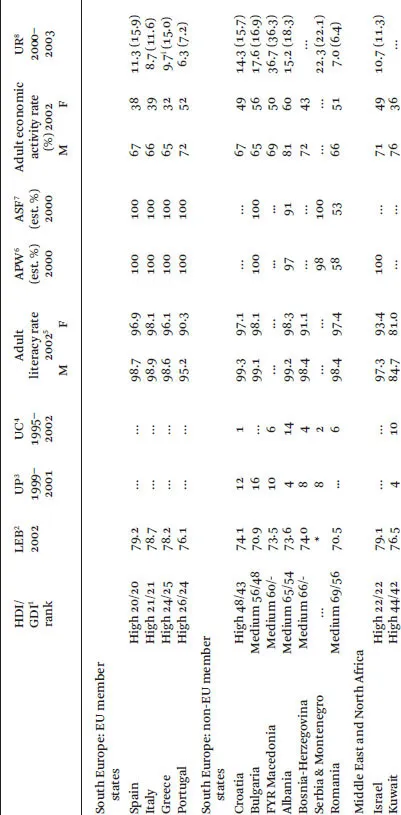
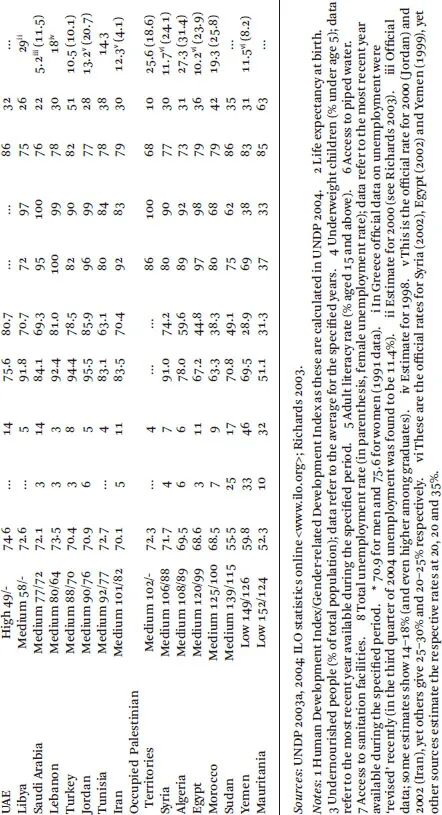
Second, geographic proximity warrants approaching the countries around the Mediterranean as a unit of analysis, while also acknowledging that the area encompasses a great deal of diversity within its borders. Located at the crossroads of three continents, the area comprises societies and cultures that differ considerably, but which were also influenced by cross-cultural exchanges at various stages of the region’s historical development. Depending on the criteria used, different sub-groupings (or zones/regions) can be defined. On the basis of the level of socio-economic development, measured by economic growth performance indicators and the Human Development Index (see Tables 1.1 and 1.2), the southern EU member countries (including Cyprus) constitute the more developed zone of the area. This group of countries is distinguished from the Balkan transition economies as well as the MENA region, which include countries of a medium to low level of socio-economic development. There is a considerable degree of variation within both of these regions, however. Among the ex-communist Balkan countries, Croatia is ranked much higher than the rest in terms of economic performance and other relevant indicators.9 In the Middle East, Israel and the small oil-rich countries of the Gulf (Kuwait, Bahrain, Qatar and the United Arab Emirates) are ranked among the high human development countries. On the other hand, the majority of the MENA countries cluster around medium and low-medium income, economic and human development indicator rates, and a few of them (such as Sudan, Yemen and Mauritania) are characterized by very low levels of socio-economic development.
Third, a number of other criteria produce cross-cutting classifications that are highly illuminating in terms of similarities and differences in social structures and patterns of inequality. These criteria refer to common historical traits and trajectories (even between countries that belong to different zones of socio-economic development), and are due to population movements, cross-cultural influences and historical links – for instance, through occupation (four centuries of Ottoman rule in the Balkans and most of the MENA region) and colonial domination. An expanding debate on the historical trajectories of economic and political systems, and cultural patterns, in what we would call the ‘eastern side’ of the Mediterranean area (i.e. the Balkan and MENA regions) is quite revealing in terms of the specificities of development across a north-west/south-east axis in the area.10
Starting from southern Europe, a crucial distinction can be made along the north-west/south-east axis within this region, which extends farther to the east and the south of the Mediterranean area. As shown elsewhere (Petmesidou and Tsoulouvis 1994; Petmesidou 1996; see also Chapter 2 in this volume), significant differences in the structure of the economy, the state/civil society relationship and, specifically, in the strength of civil society vis-à-vis state authority and interventionism, as well as in terms of cultural characteristics, arise in this geographic cluster. From the north-west of southern Europe towards the Balkan area and the MENA region, agrarian structures and extensive self-employment (in the form of petty trade) have been maintained and reproduced on a large scale, together with an extensive informal economy,11 while authoritarian structures (and political instability, to one degree or another) have been prevalent.
TABLE 1.1 Economic growth performance, human development and integration in the global economy
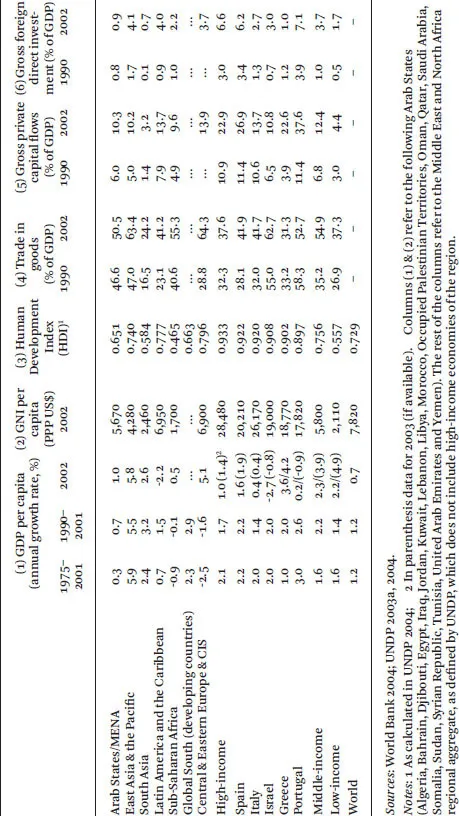
TABLE 1.2 Social indicators for three distinct groups of countries
These characteristics distinguish the so-called Latin Rim countries, Italy, Spain and Portugal (and particularly their more developed northern regions, for example, the Basque country, Navarre and Catalonia in Spain, Norte in Portugal, Piedmont, Lombardy, Tuscany and Lazio in Italy), from the less developed regions of southern Europe (for example, southern Spain and southern Italy), and particularly from south-eastern Europe (i.e. the Balkan countries, including Turkey). Towards the south-east, significant sociocultural characteristics such as statism and paternalistic forms of social organization, closely linked with values upholding familism and nepotism, become prevalent. They are linked with eastern statist traditions extending far back in the history of Ottoman and Russian autocracy. These sociocultural characteristics are even more pronounced in the MENA countries.
For instance, in the Arab countries statist ideology and patrimonial tendencies have been prevalent throughout the twentieth century. Historical accounts explain the strong enmeshment of state and civil society with respect to the emergence of Arab states (in the first half of the last century), and particularly with respect to the top-down citizenship that characterized state-building in the region after the demise of empires.12 These conditions created and maintained a strong fluidity of boundaries between the governmental, non-gove...
Table of contents
- Cover
- About this book
- Crop International Studies in Poverty Research published by Zed Books in association with Crop
- About Crop
- Title
- Copyright
- Contents
- Tables and figures
- Acknowledgements
- 1 Introduction: comparing poverty phenomena in the Mediterranean area
- one | The southern EU member states, the Balkan transition countries and Turkey
- two | The Middle East and North Africa
- About the contributors
- Index
Trusted by 375,005 students
Access to over 1.5 million titles for a fair monthly price.
Study more efficiently using our study tools.
Frequently asked questions
Yes, you can cancel anytime from the Subscription tab in your account settings on the Perlego website. Your subscription will stay active until the end of your current billing period. Learn how to cancel your subscription
No, books cannot be downloaded as external files, such as PDFs, for use outside of Perlego. However, you can download books within the Perlego app for offline reading on mobile or tablet. Learn how to download books offline
Perlego offers two plans: Essential and Complete
- Essential is ideal for learners and professionals who enjoy exploring a wide range of subjects. Access the Essential Library with 800,000+ trusted titles and best-sellers across business, personal growth, and the humanities. Includes unlimited reading time and Standard Read Aloud voice.
- Complete: Perfect for advanced learners and researchers needing full, unrestricted access. Unlock 1.5M+ books across hundreds of subjects, including academic and specialized titles. The Complete Plan also includes advanced features like Premium Read Aloud and Research Assistant.
We are an online textbook subscription service, where you can get access to an entire online library for less than the price of a single book per month. With over 1.5 million books across 990+ topics, we’ve got you covered! Learn about our mission
Look out for the read-aloud symbol on your next book to see if you can listen to it. The read-aloud tool reads text aloud for you, highlighting the text as it is being read. You can pause it, speed it up and slow it down. Learn more about Read Aloud
Yes! You can use the Perlego app on both iOS and Android devices to read anytime, anywhere — even offline. Perfect for commutes or when you’re on the go.
Please note we cannot support devices running on iOS 13 and Android 7 or earlier. Learn more about using the app
Please note we cannot support devices running on iOS 13 and Android 7 or earlier. Learn more about using the app
Yes, you can access Poverty and Social Deprivation in the Mediterranean by Maria Petmesidou, Christos Papatheodoru, Maria Petmesidou,Christos Papatheodoru in PDF and/or ePUB format, as well as other popular books in Economics & Development Economics. We have over 1.5 million books available in our catalogue for you to explore.