Somalia is a failed state, representing a threat to itself, its neighbours and the wider world. In recent years, it has become notorious for the piracy off its coast and the rise of Islamic extremism, opening it up as a new 'southern front' in the war on terror. At least that is how it is inevitably portrayed by politicians and in the media.
Mary Harper presents the first comprehensive account of the chaos into which the country has descended and the United States' renewed involvement there. In doing so, Harper argues that viewing Somalia through the prism of al-Qaeda risks further destabilizing the country and the entire Horn of Africa, while also showing that though the country may be a failed state, it is far from being a failed society. In reality, alternative forms of business, justice, education and local politics have survived and even flourished.
Provocative in its analysis, Harper shows that until the international community starts to 'get it right' the consequences will be devastating, not just for Somalia, but for the world.
- English
- ePUB (mobile friendly)
- Available on iOS & Android
eBook - ePub
About this book
Information
1 | CLAN AND COUNTRY
Although it is part of the African continent, Somalia points outwards and upwards towards the Arab world (see Map 1.1). Its shape resembles the horn of a rhinoceros; it is sharp and aggressive, forming the outer part of the Horn of Africa. The country’s proximity to the Arabian Peninsula, together with its 3,000-kilometre coastline facing east towards the Indian Ocean and north to the strategic Gulf of Aden, means that for centuries Somalis have seen themselves as part of a world beyond Africa.
Somalis are an outward-looking, travelling people, despite the fact that their society is relatively closed. They have a strong seafaring tradition, and for many years provided large numbers of crew for international ocean-going vessels. Perhaps this, together with their strategically situated coastline, which is the longest in Africa, helps explain why they are so well placed to have become the world’s most active twenty-first-century pirates, who, by the late 2000s, were seizing dozens of ships and hundreds of hostages every year.
It is not only Somalia’s geography which points it away from Africa. There is of course great diversity within the continent, but the differences between Somalis and most other Africans are especially acute. This makes it difficult, even impossible, to apply to Somalia most models, theories or ‘ways of thinking’ about sub-Saharan Africa. Many Somalis do not see themselves as African; they are somehow apart, and often make cruel jokes at the expense of people they describe as ‘Africans’, ‘blacks’ or ‘those with broad noses’. One reason for this sense of otherness is that Somalis are so easily identifiable as a people or even a ‘race’;1 unlike the populations of almost every other country in sub-Saharan Africa, most Somalis have a common ethnicity, religion, language and, to a large extent, culture.
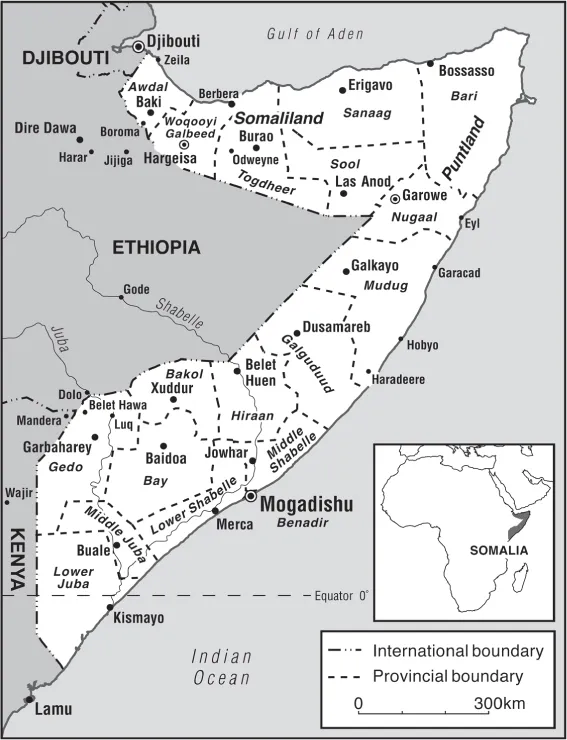
Map 1.1 Somalia
There are of course exceptions. There are minority groups in Somalia who have traditionally been marginalized by the majority population; some of them have suffered disproportionate violence during periods of conflict. The largest minority is the Bantu or Jareer, descendants of slaves and settled farmers; the word ‘jareer’ literally means ‘those with coarse hair’. They have mainly lived and worked as farmers or craftspeople in the fertile inter-riverine region of southern Somalia, but many have been displaced. They are sometimes referred to as adoon, the Somali term for ‘slave’. Other minority groups include the Benadiri mercantile communities of Arab origin living in coastal areas, religious minorities including a small group of Christians, and occupational groups such as blacksmiths, leather workers and ritual specialists. The minorities speak Somali but generally live as separate communities, and are looked down upon by other Somalis.
Resources
Somalis like to joke that, even without the numerous conflicts they have endured, they live in a hostile environment, and this is what makes them so prone to fighting and violence. Much of the country is harsh, arid scrubland, dotted with camels and other hardy animals, watched over by equally hardy nomads in their relentless search for water and pasture. Livestock has for centuries been the mainstay of the Somali economy, with trading networks stretching across the sea to the Arabian Peninsula, and by land into Kenya and other countries in the region. It is amazing to watch livestock being herded on to huge ships docked at the port of Berbera in Somaliland, great waves of sheep streaming up runways on to the vessel, camels swinging high in the air, suspended from chains with belts around their bellies as they are winched, often two at a time, up on to the deck. Most are taken to Saudi Arabia, where fortunes can be made from their sale, especially during the busy haj period. However, the livestock trade is a precarious business; Saudi Arabia periodically imposes bans on the import of Somali animals, sometimes for years. Poor rainfall and drought are also a near-constant threat.
Although significantly more money is made from the sale of cattle, sheep and goats, by far the most precious form of livestock in Somalia is the camel, which plays a central part in the local culture. A typical rural landscape includes camels wandering among thorn trees, aloe plants, cacti and anthills. Sometimes a single hobbled beast stops vehicular traffic as it stumbles awkwardly across the road; herds of baby camels wander through the scrub, separated from their mothers to stop them suckling; groups of adult beasts munch nonchalantly, watched over by a skinny nomad dressed in simple robes, his arms draped around a stick balanced horizontally across his shoulders.
We Somalis are completely inseparable from our camels. Historically we have depended on them for milk, meat, money and transport. They were our first form of long-haul transport, carrying all of our worldly belongings on their backs for days without needing a drop of water. Camels are the backbones of the rural areas. Somalis have a sort of romantic relationship with camels because they are so deeply attached to them. Even though the number of nomads is declining, our love for camels will never die. We even write poems about them. (Abdullah Farah, farmer, Somaliland)
Camels have traditionally been used in life’s most important transactions. They are used for dowry payments; blood money is often paid in camels or their equivalent in cash, as is compensation for injury. Camels represent the very essence of Somali life; people sing them special praise songs, they speak on their behalf and they impersonate them. The Somali camel has even had its own Facebook page.2.
One reason why the camel has earned such respect is its ability to endure the difficult environmental conditions in the country. As the Somalia expert John Drysdale writes:
The Somali camel, a one-humped beast, can go longer without water than any other breed of camel. In the very driest weather it need not be watered more than once every three weeks … The nomad subsists during this dry period entirely on camel’s milk. Not even the morning dew passes between his lips; that he collects to wash himself.3
The romance and importance of the Somali camel have also been described eloquently by Professor Lewis:
Milch camels provide milk for the pastoralist on which alone he often depends for his diet; burden camels, which are not normally ridden except by the sick, transport his collapsible hut or tent and all his worldly possessions from place to place. Camel-hide is used to make sandals to protect his feet on the long treks across the country. But these uses do not in themselves account for the way in which pastoralists value their camels or, despite the long-standing and wide use of money as currency, explain why it is primarily in the size and quality of his camels that a man’s substance is most tellingly measured. This striking bias in Somali culture is best expressed briefly by saying that in their social as well as economic transactions the pastoralists operate on a camel standard.4
Despite its harsh environment, hardy livestock are not Somalia’s only resource. North-eastern Somalia was in ancient times known as the ‘Land of Punt’ or the ‘Land of Fine Scents’ because on its arid terrain grow straggly trees whose sap is used to produce frankincense and myrrh. These have been traded for centuries and used as incense in religious rituals by Christians and Muslims the world over. This semi-autonomous region has in recent years reclaimed the name of Puntland, although at the time of writing it was better known for its pirates than its perfume.
In recent years, oil and natural gas reserves have been discovered off the Somali coast but conflict, piracy and the uncertain political situation have prevented their exploitation. On a visit to Somaliland in 2011, I met groups of Norwegians and Saudi Arabians who had come to discuss the possibility of becoming involved in the energy industry. However, the lack of international recognition for the territory has in the past served as a significant obstacle to the development of this sector.
Parts of Somalia are fertile, especially in the south between the country’s two main rivers, the Juba and the Shabelle. Farmers have traditionally lived here, growing maize, sorghum, millet and other crops, although agriculture has been severely disrupted by the long years of conflict. Farmers are looked down upon by Somali nomads, who consider their settled way of life as inferior to their own constant wanderings. During colonial times, large banana plantations were developed along the rivers, with most of the fruit sold for export. The banana trade continued for some time during the period of intense conflict following the ousting of President Siad Barre – indeed, the sale of ‘blood bananas’ helped fund some of the warring factions – but as the years of instability dragged on, the international banana business all but collapsed, with some plantations destroyed during battles between different armed groups. Bananas continue to be an important part of the Somali diet, often eaten as an accompaniment to the main savoury dish.
The long coastline is rich in fish and other marine resources, although nomads have traditionally scorned people who eat fish. There is an old Somali saying about a nomad who vomited every time he met somebody who lived near the sea because just the thought of somebody eating fish made him feel violently unwell. Despite their superior attitudes towards farmers and fishermen, tens of thousands of nomads were forced to take up these occupations when they were resettled by the government after a severe drought in the mid-1970s, which decimated their livestock and destroyed their way of life. They found this change of lifestyle humiliating.
The disdain for fish has led to serious problems during periods of hunger or famine because some Somalis refuse to eat it, even when nothing else is available. Foreign aid workers have spoken of their frustration about people’s refusal to eat fish or feed it to their children during the conflict in the early 1990s when most other food had run out in Mogadishu, a seaside capital, with an ocean full of fish. I remember arriving at the airport in Mogadishu during the height of the civil war; people were starving but box after box of seafood was being loaded on to planes bound for Saudi Arabia, where it was sold for high prices as a delicacy.
Although an increasing number of Somalis are eating fish, the maritime industry faces another problem. Foreign trawlers have taken advantage of the collapse of central authority to plunder Somali waters; many pirates say it is the robbing of their seas by foreigners which led them to abandon fishing and take up piracy. In his book Somalia: The New Barbary? Martin Murphy describes the extent of the problem:
After 1991 there was no force to protect these fishing grounds. Foreign boats moved in aggressively to catch tuna, shark and ray fins, lobster, shrimp and whitefish … The fishing vessels came from, or were financed by, companies located in local states such as Yemen, Egypt, Saudi Arabia, and Pakistan and from others around the world known as distant water fishing nations including Taiwan, China, Japan, South Korea and Thailand, and from the European Union, Spain in particular, whose ships often flew the flags of Belize or other ‘flag of convenience’ states in order to circumvent EU restrictions.5
Nomads
Perhaps the greatest resource Somalia has is its people. Because they live in such an unforgiving environment, they are hugely resourceful, resilient and enterprising. Somalis have little to rely on apart from themselves and their strong clan networks. Wherever they go in the world, they survive and often thrive by engaging in business. Despite the many years of conflict and other difficulties that have led so many Somalis to settle abroad, or live for years in refugee or displaced people’s camps, many of them have clung with fierce pride to elements of their traditional nomadic culture, even though it is a way of life that many of them have lost for ever.
It is difficult to put numbers on anything in Somalia, but it has been estimated that between 60 and 70 per cent of Somalis are nomads or have a nomadic affiliation.6 Unlike in many other African countries where nomadic communities are looked down upon or viewed with suspicion, the Somalis, even those living in towns and cities at home and abroad, tend to idealize this way of life, maintaining contact with and interests in the nomadic lifestyle. I have on several occasions sat with Somali friends in London, Nairobi, Hargeisa and Mogadishu, as they speak in a dreamlike way about their camels and their lucky cousins who still live as nomads. The highest admiration of all is reserved for the camel herders, who they say are the finest and fiercest of all Somalis. They have ironic but humorous contempt for what they describe as the indulgent, lazy ways of urban dwellers like themselves. Professor Lewis explains how central nomadism has remained to the Somali way of life:
It cannot be emphasised too strongly that pastoral nomadism constitutes the economic base of the vast bulk of the Somali population, and the manifestations of the nomadic lifestyle and traditions pervade almost all aspects of Somali life. In contrast to nomadic minorities in other countries, Somalia’s nomads are not cut off from the life of urban centres or culturally and socially separated from the majority of urban residents, civil servants and other government employees such as members of the armed forces. From the president downwards, at all levels of government and administration, those living with a modern lifestyle in urban conditions have brothers and cousins living as nomads in the interior and regularly have shares in joint livestock herds. Civil servants commonly invest in livestock, including camels, that are herded by their nomadic kinsmen.7
It is vital to understand the survival of the nomad ‘ethos’ in Somalia because it helps explain the country’s resistance to a centralized system of government. As Lewis explains, ‘...
Table of contents
- Cover
- About the Author
- Title
- Copyright
- Contents
- Illustrations
- Acknowledgements
- Author’s note
- Chronology
- Glossary
- Introduction
- 1 Clan and Country
- 2 History
- 3 Islamism
- 4 A Failed State?
- 5 Piracy
- 6 Somalia and the Outside World
- Conclusion
- Notes
- Bibliography
- Index
- About Zed Books
Trusted by 375,005 students
Access to over 1.5 million titles for a fair monthly price.
Study more efficiently using our study tools.
Frequently asked questions
Yes, you can cancel anytime from the Subscription tab in your account settings on the Perlego website. Your subscription will stay active until the end of your current billing period. Learn how to cancel your subscription
No, books cannot be downloaded as external files, such as PDFs, for use outside of Perlego. However, you can download books within the Perlego app for offline reading on mobile or tablet. Learn how to download books offline
Perlego offers two plans: Essential and Complete
- Essential is ideal for learners and professionals who enjoy exploring a wide range of subjects. Access the Essential Library with 800,000+ trusted titles and best-sellers across business, personal growth, and the humanities. Includes unlimited reading time and Standard Read Aloud voice.
- Complete: Perfect for advanced learners and researchers needing full, unrestricted access. Unlock 1.5M+ books across hundreds of subjects, including academic and specialized titles. The Complete Plan also includes advanced features like Premium Read Aloud and Research Assistant.
We are an online textbook subscription service, where you can get access to an entire online library for less than the price of a single book per month. With over 1.5 million books across 990+ topics, we’ve got you covered! Learn about our mission
Look out for the read-aloud symbol on your next book to see if you can listen to it. The read-aloud tool reads text aloud for you, highlighting the text as it is being read. You can pause it, speed it up and slow it down. Learn more about Read Aloud
Yes! You can use the Perlego app on both iOS and Android devices to read anytime, anywhere — even offline. Perfect for commutes or when you’re on the go.
Please note we cannot support devices running on iOS 13 and Android 7 or earlier. Learn more about using the app
Please note we cannot support devices running on iOS 13 and Android 7 or earlier. Learn more about using the app
Yes, you can access Getting Somalia Wrong? by Mary Harper in PDF and/or ePUB format, as well as other popular books in Politica e relazioni internazionali & Relazioni internazionali. We have over 1.5 million books available in our catalogue for you to explore.