Ever since the uprisings that swept the Arab world, the role of Arab women in political transformations received unprecedented media attention. The copious commentary, however, has yet to result in any serious study of the gender dynamics of political upheaval.
Rethinking Gender in Revolutions and Resistance is the first book to analyse the interplay between moments of sociopolitical transformation, emerging subjectivities and the different modes of women's agency in forging new gender norms in the Arab world. Written by scholars and activists from the countries affected, including Palestine, Egypt, Tunisia and Libya, this is an important addition to Middle Eastern gender studies.
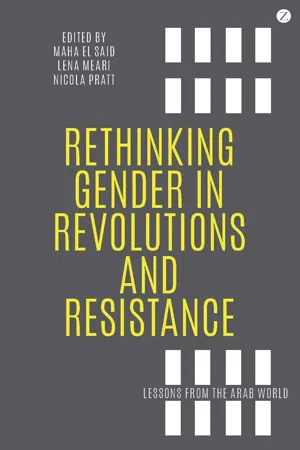
eBook - ePub
Rethinking Gender in Revolutions and Resistance
Lessons from the Arab World
- English
- ePUB (mobile friendly)
- Available on iOS & Android
eBook - ePub
Rethinking Gender in Revolutions and Resistance
Lessons from the Arab World
About this book
Information
PART I
The Malleability of Gender and Sexuality in Revolutions and Resistance
ONE
Reconstructing Gender in Post-Revolution Egypt
Shereen Abouelnaga
Introduction
The prefix ‘post’ might suggest that the revolution is over, in the sense of either having been crushed or having fulfilled its aims. I use ‘post’ in neither sense because I fully adopt the slogan ‘the revolution continues’. The prefix means what happened after the famous ‘Eighteen Days’. Egyptians also generally use the word ‘revolution’ to refer to the same period (25 January–11 February 2011). The title of this chapter is highly misleading in another sense. It suggests that ‘reconstructing gender’ has been a corollary of the revolution. Perhaps the revolution has been one of the epistemic incentives but not the only one. It seems that the huge numbers of women who took to the streets during those Eighteen Days in 2011 led the media, analysts, writers and observers to conclude that such a conspicuous presence meant that gender was being revolutionized. It is impossible not to notice the plethora of studies, articles and conferences that took the Egyptian and Tunisian Revolutions to be markers of the liberation of women.1 Surely, this is an oversimplification that does not take into consideration the mish-mash of socio-cultural complexities along with power relations. To conflate the public sphere with the streets and to assume that women were previously physically incarcerated is quite a mistaken hypothesis that keeps generating more simplistic views about the dynamics and polemics of the context. It was a revolution against the corruption and barbarity of a regime – with a special focus on the physical torture that had become systematically perpetrated by the security services – in which almost every citizen was willing to play a role regardless of gender, religion or class. Gender roles and women’s rights were not listed on the agenda of protesters, in spite of a few feeble unheard voices;2 and, in retrospect, that was the mistake.
This chapter argues that the initial formulation, or rather unfolding, of new constructs of gender appeared as a result of the incessant violations of women’s rights, where the body stood as the main protagonist. That is to say, gender became a priority when the utopia of the Eighteen Days turned into a dystopia.
Back to the 1990s
In order to understand and explore the malleability of gender in the current period, it is necessary to go back to the 1990s. This decade derives its importance from the plethora of activities related to women’s rights. For example, in 1994 the UN held the International Conference on Population and Development in Cairo. The conference received considerable media attention due to disputes over the question of reproductive rights. Muslim and Christian authorities were equally staunch critics. That was followed by the 1995 Beijing Conference, which was a catalyst for the formation of several task forces in Egypt to promote women’s rights. At the same time, there was a remarkable surge in activism with the establishment of many NGOs that were actively engaged in defending women’s rights. Put differently, it is essential to understand, or rather to remember, how the Mubarak regime perceived gender and how it kept it as a decorative not a functional tool. Literally speaking, all international conventions were signed and even ratified only to pose a stance of modernity (Mernissi 2002).3 Whilst the state sought to keep a certain ‘image’ intact regarding women’s rights, it feared that women’s rights and other civil society organizations could mobilize against the regime and, hence, attempted to suppress their efforts. This authoritarian attitude gained even more power and momentum as the state presented its own version of ‘women’s rights’ as covered by and consistent with the teachings of Islam. This attitude continued until 2011 without the slightest change. What changed indeed was the vision of the ruled.
Not surprisingly, violations of women and their rights have been just a continuation of the techniques of the ex-regime, where the female body, the most sensitive issue in Islam, was the major player in identity politics. Prior to the 2011 Revolution, state feminism monopolized the official enunciation of the demands of women through a form of co-option that failed to engage with the plurality of women’s voices. In an interview, Hoda Elsadda, Egyptian feminist activist and academic, explains that:
Under Mubarak’s rule, and as he sought to present himself as the sole guardian of the commitment of Egypt to modern values in the battle against the rising power of Islamists in the Arab region, the role of the ex-First Lady as the foremost champion of women’s rights was fore-grounded and celebrated. What actually happened was that the work and struggles of women’s rights activists was appropriated and manipulated by state representatives. (Elsadda 2013a)
The distorted relation between women and the ‘governmental’ discourse meant that women had to find alternatives to a suffocating agenda. The challenge was to avoid any confrontation with the state discourse that turned out to be catering to an international image. As for women activists, they had to abide by the law of non-governmental organizations. According to Law 32 issued in 1964 and the modifications to it that took place in 1999 and 2002, no organization was allowed to engage with politics. NGOs were forced either to do charity work or to replace the state in providing the most fundamental basic services, including the issuing of voter IDs for women as a priority, for example. When the issue of violence against women was raised by the New Woman Research Centre in 1995, the regime’s denial of its existence was really shameful. Meanwhile, the masses of women had to manoeuvre the economic and cultural difficulties of daily life without clashing with the government.
Propagated heavily was the image of women as markers of the cultural identity of the nation. The state-run media, politicians, political parties and even intellectuals adopted this discourse that is reminiscent of, for example, Ahmed Fuad Nijm’s famous poem ‘Masr yamma ya Baheya’.4 That is to say, the cultural – Egypt as a woman – intertwined with the political to facilitate the elimination of individuality and diversity and to prioritize nationalism in its more orthodox form. The ex-regime’s nationalism did not highlight national independence in front of foreign economic and political powers. It was a discursive form of nationalism that relied upon, among other things, women’s bodies. Moreover, these discursive practices justified, or even legitimized, coercing women into accepting a uniform political path and a monolithic practice and conduct, where all socio-political and cultural differences were dismissed. Political suppression along with a monolithic discourse about women and their rights augmented frustration and pessimism and left no room for negotiation. Therefore, women had to find their own way in the politics of daily life: transportation, work, writing, clothing, self-image, self-esteem, self-defence, getting married and struggling.
One cannot deny that sexual abuse and domestic violence were among the concerns of a rising feminist agenda; yet, the image created by the state, which celebrated Egypt as the ‘safest place’, obstructed any efforts to mobilize around such critical issues and almost prohibited women from revealing such atrocities. The state ignored such violations for the sake of a touristic image. The furore provoked by a CNN film that showed the circumcision of a young Egyptian girl cannot be forgotten.5 In addition to being labelled a national scandal, the reactions to the film proved that women were ‘subsumed symbolically into the national body politic as its boundary and metaphoric limit’ (McClintock 1997: 90).
It was in the same decade when the idea of women’s honor was translated as the synonym of the nation’s honor. To pillar a whole nation on a gendered subject was another translation of the assumption that women are the markers of cultural identity. The crisis of the material gendered body fully erupted in 1993 when a young girl- known as Ataba6 girl- was sexually harassed on a public bus. The public opinion was shocked; yet, that did not protect the girl from taking all the blame.7 And ever since that time, indictment has been the regular reaction to any sexual molesting. Concomitantly, domestic violence became an issue that the state either denied or accepted ambivalently, on the basis that it is an ‘individual and aberrant’ case. In other words, the national body politic depended upon controlling and disciplining women’s bodies, especially in the private sphere where all violations are not only considered to be private, but also legitimate according to a specific interpretation of Islam and a strong tendency of patriarchal patronization.
In many instances, women suffered from collective sexual harassment. However, it was never employed as a means of political discipline and punishment of those taking to the streets until 2005. In May of that year, and during a protest organized by the Kefaya movement for political reform, journalist Nawal Ali was sexually assaulted on the stairs of the Journalists’ Syndicate. This incident demonstrated the audacity and brutality of the regime and Ali courageously recounted the details of her scandalous assault by pro-Mubarak thugs. Meanwhile, the media conducted an unprecedented and fierce smear campaign against her. In spite of the solidarity with Ali, the fierce public vilification earned her a divorce and the complaint she filed disappeared from the court archives. That incident, so fierce and ugly, declared the female body to be a site of contest. Apparently, the incident resided in the collective unconscious and in May 2013 the memory of Ali was commemorated in several papers and on many social media sites. The commemoration signifies a shift in the way women’s bodies have come to be perceived, as a result of the rising challenge to the previously undisputed orthodox constructions of gender. However, shamefully, those who condemned Ali earlier were amongst those who hailed her as a champion now that they had realized that they had become targets of sexual violence.
From the above discussion, it is clear that the dominant paradigm governing women’s agency and subjectivity before 2011 was generated by a set of modern patriarchal values, set implicitly by society and consolidated crudely by the state, that reduced female identity to the corporeal body by which abuse, mutilation, isolation and harassment were justified culturally. That is to say, since women’s bodies stand for national honour, then these bodies must be ‘protected’ through discipline and punishment.
The 1990s witnessed another controversy over the term ‘writing the body’, which popped up in the literary and critical arena as a result of women’s writings.8 The writings of this generation focused on female subjectivity through narrating the personal and the particular, rather than the national and societal. They were concerned with the position of the self in the world. Yet, the literary milieu was not willing to integrate women’s writings that introduced different epistemological approaches into the canon. Women writers who came of age in the era of the 1990s were, therefore, sidelined at best and attacked on the ground that they dropped the ‘national cause’ for the sake of trivial bourgeois details, that is, the body. The dismissal of these writings from the literary and critical discourse sprang from the refusal to deal with the misnomer ‘writing the body’, which is not to be taken as an echo of the French school of l’écriture féminine. That term meant simply that those women writers talked about the violations and aspirations of their bodies. It was then that visual and textual practices – theatre, painting, films and writing – managed to carve discursive spaces in which women were represented and addressed as subjects, possessed of both specificity and a history. These creative forms provided a safe exit from the strait jacket of the pseudo-feminist discourse advanced by the state, a discourse that was bent on marginalizing any different claims and demands.9 The absence of any outright confrontation with that institutional discourse meant that Egyptian women chose to reject the act of enunciation in favour of ‘silence as a will not to say or a will to unsay and as a language of its own’ (Minh-ha 1997: 416). It is very likely that such tactical silence was translated by all observers and analysts as exclusion from the public sphere. The silence that was translated as passivity was in fact a cruel form of indifference, hence retaliation, where women divorced the regime from their daily life and resorted to their own strategies to cope without the least attempt at confrontation.
Space of Appearance Lost
The long-deferred public confrontation between women and a solid patriarchal paradigm – with all the reservations on the word ‘patriarchy’10 – was triggered by the post-revolution socio-cultural clash, where women’s bodies turned into a battlefield. The sense of struggle and the weight of oppression formed a point of departure from which women decided to restore the utopian experience of Tahrir Square, which had come to stand for the ‘space of appearance’ as defined by Hannah Arendt. This space is a creation of action and, thus, is highly fragile. It ‘comes into being wherever men [and women] are together in the manner of speech and action, and therefore predates and precedes all formal constitution of the public realm’ (Arendt 1958: 178). Its peculiarity, as Arendt says, is
unlike the spaces which are the work of our hands, it does not survive the actuality of the movement which brought it into being, but disappears not only with the dispersal of men – as in the case of great catastrophes when the body politic of a people is destroyed – but with the disappearance or arrest of the activities themselves. Wherever people gather together, it is potentially there, but only potentially, not necessarily and not forever. (1958: 199)
Naturally, with the arrest of socio-political activities that were smoothly practised in Tahrir Square by men and women on an equal footing, Egyptian women protesters in particular not only wanted to secure this space of appearance but were also working on recreating it in the liminal spaces of the personal and political. As I see it, the departure of the people from Tahrir Square on 11 February – myself included – signified a political naivety that aborted all the discursive practices of the utopian Eighteen Days. That a ‘New Egypt’ was waiting to embrace the ‘New Woman’ that emerged from the Square turned out to be a mirage. The dispersal of the masses led to the arrest of activities and the aspiration to revolutionize socio-cultural practices was challenged by the lack of power, which is not the same as strength, force and violence (Arendt 1972: 143–55). Women did not have to wait long for the big disappointment: they were not welcomed in the streets as protesters anymore. On the one hand, the power needed to actualize women’s agency was absent and, in the best-case scenario, fragile. The neo-conservative voices were much louder and fiercely determined to keep women’s agency mediated through the male designation. On the other hand, we are reminded by Foucault that resistance is never in a position of exteriority to power relations;11 that is, we have to examine the networks of practices, institutions and technologies that sustain positions of dominance and subordination. In other words, we should be concerned not only with how the body is perceived and given meaning, but with the manner in which what is most material in it is invested and solidified. At the crossroads of culture and politics, women lost the ‘space of appearance’, and the body...
Table of contents
- Cover Page
- Praise
- About the Editors
- Title
- Copyright
- Contents
- Acknowledgments
- Introduction: Rethinking Gender in Revolutions and Resistance in the Arab World
- PART I: The Malleability of Gender and Sexuality in Revolutions and Resistance
- PART II: The Body and Resistance
- PART III: Gender and the Construction of the Secular/Islamic Binary
- Conclusion: Towards New Epistemologies and Ontologies of Gender and Socio-Political Transformation in the Arab World
- About the Contributors
- Notes
- References
- Index
Trusted by 375,005 students
Access to over 1.5 million titles for a fair monthly price.
Study more efficiently using our study tools.
Frequently asked questions
Yes, you can cancel anytime from the Subscription tab in your account settings on the Perlego website. Your subscription will stay active until the end of your current billing period. Learn how to cancel your subscription
No, books cannot be downloaded as external files, such as PDFs, for use outside of Perlego. However, you can download books within the Perlego app for offline reading on mobile or tablet. Learn how to download books offline
We are an online textbook subscription service, where you can get access to an entire online library for less than the price of a single book per month. With over 1.5 million books across 990+ topics, we’ve got you covered! Learn about our mission
Look out for the read-aloud symbol on your next book to see if you can listen to it. The read-aloud tool reads text aloud for you, highlighting the text as it is being read. You can pause it, speed it up and slow it down. Learn more about Read Aloud
Yes! You can use the Perlego app on both iOS and Android devices to read anytime, anywhere — even offline. Perfect for commutes or when you’re on the go.
Please note we cannot support devices running on iOS 13 and Android 7 or earlier. Learn more about using the app
Please note we cannot support devices running on iOS 13 and Android 7 or earlier. Learn more about using the app
Yes, you can access Rethinking Gender in Revolutions and Resistance by Professor Maha El Said, Lena Meari, Doctor Nicola Pratt, Professor Maha El Said,Lena Meari,Doctor Nicola Pratt in PDF and/or ePUB format, as well as other popular books in Sozialwissenschaften & Genderforschung. We have over 1.5 million books available in our catalogue for you to explore.