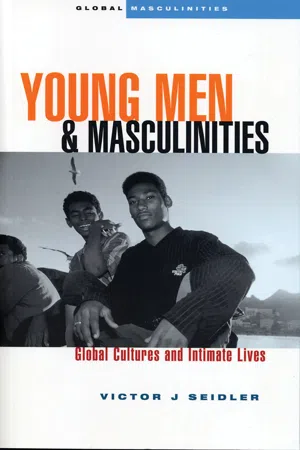
In this book Victor J Seidler, one of the leading contributors to the growing debate about masculinities, turns his attention to the lives of young men and their understandings of themselves as gendered beings. By contextualizing their experiences and subjectivities within a rapidly globalizing world, Seidler pays particular attention to the impact of the global media. How does the mass circulation of images of men's bodies, desires and sexualities affect their self-perception and behaviours, and how are these images framed within particular histories, cultures and traditions?
Questioning universalist theories of 'hegemonic masculinities', the book argues that young men often feel caught between prevailing masculinities and their own struggle for self-definition. It explores both how the idea of men as 'the First Sex' has been established within the West and the ways in which men in other cultures and societies affirm their gendered identities. Seidler pioneers new methodologies that involve listening to the silences surrounding male experience as well as to oral testimonies. This enables innovative analysis of the contradictions young men are faced with in both creating their own gendered identities and establishing more equal relationships within a world of intense inequalities.
- English
- ePUB (mobile friendly)
- Available on iOS & Android
eBook - ePub
About this book
Information
notes
preface
1. For some helpful discussions around developments within the sociology of family and intimate relations, see David Morgan, Family Connections (1996); P.M. Nardi, Gay Men’s Friendships (1999); C. Ramazanoglu, Feminism and the Contradictions of Oppression (1989); b. hooks, Salvation: Black People and Love (2001). See in particular Judith Stacey, Brave New Families: Stories of Domestic Upheaval in Late Twentieth Century America (1990), and her In the Name of the Family: Rethinking Family Values in the Postmodern Age (1996). See also Arlie Hochschild and Anne Machung, The Second Shift: Working Parents and the Revolution at Home (1989); Lillian Rubin, Families on the Faultline: America’s Working Class Speaks about the Family, the Economy, Race and Ethnicity (1994); Neil Miller, Out in the World: Gay and Lesbian Life from Buenos Aires to Bangkok (1992); Suzanne Sherman (ed.), Lesbian and Gay Marriage: Private Commitments, Public Ceremonies (1992); Michael Warner (ed.), Fear of a Queer Planet: Queer Politics and Social Theory (1993).
2. For some helpful reflections upon the experience of young Asian girls in Britain, see Amrit Wilson, Finding a Voice (1976); N. Puwar and P. Raghuram (eds), South Asian Women in the Diaspora (2003).
3. By recalling our own teenage years and their intensity of emotions we may relate honestly to young men in the present. I have shared some of the complexities of growing up in a refugee family in London in Victor J. Seidler, Shadows of the Shoah: Jewish Identity and Belonging (2001).
4. For some illuminating discussions that recall the excitements and new thinking in relation to sexual politics in the 1970s, see Sheila Rowbotham, Woman’s Consciousness, Man’s World (1972), and Dreams and Dilemmas (1983); Jeffrey Weeks, Coming Out: Homosexual Politics in Britain (1977), and Sex, Politics and Society (1989); and Victor J. Seidler, Rediscovering Masculinity: Reason, Language and Sexuality (1987).
5. For a sense of the development of Bob Connell’s important work, see R.W. Connell, Gender and Power: Society, the Person and Sexual Politics (1987), and the new edition of Masculinities (2005). We have been involved in an ongoing creative dialogue over many years. For a more sustained engagement with Connell’s work, see Victor J. Seidler, Transforming Masculinities: Men, Cultures, Bodies, Power, Sex and Love (2005; originally published in 1995).
one
1. For a useful account of different generations of men and masculinities in Britain that goes back to the 1950s, see Lynne Segal, Slow Motion: Changing Masculinities, Changing Men (1990). For the ways these backgrounds influenced the emergence of discussions of men and masculinities in the 1970s in Britain, see my Rediscovering Masculinity.
2. For helpful discussions about ways masculinities are shaped within schooling, see M. Mac an Ghail, The Making of Men: Masculinities, Sexualities and Schooling (1994); A. Nayak and M. Kehily, ‘Playing it Straight: Masculinities, Homophobias and Schooling’, Journal of Gender Studies 5(2), pp. 211–30. There is also useful research on the ways boys learn their masculinities in school in Britain in S. Frosh, A. Phoenix and R. Pattman, Young Masculinities: Understanding Boys in Contemporary Society (2002).
3. The distinction that Connell makes between the ‘therapeutic’ and the ‘political’ serves to discount the ways that men’s sexual politics in the 1980s sought to explore the connection between the personal and the political. Rather than learning from these diverse experiences, Connell tends to discount them as ‘therapeutic’, and so develops a vision of hegemonic masculinities that embodies a structural universalism in its vision of politics that is unable to make connection with the contradictions of men’s lived experience. This is a theme that first appears in Connell, Gender and Power, and is continued in his influential Masculinities.
4. The crisis of authority in late capitalism and the ways this impacts upon fathering relations is explored in ‘Fathering, Authority and Masculinity’ in R. Chapman and J. Rutherford (eds), Male Order: Unwrapping Masculinity (1988).
5. Some interesting interviews with men around issues of negotiation in relation to contraception and sexuality are presented in J. Holland, C. Ramazanoglu, S. Sharpe and R. Thompson, The Male in the Head: Young People, Heterosexuality and Power (1998). This followed an earlier monograph, Wimp Or Gladiator: Contradictions in Aquiring Male Sexuality (1993).
6. Issues in relation to diverse male sexualities were initially explored in Victor J. Seidler (ed.), Men, Sex and Relationships (1992). See also J. Wood, ‘Groping Towards Sexism: Boy’s Sex Talk’, in A. McRobbie and M. Nava (eds), Gender and Generation (1984); K. Mercer and I. Julien, ‘Race, Sexual Politics and Black Masculinity – A Dossier’, in Chapman and Rutherford (eds), Male Order. For a discussion in relation to Latin American masculinities and the continuing influence of the Catholic Church in the shaping of gender and sexual relationships, see the papers gathered in Jose Olavarria, Varones Adolescentes: Genero, identidades y sexualidades en America Latina (2003).
two
1. How Western modernities were established in largely secularised Protestant terms is a theme that is explored in Zygmunt Bauman’s Modernity and Ambivalence. The ways in which others were defined as lacking is a theme that is explored in Paul Gilroy’s Black Atlantic: Modernity and Double Consciousness (1993) and implications in relation to bodies and sexualities in Victor J. Seidler, The Moral Limits of Modernity (1991).
2. Gramsci explores the evolutionary assumptions implicit in guiding social theories in the Prison Notebooks (1971). He was interrogating Marxist traditions he had inherited, particularly the influence of Lenin and tendencies within orthodox Marxist traditions to construe Marx in positivist terms. Drawing on the influence of Croce’s readings of Hegel, Gramsci questions the universalism of scientific Marxism, which made it difficult to engage critically with traditions of Italian Catholicism, too easily dismissed within rationalist traditions as ‘backward’ and ‘irrational’. Gramsci’s Letters from Prison (1975) show the efforts he was making to engage with particular histories, cultures and religious traditions, rather than treat them as ‘lacking’ in contrast to a secular modernity.
3. For an exploration of some of the Christian notions that framed the Conquest of Central and Latin America, see Eduardo Subirats, El Continente Vacio (1996), a text to which I was introduced in discussions with Teresa Ordorika. This is also a theme that is explored in Roger Batra, The Cage of Melancholy: Identity and Metamorphosis in the Mexican Character (1992). Carlos Fuentes claims that one of the implications of Conquest in Mexico has meant that people have lived with issues of identity ever since. In Los Cinco Soles de Mexico (2000: 17) he writes: ‘Mexicans are the oldest citizens of the twenty-first century … captured between traditional identity and modern otherness, between the local village and the global village, between economic interdependence and political balkanization. Mexico has been living with this, our radical present modernity, since five hundred years ago.’
4. Simone Weil explores how Roman notions of power and greatness have helped to frame Western cultural traditions and conceptions of ‘civilization’ in The Need for Roots (1972). She was reflecting upon the importance of rethinking inherited traditions in the wake of the liberation of France from Nazi rule. She was seeking to identify alternative values within French historical traditions that could sustain a notion of the life of the nation that was not framed within Roman terms of power and greatness, which she recognised as also sustaining Europe’s imperial and colonial relationships. This theme is explored in Lawrence A. Blum and Victor J. Seidler, A Truer Liberty: Simone Weil and Marxism (1991).
5. Walter Benjamin in his seminal late essay ‘Theses on the Philosophy of History’, in Illuminations (1973), was questioning the evolutionary assumptions that so often shaped traditions of orthodox Marxism and the conceptions of history and progress that they fostered.
6. For an exploration of the place of mestizaje in Mexico it is still helpful to recall the insights of Octavio Paz: ‘The Mexican does not want to be either an Indian or a Spaniard. Nor...
Table of contents
- Cover
- About the Author
- Title
- Dedication
- Copyright
- Contents
- Preface: Young Men, Global Cultures and Intimate Lives
- One: Introduction: Young Men and Masculinities
- Two: Masculinities, Histories, Cultures and Religions
- Three: Listening, Speaking and Learning
- Four: Questioning Adam: Men, Power and Love
- Five: Rethinking Fatherhood
- Six: Masculinities, Bodies and Emotional Life
- Seven: Bodies, Desires, Pleasures and Love
- Eight: Authority, Identities, Bodies and Intimacy
- Nine: Bodies, Ethics, Fears and Desires
- Ten: Friends, Risks and Transgressions
- Eleven: Risk, Fears, Race and Belongings
- Twelve: Risk, Self-Harm, Abuse and Control
- Thirteen: Young Men, Bodies, Sexualities and Health
- Fourteen: Young Men’s Sexual and Reproductive Health
- Fifteen: Young Men, Heroes, Violence and Conflict
- Notes
- Bibliography
- Index
Trusted by 375,005 students
Access to over 1.5 million titles for a fair monthly price.
Study more efficiently using our study tools.
Frequently asked questions
Yes, you can cancel anytime from the Subscription tab in your account settings on the Perlego website. Your subscription will stay active until the end of your current billing period. Learn how to cancel your subscription
No, books cannot be downloaded as external files, such as PDFs, for use outside of Perlego. However, you can download books within the Perlego app for offline reading on mobile or tablet. Learn how to download books offline
Perlego offers two plans: Essential and Complete
- Essential is ideal for learners and professionals who enjoy exploring a wide range of subjects. Access the Essential Library with 800,000+ trusted titles and best-sellers across business, personal growth, and the humanities. Includes unlimited reading time and Standard Read Aloud voice.
- Complete: Perfect for advanced learners and researchers needing full, unrestricted access. Unlock 1.5M+ books across hundreds of subjects, including academic and specialized titles. The Complete Plan also includes advanced features like Premium Read Aloud and Research Assistant.
We are an online textbook subscription service, where you can get access to an entire online library for less than the price of a single book per month. With over 1.5 million books across 990+ topics, we’ve got you covered! Learn about our mission
Look out for the read-aloud symbol on your next book to see if you can listen to it. The read-aloud tool reads text aloud for you, highlighting the text as it is being read. You can pause it, speed it up and slow it down. Learn more about Read Aloud
Yes! You can use the Perlego app on both iOS and Android devices to read anytime, anywhere — even offline. Perfect for commutes or when you’re on the go.
Please note we cannot support devices running on iOS 13 and Android 7 or earlier. Learn more about using the app
Please note we cannot support devices running on iOS 13 and Android 7 or earlier. Learn more about using the app
Yes, you can access Young Men and Masculinities by Victor J. Seidler in PDF and/or ePUB format, as well as other popular books in Social Sciences & Gender Studies. We have over 1.5 million books available in our catalogue for you to explore.