An important academic goal is to understand ongoing contestations in knowledge in the search to engage everyday social practice and experiences, as well as the social barriers and approaches to peaceful human coexistence. This reader pulls together ideas concerning Indigenous epistemologies (e.g., worldviews, paradigms, standpoints, and philosophies) as they manifest themselves in the mental lives of persons both from and outside the orbit of the usual Euro-American culture. The book engages Indigenous knowledges as far more than a «contest of the marginals», thereby challenging the way oppositional knowledges are positioned, particularly in the Western academy. Subsequently, this book is a call to recognize and acknowledge Indigenous knowledges as legitimate knowings in their own right, and not necessarily in competition with other sources or forms of knowledge. The project offers an opportunity for the critical thinker to continue on a de-colonial/anti-colonial intellectual journey in ways informed by Indigenous theorizing.
eBook - PDF
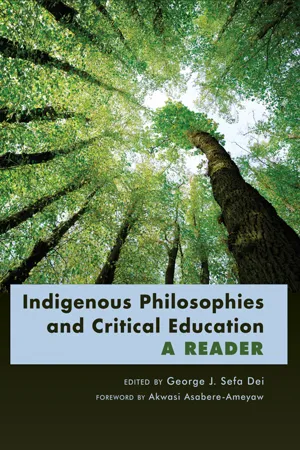
Indigenous Philosophies and Critical Education
A Reader- Foreword by Akwasi Asabere-Ameyaw
- 498 pages
- English
- PDF
- Available on iOS & Android
eBook - PDF
Indigenous Philosophies and Critical Education
A Reader- Foreword by Akwasi Asabere-Ameyaw
About this book
Information
Table of contents
- Contents
- Foreword by Akwasi Asabere-Ameyaw xi
- Acknowledgments xv
- Introduction George J. Sefa Dei 1
- SECTION I: INDIGENOUS KNOWLEDGES AS PHILOSOPHY AND THE IMPLICATIONS OF DECOLONIZATION
- Introduction to Section I 15
- 1. Revisiting the Question of the ‘Indigenous’ George J. Sefa Dei 21
- 2. (Re) Conceptualizing ‘Indigenous’ from Anti-Colonial and Black Feminist Theoretical Perspectives: Living and Imagining Indigeneity Differently Temitope Adefarakan 34
- 3. We Are All One: Holistic Thought-Forms within Indigenous SocietiesIndigeneity and Holism Farah Shroff 53
- 4. Indigenous Education and Indigenous Studies in the Australian Academy: Assimilationism, Critical Pedagogy, Dominant Culture Learners and Indigenous Knowledges Marcelle Cross-Townsend 68
- 5. African Philosophies of Education: Deconstructing the Colonial and Reconstructing the Indigenous Ali Abdi 80
- 6. Space, Time and Unified Knowledge : Following the Path of Vine Deloria, Jr. Jefferey D. Anderson 92
- SECTION II: THE QUESTION OF DIFFERENCE, IDENTITY AND REPRESENTATION AND INDIGENOUS KNOWLEDGE PRODUCTION
- Introduction to Section II 109
- 7. “I Live Somewhere Else but I’ve Never Left Here”: Indigenous Knowledge, History, and Place Michael Davis 113
- 8. Ruminations on Red Revitalization: Exploring Complexities of Identity, Difference and Nationhood in Indigenous Education Martin Cannon 127
- 9. Identity, Representation, and Knowledge Production Patience Elabor-Idemudia 142
- 10. Indigeneity in Education: A By-product of Assimilation? Dennis Mcpherson 157
- SECTION III: INDIGENOUS KNOWLEDGES AND THE QUESTION OF DEVELOPMENT: TENSIONS OF CHANGE, TRADITION AND MODERNITY
- Introduction to Section III 167
- 11. Education for Endogenous Development: Contrasting Perspectives from Amazonia and Arabia Serena Heckler & Paul Sillitoe 171
- 12. Neo-Colonial Melancholia: Alaska Native People, Education and Oil Maria Shaa Tláa Williams 189
- 13. Sacred Mountains and Ivory Towers: Indigenous Pedagogies of Place and Invasions from Modernity Michael Marker 197
- 14. Indigenous Knowledge in Transition: The Fundamental Laws of the Diné in an Era of Change and Modernity Lloyd L. Lee 212
- SECTION IV: INDIGENOUS KNOWLEDGE, EDUCATION AND SCIENCE: BEYOND THE FORMAL CURRICULUM
- Introduction to Section IV 225
- 15. Bringing the Experience of Indigenous People into Alaska Rural Systematic Initiative/ Alaska Native Knowledge Network Gregory Smith 229
- 16. Learning Life Lessons from Indigenous Storytelling with Tom Mccallum Judy Iseke & Brennus BMJK 245
- 17. Ua Lele Ka Manu; The Bird Has Flown: A Search for Hawaiian Indigenous/Local Inquiry Methods Pauline Chinn, Isabella Aiona Abbott, Michelle Kapana-Baird, Mahina Hou Ross, Lila Lelepali, Ka’umealani Walker, Sabra Kauka, Napua Barrows, Moana Lee, and Huihui Kanahele-Mossman 262
- 18. The Kenyan Herbalist Ruptures the Status Quo in Health and Healing Njoki Wane 280
- 19. ‘Glocalising’ Indigenous Knowledges for the Classroom Ocean Ripeka Mercier 299
- 20. The Challenges of Science Education and Indigenous Knowledge Lyn Carter 312
- SECTION V: FUTURE CHALLENGES: CENTERING SPIRITUALITY AND SPIRITUAL WAYS OF KNOWING AND THE DISCOURS OF INDIGENEITY IN THE ACADEMY
- Introduction to Section V 331
- 21. Endarkened Feminism and Sacred Praxis: Troubling (Auto) Ethnography through Critical Engagements with African Indigenous Knowledges Cynthia B. Dillard & Charlotte Bell 337
- 22. Re/Membering In—Between “Japan” and “The West”: A Decolonizing Journey through the Indigenous Knowledge Framework Kimine Mayuzumi 350
- 23. Revealing the Secular Fence of Knowledge: Towards Reimagining Spiritual Ways of Knowing and Being in the Academy Riyad Shahjahan & Kimberly Haverkos 367
- 24. Knowledge, Power and Decolonization: Implication for Non-Indigenous Scholars, Researchers and Educators Soenke Biermann 386
- 25. Coyote and Raven Chat about Protecting Indigenous Intellectual Property Pat O’Riley & Peter Cole 399
- 26. Indigenous Spirituality and Decolonization: Methodology for the Classroom Eric Ritskes 411
- 27. Beyond Deconstruction: Evolving the Ties between Indigenous Knowledges and Post-Foundational Anti-Racism Zahra Murad 422
- 28. Indigenous Knowledge: Multiple Approaches Priscilla Settee 434
- Contributors 451
- Index 457
Trusted by 375,005 students
Access to over 1.5 million titles for a fair monthly price.
Study more efficiently using our study tools.
Frequently asked questions
Yes, you can cancel anytime from the Subscription tab in your account settings on the Perlego website. Your subscription will stay active until the end of your current billing period. Learn how to cancel your subscription
No, books cannot be downloaded as external files, such as PDFs, for use outside of Perlego. However, you can download books within the Perlego app for offline reading on mobile or tablet. Learn how to download books offline
Perlego offers two plans: Essential and Complete
- Essential is ideal for learners and professionals who enjoy exploring a wide range of subjects. Access the Essential Library with 800,000+ trusted titles and best-sellers across business, personal growth, and the humanities. Includes unlimited reading time and Standard Read Aloud voice.
- Complete: Perfect for advanced learners and researchers needing full, unrestricted access. Unlock 1.5M+ books across hundreds of subjects, including academic and specialized titles. The Complete Plan also includes advanced features like Premium Read Aloud and Research Assistant.
We are an online textbook subscription service, where you can get access to an entire online library for less than the price of a single book per month. With over 1.5 million books across 990+ topics, we’ve got you covered! Learn about our mission
Look out for the read-aloud symbol on your next book to see if you can listen to it. The read-aloud tool reads text aloud for you, highlighting the text as it is being read. You can pause it, speed it up and slow it down. Learn more about Read Aloud
Yes! You can use the Perlego app on both iOS and Android devices to read anytime, anywhere — even offline. Perfect for commutes or when you’re on the go.
Please note we cannot support devices running on iOS 13 and Android 7 or earlier. Learn more about using the app
Please note we cannot support devices running on iOS 13 and Android 7 or earlier. Learn more about using the app
Yes, you can access Indigenous Philosophies and Critical Education by George J. Sefa Dei in PDF and/or ePUB format, as well as other popular books in Education & Education General. We have over 1.5 million books available in our catalogue for you to explore.