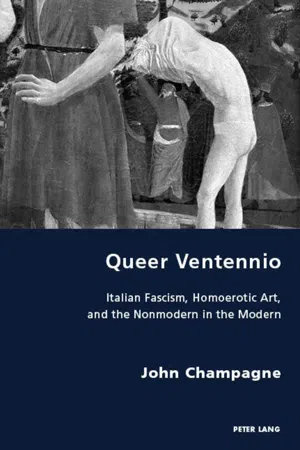
Given fascist proscriptions against homosexuality, a surprising number of artists under Mussolini's regime were queer. Exploring the contribution of Italy to our understanding of both the history of homosexuality and European modernism, this ground-breaking study analyses three queer modernists – writer Giovanni Comisso, painter and writer Filippo de Pisis, and painter Corrado Cagli. None self-identified as fascists; none, however, were consistent critics of the regime. All understood their own sexuality via the idea of the primitive – a discourse fascism also employed in its efforts to secure consent for the dictatorship. What happens when we return to these men and their work minus the assumption that our most urgent task is identifying their fascist tendencies or political quietism? Variously infantilized, pathologized, marginalized, and stigmatized, treated as both cause and effect of fascism, queer ventennio artists are an easy target, not brave or selfless or savvy enough to see their common struggle with fascism's other victims. Revisiting their works and lives with an eye toward neither rehabilitation nor condemnation allows us to ponder more carefully the relationship between art and politics, how homophobia has structured art criticism, the need to further bring queer perspectives to Italian cultural analysis, and how such men disrupt our sense of modern homo/heterosexual definition.
eBook - PDF
Queer Ventennio
Italian Fascism, Homoerotic Art, and the Nonmodern in the Modern
- 322 pages
- English
- PDF
- Available on iOS & Android
eBook - PDF
About this book
Information
Table of contents
- Cover
- Contents
- List of Figures
- Acknowledgments
- Introduction: Queer Ventennio
- Chapter 1: Queer Unhistoricism
- Chapter 2: Giovanni Comisso
- Chapter 3: Filippo de Pisis
- Chapter 4: Corrado Cagli
- “Quasi una conclusione”: On Saba’s Ernesto
- Bibliography
- Index
Trusted by 375,005 students
Access to over 1.5 million titles for a fair monthly price.
Study more efficiently using our study tools.
Frequently asked questions
Yes, you can cancel anytime from the Subscription tab in your account settings on the Perlego website. Your subscription will stay active until the end of your current billing period. Learn how to cancel your subscription
No, books cannot be downloaded as external files, such as PDFs, for use outside of Perlego. However, you can download books within the Perlego app for offline reading on mobile or tablet. Learn how to download books offline
Perlego offers two plans: Essential and Complete
- Essential is ideal for learners and professionals who enjoy exploring a wide range of subjects. Access the Essential Library with 800,000+ trusted titles and best-sellers across business, personal growth, and the humanities. Includes unlimited reading time and Standard Read Aloud voice.
- Complete: Perfect for advanced learners and researchers needing full, unrestricted access. Unlock 1.5M+ books across hundreds of subjects, including academic and specialized titles. The Complete Plan also includes advanced features like Premium Read Aloud and Research Assistant.
We are an online textbook subscription service, where you can get access to an entire online library for less than the price of a single book per month. With over 1.5 million books across 990+ topics, we’ve got you covered! Learn about our mission
Look out for the read-aloud symbol on your next book to see if you can listen to it. The read-aloud tool reads text aloud for you, highlighting the text as it is being read. You can pause it, speed it up and slow it down. Learn more about Read Aloud
Yes! You can use the Perlego app on both iOS and Android devices to read anytime, anywhere — even offline. Perfect for commutes or when you’re on the go.
Please note we cannot support devices running on iOS 13 and Android 7 or earlier. Learn more about using the app
Please note we cannot support devices running on iOS 13 and Android 7 or earlier. Learn more about using the app
Yes, you can access Queer Ventennio by John Champagne in PDF and/or ePUB format, as well as other popular books in Kunst & Kunsttechniken. We have over 1.5 million books available in our catalogue for you to explore.