This book applies practical clinical concepts to the latest four-stage model of heart failure from preclinical risk and early asymptomatic disease to classic symptomatic heart failure and finally advanced heart failure. This framework emphasizes a tailored approach to ongoing heart failure assessment to guide therapy and improve outcomes.Features: • Illustrated with over 250 full-color figures• Specific recommendations backed by clinical trial data• Practical algorithms for diagnosis and therapyTopics include: • Prevention of heart failure• Identification and treatment of structural heart disease prior to heart failure• How to combine lifestyle changes, medications, and devices to improve outcomes• Reversing decompensated heart failure• Key indicators of advanced heart failure and appropriate treatment options• Emerging new therapies
- 336 pages
- English
- ePUB (mobile friendly)
- Available on iOS & Android
eBook - ePub
The 4 Stages of Heart Failure
About this book
Information
Topic
MedicinaSubtopic
CardiologiaCHAPTER 1
Heart Failure Diagnosis and Epidemiology
“The prime candidates for the development of heart failure are patients with hypertension in whom death from stroke has been prevented by antihypertensive therapy and survivors of acute myocardial infarction who have been spared death from arrhythmia.”
—Eugene Braunwald, Shattuck Lecture 19971
Heart Failure Recognition
The diagnosis of heart failure may emerge from history, physical examination, or laboratory data.
CLINICAL CRITERIA OF HEART FAILURE
The Framingham study defined useful clinical criteria to identify patients with heart failure (Table 1.1). Patients not fulfilling the Framingham criteria can still have heart failure, albeit less severe disease, if they have symptoms of dyspnea or fatigue associated with structural or functional left ventricular abnormalities.2 Specifically, heart failure may be present when an individual has physical limitations at rest or with activity due to inadequate cardiac output or increased left or right ventricular filling pressures. Blood levels of biomarkers, such as B-type natriuretic peptide (BNP), supplement clinical findings to characterize the presence and severity of heart failure.
TABLE 1.1 Framingham diagnostic criteria for heart failure. The diagnosis of heart failure, in the Framingham heart failure study, required two major or one major and two concurrent minor criteria. Minor criteria cannot be attributed to another medical condition.4 Source: Adapted from the New England Journal of Medicine, with permission.
MAJOR CRITERIA | MINOR CRITERIA |
Acute pulmonary edema | Dyspnea on exertion |
Paroxysmal nocturnal dyspnea or orthopnea | Night cough |
Neck-vein distention | Tachycardia (> 120 beats/min) |
Rales | Pleural effusion |
S3 gallop | Hepatomegaly |
Abdominojugular reflux | Ankle edema |
Cardiomegaly on chest x-ray | Vital capacity decrease (1/3 from max) |
Increased venous pressure (> 16 cm H2O) | Weight loss* |
Weight loss* |
*Weight loss > 4.5 kg 5 days into treatment can be classified as a major or minor criterion
HEART FAILURE CLASSIFICATION
In 1928, the New York Heart Association (NYHA) functional classification was proposed to classify the severity of heart failure based on symptoms.3 In this system, severity ranges from no limitation of functional activity (Class I), slight limitation of functional activity (Class II), marked limitation of functional activity (Class III), to the presence of symptoms at rest (Class IV). Although useful, to characterize a patient’s functional impairment at any point in time and provide an index that correlates with prognosis, the system is limited by the potential for a patient’s class to either worsen or improve rapidly in response to acute exacerbations or treatments (Figure 1.1).
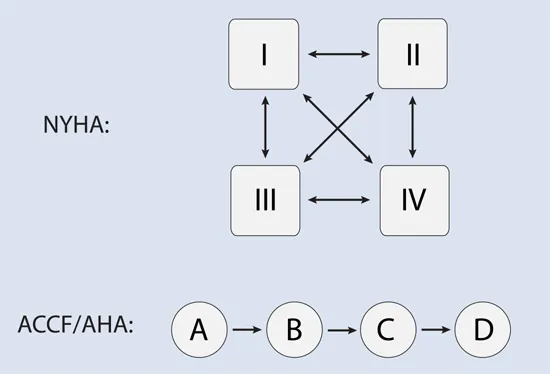
FIGURE 1.1 The ACCF/AHA stages of heart failure compared to the NYHA classification. Whereas NYHA functional class can wax and wane, the ACCF/AHA Stages (A–D) can only advance, usually with greater underlying structural and functional cardiac impairment.
Partly to address this potential for fluctuation in NYHA patient classification, in 2001 the American College of Cardiology Foundation and the American Heart Association published a four-component staging of heart failure in which progression occurs in only one direction encompassing risk factors (Stage A) to end-stage heart disease (Stage D).5 This classification was most recently updated in 2013.6 The previous New York Heart Association functional class, based solely on symptoms, can still describe the current functional status of a patient in Stages B through D. Especially in Stage C, however, any of the three symptomatic NYHA classifications (Class II, III, or IV) may repeatedly arise, resolve, and recur (Figure 1.2).
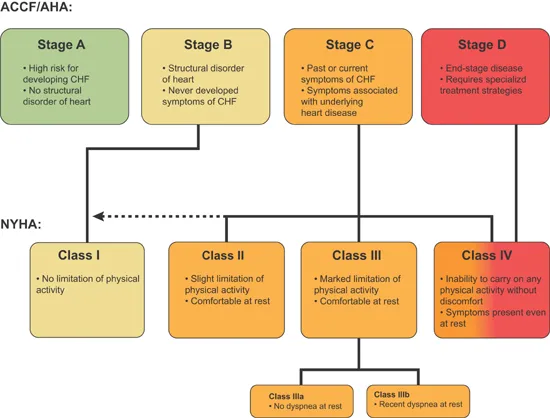
FIGURE 1.2 The ACCF/AHA stages of heart failure compared to the NYHA classification. With treatment, a heart failure patient can become asymptomatic, but will remain Stage C.
Stage B is defined as development of structural heart disease in patients who never manifest symptoms or signs of heart failure.5 Most patients with a diagnosis of heart failure with either past or current symptoms are considered Stage C. Approximately 1% of patients with heart failure have progressed to an advanced Stage D.2
Epidemiology
Heart failure is increasing, particularly as a disease of aging. T...
Table of contents
- Cover Page
- Title Page
- Copyright Page
- Table of Contents
- In Gratitude
- About the Author
- Foreword
- Preface
- Abbreviations
- Introduction
- Chapter 1 HEART FAILURE DIAGNOSIS AND EPIDEMIOLOGY
- Chapter 2 HEART FAILURE PRESENTATIONS AND FUNCTIONAL TYPES
- Chapter 3 STAGE A: PATIENTS AT RISK FOR DEVELOPING STRUCTURAL HEART DISEASE
- Chapter 4 STRUCTURAL HEART DISEASE AND PROGRESSION TO FAILURE: STAGES B, C, AND D
- Chapter 5 STAGE B: ASYMPTOMATIC STRUCTURAL HEART DISEASE
- Chapter 6 ASSESSMENT OF STAGE C PATIENTS WITH HF- r EF
- Chapter 7 ASSESSMENT OF STAGE C PATIENTS WITH HF- p EF
- Chapter 8 STAGE C: IMPROVING OUTCOMES IN SYMPTOMATIC HEART FAILURE
- Chapter 9 STAGE C: THERAPIES FOR ACUTE DECOMPENSATED HEART FAILURE
- Chapter 10 STAGE C: CARDIORENAL SYNDROME
- Chapter 11 STAGE D HEART FAILURE: OPTIONS AND OPPORTUNITIES
- Chapter 12 A PATIENT-ORIENTED PERSPECTIVE TO THE 4 STAGES OF HEART FAILURE
- Appendix A: Glossary
- Appendix B: Summary of Clinical Trials of Therapy
- Index
Trusted by 375,005 students
Access to over 1.5 million titles for a fair monthly price.
Study more efficiently using our study tools.
Frequently asked questions
Yes, you can cancel anytime from the Subscription tab in your account settings on the Perlego website. Your subscription will stay active until the end of your current billing period. Learn how to cancel your subscription
No, books cannot be downloaded as external files, such as PDFs, for use outside of Perlego. However, you can download books within the Perlego app for offline reading on mobile or tablet. Learn how to download books offline
Perlego offers two plans: Essential and Complete
- Essential is ideal for learners and professionals who enjoy exploring a wide range of subjects. Access the Essential Library with 800,000+ trusted titles and best-sellers across business, personal growth, and the humanities. Includes unlimited reading time and Standard Read Aloud voice.
- Complete: Perfect for advanced learners and researchers needing full, unrestricted access. Unlock 1.5M+ books across hundreds of subjects, including academic and specialized titles. The Complete Plan also includes advanced features like Premium Read Aloud and Research Assistant.
We are an online textbook subscription service, where you can get access to an entire online library for less than the price of a single book per month. With over 1.5 million books across 990+ topics, we’ve got you covered! Learn about our mission
Look out for the read-aloud symbol on your next book to see if you can listen to it. The read-aloud tool reads text aloud for you, highlighting the text as it is being read. You can pause it, speed it up and slow it down. Learn more about Read Aloud
Yes! You can use the Perlego app on both iOS and Android devices to read anytime, anywhere — even offline. Perfect for commutes or when you’re on the go.
Please note we cannot support devices running on iOS 13 and Android 7 or earlier. Learn more about using the app
Please note we cannot support devices running on iOS 13 and Android 7 or earlier. Learn more about using the app
Yes, you can access The 4 Stages of Heart Failure by Brian Jaski in PDF and/or ePUB format, as well as other popular books in Medicina & Cardiologia. We have over 1.5 million books available in our catalogue for you to explore.