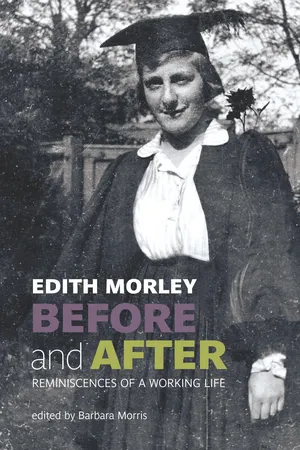
Edith Morley (1875-1964) was a scholar and the main 20th century editor of the works of Henry Crabb Robinson. She was the first woman appointed to a chair at an English university-level institution. Born into a middle-class Victorian family, she hated being a girl, but a forward-thinking home life and a good education enabled her to overcome prejudices and become Professor of English Language at University College, Reading, in 1908. An early feminist with a strong social conscience, she 'fought… with courage… and passionate sincerity for human rights and freedom.' Covering the vividly described era of her late Victorian childhood, her student days with the increasing freedoms they brought, the early feminist movement, the growing pains of a new university and, much later, the traumas endured by refugees fleeing Nazi Germany, this absorbing memoir brings alive a very different era, one foundational to the freedoms we enjoy today. Intended to 'relate my experiences to the background of my period and to portray incidents in the life of a woman born in the last quarter of the nineteenth century', Edith Morley's 1944 memoir, Before and After, was written a few years after her retirement.
eBook - ePub
Edith Morley Before and After
Reminiscences of a Working Life
- English
- ePUB (mobile friendly)
- Available on iOS & Android
eBook - ePub
About this book
Information
Topic
EducationSubtopic
History of EducationCHAPTER 1:
Childhood background
I was born in 1875, in the tall Bayswater house which was to be my home until my mother’s death in 1926. My father was a surgeon-dentist with a West End practice, and since he had six children, the eldest an invalid, there was never much money to spare for luxuries. On the other hand, since he was a great stickler for professional etiquette and the proprieties, we were brought up strictly in accordance with the middle-class conventions of the day, which included, happily, a beloved nurse and as good an education as could be managed for all of us, a six-weeks country or seaside holiday every summer and regular visits to the pantomime or theatre at Christmas or on birthdays. Certainly in my own home and in the houses we visited, nothing was known of the Victorian suppression and repression of children about which so much is read today. On the contrary, I was myself a much indulged and very spoiled little girl, very conscious of my importance as the only sister among four brothers, two much older, one near my own age, and one nine years younger. But I did hate being a girl* and can still remember my indignation at hearing my brother told that only girls cheated at games and the like, or cried when they were hurt. And how I hated and resented wearing gloves. When quite small I suffered from a thick woollen veil, which was supposed to safeguard the complexion, but my very noisy and voluble protests soon relieved me of that infliction – old-fashioned and unusual even in those days. I also resented and constantly disobeyed the rule that I must not slide down the banisters or turn head over heels! I had gymnastic lessons, however, and learned to swim, but I yearned for more of the team games which girls did not yet play and suffered a good deal from insufficient outlets for my physical exuberance. Walks in Kensington Gardens and Hyde Park were no adequate substitute, even when enlivened by forbidden tree climbing and jumping of railings, or by games of hide-and-seek.
My father wished me to be educated at home by a governess but luckily yielded to my desire to go to school. When I was just five, I was sent to a neighbouring kindergarten which was kept by a natural history enthusiast, to whose wise guidance my childhood owed an incalculable debt. ‘Brownie’ as we called her, became a family friend: she spent many holidays with us and even succeeded in persuading my nurse that muddied clothes didn’t matter if they were the results of dredging expeditions. From her, I learned to collect everything that crept and crawled: I kept silkworms, spiders (until they got loose in the drawing room), tadpoles and newts; I pressed and named flowers; looked for fossils, collected shells and joined a ‘Practical Naturalists’ Society’. And when my ‘museum’ – a glass case with sliding trays and bookshelves on the top of the cabinet – was supplemented by a real microscope, my satisfaction was complete. I learned to make slides, and thereby hangs a truly Victorian tale.
When I was eleven, I discovered a little boy about a year older who had similar tastes. I used to go to tea with him, and to his nurse’s horror we spent hours together in his bedroom making slides and looking at them. These highly improper proceedings had to be sanctioned by the parents of both sinners before we could be allowed to seclude ourselves in so unseemly a fashion! Then there were the long and happy hours spent at the Natural History Museum, identifying various specimens and the never-to-be-forgotten afternoon when the Director (he called me ‘madam’!) invited me, subject to my nurse’s permission, to come downstairs and help his young men to name their shells. I had tea with them and was fully convinced that they needed my assistance, and my brother was not asked too, and altogether it was a delightful and wonderful experience and one which filled me with self-importance.
Kindergarten days over, I was sent to a select private school because Notting Hill High School was at least twenty-five minutes’ walk from our home and the nursemaid could not be spared to take and fetch me. Besides I might have made friends there with tradesmen’s daughters or someone equally undesirable! However the Doreck College was very good in its old-fashioned way, and I was well taught and spent four happy years there before I was sent, when just fourteen, to Hanover to learn German, and also to be turned into a ‘young lady’ and acquire some of the feminine accomplishments I refused to have anything to do with at home.
It was not uncommon at that period for girls to be sent abroad to a finishing school, though more often to Paris than elsewhere. The Hanover school to which I went was kept by an English woman, a friend of my mother in their youth, and many girls in our circle went there. It was very cosmopolitan in its clientèle and most of the pupils were between sixteen and eighteen years of age, so I was among the youngest. The teaching and methods were entirely German, and the English head died and was succeeded by a German while I was there. We were thoroughly instructed in modern languages, in German, French and English literature, universal history (not then a subject often taught in English schools) and history of art. Arithmetic was rudimentary, and at fourteen I already knew a good deal more of that subject than my foreign schoolfellows and did not add to my knowledge while there. We learned no Latin and no mathematics or science, but at that date that would probably also have been the case at a private school at home.
What most perturbed me was the unblushing way in which all, except the English girls, read their lessons from books concealed under the desk and otherwise cheated – doubtless because no-one was believed to be truthful without proof. I was of course used to the opposite method: at home every child was trusted unless discovered to be a liar, and I suffered a good deal from the unwonted treatment and its effects on the girls’ morale. I also disliked and never got used to the system of favouritism and spying which prevailed, nor to the encouragement of tell-tales. On the whole, however, I was very happy in Hanover and stayed an extra session by my own desire – a fact which made my last year one of continuous spoiling by the authorities, with repeated visits to the theatre and the like, from which my alleged ill-conduct had almost wholly debarred me during my first years at the school. The Hoftheater in Hanover had very good companies, and the performances of classics and modern drama were a pleasant way of improving our knowledge of the language. Twice during the summer holidays I went with the school to the Harz Mountains and on other occasions visited the homes of fellow pupils in other towns.
Kaiser Wilhelm had only recently succeeded to the throne when I went to Hanover, and I well remember how the ‘Reise Kaiser’ was criticised by his subjects as compared with his father, the ‘Weise Kaiser’, and his grandfather, the ‘Greise Kaiser’.1 He arrived unexpectedly at Hanover one morning at about 3am and made a tremendous to-do because at that hour there was not a proper turnout of the guard at the barracks. Later in the day, he rode past our Pensionat and, to our great satisfaction, stopped to salute our Union Jack. A subsequent memory is of a visit to a former schoolfellow in Berlin who feared I should be arrested for lèse-majesté if I expressed my views so openly as I was doing in a café, where they might be overheard.
Apart from school altogether, I had the inestimable benefit of living at home in a house that was full of books, to any and all of which I had access. My mother was herself an omnivorous reader and an exceptionally intelligent woman. Luckily she also held the opinion that it would do far more harm than good to try to control my reading. So I read everything I could lay my hands on – boys’ books by Henty, Ballantyne, Kingston, Anthony Hope, Manville Fenn,2 etc., girls’ books (usually very inferior to those meant for boys), nursery classics, such as Miss Edgeworth, Harriet Martineau, Charlotte Yonge, Mrs Molesworth, Mrs Ewing,3 and Lewis Carroll; grown-up classics such as Scott, Dickens, George Eliot and Charlotte Brontë; dozens of three-volume trash from Mudie’s4 which had the beneficent result of putting me permanently off that kind of thing later on. I also devoured many books that dated from my mother’s childhood or were at any rate old-fashioned in my time – Miss Porter’s Days of Bruce, Queechy and The Wide Wide World (many grammar lessons were enlivened by surreptitious counting of the number of times the heroines cried and fainted); Peter Parley’s Voyages, Mrs Markham’s Histories, even Magnall’s Questions, Little Mary’s Grammar and The Parent’s Assistant.5
We took in Little Folks and the Boys’ Own Paper; the grown-ups read all the better periodicals from which I was at liberty to extract what I could; my eldest brother was at the period engrossed by Carlyle, RUSKIN and by such lesser reformers as Bellamy and his Looking Backward.6 If I did not read through all of these, at least I knew what they looked like and the kind of thing I could find there. Hugh Miller7 and Charles Darwin I did tackle seriously, and the first book I ever bought with my own pocket-money, supplemented by a final 2/– from my father, was a complete Shakespeare in thirteen small volumes in a red case. I have it still, much thumbed and rather decrepit but very precious. We ‘did’ Shakespeare plays at school in the old Clarendon Press edition, and to this day I know most of Henry V by heart – the first complete play I studied. Not even analysis and parsing of the great speeches and learning all the abstruse ‘notes’ verbatim could spoil the thrill of the poetry. How well I remember teaching Nurse the speeches by heart while she brushed my hair in the mornings, and how I loved to declaim ‘Friends, Romans, Countrymen’ to anyone who would listen, or for my own delectation when no-one could be found. My father was very strict about slang and bad language. But what could be said to my shout of ‘The devil damn thee black, thou cream-faced loon’. ‘That’s Shakespeare?’
Except needlework, French, music and dancing, I loved all my lessons, even learning the queens of England, or jingles about battles of the Wars of the Roses, or the capitals and rivers of the countries of Europe or of the British counties, but Shakespeare came far away first. Once in the Christmas holidays some brothers and cousins and I went to the house of Miss Cowen, the actress (and a family friend) and read and acted with her A Midsummer Night’s Dream. What fun it was to be Hermia and abuse the hapless Helena! Those were the days of Irving and Ellen Terry, and we were taken to see them act at least once a year, and whatever the ornateness of the staging or the unwarranted alterations of the text, nothing could spoil the plays in a child’s eyes. Irving as Richard III or Shylock, Ellen Terry in any and every part she adorned – these were revelations which nothing can efface or render less memorable.
Of course our ‘treats’ were not always of so improving a nature. The zoo (with a ride on the elephant or camel), fireworks at the Crystal Palace, German Reeds with Corney Grain and Grossmith, Maskelyne and Cooke’s8, Mme Tussaud’s, Gilbert and Sullivan (The Mikado when it first appeared was my first play, in the evening of such a snowy day that it was doubtful if my grandmother’s coachman could get us to the theatre), pantomimes at the Aquarium (Drury Lane pantomimes were considered too vulgar for us children), circuses, magic lantern shows at the Polytechnic9 – we sampled and enjoyed them all, even a stage adaptation of the sentimental Little Lord Fauntleroy. Nor must the Lord Mayor’s Show days be forgotten, when a relative invited all his young friends to view the procession from his warehouse in the City, entertaining them afterwards to a sumptuous spread.
Once every summer Grannie took us to Buszard’s10 for strawberries and cream and ices – an event not to be underestimated by those who have been used to tea-shops and restaurant meals all their lives. In my young days there was nowhere where one could drop in to lunch or tea as a matter of course and ordinary middle-class folk went home or to their friends for tea, unless on some very special occasion. I remember many, many years later, on the day when the then Duke of York (George V) married Princess May (Queen Mary), one of my brothers and I stood for hours in the crowd to see them drive to and from Westminster Abbey. On our way home, tired and thirsty, we walked all down Regent ...
Table of contents
- Contents
- Foreword
- Introduction
- Preface
- Chapter 1: Childhood background
- Chapter 2: Home life
- Chapter 3: External conditions
- Chapter 4: Education and emancipation
- Chapter 5: First years of professional work
- Chapter 6: Other interests
- Chapter 7: Reading, college and university
- Chapter 8: Social and political activities
- Chapter 9: The last chapter
- Epilogue
- Biographical notes
Trusted by 375,005 students
Access to over 1.5 million titles for a fair monthly price.
Study more efficiently using our study tools.
Frequently asked questions
Yes, you can cancel anytime from the Subscription tab in your account settings on the Perlego website. Your subscription will stay active until the end of your current billing period. Learn how to cancel your subscription
No, books cannot be downloaded as external files, such as PDFs, for use outside of Perlego. However, you can download books within the Perlego app for offline reading on mobile or tablet. Learn how to download books offline
Perlego offers two plans: Essential and Complete
- Essential is ideal for learners and professionals who enjoy exploring a wide range of subjects. Access the Essential Library with 800,000+ trusted titles and best-sellers across business, personal growth, and the humanities. Includes unlimited reading time and Standard Read Aloud voice.
- Complete: Perfect for advanced learners and researchers needing full, unrestricted access. Unlock 1.5M+ books across hundreds of subjects, including academic and specialized titles. The Complete Plan also includes advanced features like Premium Read Aloud and Research Assistant.
We are an online textbook subscription service, where you can get access to an entire online library for less than the price of a single book per month. With over 1.5 million books across 990+ topics, we’ve got you covered! Learn about our mission
Look out for the read-aloud symbol on your next book to see if you can listen to it. The read-aloud tool reads text aloud for you, highlighting the text as it is being read. You can pause it, speed it up and slow it down. Learn more about Read Aloud
Yes! You can use the Perlego app on both iOS and Android devices to read anytime, anywhere — even offline. Perfect for commutes or when you’re on the go.
Please note we cannot support devices running on iOS 13 and Android 7 or earlier. Learn more about using the app
Please note we cannot support devices running on iOS 13 and Android 7 or earlier. Learn more about using the app
Yes, you can access Edith Morley Before and After by Edith Morley, Barbara Morris in PDF and/or ePUB format, as well as other popular books in Education & History of Education. We have over 1.5 million books available in our catalogue for you to explore.