Contributions by Thomas J. Cobb, Donna A. Gessell, Helena Goscilo, Cyndy Hendershot, Christian Jimenez, David LaRocca, Lori Maguire, Tatiana Prorokova-Konrad, Ian Scott, Vesta Silva, Lucian Tion, Dan Ward, and Jon Wiebel
In recent years, Hollywood cinema has forwarded a growing number of images of the Cold War and entertained a return to memories of conflicts between the USSR and the US, Russians and Americans, and communism and capitalism. Cold War II: Hollywood's Renewed Obsession with Russia explores the reasons for this sudden reestablished interest in the Cold War. Essayists examine such films as Guy Ritchie's The Man from U.N.C.L.E., Steven Spielberg's Bridge of Spies, Ethan Coen and Joel Coen's Hail, Caesar!, David Leitch's Atomic Blonde, Guillermo del Toro's The Shape of Water, Ryan Coogler's Black Panther, and Francis Lawrence's Red Sparrow, among others, as well as such television shows as Comrade Detective and The Americans.
Contributors to this collection interrogate the revival of the Cold War movie genre from multiple angles and examine the issues of patriotism, national identity, otherness, gender, and corruption. They consider cinematic aesthetics and the ethics of these representations. They reveal how Cold War imagery shapes audiences' understanding of the period in general and of the relationship between the US and Russia in particular. The authors complicate traditional definitions of the Cold War film and invite readers to discover a new phase in the Cold War movie genre: Cold War II.
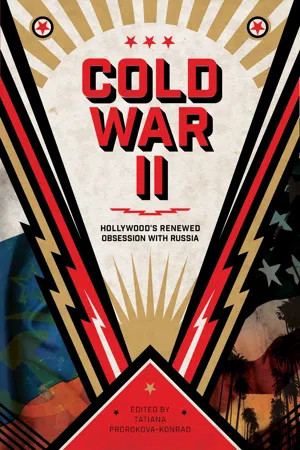
eBook - ePub
Cold War II
Hollywood's Renewed Obsession with Russia
- 264 pages
- English
- ePUB (mobile friendly)
- Available on iOS & Android
eBook - ePub
Cold War II
Hollywood's Renewed Obsession with Russia
About this book
Information
Publisher
University Press of MississippiYear
2020Print ISBN
9781496831101
9781496831095
eBook ISBN
9781496831118
Subtopic
North American HistoryPART I
ENDURING CLICHÉS
THE WARM GLOW OF COLD WAR NOSTALGIA
We are likely soon to regret the passing of the Cold War.
—JOHN MEARSHEIMER, The Atlantic, 1990
Without the Cold War what’s the point of being American?
—RABBIT ANGSTROM, Rabbit at Rest, John Updike, 1990
Christ, I miss the Cold War!
—M, Casino Royale, 2006
It seems that almost since the November 1989 day when the Berlin Wall fell, some were missing the global order it symbolized—or at least missing the ways that the Cold War had allowed them to make sense of the world. The appeal of a simplified Cold War story is not difficult to see. From the American perspective, we firmly occupied the role of the “good guys” fighting for freedom and democratic ideals, battling the scourge of communism and tyranny. That such a story bears little resemblance to the moral quagmires and ethical missteps of key Cold War events (think McCarthy, Korea, Vietnam, the Cuban Missile Crisis, etc.) matters less and less as time goes on and Americans become increasingly sure of our romantic retellings of our bipolar past.
As early as 2000, George W. Bush argued, “This is a world that is much more uncertain than the past. In the past we were certain, we were certain it was us versus the Russians in the past.”1 In 2014, James Inhofe, the ranking Republican on the Senate Armed Services Committee remarked, “I look back wistfully at the Cold War. There were two superpowers, they knew what we had, we knew what they had.”2 These sentiments—that the Cold War was an era of certainty and stability—have gained increased traction in the twenty-first century as we lament a world of rogue states, terrorist cells, suicide bombings, and social media attacks. The enemy we knew (or at least thought we knew) is a comforting image when many contemporary threats seem hard to locate or pin down.
Against the backdrop of new and emergent threats, the second decade of the twenty-first century has seen an explosion of Cold War stories in American films and television series that highlight a nostalgic desire for a return to the more “certain” past referenced by President Bush and Senator Inhofe. But nostalgia should not be thought of simply as a desire to return to some lost time. It is always as much about reconstructing ourselves in the present as it ever is about remembering our past. As Michael Pickering and Emily Keightley argue, nostalgia is “not only a search for ontological security in the past, but also a means for taking one’s bearings for the road ahead in the uncertainties of the present.”3
In this essay, we look in detail at two recent films, Bridge of Spies (2015) and Atomic Blonde (2017), in order to explore the specificities of Hollywood Cold War nostalgia in the 2010s. These two films, the first featuring the construction of the Berlin Wall and the second set on the eve of its collapse, reveal the ways in which Hollywood films use nostalgic representations of the Cold War to recapture a feeling of what Tom Engelhardt terms American “victory culture.”4 Engelhardt suggests that victory culture is a way of combining American military might, moral right, and divine exceptionalism to create a sense of the world in which our wars are all justified and glorious and our victories are all assured. We argue that Cold War nostalgia narratives are a way of resecuring a sense of American exceptionalism and victory in a time of uncertainty and fear. In other words, nostalgic Cold War narratives help reassure contemporary Americans that we are still the good guys (and gals) fighting on the right side to protect the world.
Although other genres of war/conflict films can contribute to a re-creation of victory culture, Cold War narratives are exceptionally well positioned to be effective in generating nostalgic power in the social and political climate of the 2010s. The 2018 Edelman Trust Barometer indicates that only about a third of Americans trust our government “to do what’s right,” the lowest level ever recorded in the eighteen-year history of the survey.5 Unlike nostalgic World War II narratives, Cold War narratives focus on heroic individuals (the spy, the negotiator, etc.) and thus do not require audiences to believe that our military or our leaders are trustworthy or will do the right thing. Our faith is in the clever and strong individual American who stands up not only against the enemy but also, if needed, against our supposed friends and allies who fail to fulfill their part of the mission.
We begin by briefly considering the importance of film as a way of constructing popular understandings of war and conflict. Then we turn to a consideration of the twenty-first-century global political context out of which the new Hollywood Cold War narratives emerge. We then look at nostalgia as a critical frame and apply it to a close reading of the films, considering especially the themes of American exceptionalism and the contrast between East and West.
Hollywood Film and War
Research from a wide array of disciplines has established the influence of cinema and the role of Hollywood in “the production, reproduction, and transformation of everemerging US individual, national, and international subjectivities.”6 While stories continue to circulate about the decline in cinema,7 theaters are still able to attract millions of viewers each week. Cinema, therefore, remains a critical site where an “understanding of particular events, national identity and relationships to others” is forged and reforged.8 Of particular interest to this project is the role of film in developing popular understandings of global politics and historical events. Cinema has been, and continues to be, a “space involved in the process of actively forgetting and actively producing history.”9 That process of (re)producing history is far from a neutral form of storytelling. Bracketing for the moment the notion that all storytelling is political insofar as it entails intentional and unintentional expressions of extant systems of power and privilege, it is also the case that Hollywood has a long “tradition of using history for political purposes.”10 Two of those purposes are of particular interest to this project: the maintenance of the culture of victory and Hollywood’s contribution to the “cultural Cold War.”11
In his treatment of American victory culture, Engelhardt notes the function of film in reinforcing victory culture, particularly among the youth of America. Although not the originator of the war story on which victory culture was predicated, Hollywood used America’s martial past as a way to reinforce a larger story of progress that served as America’s defining mythos. For example, the function of the Western was to reinforce an “unforgettable history” of America’s “westward progress to dominance.”12 Hollywood used the logics that subtended the Western to help the public make sense of events in the present. Thus Engelhardt notes that not long after the US entered World War II, “Hollywood’s film studios began producing war movies in which … a savage, nonwhite enemy ambushed and overwhelmed small groups of outnumbered American soldiers.”13 These films, like the Westerns that preceded them, sought to advance a triumphalist narrative that constituted a critical element of what it meant and means to be American.
In terms of the Cold War, Tony Shaw offers a detailed assessment of the “American film industry’s unique contribution to the cultural Cold War.”14 Attending to questions of political economy, Shaw explores how the “relationship between Hollywood’s Cold War coverage” and the “US political establishment” and its views on the conflict functioned to influence domestic and global perceptions of the conflict.15 In his comprehensive survey of Hollywood during the Cold War, Shaw does note moments where Hollywood challenged the dominant narrative advanced through US policy and governing institutions; yet even then Hollywood filmmakers reified and promoted key elements of “Cold War orthodoxy.”16 This relationship has continued beyond the Cold War with Hollywood filmmakers producing films that reinforce dominant ideas about September 11, 2001, and the American fight against global terrorism. Given this history, it is not surprising that Hollywood filmmakers are returning to stories of the Cold War at the very moment policymakers, national security and foreign policy experts, and academics are warning of the existence of a new Cold War. And just as they did in the past, filmmakers in Hollywood are turning to history to speak to contemporary anxieties and insecurities.
America and Conflict in the Twenty-First Century
At the onset of the Global War on Terrorism, President George W. Bush declared to the American public that this war would be “a lengthy campaign, unlike any other we have ever seen,”17 and in the nearly two decades since, the US has seemingly come no closer to bringing the War on Terror to a successful close. Our experiences in Vietnam taught policymakers that public support for conflicts abroad could be maintained only if interventions met at least one of three specific conditions: (1) they were “short, sharp operations” that demonstrated “decisive use of force,” such as the first war in Iraq; (2) they were conducted through the use of proxy forces; or (3) they consisted primarily of air operations, such as those in Kosovo.18 From the outset, it was recognized that the War on Terror violated these conditions. Indeed, in his joint statement to Congress at the start of the conflict, President Bush cautioned his listeners that the War on Terror would not “be like the war against Iraq” or the “air war above Kosovo” and pledged that the US would deploy “every necessary weapon of war,” making it clear that it would not be a war by proxy.19 It should not be surprising then that many of the critical words and phrases associated with Vietnam, such as quagmire, soon became part of the public discourse of the Global War on Terror.20
The American public’s weariness with the War on Terror is perhaps best exemplified by the growing belief among Americans that our military involvement in Afghanistan was a mistake. While a Gallup poll in October 2001 showed almost universal support for the military intervention in Afghanistan,21 by 2014 polls showed that roughly half of the American public (48 percent) characterized the intervention as a “mistake.”22 After seventeen years in Afghanistan, fewer than half of the American public (45 percent) believed the US made the “right decision” to use military force in Afghanistan, and nearly half (49 percent) believed that the United States had “mostly failed” in “achieving its goals in Afghanistan.”23
Sixteen years after President Bush pledged to use whatever military force was necessary to win the War on Terror, President Trump appeared before the nation to discuss his administration’s approach to Afghanistan. Even as he acknowledged that the war in Afghanistan was emblematic of Americans’ weariness of a “war without victory” and claimed to share “the American people’s frustratio,n” President Trump affirmed a commitment to a war with no foreseeable victory, promising that America would “never let up” until the terrorists were “dealt a lasting defeat.”24 Yet a year later, the US Department of Defense concluded that “terrorist and insurgent groups continued to present a formidable challenge to Afghan, U.S., and coalition forces.”25
Americans’ sense that the War on Terror has become a war without much hope of victory is also evidenced by the belief many Americans hold that they are no safer from terrorism today than they were prior to September 11, 2001. This sentiment persists despite the trillions of dollars spent and thousands of lives lost attempting to defeat global terrorism. Since 9/11, any number of factors arguably could have precipitated a decline in public anxiety about the threats posed by global terrorism; however, a study of polling data since 9/11 reveals that although other issues have taken center stage, there has been little change in the “degree to which Americans voice concern” about the danger posed by global terrorism.26 The study argues that the most plausible explanation for the ongoing anxiety is the characterization of Islamic terrorism as “part of a large and hostile conspiracy that is international in scope and rather spooky.”27 Epitomizing this discourse is a recent report from the RAND Corporation which declares that even as al-Qaeda’s ability to launch 9/11-style attacks has been eroded, al-Qaeda is “unquestionably a dangerous organization” that in becoming “more decentralized” relies on “its affiliates and allies” and its ability to “inspire homegrown recruits to carry out terrorist attacks.”28
Thus, even as the Department of Defense articulates its successes in limiting the capabilities of al-Qaeda, it nonetheless reinforces the very characteristics of Islamic terrorism that bear directly on Americans’ ongoing anxiety: In becoming more decentralized and thus harder to locate, terrorism seems more threatening. And as it doubles down on cultivating “do-it-yourself” forms of terrorism, the reach of “Islamic terrorists” becomes ever greater. Given this framing, it is no wonder that more Americans now than in 2003 believe that terrorists have increased their capabilities for launching another major attack on the United States.29
The New Cold War
At the same time that Americans grapple with the uncertainties of global terrorism, we are also encountering the re-emergence of Russia as a real or potential enemy. Journalists, former diplomats, and security experts have for years now been warning of a new Cold War. Some of these analysts assert that the actions of Russia and Vladimir Putin have created the context for a new Cold War,30 while others claim that the post–Cold War policies of the United States are the key factor in the growing hostilities.31 Both sides, however, agree that once again Russia and the US are on opposite sides in a larger global conflict.
American media institutions have repeatedly characterized the tensions between the United States and Russia in the 2010s as a new Cold War. For example, since early 2013 The Nation has published numerous articles by Stephen Cohen warning of the advent of this new Cold War, claiming that it may be even more dangerous than the last and even warning that an armed conflict with Russia is a real possibility. A Nexus search of the New York Times and Washington Post between October 16, 2015 (the release date for Bridge of Spies), and July 28, 2017 (the release date...
Table of contents
- Cover
- Title Page
- Copyright
- Contents
- Introduction: Cinematic Reimagining of the Cold War in the 2010s
- Part I. Enduring Clichés
- Part II. New Aesthetics of the Old Past
- Part III. Of Patriotism, Corruption, and Otherness
- About the Contributors
Trusted by 375,005 students
Access to over 1.5 million titles for a fair monthly price.
Study more efficiently using our study tools.
Frequently asked questions
Yes, you can cancel anytime from the Subscription tab in your account settings on the Perlego website. Your subscription will stay active until the end of your current billing period. Learn how to cancel your subscription
No, books cannot be downloaded as external files, such as PDFs, for use outside of Perlego. However, you can download books within the Perlego app for offline reading on mobile or tablet. Learn how to download books offline
Perlego offers two plans: Essential and Complete
- Essential is ideal for learners and professionals who enjoy exploring a wide range of subjects. Access the Essential Library with 800,000+ trusted titles and best-sellers across business, personal growth, and the humanities. Includes unlimited reading time and Standard Read Aloud voice.
- Complete: Perfect for advanced learners and researchers needing full, unrestricted access. Unlock 1.5M+ books across hundreds of subjects, including academic and specialized titles. The Complete Plan also includes advanced features like Premium Read Aloud and Research Assistant.
We are an online textbook subscription service, where you can get access to an entire online library for less than the price of a single book per month. With over 1.5 million books across 990+ topics, we’ve got you covered! Learn about our mission
Look out for the read-aloud symbol on your next book to see if you can listen to it. The read-aloud tool reads text aloud for you, highlighting the text as it is being read. You can pause it, speed it up and slow it down. Learn more about Read Aloud
Yes! You can use the Perlego app on both iOS and Android devices to read anytime, anywhere — even offline. Perfect for commutes or when you’re on the go.
Please note we cannot support devices running on iOS 13 and Android 7 or earlier. Learn more about using the app
Please note we cannot support devices running on iOS 13 and Android 7 or earlier. Learn more about using the app
Yes, you can access Cold War II by Tatiana Prorokova-Konrad, Tatiana Prorokova-Konrad,Tatiana Konrad in PDF and/or ePUB format, as well as other popular books in Media & Performing Arts & North American History. We have over 1.5 million books available in our catalogue for you to explore.