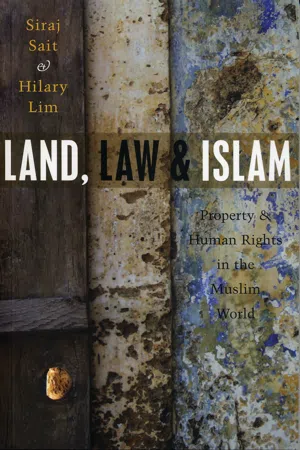
In this pioneering work Siraj Sait and Hilary Lim address Islamic property and land rights, drawing on a range of socio-historical, classical and contemporary resources. They address the significance of Islamic theories of property and Islamic land tenure regimes on the 'webs of tenure' prevalent in the Muslim societies. They consider the possibility of using Islamic legal and human rights systems for the development of inclusive, pro-poor approaches to land rights. They also focus on Muslim women's rights to property and inheritance systems.
Engaging with institutions such as the Islamic endowment (waqf) and principles of Islamic microfinance, they test the workability of 'authentic' Islamic proposals. Located in human rights as well as Islamic debates, this study offers a well researched and constructive appraisal of property and land rights in the Muslim world.
- English
- ePUB (mobile friendly)
- Available on iOS & Android
eBook - ePub
1

Researching Islam, Land and Property
The concept of dual ownership [human being–God] is one of the special features of the Islamic doctrine of economics. Islam protects and endorses the personal right to own what one may freely gain, through legitimate means…. It is a sacred right. Yet, human ownership is tempered by the understanding that everything, in the last analysis, belongs to God…. What appears to be ownership is in fact a matter of trusteeship, whereby we have temporary authority to handle and benefit from property. (Abdul-Rauf 1984: 19)
Land, property and housing rights are generally cross-cultural and asserted within every socio-economic and political system, but the practice regarding their regulation and protection may take many forms. However, there has been little research on the complex and distinctive forms of land tenure and land rights found in Muslim societies, despite the fact that over 20 per cent of the world’s population is Muslim. Although there has been extensive literature generally on Islam and human rights, there has been very little focus on Islam and property rights. This book seeks to address this gap in the literature. Too often global reviews of land tenure and strategies fail to take into account Islamic principles and practices because they are assumed to be either nonexistent or irrelevant. By way of illustration, Hernando de Soto’s (2000) influential and best-selling work The Mystery of Capital, which predicates economic development and poverty alleviation upon the formalization and legal protection of land titles, does not explore Islamic conceptions of land, property and housing rights. His proposals for converting ‘dead capital’, by which he means informally owned property, into formally recognized property rights, through surveying, mapping, registration, monitoring, maintenance and facilitative mechanisms, have led to plaudits (Clinton 2001; USAID 2002), as well as critiques (Home and Lim 2004; Payne 2002) but are considered automatically applicable in the Muslim world. Though Egypt is on de Soto’s study list, he merely explores its symptomatic problems, particularly the bureaucratic delays in asserting property rights. The issues faced by Muslim countries, however, are far more complex than problems with red tape and apathy.
Islam is considered by Muslims to be a complete way of life, and property conceptions go far beyond theorization to impact on the lived experiences of Muslims. They also inform, to varying degrees, state policies and land rights discourse. Better understanding of, and engagement with, Islamic dimensions of land may potentially support land rights initiatives in Muslim societies, which have implications for programmes relating to land administration, land registration, urban planning and environmental sustainability. No generalization can be made about the extent to which Islamic dimensions may be relevant or appropriate to a particular context – that is for land professionals, policy makers, civil society and ultimately the people to determine. The fear of Islamizing the land discourse is exaggerated because Islam, as this research demonstrates, is never a stand-alone and there is a dynamic interplay between universalist, human rights, customary, informal and Islamic conceptualizations and applications. Rather, the lack of engagement with the internal Islamic dialogue risks creating land systems that are bereft of authenticity and legitimacy and thereby of effectiveness and durability. Even where well-intentioned donor-driven efforts to establish modern land systems succeed, the obduracy of informal norms, practices and processes leads to unattended dualisms that undermine the prospect of integrated and unifying land policies.
This chapter provides an introduction to the context, methodology and scheme of this research, to distinctive conceptions of land tenure and rights in Islamic theory, as well as to key economic principles promoting private ownership and their present and potential role in promoting access to land. Furthermore, it outlines the application of Islamic perspectives on land registration, urban planning and environmental sustainability.
Scope of the Research
This research was initiated by the Land and Tenure Section (Shelter Branch, Global Division) at UN-HABITAT, which carries out systematic research into distinctive land, housing and property issues and approaches in various regions of the world. During its work in a range of countries from Afghanistan to Indonesia, UN-HABITAT has been increasingly aware of the importance of Islamic land tenure conceptions and land rights. It therefore commissioned us to carry out a year-long, in-depth study of the Islamic and other dimensions of land and property rights in the Muslim world. The eight research papers which emerged from the study provided the chapters of this book.
The general findings of the research point to distinctive Islamic conceptions of land and property rights that vary in practice throughout the Muslim world. Though Islamic law and human rights are often important factors in the Islamic conceptualization of land and property rights, and their application, they intersect with state, customary and international norms in various ways. In doing so, they potentially offer opportunities for the development of ‘authentic’ Islamic land tools which can support the campaign for the realization of fuller land rights for various sections of Muslim societies, including women. However, in order to facilitate that role, the various stakeholders must constructively review the normative and methodological Islamic frameworks and their relationship with other systems of formal and informal land tenure.
This chapter will show that Islamic property and land concepts are part of a mature and developing alternative land framework operating alongside international regimes. The roles of Islam, history, politics, culture, kinship and custom – operating in different dimensions within Muslim societies – are intertwined in distinctive property conceptions and structures. In the Islamic system, private property rights are promoted but the ultimate ownership of God over land is assumed and requires all rights to be exercised within the Islamic legal and ethical framework with a redistributive ethos. It is argued that engagement with Islamic dimensions of land may potentially support land rights initiatives in Muslim societies and has implications for programmes relating to land administration, land registration, urban planning and environmental sustainability.
Chapter 2 considers Islamic law in relation to land rights and tenure systems in Muslim societies. A striking feature of Islamic societies is the high degree of reliance on legal cultures, arising in part because of the sophistication and breathtaking scope of the Shari’a. Though it is a site of struggle between conservatives and liberals, Islamic law is not medieval and static, but a ‘living’ field. An appreciation of the distinctive features and sources of Islamic law, its methodologies and diversity in application and its dispute resolution mechanisms may contribute towards strategies aimed at enhancing security of tenure.
Chapter 3 explores how the multifaceted, generally distinctive and certainly varied nature of land tenure concepts, categorizations and arrangements within the Islamic world leads to the ‘web of tenure’ in contemporary Muslim societies. An appreciation of the historical context of land tenure in Muslim societies and the range of land tenure forms contributes towards the development of authentic and innovative strategies for enhancing access to land and land rights.
Chapter 4 sets out to examine the relationship between international human rights and Islamic conceptions of human rights in theory and practice. It argues that, with respect to land rights, the difference between these two sets of rights appears minimal and a sensitive and careful recognition of Islamic religious and political sensitivities can help deliver international human rights more effectively in Muslim societies, without offending Islamic principles.
Chapter 5 explores the nature and scope of women’s rights to property and land under Islamic law (Shari’a) through a socio-historical background to women’s property rights, an appraisal of modern legal reforms and the avenues for enhancing their security of tenure. It argues that, despite assumptions to the contrary, there are potentially empowering strategies for women through Islamic law that can enhance women’s access to land and enforcement of their other property rights.
Chapter 6 considers how Muslim societies generally derive from religious sources their inheritance rules for the division of an individual’s property upon death, some of which are controversial. Yet, it argues that the application of these formal inheritance rules pertaining to designated shares must be understood in a broader socio-cultural and economic context and within wider systems of inheritance practice.
Chapter 7 outlines the waqf as a key Islamic institution, which has incorporated within its legal sphere vast areas of land within the Muslim world, connected firmly with the religious precept of charity. Modern reforms in several Muslim countries have abolished or nationalized religious endowments, or subjected them to strict regulation, but the waqf remains influential and there are clear signs of its reinvigoration. The chapter evaluates the role of the waqf in strategies to improve security of tenure based on its legal foundations, history and socio-economic impacts.
Finally, Chapter 8 considers the increasing demand from within Islamic communities that financial services be compliant with the Shari’a. This chapter explores the Islamic context which stimulates such alternative credit systems, the key distinguishing features of Islamic banking models, the development of Islamic microfinance practices, and the practical challenges to these innovations. It considers how Islamic finance, banking principles and credit, particularly housing microfinance, can contribute to security of tenure and help to transform the lives of the poor.
This is a preliminary study which seeks to contribute to the debate about appropriate strategies to realize innovative and pro-poor land tools in their particular context. With that in mind, it has been written for a general audience without any assumption of knowledge regarding Islam, law or property rights, offering basic information as well as an opportunity to revisit first principles.
Methodology
A project that seeks to explore key themes and developments within the Muslim world raises fundamental questions regarding the scope and methodology – even feasibility – of such an endeavour. Resident in over 57 Muslim-majority countries (member states of the Organization of Islamic Conference, OIC), or as significant minorities in the West and from China to Russia, there are an estimated 1.2 billion Muslims amongst the world’s population. Though Muslims see themselves as a universal community (Umma), they are, in fact, divided into several nationalities and, contrary to popular assumptions, only 20 per cent of Muslims reside in the Arab world. They include many different ethnic groups and speak dozens of languages, including Arabic, Turkish, Urdu, and Persian. The lived experiences of Muslims – reflecting various socio-economic conditions, political affiliations and religious practices – cannot be essentialized or simplified. The Muslim holy book, the Qur’an, celebrates this diversity:
O mankind! Truly We have created you out of a male and a female, and We have made you into nations and tribes, that you may know one another (Qur’an 49: 13). And among His signs is the creation of the heavens and the earth, and the difference of your languages and colours. Verily in that are signs for men of sound knowledge. (Qur’an 30: 22)
Callaway notes, in the context of Africa, that ‘in each major region of each country, the impact of Islam is different. No study can reasonably blanket the region with one set of generalizations about how Islam interacts with society and shapes it’ (Callaway 1994: 1). Given the enormous range of Muslim identities intertwined with indigenous and Western practices, a project such as ours, which uses thematic approaches, can only provide selective case studies, often in a comparative mode. It cannot generalize or universalize these experiences as a homogeneous Muslim position. Rather, the research underscores the considerable variations in the doctrine and practice of land tenure arrangements driven by local socio-economic, customary, cultural and political factors, as well as by secular influences. The prefix ‘Islamic’ has been preferred to ‘Muslim’ for conceptual formulations or attempts at authenticity because land issues are mostly theorized from the Qur’anic and other Islamic legal principles. It is equally true, though, that Islam is a contested zone and is ultimately a matter of human interpretation of divine intent. There are differences between the Muslim Sunni and Shi’a sects, as well as within the maddahib (schools of jurisprudence) within the sects. However, this project avoids referring to states, societies or individuals who invoke Islam as ‘Islamic’ (except sometimes by way of emphasizing distinctive puritanical approaches), preferring ‘Muslim’ because they are practitioners of Islam rather than embodiments of it.
At the same time there is much that unites Muslims. The term ‘Islam’ comes from the Arabic word-root s-l-m, which has a general reference to peace and submission. Specifically, Islam means submission to the will of God, and a Muslim is one who makes that submission. Muslims are identified as those who share shahada (common faith) in the oneness of God (Allah or the God, in Arabic), acceptance of the Prophet Muhammad (peace be upon him, hereafter referred to as ‘the Prophet’) as being the final Prophet in a long line of Judeo-Christian messengers including Adam, Abraham, Moses and Jesus (peace be upon them). This first pillar of Islamic faith is accompanied by four others: salat (prayer) which is performed five times a day, zakat (charity, literally purification), fasting during the Islamic month of Ramadhan and the Hajj (pilgrimage to Makkah), although the last is only an obligation for those who are physically and financially able to perform it. As Esposito (1980: ix) points out: ‘A distinctive feature of the Islamic tradition is the belief that Islam is a total, comprehensive way of life’; it is ‘integral to all areas of Muslim life – politics economics, law, education and the family’. It is not surprising, therefore, that Islam has much to say about various aspects of land, property and housing rights and regulates property relationships within the family, communities and between individuals and the state.
This book is co-authored by a Muslim and a non-Muslim, a male and a female, a Southerner and a Northerner coming from different fields of expertise and experiences. Together, the team has sought to be academically neutral, pursuing internal and external critiques and debates. Through a dialogic method of research, they have adopted a general approach that Islam, like other religions and cultures, must be constructively analysed to discern its potential benefits as seen by Muslims as well as other communities. This research uses international, cross-cultural human rights and development standards as the framework for engaging with Islamic principles. A range of materials was used, including Muslim and non-Muslim sources, though largely restricted to English-language resources and translations. However, the researchers have been sensitive to arguments over orientalism (Said 1978; Tibawi 1964; Macfie 2000) – texts that generate essentializing statements about ‘the Orient’, amounting to an exercise of power. Postcolonial approaches to and critiques of Western imperialism were incorporated along with caution over occidentalist trends in literature, as reactive to orientalism (Buruma and Margalit 2004). As Smith argues, scholars and foreign affairs experts agree that Islam’s teachings are humane but many Westerners have considered ‘radical Islam one of the gravest threats facing the free world’ (Smith 2000). At the root of this constructive endeavour is a predisposition to see land, property and housing rights as basic and universal aspirations though there may be different pathways to realizing them, including Islamic approaches.
Land and Property Rights in Muslim Societies
The extent to which land rights are protected within Muslim countries is difficult to detail or even generalize because of the sheer diversity of Muslim countries as well as the lack of systematic and reliable data. The annual Index of Economic Freedom...
Table of contents
- Cover
- About the Authors
- Title
- Copyright
- Contents
- Abbreviations
- Acknowledgements
- Foreword by Anna K. Tibaijuka, UN Under-Secretary-General, Executive-Director of UN-HABITAT
- 1 Researching Islam, Land and Property
- 2 Islamic Law, Land and Methodologies
- 3 Islamic Land Tenures and Reform
- 4 Islamic Human Rights and Land
- 5 Inheritance Laws and Systems
- 6 Muslim Women and Property
- 7 The Waqf (Endowment) and Islamic Philanthropy
- 8 Islamic Credit and Microfinance
- Postscript
- Bibliography
- Glossary
- Index
Trusted by 375,005 students
Access to over 1.5 million titles for a fair monthly price.
Study more efficiently using our study tools.
Frequently asked questions
Yes, you can cancel anytime from the Subscription tab in your account settings on the Perlego website. Your subscription will stay active until the end of your current billing period. Learn how to cancel your subscription
No, books cannot be downloaded as external files, such as PDFs, for use outside of Perlego. However, you can download books within the Perlego app for offline reading on mobile or tablet. Learn how to download books offline
Perlego offers two plans: Essential and Complete
- Essential is ideal for learners and professionals who enjoy exploring a wide range of subjects. Access the Essential Library with 800,000+ trusted titles and best-sellers across business, personal growth, and the humanities. Includes unlimited reading time and Standard Read Aloud voice.
- Complete: Perfect for advanced learners and researchers needing full, unrestricted access. Unlock 1.5M+ books across hundreds of subjects, including academic and specialized titles. The Complete Plan also includes advanced features like Premium Read Aloud and Research Assistant.
We are an online textbook subscription service, where you can get access to an entire online library for less than the price of a single book per month. With over 1.5 million books across 990+ topics, we’ve got you covered! Learn about our mission
Look out for the read-aloud symbol on your next book to see if you can listen to it. The read-aloud tool reads text aloud for you, highlighting the text as it is being read. You can pause it, speed it up and slow it down. Learn more about Read Aloud
Yes! You can use the Perlego app on both iOS and Android devices to read anytime, anywhere — even offline. Perfect for commutes or when you’re on the go.
Please note we cannot support devices running on iOS 13 and Android 7 or earlier. Learn more about using the app
Please note we cannot support devices running on iOS 13 and Android 7 or earlier. Learn more about using the app
Yes, you can access Land, Law and Islam by Hilary Lim in PDF and/or ePUB format, as well as other popular books in Law & International Law. We have over 1.5 million books available in our catalogue for you to explore.