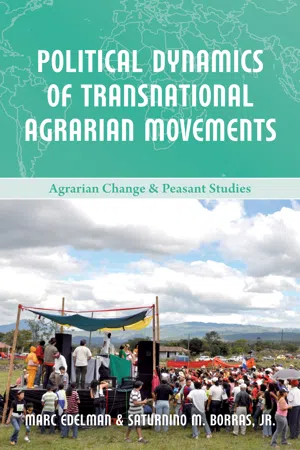
Transnational agrarian movements (TAMs) are organizations, networks, coalitions and solidarity linkages of farmers, peasants, pastoralists and their allies that cross national boundaries and seek to influence national and global policies. Today's TAMs have contributed to reframing a wide range of debates and practices in the fields of international development and agrarian and social movement studies, including sustainability and climate change, land rights and agrarian reform, food sovereignty, neoliberal economics and global trade rules, corporate control of seeds and technology, the human rights of peasants, and gender equity.In Political Dynamics of Transnational Agrarian Movements, Marc Edelman and Saturnino M. Borras Jr. offer a state-of-the-art review of scholarship on transnational agrarian movements, a synthetic history of TAMs from the early twentieth century to the present, and an analytical guide to TAM research.
- English
- ePUB (mobile friendly)
- Available on iOS & Android
eBook - ePub
Political Dynamics of Transnational Agrarian Movements
About this book
Information
Topic
Scienze socialiSubtopic
Studi sullo sviluppo globale1
Transnational Agrarian Movements: Histories and Diversity
Contemporary transnational agrarian movements and networks are plural and diverse, even though observers often focus attention only on the most visible and “noisy” TAMs, such as La Vía Campesina (LVC). Many analysts also assume—and many agrarian activists claim—that contemporary TAMs constitute a novel phenomenon, caused by neoliberal globalization and enabled by new communications technologies and inexpensive air transport. The dream of international solidarity, however, predates the internet by at least a century, and TAMs are hardly new. Some took shape in the late nineteenth and early twentieth centuries, others in the aftermath of World War II, and many more in the 1980s and 1990s. Some movements and networks have been in existence for decades, for example, the Campesino a Campesino (Peasant to Peasant) movement, a horizontal agricultural extension process in Central America and Mexico that started in the 1960s (Boyer 2010; Bunch 1982; Holt-Giménez 2006). Moreover, transnational movements or networks often build directly on older cross-border linkages formed well before the neoliberal onslaught commenced in the early 1980s (Edelman 2003). Many cross-border and cross-continental links were forged, for example, during the 1970s and 1980s as part of the extensive solidarity networks in Europe and North America that backed national liberation and anti-dictatorship movements in developing countries, such as Chile, Nicaragua, South Africa and the Philippines. But transnational alliance-building among peasants and farmers goes back much earlier. Understanding the diversity and dynamics of contemporary TAMs is enriched by an understanding of past TAMs and in some cases helps to explain the emergence of contemporary movements and networks.
Historical Antecedents
Several historical and contemporary TAMs have received relatively little scholarly attention. Transnational alliance-building among peasant and small farmer organizations accelerated after the late 1980s, but its origins lie as far back as the late nineteenth century. This suggests that cross-border activism is not just an outgrowth of computers and the internet, cheap air transport, the growing power of supra-national governance institutions and a weakening of contemporary states under neoliberal globalization. Early transnational agrarian organizations manifested sometimes eclectic combinations of agrarian populism, communism, elite-led reformism and noblesse oblige, pacifism and feminism. Like the “new social movements” of the 1960s and after, lifelong activists who participated in one movement after another built on previous experiences of struggle to make new kinds of claims.
Associated Country Women of the World
These connections between issues and across generations stand out in the forces that converged in the Associated Country Women of the World, a transnational agrarian organization that began to take shape in the late 1920s.1 ACWW’s proximate origins lay in encounters between leaders of the International Council of Women (ICW)—founded in Washington in 1888—and the Women's Institute movement, which began in Canada in the 1890s and spread to the United States, England and many British colonies (Davies n.d.). The ICW was founded by U.S. activists (and delegates from eight other countries) who had participated in the abolitionist, women's suffrage and temperance movements (Rupp 1997).2 The Women's Institutes were initiated by leaders of ICW’s Canadian affiliate as auxiliaries to the Farmers’ Institutes, a provincial extension program that also existed in the United States (Moss and Lass 1988; McNabb and Neabel 2001). In 1913, Canadian activist Madge Watt moved to Britain, where she helped found several hundred local Women's Institutes and interested long-time ICW president Ishbel Gordon Aberdeen in starting an international federation. Watt and Lady Aberdeen, an aristocratic feminist whose husband had served as British Governor General of Canada, called a meeting in London in 1929 with women from twenty-three countries who established an ICW committee on rural women (Drage 1961). The committee published a yearbook (What the Country Women of the World Are Doing), a journal (The Country Woman) and a newsletter (Links of Friendship); it also circulated leaflets in three languages to recruit new national associations (Meier 1958). In 1933, in Stockholm, it became Associated Country Women of the World.
In the ACWW’s early years, women from the English, Belgian, Romanian, German and Swedish nobility played key roles (and even as recently as 2012 its board included a Malaysian princess) (ACWW 2012; Meier 1958; Drage 1961; London Times 1946a). By 1936, its first Triennial Conference outside Europe, in Washington, DC, attracted some 7,000 farm women, most of them Americans (Meier 1958). The Association set up speakers schools for organizers and researched issues such as midwifery services and nutrition. In the pre-war period, it worked with the League of Nations. During World War II, it moved its headquarters from London to Cornell University, a major centre of agricultural research in upstate New York. Following the war, it attained consultative status with several United Nations agencies (Meier 1958). More recently, ACWW has supported small-scale income-generating programs, including palm oil farms, and advocated in international fora for women's rights, albeit with little critical attention to land, labour or environmental issues. Despite growing participation by women from less-developed countries and an increasingly sophisticated approach to gender issues, ACWW has never transcended its elite British origins. Its conventions are still held in English, without translation services, a practice that limits participation from outside the English-speaking world primarily to educated middle- and upper-class women, most of whom are NGO personnel rather than rural producers (Edelman 2003). Nonetheless, today ACWW claims a membership of nine million in 450 participating societies in over seventy countries (ACWW 2012).
Green International
In the ten years after World War I, two rival international movements vied for peasant support in central and Eastern Europe: the agrarian Green International, eventually headquartered in Prague, and the Moscow-based Peasant International, or Krestintern (Jackson 1966).3 Following the war, agrarian or peasant-led political parties came to power in Bulgaria and Yugoslavia and had major influence in Czechoslovakia, Poland, Romania, Hungary, Austria and the Netherlands. The agrarian parties differed in ideology and practice, and each was typically composed of bitterly competing factions, but most sought to shift the terms-of-trade in favour of rural areas, to implement land redistribution and to break the power of the traditional landowning groups. The latter two objectives were, of course, shared by the Communists, with whom the Agrarians had complex, occasionally collaborative and more usually antagonistic relations in country after country.
The most powerful agrarian government was in Bulgaria, where in 1919, following a period of violence and instability, Alexander Stamboliski's Agrarian Union won the first postwar elections (Jackson 1966; Bell 1977). Stamboliski carried out wide-ranging social reforms, most notably modifying the tax system to favour the rural poor and distributing the few large estates to the peasantry. Over the next four years, the Agrarians won growing electoral support (as did the Communists, the second largest party). Stamboliski—famously hostile to cities and urbanites, which he repeatedly termed “parasites”—hoped to turn Bulgaria into a “model agricultural state” within twenty years (Jackson 1966; Pundeff 1992).
Stamboliski ruled Bulgaria with the help of the Agrarian Orange Guard, peasant militias armed with clubs, which he mobilized to meet threats to the government, mainly from the Communists and right-wing Macedonian nationalists (Pundeff 1992). In foreign policy, he attempted to secure support from agrarian parties in Poland, Czechoslovakia and elsewhere for an international agricultural league that would serve as a counterweight to the reactionary “White International” of the royalists and landlords and the “Red International” of the Bolsheviks (Colby 1922; Gianaris 1996; Alforde 2013).
The Green International first took shape in 1920, when agrarian parties from Bulgaria, Yugoslavia, Austria, Hungary, Romania, the Netherlands and Switzerland exchanged delegations and set up a loosely organized “league” under the direction of a monarchist Bavarian physician and peasant leader, Dr. Georg Heim (Durantt 1920). The following year, the alliance formally constituted itself as the International Agrarian Bureau and set up a headquarters in Prague (Bell 1977). This effort, due significantly to Stamboliski's initiative, made little headway over the next three years, as the Bulgarian leader was occupied with diverse diplomatic problems and a wide range of domestic opponents, including the Communists, disenchanted urban elites, nationalist and royalist army officers, “White” refugees from the civil war in the Soviet Union and right-wing Macedonian extremists.
In 1923, Stamboliski's enemies assassinated him in a bloody right-wing coup that ushered in more than two decades of military and royalist dictatorship.4 They rapidly overcame intermittent peasant resistance, and dozens of Agrarian Union supporters were killed in the succeeding weeks. Several months after the coup, a short-lived, fragile alliance between exiled Bulgarian Agrarians and Communists produced a Communist-led uprising, but this too was rapidly squelched, with an estimated 5,000 rebel fatalities (Pundeff 1992; Carr 1964).
Red Peasant International
The Bulgarian disaster paved the way for the 1923 decision of the Communist International (Comintern) to establish the Red Peasant International (Krestintern) and to seek deeper ties with the agrarian parties. Several factors in the Soviet Union and the international Communist movement also contributed to this move. The 1921 introduction of the New Economic Policy (NEP) in the U.S.S.R., characterized by greater tolerance of agricultural markets and smallholding property, ushered in a uniquely pro-peasant period in Soviet history that lasted until 1929, when the consolidation of Stalin's rule brought the initial steps toward collectivizing agriculture and “liquidating the kulaks as a class.” Disappointed by the failure of the 1919 communist uprisings in Germany and Hungary and by the 1920 defeat of the Soviet invasion of Poland, Moscow increasingly looked to the east as the most likely zone for successful new revolutionary movements, but these societies had only tiny industrial proletariats and massive peasantries. At the Krestintern's founding congress in 1923, the group appealed to “the peasant toilers of the colonial countries” (Carr 1964: 615). The first issue of its journal contained articles by Nguyen Ai-quoc (a pseudonym for Ho Chi Minh) and Sen Katayama, the Japanese Comintern operative whose activities ranged across Asia and as far as Mexico and Central America (Edelman 1987).
The Krestintern only succeeded in attracting non-communist agrarian movements as members on a few occasions. In 1924, it briefly recruited Stjepan Radić’s Croat Peasant Party, which, like Moscow, strongly opposed the idea of a Yugoslav federation that might become “a mask for Great Serbian imperialism” (Biondich 2000: 198). Radić, who hoped to use the Krestintern affiliation to pressure Belgrade for greater Croatian autonomy, had pacifist leanings and found it difficult to collaborate with the Yugoslav Communists. He never actually participated in any Krestintern activities and his rapid withdrawal weakened the legitimacy of an already frail organization (Carr 1964; Jackson 1966).
China's nationalist Kuomintang (KMT) also flirted with the Krestintern during the mid-1920s as part of its alliance with the Chinese Communist Party (CCP). Several KMT leaders visited Moscow, and Krestintern and Comintern operatives, including Ho Chi Minh and a significant group of Vietnamese militants, studied at the CCP’s Peasant Movement Training Institute, where Mao Tse-tung was an instructor (Quinn-Judge 2003). But this connection was also severed, in 1927, when the KMT massacred its Communist allies in Shanghai, something that caught Soviet leaders by surprise. On the eve of the coup, the Comintern had instructed the CCP to bury its arms (Cohen 1975).
The Krestintern never attained the influence of the other “auxiliary organizations” of the Comintern, such as the Red International of Trade Unions (Profintern) or the International Organization for Aid to Revolutionaries (also known as Red Aid or MOPR, its Russian acronym). Following the 1925 Comintern congress, the Krestintern held a plenum, with seventy-eight delegates from thirty-nine countries. It recommended that its militants participate in existing peasant organizations and try to align them with Communist positions (Carr 1964). But this was precisely the approach that two years later led to the Shanghai fiasco, and apart from some ephemeral organizing successes, the Krestintern was moribund by the end of the 1920s. Pro-peasant figures in the Soviet Party, in particular Nikolai Bukharin, increasingly found that they had to conform to Stalin's vision of the rural world and most were ultimately eliminated in the purges of the 1930s (Cohen 1975). The Krestintern's only durable achievement was the founding of the International Agrarian Institute in Moscow, which was explicitly intended to serve as a counterweight to the Rome-based International Institute of Agriculture (IIA), founded in 1905 with Rockefeller Foundation support and a remote ancestor of the United Nations Food and Agriculture Organization (Carr 1964; Jackson 1966).
Green versus Red in the 1920s
From the outside, however, the Red Peasant International did not appear so weak. In 1926–1927, in response to the perceived Krestintern threat, rival coalitions sought to form an international coordinating body for peasant organizations. The first originated with Dr. Ernst Laur, general secretary of the Swiss Peasant Union, who sought to unite the Paris-based International Commission of Agriculture (ICA) and the IIA in Rome, which was closely associated with the League of Nations.5 Laur's plan was to create closer links between national peasant and farmer organizations and the two policy bodies, but it foundered when the ICA and IIA each established competing international coordinating groups of farmer organizations and when the eastern European agrarian parties kept their distance, suspicious of Laur's opposition to state expropriations of large estates and intervention in the agricultural sector (Jackson 1966).
By 1926, the Prague International Agrarian Bureau, or Green International, jettisoned its initial Pan-Slav orientation and began to reach out to farmer organizations in France, Romania, Finland and elsewhere in Europe. Under the leadership of Karel Mečiř, who had served as Czech ambassador to Greece, the Green International defined itself as a centre for the exchange of experiences, moral reinforcement and solidarity for peasants and agrarian parties, and as an international adversary to national governments that threatened peasant interests. Its main activities, however, were the publication of a multilingual quarterly bulletin and the holding of annual conventions. At its height in 1929, it included sevent...
Table of contents
- Cover Page
- Advance Praise for Political Dynamics of Transnational Agrarian Movements
- Title Page
- Copyright Page
- Dedication Page
- Contents
- Series Editors’ Foreword
- Interchurch Organization for Development Cooperation Statement
- Acknowledgements
- Abbreviations
- Introduction: A Framework for Understanding Transnational Agrarian Movements
- 1. Transnational Agrarian Movements: Histories and Diversity
- 2. Internally Differentiated TAMs: Competing Class, Identity and Ideological Interests
- 3. Class, Identity and Ideological Differences between TAMs
- 4. Linking the International, the National and the Local in TAMs
- 5. “Not about us without Us”: TAMs, NGOs and Donor Agencies
- 6. TAMs and Intergovernmental Institutions
- 7. Challenges
- Index
- Back Cover
Trusted by 375,005 students
Access to over 1.5 million titles for a fair monthly price.
Study more efficiently using our study tools.
Frequently asked questions
Yes, you can cancel anytime from the Subscription tab in your account settings on the Perlego website. Your subscription will stay active until the end of your current billing period. Learn how to cancel your subscription
No, books cannot be downloaded as external files, such as PDFs, for use outside of Perlego. However, you can download books within the Perlego app for offline reading on mobile or tablet. Learn how to download books offline
Perlego offers two plans: Essential and Complete
- Essential is ideal for learners and professionals who enjoy exploring a wide range of subjects. Access the Essential Library with 800,000+ trusted titles and best-sellers across business, personal growth, and the humanities. Includes unlimited reading time and Standard Read Aloud voice.
- Complete: Perfect for advanced learners and researchers needing full, unrestricted access. Unlock 1.5M+ books across hundreds of subjects, including academic and specialized titles. The Complete Plan also includes advanced features like Premium Read Aloud and Research Assistant.
We are an online textbook subscription service, where you can get access to an entire online library for less than the price of a single book per month. With over 1.5 million books across 990+ topics, we’ve got you covered! Learn about our mission
Look out for the read-aloud symbol on your next book to see if you can listen to it. The read-aloud tool reads text aloud for you, highlighting the text as it is being read. You can pause it, speed it up and slow it down. Learn more about Read Aloud
Yes! You can use the Perlego app on both iOS and Android devices to read anytime, anywhere — even offline. Perfect for commutes or when you’re on the go.
Please note we cannot support devices running on iOS 13 and Android 7 or earlier. Learn more about using the app
Please note we cannot support devices running on iOS 13 and Android 7 or earlier. Learn more about using the app
Yes, you can access Political Dynamics of Transnational Agrarian Movements by Marc Edelman in PDF and/or ePUB format, as well as other popular books in Scienze sociali & Studi sullo sviluppo globale. We have over 1.5 million books available in our catalogue for you to explore.