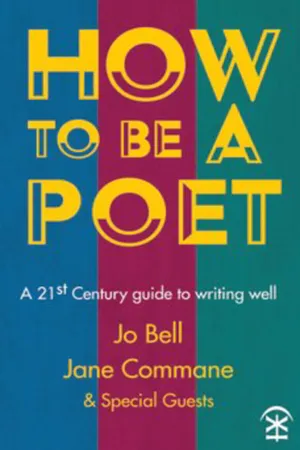
How to be a Poet is the brainchild of poet
Jo Bell and editor
Jane Commane. As a natural follow-on to the 52 Project of 2014, this book aims to help poets taking the next step in developing, working and participating in the wider creative community as a writer.
How to be a Poet combines practical advice and topical mini-essays that examine both the technical and creative dimensions of being a poet. It's a no-nonsense manual where we've replaced the spanners with lots of ink, elbow grease and edits. At each step, we ask plenty of questions: what makes a poem tick over perfectly, how do we get it started when it stalls, and which warning lights should you never ignore?
- English
- ePUB (mobile friendly)
- Available on iOS & Android
eBook - ePub
How to Be a Poet
About this book
Information
CHAPTER ONE
On Your Marks...
Let’s get this out of the way. Can we teach someone How to be a Poet? The answer is crystal clear.
No.
And yes. This project isn’t called How to Write a Poem, or How to Get Your Poetry Published, though we’ll talk at some length about both. It isn’t called Get Rich Writing Poetry because nobody knows how to do that. We called our project How to Be a Poet because it’s not just a writing manual. It’s an offering up of our own thoughts on the practice of poetry; a consideration of what poetry reading and writing can mean to a thoughtful person seeking to do both with pleasure and skill.
Certainly we can and will teach you useful things about technique. Certainly we can give shortcuts that will save you a lot of time in hitting your stride on the page, and help you to avoid the common pitfalls of writing – the traps of cliché, of being derivative, of sloppy editing. We’re well qualified. Between us we have helped hundreds of people to write like their best selves, and there is a stream of award-winning work from the poets we’ve worked with to prove it. We have also made (and continue to make) the mistakes we’re going to try and talk you out of. In poetry as in life, no-one stops learning.
Our book is only one of many you could read. Stephen King’s On Writing, Glyn Maxwell’s On Poetry, Joyce Carol Oates’ The Faith of a Writer, Ted Hughes’ Poetry in the Making, Robin Behn’s The Practice of Poetry – there’s no need to rush at the reading list. You will never get to the end of it, because some blighter always writes a new one just as you tick off the last one. Above all, as Jane will tell you, read poetry. Jane, by the way, is a much nicer person than me. I’ll be the bad cop for much of this project, chivvying and poking you to push yourself further and confront unpleasant truths. She’ll be right along with soothing advice whenever I offend you.
We’ll help you approach your own writing in such a way that you aren’t bowled over by its little disappointments, nor by its little successes. We might also help you to redefine success, and to use poetry in a way that bleeds into every minute of your day. For us, poetry is a map to navigate by, a tool to use in tackling daily dilemmas. It’s a way of sharing the experiences that go beyond small talk, and exploring the places that hurt, or shine, or sing.
That’s why we called this project How to be a Poet. Come on in.
CHAPTER TWO
How to Read Widely, and Why it Matters
We’ve said it loud and clear and in large letters at the very start of proceedings: Read Poetry. Read, for good poetry can never be written without first reading good poetry widely.
One thing heard far too frequently by creative writing tutors in workshops or mentoring sessions is the plaintive cry of ‘Oh, of course I don’t read other people’s poetry in case it influences my own’. Yet this is exactly why you should be reading poetry other than your own.
What results from the kind of mono-cultural and self-informed diet of poetry, where the only poetry being read by the poet is their own, is a thin gruel of a poem which an editor will always spot immediately. Like a wonky bicycle wheel, it is doomed forever to be out of kilter and lacking balance; it is fundamentally flawed. Without fail, these poems will display a lack of craft and a lack of awareness of how hard each line and every word must work to earn its place. It’s okay to write these kind of poems to get started, but a good poet is one who strives to move on and to write better, and seeks to take up an apprenticeship with the master craftspersons of their trade.
Can you imagine a great artist who never looks at other art, or the great musician who never listens to any other music, lest it influence their own ‘style’?
Far from it – great artists and musicians will always first find and expose themselves to a wide palette of inspiration and influences, and in the early stages of discovering their own styles, will emulate, learn from and then ultimately grow up and beyond the various influences they absorb. The more influences (and the wider the sources of those influences) you take on board, the richer and more adventurous your own writing will be. Learn from the best. Reading poetry widely gives us a chance to ask what works, and how. It allows us to take a poem apart and see the moving parts to understand the techniques, approaches, form and language at work and get an idea of how it all adds up. That is why our one major piece of advice, alongside writing the thing, and finishing the thing, is that you must read, and read widely and voraciously.
Read poems from your contemporaries and gain an understanding of what the current poetry landscape looks like. Who is writing now, what do they write about, and how? You don’t need to feel you have to copy or replicate the styles and approaches they have, but you should think about where your place is on this landscape, and which kind of approaches speak to you most directly.
Read also great and classic poems from across time and place, and from cultures and languages other than your own. Read Li Bai and Hafez and Sappho as well as Blake and Keats and Dickinson. Modern poetry in translation, and indeed the superb magazine Modern Poetry in Translation, can open doors to some incredible poetry and give you not just a local view of poetry, but a fully global and contemporary one. The widest range of influences will ensure that no one single style or voice becomes a dominant inspiration in your work.
In enjoying and discovering poetry, also allow yourself to like and dislike things. It is completely permissible to dislike a poem, or find that you don’t enjoy a particular poet’s style or approach. You should never feel that you ‘have to’ like a poem, or that you have failed if you don’t ‘get it’. So long as you always interrogate this reaction, work at it; find out perhaps that a poem does work, but is complex and rewards being poked and prodded and pondered over. Or perhaps you will discover that, for all its interesting acute angles, you and the poem still don’t quite get along, but you know why and will come to understand something of yourself and how you want to write by this. These conscious moments of realisation as to why something doesn’t quite work for you are just as valuable as the ones where a poem will come to you one day, make itself at home and worm its way into your thoughts and become a part of your daily living and being.
As a publisher, I should at this point declare that I have a professional interest in you reading (and buying) poetry. But I also recognise that not only is there a mind-boggling amount of poetry out there to choose from, but it can be expensive and that many of us lack the funds to buy as many books as we might like to. Libraries, where we remain fortunate enough to still have them, can be invaluable, and our borrowing helps them to stay open. Though not all will have extensive poetry collections, there are some notable exceptions and enthusiastic, poetry-loving librarians out there. If you’re lucky enough to be near the Poetry Library at the Southbank Centre in London, it’s free to join and there is an embarrassment of poetry riches in its collections – many of which (non-Londoners, visiting for the day, take note) can even be borrowed and posted back.
Other ways to read poetry on a shoestring or non-existent budget is to browse the wealth of resources provided by the Poetry Foundation. Their website features poems, recordings, articles, interviews and much more; the quality of the work you will encounter is guaranteed to be high, and their overview of poetry’s contemporary and modern landscapes is fairly comprehensive. And if you’re looking for an excellent introduction to contemporary and modern poetry, but are limited in funds and bedazzled by the plethora of possible books to buy, investing in a copy of the Staying Alive anthology from Bloodaxe Books, with its myriad of poets, themes, forms and styles, is a really sound place to begin. And you can’t go far wrong with the subsequent anthologies Being Alive and Being Human, either.
One last thing: poetry needs Good Readers. Most of us are happy to go to the Tate without feeling a need to become a sculptor, and few members of any theatre’s audience are there because they are aspiring actors – yet each healthy-sized audience makes sure that theatres can continue to be viable, that galleries remain open and stage new exhibitions to throngs of appreciative visitors. If ever an art form needed more audience and appreciators rather than simply more participants, it is certainly poetry. Be an active participant wherever you can, not just a passive contributor.
In the following chapter, let’s be Good Readers and put this into practice. Let’s also think about what it would mean to ‘read like a poet’, as Jo continues on this topic and asks you to read a favourite poem of hers very closely, with forensic care.
CHAPTER THREE
On Reading
Let me also reinforce the points from Jane’s previous chapter and start with a bald, clear statement. To write poetry well, you must read poetry. Reading other people’s poetry is the best way to improve your own work. If you take nothing else from this book, believe this.
Some poets see reading as a pursuit entirely separate from their writing – a distraction even. But those who are interested only in their own poetry, and not in poetry full stop, often produce work which is self-indulgent and doesn’t interest others. Reading is a way of understanding the poetry culture you’re part of, its current preoccupations and clichés. It’s also a labour-saving device. If you read attentively, every poem you read will teach you as much as three or four painful experiments in drafting.
Note that word ‘attentively’. In the ordinary way of reading we skim over the odd word, and take away a general mood or feeling. Reading as a writer requires a closer look at the work in hand. The process needn’t be painful nor spoil your pleasure, but you can read poetry in the same way that a painter looks at paintings in a gallery. The painter notes the overall effect first, like any intelligent viewer, but then interrogates the work a little to see what techniques have been used to create it.
Recently I taught a class who all agreed that a particular piece of writing was clichéd and unimaginative. Okay, I said – but which specific part of it makes you feel that? The responses varied but all were vague; ‘Oh, just all of it’ or ‘well, it’s just old-fashioned isn’t it?’ I kept bringing them back to the page – ‘Yes, but WHERE is it old fashioned? Which words, which turns of phrase, which rhymes are old fashioned?’ You can’t avoid those effects until you identify them.
That’s the secret and the purpose of reading poetry carefully. Poetry, after all, is just marks on a page. Whatever effect a poem has on you is achieved by the placement of words, line breaks and punctuation marks. Whether you find it trite or vivid or dynamic, you can look closely at it to find out exactly what is creating that effect.
I’ll talk more about that below, with an example. But where will you find the reading material on which to practice these skills? The classics of world poetry are easy to find in bookshops and libraries, and are very often free as eBooks. You also need to consume current work in reputable journals, collections and web sites. For the purposes of this chapter, ‘current work’ doesn’t mean the drafts of your peers (though you will read those too, I hope), nor the work found on those websites that accept all poems without discrimination.
Poetry journals come and go, but there are a few big names that remain constant. You don’t have to subscribe to read them. Most can be bought as a single issue, and in fact buying three single issues of different magazines will give you a better cross section of poetry culture than subscribing to a single one. You can also sample some journals online. Poetry Review is the UK flagship, publishing high-end literary poetry. You might enjoy Magma, Rialto, Poetry London, Ambit or Under the Radar (published, we must declare, by Nine Arches Press). The American journal Rattle is full of gems and offers a digital subscription. The US flagship journal POETRY is stellar and offers a wide range of styles. As Jane has mentioned, the Poetry Foundation has a great range of poems and essays online, but their free app for smartphones is the single best source I have found for poetry, throwing up random classics or new discoveries while you are waiting for a train.
If you don’t like the style of a particular publication – or if you feel it goes right over your head – that is fine. Some of the most esteemed poetry journals contain work that is technically splendid but feels no need to actually say something. One particularly high-end periodical leaves me entirely cold; as a workshopper of mine once said ‘It’s clever – but it’s nothing but clever.’ If it leaves you cold, find out why by reading it closely but don’t beat yourself up about it. You’re allowed to dislike even the greatest literary effort, with no shame, but try to pinpoint what it is that makes you dislike it.
All poetry presses are small presses. It’s good (and not entirely selfless) to support them by buying books. If you find a poet whose work you love, look at other titles from the same publisher. Seren, Bloodaxe, Carcanet, Cape and Picador are the main poetry imprints but there are many others. Arc specialise in translations, Smokestack in radical or left-wing poetry, Longbarrow in poets of the landscape around Sheffield. There are many other niche publishers in the rich ecology of letters. At the time of writing, Kindle and other eBooks are not the best way to read poetry because they can disrupt the format. Poetry is a visual format – it matters how it looks on the page – so it’s best to see it on a page or a larger screen.
Online sources are important, but not all are equal. Anyone can set up a website and some of them are a ragbag of poems accepted by an editor with little discrimination. Good online sources include Josephine Corcoran’s And Other Poems, Anthony Wilson’s archive of Lifesaving Poems, The Clearing, BODY and Angle. The Poetry Library website has a list of current online journals.
Read poets whose style is unfamiliar and perhaps even unattractive to you. Read poets of a different nationality or background, poets of different centuries, and read poets of a different gender to your own. Male readers, please trust us on this. Research including our own confirms that most men read three or four times as many books by male po...
Table of contents
- Cover
- Title Page
- Copyright
- About the Authors:
- CONTENTS
- A note to our readers:
- Welcome to How to be a Poet
- CHAPTER ONE: On Your Marks...
- CHAPTER TWO: How to Read Widely, and Why it Matters
- CHAPTER THREE: On Reading
- CHAPTER FOUR: On Listening by Jonathan Davidson
- CHAPTER FIVE: How to Learn from Art and Artists
- CHAPTER SIX: On Looking
- CHAPTER SEVEN: How to Start a Poem
- CHAPTER EIGHT: On the First Draft
- CHAPTER NINE: How to Recover from a Full Stop
- CHAPTER TEN: On the Second Draft
- CHAPTER ELEVEN: Why Use Poetic Form? by Mona Arshi
- CHAPTER TWELVE: On the Third, Seventh and Fifty-Third Draft: Fine Polishing
- CHAPTER THIRTEEN: Making Peace with Poetry by Robert Peake
- CHAPTER FOURTEEN: Interrogating the Self by Joelle Taylor
- CHAPTER FIFTEEN: On Politics and Polemics
- CHAPTER SIXTEEN: How to Explore the World of Poetry Magazines and Journals
- CHAPTER SEVENTEEN: On Submitting to Magazines and Journals: The Patented Jo Bell Method
- CHAPTER EIGHTEEN: How to Submit Your Poems
- CHAPTER NINETEEN: Why Publish Your Poetry? by Clive Birnie
- CHAPTER TWENTY: How to Polish your Manuscript for Publication: Part One
- CHAPTER TWENTY-ONE: On Getting it Wrong
- CHAPTER TWENTY-TWO: How to Polish your Manuscript: Part Two
- CHAPTER TWENTY-THREE: How a Bathtub Can Change Your Life by Rishi Dastidar
- CHAPTER TWENTY-FOUR: How to Take the Publication Plunge
- CHAPTER TWENTY-FIVE: On Success
- CHAPTER TWENTY-SIX: How to Stand Out in the Submissions Pile
- CHAPTER TWENTY-SEVEN: On Confidence
- CHAPTER TWENTY-EIGHT: How to Build a Track Record
- CHAPTER TWENTY-NINE: On Money
- CHAPTER THIRTY: When ‘Poet’ Will Never Be Your Only Title by Abi Palmer
- CHAPTER THIRTY-ONE: How to Go Live: Performing and Reading Your Poems
- CHAPTER THIRTY-TWO: On Social Media
- CHAPTER THIRTY-THREE: The Final Word
- Jo Bell’s Big Ruthless List for Poetry Writing*
- Jane Commane’s Top Ten Tips for Good Poetry Practice
- Resources for Poets
- Notes and Thanks
- Acknowledgements
Trusted by 375,005 students
Access to over 1.5 million titles for a fair monthly price.
Study more efficiently using our study tools.
Frequently asked questions
Yes, you can cancel anytime from the Subscription tab in your account settings on the Perlego website. Your subscription will stay active until the end of your current billing period. Learn how to cancel your subscription
No, books cannot be downloaded as external files, such as PDFs, for use outside of Perlego. However, you can download books within the Perlego app for offline reading on mobile or tablet. Learn how to download books offline
Perlego offers two plans: Essential and Complete
- Essential is ideal for learners and professionals who enjoy exploring a wide range of subjects. Access the Essential Library with 800,000+ trusted titles and best-sellers across business, personal growth, and the humanities. Includes unlimited reading time and Standard Read Aloud voice.
- Complete: Perfect for advanced learners and researchers needing full, unrestricted access. Unlock 1.5M+ books across hundreds of subjects, including academic and specialized titles. The Complete Plan also includes advanced features like Premium Read Aloud and Research Assistant.
We are an online textbook subscription service, where you can get access to an entire online library for less than the price of a single book per month. With over 1.5 million books across 990+ topics, we’ve got you covered! Learn about our mission
Look out for the read-aloud symbol on your next book to see if you can listen to it. The read-aloud tool reads text aloud for you, highlighting the text as it is being read. You can pause it, speed it up and slow it down. Learn more about Read Aloud
Yes! You can use the Perlego app on both iOS and Android devices to read anytime, anywhere — even offline. Perfect for commutes or when you’re on the go.
Please note we cannot support devices running on iOS 13 and Android 7 or earlier. Learn more about using the app
Please note we cannot support devices running on iOS 13 and Android 7 or earlier. Learn more about using the app
Yes, you can access How to Be a Poet by Jo Bell,Jane Commane in PDF and/or ePUB format, as well as other popular books in Languages & Linguistics & Creative Writing. We have over 1.5 million books available in our catalogue for you to explore.