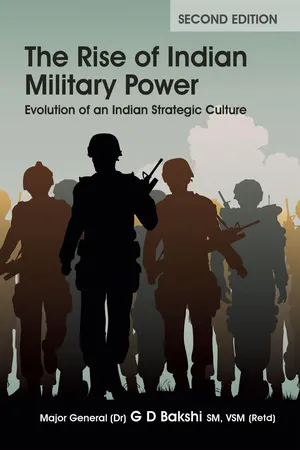
This is a monumental & epic work on India's Military History. It seeks to answer the seminal question – 'Is there an Indian Way of War-fighting and an Indian Strategic Culture?' The author has traced the history of war-fighting in India from the Vedic & Mahabharatan period to the Mauryan & Mughal Eras and thereafter the British Period. It is a comprehensive audit of India's combat performance in the ancient, medieval, modern and post-modern periods of Indian history. The focus of this work however, is on India's Post-independence Military History. The author has analysed each of India's wars with China & Pakistan as also its CI and CT campaigns in meticulous detail, to draw lessons for the future. The path-breaking contribution is the author's thesis that there have been three local Revolutions in Military Affairs (RMAs) in India, which shaped the course & flow of her history. Each of these RMAs helped to unify India under a great Empire and transformed it from a civilisational entity to a strong empire state. The first was the Mauryan RMA of using War Elephants in mass to generate shock & awe. This politically unified the whole of India and Afghanistan for the first time. The next RMA came with the Mughals who introduced Field Artillery, Muskets and Horsed Cavalry Archers with stirrups and cross bows. The Mughal horsed cavalry and artillery helped spawn the mighty Mughal Empire. The Third RMA came with the British who raised local Infantry Battalions on the European Pattern and drilled them to shoot in disciplined rhythms, to defeat all cavalry charges. This Infantry-based RMA helped establish the British Empire in India. The present Republic is a successor entity of the British Empire. The author has traced the evolution of India's Strategic Culture to the Arthashastra of Kautilya. The surprise finding is that in the 1971 War – India unconsciously returned to this Kautilyan paradigm of using information dominance, covert war and Shock- Action military campaigns to defeat its adversaries. In the post-independence phase he traces the evolution of India's war-fighting from the tactical phase of 1947-1962 when India's capacity was confined to use of 2-3 Divisions alone. The 1965 War saw the graduation to the level of Operational Art, wherein 12 Divisions and a bulk of the Indian Air Force (IAF) saw active combat. The apogee came in 1971 – when India fought a brilliant, Quasi-Total, Tri-Service Campaign that broke Pakistan into two, put 93,000 prisoners of war in the bag and for the first time after the Second World War, created a new nation state with the Force of Arms. He traces the impact of nuclearisation on South Asia and prognosticates about the Future. The time has come, he asserts, for India to create a Fourth RMA in South Asia; and decisively shape outcomes. For this, economic power must be rapidly converted into usable military power. India must field dominant war fighting capabilities in South Asia.
- 384 pages
- English
- ePUB (mobile friendly)
- Available on iOS & Android
eBook - ePub
About this book
Information
Print ISBN
9789383649495
Edition
2The relevant historical legacy of China, India and more recently Japan is that they were once triumphant states or empires with a continental reach…. This is critical to their emergence as great powers.
– Stephen P. Cohen
Military Power and Policy in Asian States: China, India and Japan
PART ONE
EVOLUTION OF AN INDIAN STRATEGIC CULTURE
A strategic culture is a distinctive body of beliefs, attitudes and practices regarding the use of force. Strategic culture is persistent over time—tending to outlast the era of its inception.
– Kerry Longhurst
CHAPTER
1
THE RISE OF ASIA: A CIVILISATIONAL OVERVIEW
Perhaps the most significant historical phenomenon of the 21stcentury has been the inexorable power shift from Europe to Asia. It is often forgotten that till the 17th century, India and China between them were generating almost 80 percent of the world’s GDP. Both these agricultural civilisations were generating huge surpluses and had massive military manpower. Their precipitate decline stemmed from their failure to keep pace with the industrial revolution. The stasis generated by stable empires of continental reach in China and India led to a relative decline in the organisation and technology for war-fighting. There was also an abject failure to grasp the nature of sea power that stemmed from an insular and continentalist mindset. Industrialisation led to the rise of Europe and the colonisation of much of Asia and Africa. Competition between the European powers over colonies, raw materials and captive markets led to the two World Wars that drained out the nations of Europe and led to the rise of the United States and the Soviet Union as superpowers. Nuclear weapons had made their debut in the closing stages of World War II and prevented the outbreak of large scale fighting in the Cold War period. What followed was an era of strategic restraint on war-fighting but unbridled geo-economic competition between the two power blocs. This enabled the ancient civilisations of India and China to emerge from the penumbra of European imperialism and colonial exploitation, and reemerge as significant players on the international arena.
The second half of the 20th century was marked by the steady rise of China as a significant military and economic power. With the “Dengist reforms” it attained self-sufficiency in agriculture and rapidly caught up with the industrial revolution to become the world’s base for cheap, mass scale and low end manufacture.
Even though India had attained its independence two years before China, its economic rise only began in the 1990s. With the first green revolution, it had attained self-sufficiency in food grains and achieved food security. In a path breaking fashion, its services sector now expanded rapidly to generate over 50 percent of its GDP. India had begun industrialisation in the public sector earlier. The economic reforms and liberalisation now unleashed the entrepreneurial energies of its middle classes. The turn of the century, therefore, saw the emergence of both China and India as major economic and military powers on the global scene. Today, the GDP of both these countries is rising dramatically. Thus, already the Indian economy is the third largest economy in the world in purchasing power parity (PPP) terms and was valued at $5.16 trillion. In terms of GDP, it was valued at $1.2 trillion and was rated as one of the fastest growing economies in the world. Its foreign exchange reserves were over $300 billion, largely due to remittances by overseas Indians and financial institutional investment. The Achilles heel of the Indian economy remains its dependence on imported fossil fuels (which currently meet 70 percent of its energy needs. This is likely to reach almost 90 percent in the next two decades).
China’s GDP, on the other hand, is over $9 trillion. It is poised to become the second largest economy in the world and, as per the Goldman Sachs report, will overtake the US economy in GDP terms by 2050. Thus, by the middle of the 21st century, both India and China will be the leading economic and military powers of the world. The historic pendulum would have completed its oscillation. The natural impact of the huge landmass, and the massive natural and human resource base of these Asian giants would assert itself and pave the way for a return to the pre-industrial revolution era when, between them, India and China generated almost 80 percent of the world’s GDP.
Massive Soviet subsidies had transformed China and India into significant regional military powers in the latter half of the 20th century itself. Soviet subsidies led to massive increments in the capital military stocks of these Asian giants and laid the infrastructure for licensed production of cutting edge technology military equipment, especially tanks, artillery and jet fighters, along with naval surface combatants and submarines. China received massive Soviet military assistance during the Korean War (till it was choked off by the Sino-Soviet dispute) but relations deteriorated rapidly thereafter. India received massive Soviet arms assistance in the 1970s and 1980s. These arms were sold at highly subsidised rates and helped India generate an asymmetric edge over Pakistan.
The People’s Republic of China had emerged from the crucible of three decades of civil war and a brutal Japanese invasion. As such, the Chinese political elite were steeped in the tradition of real politik and were adept at the use of force. The Indian political elite, on the other hand, had a pacific mindset and laid great store by soft power as opposed to hard power. Despite this pacific orientation, India had to get involved in a series of high intensity conflicts to consolidate the nascent nation state. Military conflict broke out in J&K and Hyderabad almost on the eve of independence itself. Fortunately, the Indian Republic had experienced a negotiated, non-revolutionary transfer of power from the British. As such, it had inherited intact the instrumentalities for governance. These included highly professional and combat tested armed forces that had gained valuable combat experience in World War II. In fact, at 2.5 million men, the British Indian Army was the largest all volunteer force in world history. India went on to fight a high intensity conflict with China in 1962 (which was an unmitigated disaster) and a costly stalemate with Pakistan in 1965 (which provided invaluable experience to Indian field commanders at the level of operational art). These conflicts culminated in the quasi-total war with Pakistan in 1971 which proved decisive and spectacular. For the first time after World War II, a new nation state was created with the force of arms and over 93,000 prisoners of war were taken. With Bangladesh, India had well and truly emerged as a significant military power.
This book will attempt to seek insights and overviews into India’s military historical experience over the millennia, to discern if there is an Indian way of war-fighting. Is there an Indian strategic culture that has been persistent over time and tended to outlast its era of inception? Western scholars like George Tanham and Stephen Peter Rosen have gone on record to state that India lacked a strategic culture. In fact, it had no tradition of strategic thought. Such a view is non-historical and merits refutation.
It is my contention that India has a distinct strategic culture that first crystallised around the time of the founding of the Mauryan Empire, around 300 BC. It resulted from a military clash between the Indian and Greek civilisations. This clash with the Greek non-self served to crystallise the Indian sense of self. It helped Kautilya to transform India from a civilisational to a political entity. Kautilya helped Chandragupta Maurya (Sandra Kotos to the Greeks) to transform India from a mosaic of princely states and republican clans into a highly centralised and well managed empire of continental reach. The Indian paradigm of war was premised upon mass armies (the imperial Mauryan Army had a strength of over 650,000). It overcame the Indian penchant for attrition by learning the art of manoeuvre warfare from the Greeks. It relied upon mobility and shock action generated by a huge corps of some 9,000 war elephants which created an RMA upon the Indian subcontinent. The Kautilyan paradigm relied upon information dominance and extensive covert action campaigns to destabilise the adversaries before launching a ground invasion to mop up in the wake of the destabilisation campaign.
The Indian penchant of mass armies resurfaced with the Mughuls. The Mughuls had generated the second RMA in India with their lethal combination of massed cannons, swift cavalry and musket fire. They introduced gun powder and the explosive paradigm of war on the Indian subcontinent. The elephant was too placid an animal to stand up to massed cannon fire. The tragedy of the indigenous armies was their refusal to learn and change. Babar’s small and lethal Turko-Mongol armies soon gave way to the ponderous Mughal Army, that at its peak numbered over two million. Akbar’s primary motivation to so expand the Mughal Army was simply to mop up the huge military manpower pool in India and thereby prevent it from going over to his adversaries. In fact, the military manpower pool in India at the time of Aurangzeb had crossed the four million mark. The Mughal Empire established a feudal economic basis for sustaining such a massive cavalry army. In fact, it was Aurangzeb’s mindless expansion of the Mughal Army for his campaigns in the south which caused the economic collapse of the Mughal Empire.
The British generated yet another organisational RMA on the Indian subcontinent. They exploited India’s excellent military manpower pool to raise European style native infantry battalions that were well drilled and disciplined and could fire in precise rhythms that decimated the Mughal style cavalry charges.
The British native infantry introduced the Napoleonic RMA of the first wave of warfare of lines and columns. Well drilled infantry battalions could generate rates of fire of up to a thousand shots a minute and in concert with massed artillery fire, devastated the Mughal style cavalry on the Indian subcontinent.
The British Indian Army did not remain impervious to the Indian penchant for mass. At 2.5 million men, the British Indian Army became the largest all volunteer force in the history of the world. The British turned the Kautilyan maxims of covert action and destabilisation into a fine art. Most of the British campaigns were won by such information operations and covert action. Ministers were bribed ,loyalties subverted and entire armies purchased.
The prime focus of this book, however, is not so much upon India’s past as on its post-independence military experience. The intention has been to discern patterns that tend to persist and recur cyclically. The aim has been not just to chronicle events but gain insights and learn lessons. Military history is much more than a mere litany of events or a recital of the dates of battles fought and force levels employed. A methodical study of military history must generate insights and overviews. It must identify the patterns that tend to persist over time and extrapolate these to discern trends and implications for the future.
It is, therefore, gratifying to discern a pattern in India’s post-independence wars that has roots in her civilisational past. The penchant for mass armies persists. At 1.1 million men, the Indian Army is still the second largest in the world. The reliance on mass is a natural corollary of India’s vast size and huge manpower base. Her human resource is her key strength and cannot be divorced from any calculus of power. The very primary need for internal security dictates that countries like India and China will always have to maintain massive armed and paramilitary forces. The Bangladesh War of 1971 marks a remarkable revival of the primal Kautilayan paradigm of war in the Indian subcontinent. It consisted of information dominance and psychological warfare operations, coupled with an extensive covert action campaign to destroy the politico-military balance of the adversary prior to the coup de main operations. The interesting aspect is that in Bangladesh, this process developed almost autonomously and without a conscious design. The Mukti Bahini staged a spontaneous uprising against the atrocities of the Pakistan Army and this served to destabilise East Pakistan and disrupt the politico-military balance of that state. This facilitated the Indian offensive. The contours of an Indian way of war-fighting, therefore, are clearly discernible in the war for the liberation of Bangladesh and form the essence of this book.
The second basic feature is the attempt to draw lessons specific to the subcontinental context. Lessons in terms of the political and strategic guidance of India’s post-independence campaigns, the levels of synergy and jointness, not just among the three Services but among the diverse organs of the government (to include the intelligence and police services and the bureaucracies). And lastly ,lessons that can help us to crystallise our doctrines for war-fighting and generate asymmetries over our likely adversaries through localised RMAs driven not merely by technology but equally by organisational and doctrinal changes.
An extrapolation of the patterns of the past will help us to determine the contours of our future.
Combat experience is the most valued asset of military organisations for it forms the primary touchstone of reality. It helps the organisation to validate theories and test concepts. In fact, conflicts provide invaluable combat laboratories to test organisations and equipment, doctrines and techniques and generate invaluable ORSA (operational research and statistical analysis) bases for the optimisation of weapons design. As Brig McMaster had said, “War is the final audit of military organizations.”
Today, the Indian armed forces are one of the world’s most combat tested forces in the post-War period. They have fought five short duration and high intensity conflicts, participated in two out of area contingencies in Sri Lanka and Maldives and prevailed against numerous tribal insurgencies and foreign aided terrorist movements. Despite this rich and varied combat experiential profile, we have exhibited a surprising failure to learn from our own experience; to create innovative doctrines or achieve excellence in our indigenous weapons design capability. Our failure to learn from our own combat experience stems from an inability to record it systematically, to reflect upon it, to gain insights useful to our context. There is a need to study and evaluate our extensive combat experience to optimise learning. One of the prime needs is to generate synergy between the diverse organs of the state that are required to act in concert to prosecute our wars and sub-conventional conflicts.This coordination and synergy has been a major Indian failing. Individually, the “Argumentative Indian” is brilliant. Collectively, we have problems in putting aside individual and institutional eg...
Table of contents
- Cover
- Half Title
- Title
- Copyright
- Contents
- Foreword by Lt Gen HS Lidder
- Preface to Second Edition
- Prologue: The Key Lessons of Indian Military History
- Part One: Evolution of An Indian Strategic Culture
- Part Two: Post-Independence Operations: Consolidation of an Indian Strategic Culture
- Bibliography
- Author’s Profile
Trusted by 375,005 students
Access to over 1.5 million titles for a fair monthly price.
Study more efficiently using our study tools.