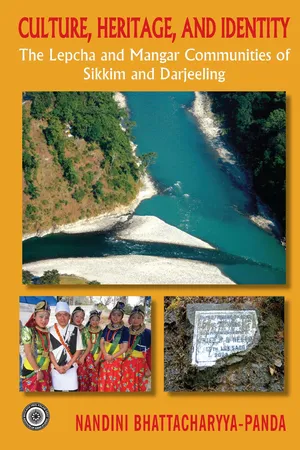
This book is about cultural politics and the quest for identity of two marginal communities of Sikkim and Darjeeling – the Lepcha and the Mangar. Sharing insights into the knowledge, aesthetics, aspirations and dreams of two marginal communities who have been innovatively and differentially appropriating 'culture' to exploit the politics of difference, it is a narrative about their ethno-cultural consciousness, notions of identity and anxieties over being minority communities in a pluralistic democracy. The narrative is essentially presented in the form of a field-trip diary, with observations and comments which try to situate the issues within a larger perspective. Based on two years of intensive field study, the book chronicles the endeavour of these two communities to reclaim their cultural past, and forge an identity that would ensure material security, self-esteem, dignity and also the fruits of 'modernity'.The book will be useful to scholars and students of anthropology, sociology, politics and history, especially those engaged in the study of culture and ethnicity in the Eastern Himalayan region.
- 118 pages
- English
- ePUB (mobile friendly)
- Available on iOS & Android
eBook - ePub
About this book
Trusted by 375,005 students
Access to over 1.5 million titles for a fair monthly price.
Study more efficiently using our study tools.
Information
Edition
11.LOCATING IDENTITY: THE HISTORICAL BACKDROP
In the absence of an archive and written traditions, complex geo-historic origin and memories of displacement, the writing of the Lepcha and Mangar communities poses challenge to a researcher of history. The anthropologists and ethnographers have constructed stories of their livelihood, food habits, religion, ritual, aesthetics and world view. But such stories essentially inhabit on the dichotomy between the ‘civilised’ and the ‘savage’, the ‘informed’ and the ‘ignorant’, the ‘advanced’ and the ‘backward’ and the ‘dominant’ and the ‘marginal’.
The ethnic communities in Eastern Himalayas made their appearance in the global knowledge only after the introduction of the British rule in the region in 1835. At that time, Darjeeling was a part of Sikkim although a large stretch within the Kalimpong sub-division was controlled by the Bhutanese theocratic regime. The British rulers annexed Kalimpong after a territorial conquest in 1864. Darjeeling was directly ruled by the British while Sikkim was converted into a suzerain state under the British protectorate.
The introduction of colonial rule completely altered the human geography of the entire region. On their arrival, the early officials and visitors in Darjeeling reported about the settlement of only hundred Lepcha families. The entire area was infested with forests and animals with sparse settlements. In major parts of Sikkim, the picture was largely the same.
Bordering with Nepal, Bhutan and China/Tibet, the Eastern Himalayan region had great strategic importance to the British rulers and they stepped into the land with a strategic mission. The ultimate objective was to build a strong military base along the borders. Over a few years, they could realize the commercial potentiality of the land by the production of finest tea along with rubber, timber and tobacco. There was rapid change in the landscape by the production of commercial crops and increasing human settlements.
The British rulers required human resources to build the imperial edifice. The Lepcha community (whom they initially encountered) refused their allegiance to the new regime. The Lepcha leaders expressed their resentment against the colonial attitude towards them. According to them, the King of Sikkim treated them with respect and dignity unlike the new rulrs (Fred Pinn). The colonial rulers dealt with their resistance through encouraging migration from the neighbouring states, especially Nepal. Subsequently, a large number of people migrated in Darjeeling and Sikkim in search of livelihood and fortune. The Nepalese immigrants found a generic definition as the Gorkhas in the colonial discourses. It is a misnomer. Gorkha is a separate ethnic community, among others from Nepal. The Mangar was also attributed with the generic definition as Gorkha.The Nepalese immigrants in Darjeeling and Sikkim still carry the legacy of a generic ‘Gorkha’ identity. Only in recent time, those people felt the urge of retracing their cultural roots and search for a new identity. The new identity inhabits on their ethnic origin and cultural difference.
The colonial experience for these communities spanning over a century was essentially a process of ethnic displacement and cultural homogenization leading to a complex socio-political developments. The ethnic communities who migrated and settled in Darjeeling and Sikkim had to adjust with the new economic imperatives and different socio-political milieu. The socio-cultural interaction of various ethnic groups in the newly emerged settlements erased distinct cultural boundaries and produced mixed cultural traits.
Around the beginning of 20th century, the educated and informed intellectuals within the migrant communities from Nepal mobilized a linguistic movement in Darjeeling harking on the concept of Gorkhali nationhood and unity which they expressed through the rhetoric of Gorkhali ekarupata (unified Gorkha identity). Initially, it was not a political movement. It focussed on the development of vernacular Nepali language was. The literary activities focused on composition of grammar, dictionary, primer and reader. The activities also encompassed translation enterprise and creative writings. Puranic and Epic texts such as the Ramayana was also brought under the foray of translation enterprise. As it is evident, the leaders of this literary movement were higher castes Hindus. The basic objective was to homogenize the linguistic and cultural traits of the migrant communities. For the non-Hindu ethnic groups, such as the Mangar, this process created a further gap between their past practices and current pursuits and thereby distanced those people from their traditional cultural forms. Gorkhali ekarupata dwelled on the idea of subsuming the cultural differences and to produce a collective identity. In the process, the cultural differences of individual ethnic groups were narrowed down. The cultural hybridity produced new cultural symbols.
The message of this language movement went across the boundary of Nepali-speaking states and countries such as Sikkim, some North Eastern states and Nepal. The language movement germinated the potentiality of a political movement that actually was given a concrete shape during the end of the 19th century. The ethnic aspirations of the Nepalese communities found expression in the demand for a separate Gorkhaland state which is still a live issue.
For the Lepcha community, the level of displacement was even more tragic. Initially, they refused to surrender to the colonial regime. In turn, the colonial rulers portrayed the Lepchas as misfit for the civilized world and were refused access to the emerging structure. The exclusion became more defined with the emergence of the Gorkhali consciousness. The Lepchas were naturally and strategically excluded from this emerging phenomenon of unified Gorkha identity. For over a century, the Lepcha community lived in the oblivion with the sticker of a ‘dying race’ or a ‘vanishing tribe’.
The ethnic communities in Sikkim were marginally affected by the new consciousness till the end of 20th century. The ‘Nepalese immigrant’ communities in Darjeeling were described as ‘Nepamul’ in Sikkim. The Tibetans were privileged groups in Sikkim for the fact that the Chogyal kings of Sikkim were from Tibetan origin. The ‘Nepamul’ groups sporadically expressed their discontent against discrimination and injustice against the ruling regimes after independence and also after its integration within the Indian Republic as a separate state in the year 1975. It does not mean that the Lepcha community was placed in a better socio-economic standing. In fact, the liminal existence of the ethnic communities both in Sikkim and Darjeeling are reflected in government documents (especially in Sikkim) and memorandum of different ethnic groups – occasionally submitted to the state and central government. Majority of the population with the marginal communities (including the Lepchas and Mangars) still live under below poverty line with little opportunities for education and employment.
The resistance against the socio-cultural subjugation was initiated in Darjeeling during the colonial period. It intensified during the last quarter of the 20th century. Subhas Ghising the leader of Gorkha National Liberation Front (GNLF) first raised the demand for a separate Gorkhaland state and asked for the secession from the state of West Bengal. The movement started with violence and anti-Bengali slogans. After negotiations with left front government in West Bengal, Ghising modified his stand and virtually withdrew from the demand of a separate state. In return, the Bengal government conceded autonomy for local administration and a political body was formed, known as Darjeeling Gorkha Hill Council.To appease and pacify his followers, Ghising adopted a populist strategy. He distributed circular to the ethnic communities in Darjeeling for submitting ethnic bio data so as to secure tribal status under Sixth schedule of the Indian Constitution. It was felt to be an immediate incentive for the mass of people to secure better prospect of life and social justice. It also ignited the cultural imagination of the people. The ethnic communities took it as an opportunity to carve ethno-cultural niche through the claim of tribal origin. Since the 1990s, each community devoted their attention to prepare their qualifying paper as a ‘tribe’. The ethnic groups addressed the tribal characteristics of their own similar to the features laid down by the Government of India:
- They possess an old dialect and language
- They have their traditional language and scripts
- They have a traditional dress code distinct from others
- The rituals and customs are unique which do not resemble with others
Over and above, the economic and social backwardness is the fundamental criteria for attaining the tribal status.
The case of Lepcha community is different. They secured tribal status in 1968 from the Government of India. But it was the Lepcha community who initiated the culture and identity movement much before the others cast their cultural gaze. The initial steps were taken in as early as 1950s under the leadership of Sonam Tserring - a musical maestro, literary personality, institution builder, visionary activist, and social mobiliser. A couple of decades, other communities have been following his trail after with similar symbols and imagination.
The emerging waves of cultural consciousness also reached Sikkim. The issues of ethnicity, culture and identity politics now have taken a large proportion in the ethno-political domain. In Sikkim, state is playing a pro-active role in the entire exercise. The present government in Sikkim extends support to the cultural activities of each community. The government goes to the extent of declaring public holidays on the occasions of festivities as stipulated in the calendar of many communities. The critics may see in this exercise an act of populism. Criticism of this kind may contain some element of truth. However, the entire exercise seems to be a visionary move. In their mission statement, the present government calls for the conversion of Sikkim into a tribal state – a call that predates a decade. The government of Sikkim appointed a Commission under B. K. Roy Burman in 2006 to probe into the tribal affairs with the objective to improve the socio-economic condition of the depressed communities. On the basis of the recommendation of the Roy Burman Commission in 2008, the present government has been negotiating with the Union Ministry of Tribal Affairs to consider the proposal of attributing tribal status to the state of Sikkim.
In contrast, the ethnic situation is rather dismal in Darjeeling. The economy is constantly facing destabilization on account of political turmoil. The concerned authorities in the West Bengal state are yet to initiate a positive move towards redressing the historic disadvantage endured by the communities during and after the colonial rule. The next chapters would situate the Lepcha and Manger communities in a historical setting.
2.LEPCHA COMMUNITY: THE IGNOBLE ‘SAVAGE’
For a long period, Lepcha community had been framed within the construct of ‘savage’ and ‘primitive. This community always appeared in the European tradition of anthropology/ethnology , as well as colonial administrative discourses, travelogue, tourist guide books, and amateur writers as inferior race. Unfortunately, such a perception still prevails in the popular imagination and also within the community itself. The revivalist movement of the Lepcha community is based on the complex dynamics of primitive vs modern.
The colonial construction about the Lepcha ethnicity was intricately linked with two issues: (a) imperial establishment and (b) land acquisition. The British rulers required manpower to build up the colonial infrastructure during the foundational phase. They could not count on the support of the Lepchas due to their refusal to act as collaborators of the white settlers. Instead, the British rulers invested their faith in the immigrant communities, especially from Nepal. The Lepcha community, being the original inhabitants controlled the land. The colonizers and the new settlers grabbed the prime land to build the colonial edifice (for example, administrative buildings, schools, colleges, churches etc) for accommodating the newly arrived immigrants and production of agricultural and commercial crops, especially tea. In the process, this community was displaced from their ancestral holdings. They withdrew to remote parts of the hills. The colonial rulrs vindicated the forcible eviction or manipulative dispossession on the ploy that this savage community was incapable to interact with a superior civilization. The ‘deserted’ land had been allotted to the immigrant community in the interest of the imperial establishment. The Lepcha community was reduced to the level of living specimen of a ‘ravine, savage and primitive tribe’, and a ‘dying race’. Due to their apparent difficulty or unsuitability to adjust with ‘modernity’ and ‘high civilisation’, a reserve was created in Zongu in the North Sikkim (a remote hill area) in the end of the 19th century. This political gesture was proclaimed as an act generosity or favour to the Lepcha community for enabling them to retain their primitive traits. In other words, the colonial rulers protected / guarded the Lepcha community against the interference / onslaughts of ‘civilisation’.
The Colonial Discourses
Compared to other ethnic groups in the region, Lepcha community attracted maximum attention from colonial officials and observers. This chapter would focus on how this community was inferiorised, romanticized and finally excluded from the ‘civilised’ society. The knowledge which was generated by the colonial official left a lasting impact on the popular imagination andon the community itself. Current revivalist agenda still operates within this paradigmatic framework to a large extent.
The intervention of Mainwaring, an army officer and an administrator in Darjeeling was perhaps most poignant and persuasive. He systematically textualised and theorised the notion of ‘primitive’ by compiling a grammar of the Lepcha language for the first time in English. In the Preface of his grammar book, he wrote:
“Of the language I cannot speak too highly. The simple and primitive state in which the Lepcha lived is admirably shown by it”. (Mainwaring, p.. xiv) PARAGRAPH
He situated the lepcha language within the framework of comparative linguistics and stated:, (the language) ‘was in likelihood, at an early period, the one, sole spoken language’. and the Lepcha language was ‘unquestionably far anterior to Hebrew or Sanskrit’ and ‘the oldest language extant’. (Mainwaring, p. xx)
Mainwaring’s narrative about the Lepcha language repeatedly uses the terms such as ‘antiquity’ and ‘primitive’ in order to indicate the savage stage of Lepcha culture and civilisation. He seemed to be rather excited to discover that ‘the Lepchas have legends in common with diverse other primitive races’. He described the Lepcha community as people with ‘primitive manners’ who retained the ‘habits of the patriarchs of old’. Mainwaring provided the rationale for physical and cultural isolation of this community. He suggested that ‘they must have remained isolated ever since such customs were in vogue’.( Mainwaring, p. xx) Mainwaring also expressed his concern over the fast disappearance of the Lepcha as a race. He felt that savage human knowledge about nature would be lost with the death of this race:
“The possessed knowledge about inconceivable variety of trees of the hills, of almost incalculable variety of plants and flowers of the hills and the forests…. This information and nomenclature extends to beasts, birds, insects – as if they were their friends and companion. But now, this simple knowledge, this simple woods and innocence and have fallen into sin and misery, and is there no one that will help them, no one that will save?” (p. xix)
In the above passage, he portrayed the Lepchas as passive, if not helpless recipients of the advanced civilisation that arrived with the British.
Like Mainwaring, other administrators and anthropologists also expressed similar observations and statements. Before Mainwaring, L.A. Waddell—an administrator in Darjeeling—drew attention to the dying’ stage of the Lepchas or the primitive state of socio-cultural traits and captured popular imagination.
Waddell used the traditional lyrics and songs of the Lepchas in order to substantiate the notions about the ‘primitive’ and ‘dying’ state of the Lepchas. For examp...
Table of contents
- Cover
- Half Title
- Title
- Copyright
- Contents
- Preface and Acknowledgements
- Introduction
- 1. Locating Identity: The Historical Backdrop
- 2. Lepcha Community: The Ignoble ‘Savage’
- 3. Present Perceptions and Pursuits: Cultural Politics of the Lepcha Community
- 4. Mangar Community: ‘Brave Warriors’ of the British Empire
- 5. Changing Perceptions of the Cultural Heritage and Identity: An Uneasy Transition
- 6. Voices from the Hills: The Field Trips
- 7. The Location of ‘Culture’: Memory and History
- 8. A Resume: Culture, Heritage and Identity: Beyond Ethnographic Subjecthood
- Select Bibliography
- The Lepcha Community
- The Mangar Community