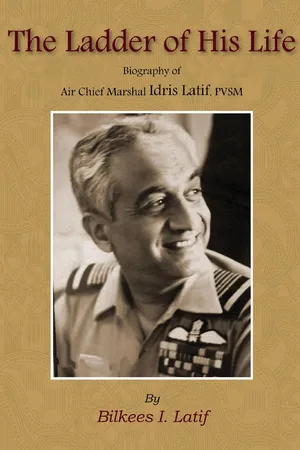
The Ladder of his Life is about Air Chief Marshal Idris Latif and his varied experiences as a fighter pilot, as Chief of the Indian Air Force, Governor of Maharashtra and Ambassador to France He is a scion of a family from which several members left eminent positions to devote their lives to follow Mahatma Gandhi. Always a topper during his education and as a flyer, as recorded in his log book, he was just 18 years old when he joined the Air Force on 1st September 1941. After his training, he was sent to the UK during World War 11 for a year where he updated his skills on the latest fighters. In 1978, he became Chief of his beloved Indian Air Force. The book gives insights into these years, particularly his assessment of challenges faced, their priorities, and his approach and actions in their resolution. The book includes accounts of interesting interactions with leading personalities such as Prime Ministers Smt Indira Gandhi, Shri Morarji Desai, Shri Rajiv Gandhi; some Ministers and respected national personalities such as Mr B.K. Nehru, and some of our own Air Chiefs. There are highlights when later as Governor of Maharashtra, he was in a totally different environment and the problems that confronted him were also very different. However, the success that he achieved, particularly as Chancellor of the University of (then) Bombay, were no less meaningful. As Chairman of the Committee for the Celebration of the 25th Anniversary of the State, his proposal to focus on the top priority requirement of every district was appreciated both by the state government and citizens. As Ambassador to France, the book stresses the heart-warming and stimulating environment, and the opportunities and achievements in the fields of culture, defence and commerce for enhancing India's image and promoting collaboration for mutual benefit. Shortly before leaving France, a suggestion by Prime Minister Rajiv Gandhi took him entirely by surprise! The book concludes with an account of a few special post retirement involvements in matters of national significance.
- 384 pages
- English
- ePUB (mobile friendly)
- Available on iOS & Android
eBook - ePub
About this book
Information
Print ISBN
9789381904855
Edition
1CHAPTER | |
01 | Who is Idris Latif? |
Who is Idris Latif? If he is to be formally addressed on any occasion, should it be as, ‘His Excellency’ as he is sometimes addressed, having been the Governor of a state? Or as Ambassador, since he was Ambassador Plenipotentiary with Minister of State rank during his three years in Paris? Or as Air Chief Marshal, the rank he finally held in his beloved Air Force? This last, I know, is by far his preference — but that also only if a formal occasion so demands.
Or, Idris Latif, who has shouldered varied responsibilities as a dedicated patriot; a Fighter Pilot, a devoted former Chief of the Indian Air Force with its outstanding personnel who were, and are, totally committed to our nation — these personnel at Air Force bases, units and headquarters located all over India — loyal and devoted, never grudging the losses of their own young lives that are the inevitable consequences of duty in the armed forces, particularly, in the Air Force, even in times of peace?
Or, Idris Latif, selected in the early 1970s, as the very first newly created Assistant Chief of Staff (Plans), and made directly responsible for planning the future shape and size of key elements of the Service? The DPSA (Deep Penetration Strike Aircraft) programme, based on the Jaguar (today a key element of our strike force), was initiated by him, and finally entered into service when he was the Air Force Chief.
Or, Idris Latif, who did so much towards the morale of Servicemen of all ranks in the Air Force — both officers and men — which had been affected due to poor promotion prospects? And who, from his very first day in office as the Chief, worked tirelessly to improve upon the human resource policies for the benefit of all personnel, and with it, importantly, improving thereby the operational capability of the Air Force?
Or Idris Latif the pilot, who fully qualified himself and flew no less than 22 different types of aircraft, including fighters, bombers and even heavy transport aircraft; and who, even in the final years of his service as the Chief, found time to fully qualify himself on the Sukhoi‐7, the MiG‐21 and the Jaguar; plus make time for familiarisation sorties on the Mirage 2000 (during an official visit to France), and, finally, the MiG‐23 and even the MiG‐25 just months after the aircraft first arrived and were being assembled, before his final retirement?
Or, Idris Latif, who, in his forty years of service, spent almost two‐thirds in Operational Units and formations and Staff appointments at Air Headquarters which had a direct bearing on the operational readiness of our Air Force — Idris Latif who, in his final three years as the Air Chief, achieved perhaps the most significant modernisation of key elements of our Air Force?
Or, Idris Latif, who, perhaps because of his forty years of man‐management in the Air Force, coupled with his integrity, loyalty and concern for the nation and its people, was so effective in his next appointment as Governor of Maharashtra?
Or, finally, the Idris Latif whose insistence on excellence in every sphere, his friendliness and charm, quick reactions and wit, elegant taste and natural warmth, made him, not only an effective Ambassador of India in France (his final government appointment), but with it, an able and effective organiser of the Festival of India?
I write about Idris Latif who has been ALL these and still is much, much more to his family and to his friends. I have tried over the last few years to get him to speak about Service life, about which we would all love to know more. He would, however, never speak on any Service matter, particularly if he felt that, at a particular point in time, security would in any way be compromised. Our children, especially the two boys, have also been very deeply interested in life in the Air Force; in fact, our younger son had got selected for the Air Force. It was quite often when the children and Idris and I were relaxing together that they would ask Idris about various episodes and which, if security considerations permitted (about which we often felt he was excessively concerned!), he related to our fascinated three children and to me. I would often jot down quick notes at the time and have used them; and, finally also, I have to say, on several occasions, I have spoken to others for this book. Idris has insisted that I should add material about myself, as, according to him, once we were married, “She was also a member of our Air Force, and over the years, on many, many occasions, proved to be a pillar of strength.” I have, therefore, with some reluctance, added accounts of some of my own far too numerous involvements.
Born on 9th June 1923, Idris joined the Air Force on 1st September 1941 and was commissioned on 26th January 1942 as Pilot Officer No: 1804 GD(P) of the Indian Air Force or, more accurately, the Indian Air Force Voluntary Reserve, as it was initially called. Following years of devoted and competent service, he was appointed Chief of the Air Staff on 1st September 1978 and retired on 31stAugust 1981, after exactly 40 years in his greatly loved Air Force. He was then appointed the Governor of the State of Maharashtra in March 1982 and, concurrently, for some time, the Lieutenant Governor (as it was then) of Goa. After three exciting and challenging years in Maharashtra, he was appointed Ambassador Plenipotentiary to the Republic of France with the rank of Minister of State for three years from April 1985.
Idris also had to decline the medal being awarded to him by the United States, after his tenure as Air Attaché at our Embassy in Washington D.C. He was informed that acceptance of such awards was against our government’s policy, at least at that time. Noteworthy also, I feel, is that Idris, in his long career of almost 50 years, never asked, or tried in any way for any appointment or position. Nor did he attempt to get out of any posting that did not attract him, for instance, a prolonged absence from active flying assignments. Offered other special appointments after returning to Hyderabad after his 50 years in government service — even another stint as Governor — he chose not to take on further official responsibilities, primarily — in fact, solely, I think — so that he could spend time with his widowed, aged and bedridden 90‐year‐old mother in Hyderabad. We have, therefore, ever since, continued to live in Hyderabad and do so with no regrets.
Among Idris’ ancestors was Sir Akbar Hydari, the late Prime Minister of the Dominions of Hyderabad. His great uncle, Justice Badruddin Tyabji was the third elected President of the 3rd session of the Indian National Congress (Madras, 1887). Abbas Tyabji, nephew of Badruddin Tyabji, and of Idris’ great grandmother, was Chief Justice of the Baroda High Court, who gave it up to join Mahatma Gandhi. During the Freedom Movement in India, on 4th May 1930, after the Salt March to Dandi, Gandhiji was arrested. Gandhiji had nominated Abbas Tyabji in charge of the next phase of the Salt Satyagraha, and it was Abbas Tyabji who then led the raid on the Dharasana Salt Works in Gujarat. Like others of his family, Idris, too, was always willing to give his life in the service of our nation.
Idris’ suggestions to the Chief of the Air Staff, Air Chief Marshal Lal (kept top secret at the time) for rendering enemy airfields temporarily unusable, were implemented and used successfully in the 1971 War. Idris was at Air Headquarters in the newly created post of Assistant Chief of the Air Staff (Plans) in the rank of Air Vice Marshal. It was in this capacity that he also carried out the demanding tasks of making first‐hand assessments of frontline combat squadrons and the modernisation plans of the Air Force. For his role, Idris received the Param Vishist Seva Medal in 1971.
Idris was in the Eastern Sector at Shillong during the 1971 conflict when the final phase of the operation leading to the surrender in (then) East Pakistan took place. He had been especially directed by the Chief of the Air Force himself, to be available at all times. He was also to, at very short notice, if the situation demanded, personally organise and monitor, in consultation with the Air Force formation directly concerned, any task that he (the Chief) may entrust to him. On a very memorable occasion, when at Shillong (the Headquarters of Eastern Air Command), on Air Chief Marshal Lal’s personal telephonic directions at 8 o’clock one morning, Idris became directly involved in organising the exceptionally accurately timed and superbly executed rocket attack by our fighters, on the Circuit House in Dhaka. Idris had apparently been told by the Air Force Chief that an urgent meeting of the Governor’s Council had been called there by the East Bengal Governor for a major policy decision, and the timing was of critical importance. Two independent sources confirmed later that the rockets struck the building with exceptional accuracy. Just minutes later, as a direct consequence, the Pakistanis decided that their forces should unconditionally surrender (more on this in Chapter 15). Our Army had fought brilliantly and it was rightly appreciated and given full credit. But it was widely acknowledged that the contribution of the Air Force, under the inspiring leadership of Air Chief Marshal Lal, was exemplary in every way. Indeed, it was of critical importance to the quick and successful outcome of the war.
On his return to Air Headquarters at the conclusion of the war, Idris, as Assistant Chief of the Air Staff (Plans), authored a detailed report on the lessons learnt for planning the future of the Air Force; in particular, the modernisation of its strike element by the acquisition of combat aircraft, including the Jaguar.
Finally, perhaps just a year before his retirement, Idris initiated the Light Combat Aircraft (better known as the LCA). Recently, he explained to me its critical importance: it was high time, he had strongly felt, to once again try and reverse our almost total dependence on imports for our Air Force’s strike force, particularly considering the government’s enormous investments of national resources in Hindustan Aeronautical Limited (HAL). Secondly, it was necessary to ensure a timely replacement for our ageing MiG‐21 fleet. Also, keeping in mind the continuing paucity of funds and HAL’s limitations, particularly in design and development, we should not aim for a sophisticated aircraft and, consequently, a much more expensive one. Calling it the LCA would, thus, help underline the critical importance of the LCA being a Low Cost Aircraft also. Idris said that his senior‐most Air Force Commanders and Staff, Chairman HAL and the Defence Ministry (including the Scientific Adviser to the Defence Minister), all agreed, and the LCA project, happily, became a unanimous decision.
Right up to the end of his career in the Air Force, Idris’ love for flying remained. He always, like most other pilots of the Air Force, wanted to fly and fly! One of his last acts before retirement was to fly the tri‐sonic MiG‐25, which had been assembled on high priority by Air Force personnel from the semi‐knocked down condition in which it had been dispatched from, what was then, the Soviet Union.
The children and I never got involved in, nor discussed, any of his assignments. Once I was in Mumbai in 1971 at a party when one of the guests asked me something about one of our aircraft. I was completely ignorant about it and did not even recognise the name of the aircraft he mentioned. He laughed when I said that my husband never discussed these things with me, and added that there were crates full of spares of these aircraft with their name on them, all lying at the docks for everyone to see, so why was there such secrecy? However, that was how it was. Service matters were not discussed with the families, which was and is a good policy. I found our stay in various places certainly challenging, but each also soon very enjoyable. In fact, even following our marriage, the transfers were so frequent that finally we chalked up a total of 28 homes that we moved to.
After 57 years of married life together, I decided to write this book in consultation with our three children, Mariam, Asad and Asgar, in spite, I have to add, of Idris’ great reluctance to having a book written about him. He has always shunned publicity for himself — except when it is linked to praise for our Air Force! We, the family, consisting of our children and grandchildren, however, felt that his life should be recorded — not only as Chief of the Indian Air Force, Governor of Maharashtra and Ambassador of India to France with Ministerial status, but as a man of true values.
Idris is warm, loving, caring and quick‐witted, with an easy sense of humour. He insists strictly on discipline, thoroughness and perfection in his own actions and in the actions of those around him. He is a human being with a quick brilliance, absolute integrity, patriotism and dedication to the nation, and a stickler for punctuality and duty, as well as correct Service protocol. He is an instinctive gentleman and never uses foul language or swear words, even when he is in a temper. Idris is a man of many interests and many talents. For Idris, his life in the Air Force, which he served for forty years, was his true vocation. Till today, this Service remains his deepest involvement. Yet he fitted in perfectly as Governor of Maharashtra, and again as Ambassador of India to France.
Idris has had infinite faith in God, and has no doubt that He would never, ever forsake him. However, I do know that his last few years in Service, before he was appointed Chief, were his most difficult ones. Still, I will not write about all that he had to face, particularly as, with Idris, his principles, and foremost amongst them is loyalty to the Service (which includes subordinates and superiors alike), are unshakable. Speaking ill of a superior, particularly in public, we have both always agreed, is, in fact, being disloyal to the Service. Idris is a perfectionist and whatever he does is invariably completed with a real touch of excellence.
It was a great honour that Idris’ name came up for consideration for President of our country. The first time was while he was Ambassador Plenipotentiary to France. We got to know of it when we received newspaper cuttings from Maharashtra. One of the cuttings is shown here.
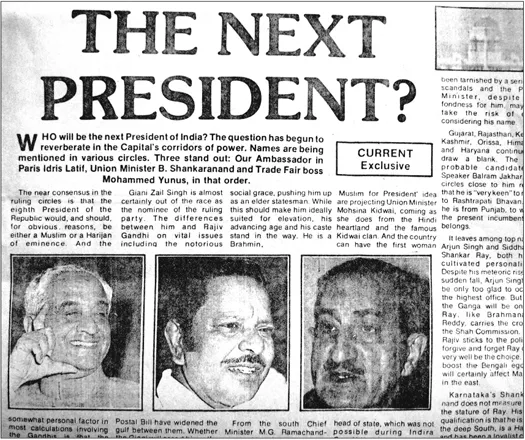
A press cutting received while in Paris, late 1980s
While Idris was serving in France, he was asked in very great confidence by Prime Minister Rajiv Gandhi if he would agree to be the Vice President of India. Idris said that he was deeply, very deeply, touched and highly honoured to be considered for such an office. However, he sincerely felt temperamentally unsuited for the position, particularly as his insistence on a very high standard of discipline, which has become so much a part of him, may well prove to be, politically, in the Rajya Sabha, a cause of serious embarrassment for the government.
We are both now happily settled in Hyderabad, Idris involved in his hobbies and family, helping others, when he can. He has been offered several assignments but prefers not to take on more responsibilities. Our time together has been very precious. We share many views and interests, but have very different ones too, so that our years together have never been dull, in fact, always stimulating. Our years together here in Hyderabad have been precious, and our greatest boon has been our wonderful children, their lovable spouses and most beautiful five grandchildren, with their values, integrity, caring and qualities of head and heart.

The following will give an idea of Idris’ outlook and thoughts through his Address to the Air Force Stations on taking over as the Chief of the Air Staff.
Over the years, our Air Force has grown enormously and our Stations, Squadrons, Units and Depots are, today, spread right across the length and breadth of India. My visit to this station, therefore, has necessarily to be somewhat brief. And it will not, unfortunately, be possible for me to meet too many of you individually, but I am happy at the opportunity to speak to you at least collectively, so that I may s...
Table of contents
- Cover
- Half Title
- Title
- Copyright
- Dedication
- Contents
- Preface
- 1. Who is Idris Latif?
- 2. Some of Idris’ Distinguished Ancestors
- 3. Stepping Stone: School, College and into the Air Force
- 4. Into the Cockpit
- 5. Fighters at Last
- 6. Wings Over Burma
- 7. Selection Board, Dehradun, During Partition
- 8. Playing with Fire
- 9. In Command of a Fighter Squadron
- 10. At Last, a Co‐Pilot
- 11. To Delhi as Deputy Director Weapons
- 12. Across the Seas, A Hand of Friendship
- 13. Hyderabad: Commanding Two Training Wings
- 14. Uncharted Waters
- 15. Air Defence of Our Eastern Frontiers
- 16. In Command of 2 Wing, Pune
- 17. Shaping the Future of the Air Force
- 18. Air Officer Administration and on to Central Air Command
- 19. Maintenance Command: A Vital Link
- 20. Vice Chief of the Indian Air Force
- 21. In the Hot Seat
- 22. Memory Holds the Door
- 23. Akbar Road: Air House
- 24. Farewell to Arms
- 25. Governor of Maharashtra
- 26. At Raj Bhavan: Administration
- 27. Environmental Initiative and Other Involvements
- 28. Ambassador Plenipotentiary
- 29. France: A Stimulating Challenge
- 30. A Potpourri of Continuing Concerns
Trusted by 375,005 students
Access to over 1.5 million titles for a fair monthly price.
Study more efficiently using our study tools.