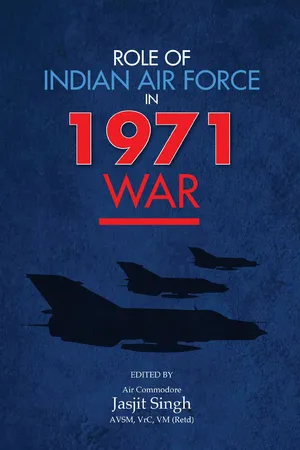
The Indian Air Force which was initially created as an independent military force proved to be an independent and versatile component of India's military power in 1971 War. This book provides insightful essays and material to critically review and revalidate some of the continuing concepts and approaches to the planning and execution of military operations. This edited version delves into the national interest protection and legitimate compulsions for India to go into war. The compilation also lays out the canvass for a comparison study with the one in 1965. The analyses on military strategy of Pakistan and avenues of shortcoming in joint planning bring out important lessons in force employment. The aggressive dimensions of offensive actions by all the three Services have been well documented.The 1971 War proved the heroism, steadfastness and courage of junior leadership that, incidentally, has also been the hallmark during Kargil in 1999. Despite frequent criticisms on jointness, instances of combined resoluteness and mutual trust during 1971 War contributed immensely to the victory. Valuable lessons can be inferred from instances where objectivity in political decisions brought about judicious outcomes through demonstrable use of military power.The book also provides a few analytical horizons on the background framework of Simla Agreement and certain events in the past that could have developed a different template for history. Air power may be difficult to understand but an evaluation of the purpose, cost and expected gains as evident from various instances of history including 1971 War would bring an end to many irreconcilable and inchoate debates. This book makes for a compelling read for those in quest of understanding the competence of air power and its dominant influences to shape victory.
- 230 pages
- English
- ePUB (mobile friendly)
- Available on iOS & Android
eBook - ePub
Role of Indian Air Force in 1971 War
About this book
Information
Print ISBN
9789381904503
Edition
1Force Levels in the 1971 War
○VIKRAM MUNSHI
Origin of Air Power in British India
Traditionally, the British were averse to allowing Indians a role in military aviation. In April 1927, the Skeene Committee finally recommended an air element for the Indian military after training at Cranwell. Thereafter, the concept of an Air Force independent in status and equal to that of the Army took root. The Indian Air Force Bill was passed by the Legislative Assembly and the Indian Air Force Act came into force on October 8, 19321. However, the new ‘Air Force’ remained under the authority and supervision of the Commander-in-Chief of India, an Army General till independence and thereafter evolved as a truly independent force.
In April 1933, four Wapiti biplanes formed the first partial squadron of the Indian Air Force which increased to four squadrons to cater for Allied requirements in World War II, and further to ten squadrons by February 1944, with Vengeance and Lysander bombers, Spitfire and Hurricane fighters.
Origin of the Indian Air Force
On partition, the undivided Air Force comprised eight fighter and two transport squadrons of which six fighter and one transport squadrons were allotted to India.2 The newly formed Royal Pakistan Air Force (RPAF) and the Royal Indian Air Force (RIAF) also took over Royal Air Force (RAF) aircraft and assets within their territory as the Britain left their colony.
The RIAF was modelled as a balanced force and needed an adequate fighter force for air defence and an equal strike force for offensive operations apart from close support to the Army and Navy. In 1949, only a ten-squadron force was approved by the Defence Committee of the Cabinet but with training and other facilities to serve a 20-squadron Air Force later.3 This comprised Hurricanes, Spitfires, Tempests, Vampires, Dakotas and US Air Force (USAF) Liberators.4
In the next three years, the strength of the Indian Air Force (IAF) was enhanced to 15 squadrons and the new units were equipped with French Ouragons or Toofanis.5 Plans to modernise the Pakistan Air Force (PAF) under the USMAP in the mid-Fifties, spurred India to double her Air Force in the next ten years to around 30 squadrons.6 This expansion saw Gnats and Mystere IVAs being inducted. Additionally, Canberra light bombers for three bomber squadrons plus were acquired to modernise the bomber force and phase out the vintage Liberators. Eventually, the Hunters were also included in the force augmentation7. As the offer of the French Mirage-IIIs and US F-5As did not materialise, India acquired MiG-21Fs and FLs to complete a force of 25 combat squadrons. By the time hostilities erupted in September 1965, only seven MiG-21s had been inducted and were too few to make an impact on the war.8 A total of eight and a half squadrons of MiG-21s and six and a half squadrons of Su-7s were inducted before the Indo-Pak War of 1971.9
The officially admitted IAF losses in the war of 1965 were 59 aircraft out of which 50 were combat aircraft.10 This equals the loss of three squadrons, amounting to 12 percent of its holdings.
Formation of PAF
The Pakistan Air Force was formed as a tactical air force whose primary function was to provide direct and indirect support to the ground forces. In order to exert its influence in support of the ground forces in the earlier stages of a conflict, it aimed to establish a favourable air situation. Therefore, it formulated both offensive and defensive means to deny the enemy free use of Pakistani air space. The offensive task was to attack bases, aircraft, air logistics, airfield installations, radars and other enemy facilities to reduce pressure on Pakistan’s air defences and a step towards establishing control of the air to ensure smooth close air support operations for the Pakistan Army. Its final aim was to achieve air superiority over the battle area through both defensive and offensive operations, followed by battlefield support to the Pakistan Army in every way, while maintaining that superiority.11 The PAF has grown into a formidable fighting formation since August 14, 1947.
According to the compromise recommendations of the Chairman Armed Forces Reconstitution Committee (AFRC), Pakistan was allotted three squadrons on an ad hoc basis as per division of the British Indian Air Force on operational requirement, which amounted to a third of the undivided Air Force rather than on the existing communal ratio which comprised the original terms of reference of the AFRC.12 At formation, the PAF comprised 220 officers and 2,112 airmen and this was about 20 percent of the undivided British Indian Air Force.13
At the time of independence, the RPAF finally received 16 Tempest fighters, 8 Dakotas, 20 Harvards, 10 Tiger Moths for training and 10 Auster observation aircraft distributed in two fighter squadrons and a transport squadron in addition to an Air Observation Flight.14 With these aircraft and additional two Halifax bombers which were inducted towards the end of the 1947-48 War, the Royal Pakistan Air Force flew 437 sorties in supply drops, communication duties and reconnaissance roles in Bunji, Chilas, Gilgit, Skardu and Occupied Kashmir.15 This rather frugal force was strengthened with additional Tiger Moths, Tempests, Harvards, Vikings and Bristol Freighters, immediately after independence, from the US and UK. The Fury, Attacker and Aiglet aircraft were inducted soon after to give new teeth to the PAF.
Subsequently, enhancing their strength by inducting numerous aircraft, the PAF underwent a major modernisation in 1957 under USMAP when the Americans agreed to supply combat aircraft for almost 11 squadrons.16 The total induction under USMAP enhanced the RPAF to the following level:
- Seven fighter-bomber squadrons and one day interceptor squadron of F-86F Sabre jets apart from six in the jet conversion school totalling 102 F-86F Sabres.17
- One air superiority fighter squadron of F-104 A/B Starfighters (9 Squadron) had 14 aircraft.18
- Two light bomber squadrons of B-57B/C, adding to 26 aircraft.19
- One jet conversion school which had 15 T- 33 20 and six F-86F Sabres.
- One air rescue squadron/Flight which was equipped with 8 H-19D, 6 H-43B helicopters and 4 SA-16 Albatross amphibians21
- One reconnaissance flight, with two RB-57Fs and six RT-33s22.
- One flying training centre (PAF Academy), with T-37s.23
- Transport aircraft squadron-one (C-130/ L382B) - six aircraft24
- Radar and navigational aids: 2 X FPS-20 &FPS—6 radars.
- Bases modernised under US assistance ...
Table of contents
- Cover
- Half Title
- Title
- Copyright
- Contents
- Contributors
- Keynote Address
- Inaugural Address
- Causes of the 1971 War
- Revisiting 1971 War and the IAF’s Role: India’s Interests and Compulsions
- Force Levels in the 1971 War
- Indian War Aims and Objectives
- Pakistan’s Military Strategy
- Jointness in the War
- Indo-Pak War in the Eastern Theatre, 1971
- War in the Western Theatre
- Higher Defence Organisation in War
- The Simla Agreement and After
- IAF in the Indo-Pak War 1971: An Assessment
- Valedictory Address
Trusted by 375,005 students
Access to over 1.5 million titles for a fair monthly price.
Study more efficiently using our study tools.