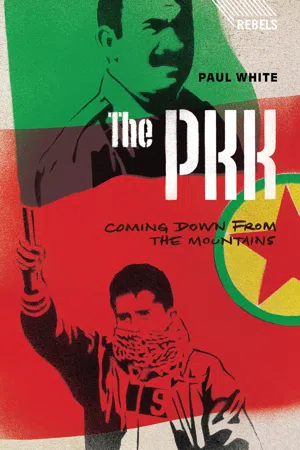
The Kurdistan Workers' Party (PKK) is infamous for its violence. The struggle it has waged for Kurdish independence in southeastern Turkey has cost in excess of 40,000 lives since 1984. A less-known fact, however, is that the PKK now embraces a non-violent end to the conflict, with its leader Abdullah Öcalan having ordered a ceasefire and engaging in a negotiated peace with the Ankara government. Whether these tentative attempts at peacemaking mean an end to the bloodshed remains to be seen, but either way the ramifications for Turkey and the wider region are potentially huge.
Charting the ideological evolution of the PKK, as well as its origins, aims and structure, Paul White provides the only authoritative and up-to-date analysis of one of the most important non-state political players in the contemporary Middle East.
- English
- ePUB (mobile friendly)
- Available on iOS & Android
eBook - ePub
ONE
‘The time of revolution has started’
‘Events, however great or sudden’, as John William Draper once reflected, ‘are consequences of preparations long ago made’ (Draper, 1875, vol. 2: 152). The emergence and evolution of the Partiya Karkerên Kurdistan provides sound verification of this astute observation. It was the product of nationalist and protonationalist uprisings and events hundreds of years earlier, which had divided Kurdistan into enclaves subservient to domination by a number of foreign states, as Figure 1 illustrates.
The Kurdish and Turkish left in Turkey almost universally regard Turkish Kurdistan as feudal. PKK Serok (Leader) Abdullah Öcalan is no exception, still maintaining:
the Kurds have not only struggled against repression by the dominant powers and for the recognition of their existence but also for the liberation of their society from the grip of feudalism. (Öcalan, 2011: 19)
As several scholars have observed, the actual picture in Turkish Kurdistan is more complex. In fact, all ancient Anatolian society stagnated under a dominant ‘Asiatic’ mode of production. Interaction with Europe increasingly evoked feudal forms there from the seventeenth century onwards. But Mustafa Kemal’s Turkish nationalist takeover in 1923 ushered in an openly modernizing regime – albeit Turkey remained a weak, underdeveloped economy, subordinate to the economies of those great powers that had successfully industrialized centuries earlier. Nevertheless, Turkey was integrated into the world economy during the 1920s and experienced real growth, including industrialization from the 1950s onwards.

FIGURE 1 Map of Kurdistan
Yet Turkish Kurdistan stumbled backwards in comparison, relatively speaking. Peasants have remained mostly landless. Kurdish economic development problems were not resolved by the economic modernization of the 1980s onwards, and political ‘democratization’ was not achieved for the Kurds. The Kurds were effectively excluded from citizenship.
As Majeed R. Jafar (1976) masterfully explains, the Kurdish region in modern Turkey is not merely underdeveloped, like Turkey as a whole, but is an exceptionally underdeveloped sector within the latter – or, as he puts it, Turkish Kurdistan suffers from ‘under-underdevelopment’. Zülküf Aydin (1986) shows that the region’s peasants remained mostly landless sharecroppers. He verifies the general verdict of severe economic underdevelopment for the region. Aydin, along with Ronnie Margulies, Ergin Yıldızoğlu (1987) and Kemal H. Karpat (1973), explain how the mechanization of agriculture, beginning in the 1950s, forced vast numbers to migrate either to western Turkey or even abroad. The landless rural Kurds who remained were caught in a horrendous poverty trap, as not even a modest degree of stunted industrial development in Turkish Kurdistan soaked up the jobless and underemployed.
The continuing war in Turkish Kurdistan has massively impacted upon all who live there. Kurdish sociologists estimate that about 3,500 Kurdish villages have been destroyed, rendering some 4 million people homeless. Severe unemployment prevails even in Amed (Diyarbakır), the largest city. In Turkey as a whole the mean annual income is US$7,000, whereas in the four poorest neighbourhoods in Amed it is a mere US$500 (Tatort Kurdistan, 2013: 70; Cagaptay and Jeffrey, 2014: 10).
İsmail Beşikçi’s Doğu Anadolu’nun Düzeni: Sosyo-ekonomik ve Etnik Temeller (1969) documents the serious effects of agricultural mechanization on the Kurdish region’s economy. Seyfi Cengiz’s work (1990; n.d.) establishes that, despite grave economic underdevelopment in the region, a Kurdish working class not only exists but periodically organizes strikes and other forms of economic and political struggle, both inside and outside the trade unions. Basing himself on Turkish government statistics, Cengiz proves his case, showing that industrial activity by Kurdish workers in the region is intimately connected to similar action by workers throughout the Turkish state. This is potentially significant for understanding the objective factors impelling Kurds into political action, for Kurdish industry and economy today are linked with Turkish industry and economy, not that of Kurdistan as a whole. Cengiz’s research thus reveals potential counter-pressures to Kurdish nationalism in Turkey.
Precursors of the PKK
Taking its prehistory into account, a schematic chronological typology of the Kurdish national movement in Turkey from its earliest murmurings up to the present day would be as follows:
• 1514–1879: the period from division to the Sheikh Ubaydallah rebellion.
• 1879–1908: the period from the defeat of Ubaydallah to the (Turkish nationalist) Young Turk rebellion.
• 1908–1925: the period from the Young Turk rebellion to the Sheikh Said rebellion.
• 1925–1938: the period from Sheikh Said’s rebellion to Dêrsim (Tunceli).
• 1938–1965: the period from the Dêrsim rebellion to the dawn of the modern national movement.
• 1965–the present: the period of the modern national movement.
All of these risings unquestionably took place on the historic territory of Kurdistan, although – as discussed in the present writer’s earlier book on the Kurds (White, 2000) – the Kızılbaṣ and Zaza peoples also claim most of them. Naturally, modern Kurdish nationalists reject these claims, also asserting that the Kızılbaṣ and Zaza are Kurds. It is quite clear that the modern Kurdish national movement considers this asserted rebellious patrimony essential for its legitimacy.
These rebellions were all evoked by a heady mix of territorial particularism (the desire to rule their own lands themselves) and economic motives. Sheikh Said’s 1925 rebellion was also animated by Islamic concerns. The modern Kurdish national movement is the product of the interaction of territorial particularist and economic motives, with leftist political radicalization, in the wake of Turkish political development and the explosion of radicalism in Western countries during the 1960s. It is Kurdish leftist political radicalization, especially, which differentiates the modern Kurdish national movement from its historical antecedents.
Emergence of the modern Kurdish national movement
In May 1960, Turkey’s armed forces – which since the establishment of the Turkish Republic in 1923 have considered themselves the Republic’s guardian – staged a military coup. The military hierarchy asserted that the military has both the right and the responsibility to intervene in affairs of state when absolutely necessary in order to guarantee the system’s continuance. It was not a left-wing coup, but the military brought in a new, and surprisingly democratic, constitution. The prime minister and two of his ministers were executed and hundreds of right-wingers were imprisoned in 1961. The result of all these events was an unprecedented leftist resurgence.
From 1968, a rising tide of strikes began, supplemented by left–right political violence, culminating in a series of political murders in early 1970. Hundreds of thousands of workers and students repeatedly clashed with police on the streets. On 12 March 1971 another military coup took place.
For a brief moment during this period, the need of the 1960 junta to repress the right allowed the left a breathing space. A staggering range of leftist publications emerged – from radical populist and social democratic in inclination, such as Yön, Ant and Türk Solu, through to ostensible Marxist, ‘Marxist–Leninist’ and Maoist. All of these groups looked towards a leftist reworking of the tradition of military intervention in national politics. In this scheme, the elite, technocrats (including, in some versions, the students) and officers would lead Turkey ‘independently’ on behalf of the workers and rural poor – ‘for the people, despite the people’. ‘Students would agitate, officers would strike, and a national junta would take power’ (Samim, April/May 1981: 65–72).
This strategy soon proved to be a failure. The radicalism sweeping across Western countries in the 1960s then swept over Turkey as well – despite the reality that in this country right-wing radicalism had a much stronger popular base than in Europe at the time. Left-wing radicalism in Turkey now took the shape of a different leftist approach, the urban guerrilla strategy of Che Guevara (Landau, 1974: 31).
Turkish Kurdistan was not immune to these developments. Indeed, many Kurdish intellectuals were deeply affected by the political cauldron of 1960s’ Turkish politics. Confused political and organizational links soon developed between the movements in Turkey proper and these intellectuals (Bozarslan, 1992: 97–8). Crucially, this confused intellectual leftist renaissance occurred at a time when Turkey’s
Kurdish population … was both more mobile and more susceptible to influence from regions to the West. Migratory movements, which were intensified by industrialization, ultra-rapid means of communication and the massive presence of Kurdish students in major Turkish towns, together with a more heterogeneous political environment were crucial in transforming East–West relations in Turkey. (Bozarslan, 1992: 98)
A number of bilingual (Turkish/Kurdish) nationalist journals emerged, only to be swiftly suspended (Kutschera, 1979: 4–5). Then in 1965 the Democratic Party of Turkish Kurdistan (PDKT in Turkish) was formed (Vanly, 1986: 64). The new party name referred to the Iraqi Kurdish Democratic Party of Iraq (KDP), founded and led by the famous Barzani clan, although in the beginning it was controlled by Ibrahim Ahmad, who had nothing to do with the Barzanis. At the time, the KDP was waging a highly successful guerrilla war against the Ba’athist authorities in Baghdad (Bozarslan, 1992: 98–9; Kutschera, 1979; More, 1984: 68, 70, 193–4; Ghareeb, 1981: 7–8; Kendal, 1982: 91–2).
The PDKT was never an effective organized force. Nevertheless the social and political issues that ripped it apart in the late 1960s were significant for the emergence of a fully modern national movement of the Kurds. At their core, these disputes involved the role of both traditional leaders and intellectuals in the Kurdish national movement and the relationship of the national movement itself towards the international working-class movement (Bozarslan, 1992: 98–9). The PDKT was clearly unable to adapt to the rapid radicalization occurring among Kurdish workers and intellectuals during the late 1960s. The organization was soon branded ‘bourgeois nationalist’ by most of the radicalized Kurdish organizations that subsequently emerged.
The catalyst of racist provocation
Kurdish resentment was growing, spurred on not just by centuries of perceived ill treatment, but also now by immediate outrages. In April 1967, a provocative article appeared in the extreme right-wing Turkish magazine Ötüken, journal of the far-right Milliyetçi Hareket Partisi (MHP – Nationalist Action Party). The article stated that the Kurds were a backward people, devoid of history and culture, who wanted to cut Turkey into pieces. The author suggested that the Kurds get out of Turkey, since Turkey was only for the Turks, adding that Kurds ‘do not have the faces of human beings’ (cited in Vanly, n.d.: 41–3).
Demanding that Ankara punish the author and ban the magazine (Section 12 of the Turkish Constitution proclaimed the equality of all citizens), a furious Kurdish protest movement erupted. The government did nothing, even when a follow-up article appeared in the June issue of Ötüken, entitled ‘The Howlings of the Red Kurds’, which declared:
the Kurds may represent a majority as high as 100 per cent of the population of the eastern provinces; yet their dreams to establish a Kurdish state on the soil of Turkey will always remain a dream comparable to that of the Armenians in a Greater Armenia…
But the day when you will rise up to cut Turkey into pieces, you will see to what a hell we shall send you… (cited in Vanly, n.d.: 42)
The Kurds were well aware that the Armenians were massacred by the Ottoman Turks (with assistanc...
Table of contents
- Cover
- About the Author
- Title
- Copyright
- Contents
- Glossary of Organizations, Cities and Towns
- Glossary of Key Figures
- Chronology of Significant Events
- Introduction
- 1. ‘The Time of Revolution has Started’
- 2. PKK Origins and Ideological Formation
- 3. Early Years of Struggle
- 4. From Ceasefire to All-Out War
- 5. The Move Towards Peace
- 6. Democratic Confederalism and the PKK’s Feminist Transformation
- 7. Coming Down from the Mountains
- References
- Index
Trusted by 375,005 students
Access to over 1.5 million titles for a fair monthly price.
Study more efficiently using our study tools.
Frequently asked questions
Yes, you can cancel anytime from the Subscription tab in your account settings on the Perlego website. Your subscription will stay active until the end of your current billing period. Learn how to cancel your subscription
No, books cannot be downloaded as external files, such as PDFs, for use outside of Perlego. However, you can download books within the Perlego app for offline reading on mobile or tablet. Learn how to download books offline
Perlego offers two plans: Essential and Complete
- Essential is ideal for learners and professionals who enjoy exploring a wide range of subjects. Access the Essential Library with 800,000+ trusted titles and best-sellers across business, personal growth, and the humanities. Includes unlimited reading time and Standard Read Aloud voice.
- Complete: Perfect for advanced learners and researchers needing full, unrestricted access. Unlock 1.5M+ books across hundreds of subjects, including academic and specialized titles. The Complete Plan also includes advanced features like Premium Read Aloud and Research Assistant.
We are an online textbook subscription service, where you can get access to an entire online library for less than the price of a single book per month. With over 1.5 million books across 990+ topics, we’ve got you covered! Learn about our mission
Look out for the read-aloud symbol on your next book to see if you can listen to it. The read-aloud tool reads text aloud for you, highlighting the text as it is being read. You can pause it, speed it up and slow it down. Learn more about Read Aloud
Yes! You can use the Perlego app on both iOS and Android devices to read anytime, anywhere — even offline. Perfect for commutes or when you’re on the go.
Please note we cannot support devices running on iOS 13 and Android 7 or earlier. Learn more about using the app
Please note we cannot support devices running on iOS 13 and Android 7 or earlier. Learn more about using the app
Yes, you can access The PKK by Doctor Paul White in PDF and/or ePUB format, as well as other popular books in History & Middle Eastern History. We have over 1.5 million books available in our catalogue for you to explore.