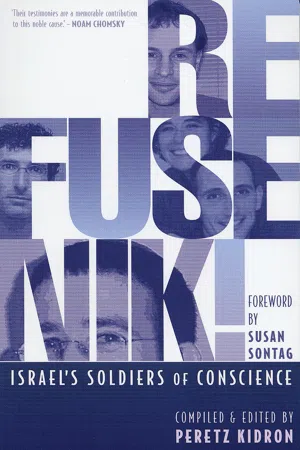
Hundreds of Israeli soldiers, called up to take part in controversial campaigns like the 1982 invasion of Lebanon or policing duties in the Palestinian territories today, have refused orders. Many of these 'refuseniks' have faced prison sentences rather than take part in what they regard as an unjust occupation in defence of illegal Jewish settlements.
In this inspirational book, Peretz Kidron, himself a refusenik, gives us the stories, experiences, viewpoints, even poetry, of these courageous conscripts who believe in their country, but not in its actions beyond its borders.
We read about the cautious, even embarrassed, response of the authorities. And we see the wider implications of the philosophy of selective refusal - which is not the same thing as pacifism -- for conscientious citizens in every country where conscription still exists. Here is a real model for the peace movement in Israel and worldwide.
- English
- ePUB (mobile friendly)
- Available on iOS & Android
eBook - ePub
About this book
Information

The second Palestinian uprising, or intifada, erupted in September 2000, following the collapse of the peace process and in response to a long series of Israeli provocations. These culminated in the controversial visit by then opposition politician Ariel Sharon to the Islamic shrine in Jerusalem, the Dome of the Rock. The Israeli army had long prepared for the confrontation with a series of measures that included training combat units for assaults on Palestinian villages. The repression was infinitely more brutal than in the first intifada, with Israeli troops instructed to use live gunfire against Palestinian protesters usually armed with nothing more than stones. As the conflict flared up, Palestinians too resorted to their guns, whereupon the Israeli command committed tanks, helicopters and combat planes. A wave of Palestinian suicide bombings, mainly directed at Israeli civilians, heightened the ferocity of the standoff and united the majority of Israelis around the official campaign of repression.
Up to the second intifada, the overwhelming majority of refuseniks were reservists called in for a few weeks of annual service. Conscripts rendering their standard three years of compulsory service were usually too overawed by the strict discipline to which they were subjected, and only a mere handful showed any resistance. That is not to say that young soldiers involved in the fighting did not suffer severe pangs of conscience. Their moral dilemma had been presented, with bitter irony, in a letter one young conscript had written to a newspaper in February 1988, during the first intifada. Dov Barak had continued to do military service in the occupied territories.
Letter to the editor of Koteret Rashit from Dov Barak
In all the difficult predicaments, in every war, a faithful individual is expected to risk his life, and render it up, for values. All the struggles our people has gone through in the battle for its very survival, its right to exist on an equal basis with other nations, the struggle by Jews to be considered human and live as such – have taken their bloody toll. The military authorities are authorised to order you to waive your humanity during wartime, and to become a machine; you become a machine, as does the enemy you face. It is exclusively in the army, during wartime, that human consciousness is capable of denying itself.
A short break; ladies and gentlemen are invited to sip coffee and nibble cake, for the introduction will be followed by the denouement: awareness.
I, a proud young Jew, nineteen last summer, want to tell you about what you call ‘an iron fist’, or ‘application of reasonable force’ This isn’t a televised ‘report from the occupied territories’ or ‘weekly diary’. It’s an attempt to tell you what passes through my mind under my steel helmet and behind the defensive uniform.
The heavy club in my right hand, my Galil assault rifle in the left, and I, like my fellow-conscripts, keep order, enforce the curfew. Carry out my superiors’ orders and those of authority. I stand behind the newspaper report that ‘order has been restored in the Palestinian refugee camps’.
Sip your coffee, it’s getting cold, take another bite of cake, light a cigarette. Don’t worry: you might be indignant, maybe hope and pray; but I’m here, beating, carrying out my orders to the letter, and gradually going crazy.
Like everything else in the IDF, the club too can be divided into three parts: the fist, the club and the head. At the first blow – I recall it was at a woman’s shoulder – I was horrified, I shut my eyes and prayed in my heart for her not to feel the blow, that it would evaporate in some miraculous manner, that I wouldn’t harm her. In time, I learned the lingo: blocking blow, direct blow, limb-breaking blow – all of them ‘reasonable’ blows. After intensive drilling, I developed the required skills: for a blow that breaks anything, you have to raise the club in a circular movement, two thirds of the length of the target with the desired force – that makes it ‘reasonable’.
Curfew at the Herpa refugee camp. All is deserted; no-one is outside, only soldiers and dogs. Suddenly a kid crosses the road: he may resemble your child, at a run. Curfew is curfew and orders are orders. Beatings are a matter of routine, but in this instance, how irritating, my consciousness awoke to declare: ‘A child is a child. Even if he’s a warmonger and a little son-of-a-bitch, he’s a child.’ My destructive consciousness, fruit of years of humanitarian upbringing, took up a defensive posture, enfolding and protecting the child, in order also to protect itself with all its might. But I’m a soldier, I’m obedient, and I raise the club.
With trained blows and employing reasonable force, I demolish consciousness. When my consciousness is destroyed, I discover myself no longer human but a wild animal, and recall Jewish history 45 years back, as I stand there in uniform and steel helmet, with club and rifle but no consciousness. The kid is loaded on a truck to be taken to hospital, and the curfew is enforced.
•••
In its bid to crush the second intifada, the army command flung a new generation of 18-year-old soldiers into a bitter confrontation with the Palestinian population. For a brave handful of youngsters, the horrors surrounding the campaign of repression helped break the pattern of compliance prevalent hitherto among the young recruits. Familiar, like most Israelis, with the refusenik movement, a group of high school students (shministim i.e. pupils of the top class) awaiting induction wrote a joint letter to prime minister Ariel Sharon, putting him on notice that they would not take part in the campaign of repression. Published initially with 62 signatures, it snowballed into a massive protest, and the number of signatories soon rose to over 300. When the time came for their induction, the youngsters backed words with deeds. Numbers of them refused to don uniform, and were subjected by the military authorities to savage retribution aimed at breaking their spirits.
Letter from the Shministim*
to prime minister Ariel Sharon
to prime minister Ariel Sharon
We the undersigned, youths who grew up and were brought up in Israel, are about to be called to serve in the IDF. We protest before you against the aggressive and racist policy pursued by the Israeli governments and its army, and to inform you that we do not intend to take part in the execution of this policy.
We strongly resist Israel’s pounding of human rights. Land expropriation, arrests, executions without trial, house demolition, closure, torture, and denial of health care are only some of the crimes the state of Israel carries out, in flagrant violation of international conventions it has ratified.
These actions are not only illegitimate; they do not even achieve their stated goal – increasing the citizens’ personal safety. Such safety will be achieved only through a just peace agreement between the Israeli government and the Palestinian people.
Therefore we will obey our conscience and refuse to take part in acts of oppression against the Palestinian people, acts that should properly be called terrorist actions. We call upon persons our age, conscripts, soldiers in the standing army, and reserve service soldiers to do the same.
Signed by: | |
Haggai Matar, | Reut Katz, |
Yair Hilo, | Yoni Cohen, |
Sahni Werner, | Amir Melanki, |
Neta Zalmanson, | Uriah Oren, |
Ra’anan Forschner, | Tali Lerner and others |
Matan Kaminer, |
STATEMENTS BY JAILED CONSCRIPTS
Those who enlist and those who don’t
18-year-old Uri Yaakovi sent the following letter to the daily Ha’aretz on 18 August 2002, two days ahead of his enlistment date. He did indeed refuse to enlist and was jailed. Earlier, Yaakovi had been an active member of the Shministim group of high school students who wrote to Sharon.
Two days from now, I won’t enlist. I’ll get on the bus with the other inductees and after we get off at the intake base I, unlike the rest, will refuse to be conscripted, and I’ll probably get sent to prison where I’ll encounter my colleagues of the Shministim letter. They, like many others, have grasped that the campaign Israel is conducting in the occupied territories – like many other wars in the course of history – is not the ‘war of the sons of light against the sons of darkness’.
When we hear on the foreign media that Israeli tanks are thundering through the streets of Palestinian cities (for some reason we rarely get to hear this in the Israeli media) we don’t hear the whole truth. The sad truth is that what the IDF does in the occupied territories goes beyond tanks demolishing the civilian infrastructure, or soldiers at road blocks delaying women in childbirth or just plain callousness towards Palestinian civilians. Our soldiers find themselves in difficult predicaments; some also make mistakes. But they kill children and old people who certainly are unconnected to any terrorist activity, demolish the homes of entire families and commit other actions best defined as ‘terrorism’. All these actions are unforgivable, and I refuse to take a hand therein. There is no justice in them, no reason in the world – certainly not the wish to colonise another stretch of land – that makes them morally correct, just as attacks on Israeli civilians are neither correct nor moral.
I don’t know whether the Palestinian leadership seeks peace. I don’t know whether the Palestinians want to remain forever impoverished and disadvantaged (though I find it hard to believe they do). I just know that the Palestinians don’t want us as their occupiers. I know they don’t want to live in combat and witness the continued bloodshed. I know it isn’t them who force us to occupy them; we do it very well without their assistance.
I am not proud of my people, I am not proud of my state, I am not proud of the actions being carried out on behalf of my security, I am not even proud that I’m about to go to jail over my refusal to serve in this army of occupation (and I’m not even overjoyed at being given the opportunity to suffer for my convictions). I am proud of being attentive to the voice of my conscience, and I shall be delighted if others are attentive to theirs, rather than to what they are told by their commanding officers.
Militarism and racism have reached a fascist level
Haggai Matar, who comes from a family of political activists, was a leading light in the group of Shministim who wrote to Sharon and other ministers putting them on notice that they will take no part in the repression in the occupied territories. Matar issued his statement on the day of his induction, which was also the date of his imprisonment for refusal to enlist.
Today, 23 October 2002, I will be sent to the military prison, as a result of my insistence upon my political views, which prevent me from enlisting in the IDF.
Despite my young age, merely 18, and despite the fact that I do not bear with me memories from Israel’s past, I can wholeheartedly declare that Israel has reached an unprecedented moral low. This extreme deterioration began with ‘Barak’s generous offers’, which were but another attempt at forcing a unilateral agreement upon the Palestinian people. Today, militarization and racism among the Jewish population have reached a fascist level. The repression of critical thinking, the total acceptance of the occupation’s crimes, the idolization of the army and the gradual acceptance of the principle of ‘ethnic cleansing’ – all these constitute only part of our society’s collapse. To this list one should add the systematic mistreatment of the Palestinian citizens of Israel, the hateful violence addressed at peace demonstrators, and the heartless attitude towards the abnormal and the weak. With all these, I refuse to cooperate.
The voice of conscience and the lessons humanity should have learnt from countless similar situations in the past leave me no choice but to refuse enlistment to the Israeli army – which is falsely dubbed a ‘Defence Force’. My refusal to enlist is inevitable. The oppression known by the peoples of this area in the age of the Empires, the torment of the slaves and the Indians in North America, the Algerian War of Independence and apartheid in South Africa – all these precedents have made my refusal inevitable. My grandfather’s actions in the Second World War, in his fight against Nazi Fascism, and his belief in humanism – these too lead to my refusal. At home I learnt of oppression and justice. In the face of such evil as one may find here and now, there is no other way.
On this significant day of my life, accompanied by my supportive family and friends, I wish to acknowledge my companions, the unseen heroes of our struggle: the Palestinian who endures the occupation without turning to violence against the Israeli civilian population, in spite of his lack of hope for a decent life; the Palestinian citizen of Israel, who keeps striving for coexistence despite day-to-day humiliations; the youth who avoids serving the occupation, her upbringing notwithstanding; the European peace activist, who physically defends Palestinians in the Occupied Territories; and my friend, a girl raised in a right-wi...
Table of contents
- Cover
- About this book
- About the editor
- Title Page
- Copyright
- Contents
- Boxes
- Dedication
- • Foreword
- • Introduction: Israel’s Refusenik Movement
- • The Early Refuseniks
- • The First Intifada
- • The Philosophy of Selective Refusal
- • The Story of Yuval and Imad
- • The Second Intifada
- • Closing Statements
- • List of Addresses
Trusted by 375,005 students
Access to over 1.5 million titles for a fair monthly price.
Study more efficiently using our study tools.
Frequently asked questions
Yes, you can cancel anytime from the Subscription tab in your account settings on the Perlego website. Your subscription will stay active until the end of your current billing period. Learn how to cancel your subscription
No, books cannot be downloaded as external files, such as PDFs, for use outside of Perlego. However, you can download books within the Perlego app for offline reading on mobile or tablet. Learn how to download books offline
Perlego offers two plans: Essential and Complete
- Essential is ideal for learners and professionals who enjoy exploring a wide range of subjects. Access the Essential Library with 800,000+ trusted titles and best-sellers across business, personal growth, and the humanities. Includes unlimited reading time and Standard Read Aloud voice.
- Complete: Perfect for advanced learners and researchers needing full, unrestricted access. Unlock 1.5M+ books across hundreds of subjects, including academic and specialized titles. The Complete Plan also includes advanced features like Premium Read Aloud and Research Assistant.
We are an online textbook subscription service, where you can get access to an entire online library for less than the price of a single book per month. With over 1.5 million books across 990+ topics, we’ve got you covered! Learn about our mission
Look out for the read-aloud symbol on your next book to see if you can listen to it. The read-aloud tool reads text aloud for you, highlighting the text as it is being read. You can pause it, speed it up and slow it down. Learn more about Read Aloud
Yes! You can use the Perlego app on both iOS and Android devices to read anytime, anywhere — even offline. Perfect for commutes or when you’re on the go.
Please note we cannot support devices running on iOS 13 and Android 7 or earlier. Learn more about using the app
Please note we cannot support devices running on iOS 13 and Android 7 or earlier. Learn more about using the app
Yes, you can access Refusenik! by Peretz Kidron in PDF and/or ePUB format, as well as other popular books in Historia & Historia del mundo. We have over 1.5 million books available in our catalogue for you to explore.