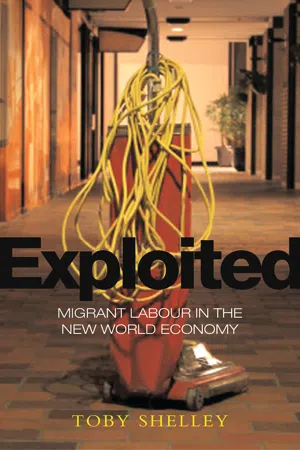
From cleaning to construction, from agriculture to domestic work, every day migrant labourers are exploited and enslaved. Extra hours are squeezed out of Polish food packers, and trafficked African children are used for forced labour. Low wages are used to drive down prices from the oil industry to airport services.
In this book, Toby Shelley shows that current unprecedented flows of migrant workers are a direct result of economic liberalization. The appalling conditions and legal abuses which confront these workers are not a premodern aberration, but an integral part of the global economy. Shelley argues that even governments, keen to protect big business, are complicit in this exploitation; their 'law and order' approach on immigration being part of this complicity.
Based on interviews and investigations with workers, unionists and activists, Exploited is a powerful and shocking read.
- English
- ePUB (mobile friendly)
- Available on iOS & Android
eBook - ePub
1
Migration in Context
Daybreak brought a massive new assault on the fence that separates Melilla from Morocco. On this occasion, some 700 immigrants had taken part in the attack, demolishing the fence, and some 300 had managed to enter Spanish territory, according to the Civil Guard sources, despite the military deployment that has supported the Civil Guard in manning the frontier since last week. The incident took place at five in the morning in the Chino neighbourhood zone, one of the points of the Melilla fence that has been raised from three to six metres … Four Civil Guards and three soldiers were variously injured by rocks hurled by the attackers … Among the immigrants also there were many wounded.1
It is the fourth assault in six days: a thousand immigrants tried to get over the fence in two waves on the 27th of September; 650 at a single go tried it on Sunday … yesterday [the government] announced the urgent construction of a new security structure. This new fence will be placed around the exterior iron fence and will consist of a series of metal bars embedded in the ground and linked with cables.2
The imagery is clear. This is medieval siege warfare. Hordes of the great unwashed hurl themselves at the ramparts of Europe, using makeshift ladders to clamber over the defences of Spain’s colonial enclaves in northern Morocco. Some 20,000 were waiting in Algeria, intending to make their way to Ceuta and Melilla with another 10,000 already in Morocco, according to the European Commission.3 They use military tactics in their desperate efforts, say Spanish officials.4 In the hinterland, in the hills and woods they mass their forces for the next assault, while Spain bolsters its defences and drafts in troops from the Spanish Legion. There are deaths. Five migrants died one morning attempting to get into Ceuta, at least three displaying bullet wounds that Spain blamed on Moroccan security forces.5 They were not the only deaths in a drama that played out over weeks until the fences were too high and the numbers of defenders too great and the numbers of migrants depleted as they were repatriated by Morocco to Senegal, Guinea Conakry, Ghana and Mali, bundled over the Algerian frontier or abandoned in the Western Sahara.
Months later the militarisation of another border was under way to stem the infiltration of Mexicans and other Latin Americans into the USA. In a prime time television speech to the nation President George W. Bush said he would send 6,000 National Guard soldiers to the frontier, bringing the total to 18,000. The speaker of the house, Dennis Hastert, said: ‘The decision to send troops is the shot in the arm we need to strengthen our borders and protect our families.’6 By mid-September 2006, the House of Representatives had passed the Secure Fence Act, calling for 700 miles of fencing along the Mexico–US border. If Ceuta and Melilla recalled earlier depictions of European history, the militarisation of the southern extremities of the USA draws on the myths of the Old West, the Alamo, the right to bear arms cherished by unhinged survivalists and vigilantes alike. So, the Friends of the Border Patrol was formed in California to spot illegal aliens and ride horseback along the frontier. Already in Arizona there was the Minutemen, an organisation that claims to be 1,000 strong, with accountants and publishers as well as ranchers in its membership.7 It claimed its patrols, some of them armed, had cut illegal migration by 98 per cent in one month. It had plans to form groups in another nine states.8 The increased militarisation of the frontier has pushed more and more would-be migrants to use the services of the ‘coyotes’ or people-smugglers, who have been able to raise their prices. Meanwhile, 500–1,000 people a year die trying to cross the border.9
August 2006: back to Spain’s African outposts but this time the Canaries, lying offshore of the Western Sahara. Day in, day out, the front pages of Spanish newspapers are dominated by accounts of the arrival of overcrowded boats bearing sub-Saharan Africans on to the tourist beaches of the archipelago, 17,000 in eight months according to El Periódico.10 Almost 1,000 people arrived in a single day in a flotilla of small, crammed cayucos, reported El País.11 To the knowledge of the Spanish authorities, hundreds die attempting the crossing in a year, and no one knows how many bodies and overturned boats are never recovered. The journey has got longer as well. The route into the Canaries used to be through the Western Sahara, where criminal gangs benefited from the blind eye turned by Moroccan occupation forces. After pressure from Spain that route was sealed, so the operation switched as far south as Senegal. Madrid moved to block that route as well, but the boats will continue to depart from somewhere, Mauritania, Gambia or back to the Western Sahara, with bigger inducements for corrupt officials and higher prices for passengers. The journey takes about a week and only around half the vessels make it, the rest being turned back or disappearing into the Atlantic. A place for the perilous journey costs between $800 and $1,250.12
Another desperate sea route is undertaken from Tunisia and Libya to the Italian Mediterranean possession of Lampedusa, where over 10,000 would-be immigrants arrived between January and September 2006. Again, many never even arrive:
Yesterday, the rescue teams recovered the bodies of 10 people and found alive another 70 who were travelling in a boat that overturned to the south of the island. The number of victims can be multiplied by four as 40 of the 120 immigrants who were travelling in the accident-hit sailing have disappeared.13
The drama of the storming of the fortifications at Ceuta and Melilla, and the pathos of the survivors of the boat crossings, well illustrate the lengths to which migrants from the global South will go to reach countries where they believe they can find work, opportunities for themselves and the means to support families at home. But they represent only a tiny fraction of the flow of migrant workers entering Spain without the required documentation. Catalonia was allocated 800 of those who arrived in the Canaries in the summer of 2006, just 0.3 per cent of the estimated total of immigrants without correct paperwork living in the region. By far the major route of entry is across the open border with France or through airports on tourist visas.14
In Britain the inflow of migrants has generally lacked the drama and the pathos of Melilla or Tenerife. That is not to say it lacks its horrors. The fifty-eight corpses found in a lorry in 2000 shocked the country, but who remembers, for example, the two who died of dehydration when they were dumped from a truck in rural south-east England in June 2006?15 Migration has soared up the news agenda nonetheless. Until the closure of the Sangatte refugee camp in 2003, footage of refugees trying to board vehicles bound for the Channel Tunnel fuelled the panic over asylum seekers, many from Kosovo, entering Britain. But since the Blair government’s crackdown on asylum seekers – boasting ‘that removals of failed asylum seekers is at its highest rate ever, while asylum intake is at its lowest level since 1993’16 – the spotlight has come to rest on those coming to Britain primarily to seek work.
Stereotypes, myths and obsessions
The considerable flow of workers from the European Union’s 2004 accession states prompted media attention that produced a crop of headlines over the summer of 2006 from a chauvinistic press: ‘Giving British jobs to foreigners is a recipe for national suicide’ opined the Daily Express;17 ‘Jobless up 92,000 as Poles flood in’, it had headlined the day before; and two days later it ran with ‘Halt the tide of EU migrants … HIV children bringing timebomb to Britain’; the Sun managed ‘Migrants get Brits’ pay slashed by 50%’;18 while the broadsheet Daily Telegraph said ‘Unchecked immigration is putting Britons out of work’,19 and reported the next week that since the Labour Party took power Britain had seen ‘by far the highest level of inward migration in the country’s history’.20
While the national press has largely concentrated on the impact of inward migration on the economy, not far below the surface lie other debates and neuroses. Former Labour minister Frank Field questioned whether current levels of immigration were acceptable. ‘This is the most massive transformation of our population. Do we just merely accept this as another form of globalisation? That it doesn’t matter where you are, or that you belong to a country and have roots? That we are all just following the jobs?’ he said to the BBC news website.21 Only the ineptitude of the far-right British National Party had prevented it from exploiting the situation, he added.
An obsession with a mythical national identity under constant threat from multitudes of incomers has been a feature of British political life since the end of the Second World War. Its expressions have ranged from the open racism of the ‘No blacks, no Irish’ notices in boarding-house windows and National Front ‘martyr’ Robert Relf, who advertised his house for sale to a white family only, through local opposition to the settlement of Vietnamese refugees in the 1970s, to the vilification of asylum seekers in the late 1990s. The inward migration of white central Europeans from the historically Christian accession states has not, by definition, fostered a racism based on skin colour or prejudice about ‘alien’ cultures, even if confrontation between migrants and members of the host community is reported in local newspapers. The received caricature of the Poles – by far the largest accession state community in Britain – is of hard drinkers and hard workers who fought with the British in the Second World War and suffered under Stalinism. But the stereotype built up of Bulgarians and Romanians as their countries’ accession approached is more sinister – corruption, organised crime, HIV infection. This is something akin to stereotyping of Chinese migrants as either victims or members of snakehead gangs, Colombians as suspect drug smugglers, or Nigerians as fraudsters. It facilitated the decision to refuse Bulgarians and Romanians the same entry rights as citizens of Poland and the other 2004 accession states. Then there is the subtly encouraged demonising of the Muslim communities in Britain, which is an internalisation of the specious generalisations of the ‘War on Terror’. Indeed, one suspects that with the waning grip of the ‘War on Terror’ and its attendant overseas adventurism and policy blunders on the popular imagination, the migration issue is being elevated to the status of next national crisis. The control of migration is a new governmental narrative, building on popular concerns, emphasising them, linking them to other anxieties like crime and security and then presenting ‘solutions’ to bind the electorate to the government. Margaret Thatcher, when she was prime minister, created the ‘enemy within’ from the trade union movement. The Blair government used ‘Muslim extremists’ and then undocumented migrants in a subplot. Linking the two are the demonised ‘asylum seekers’.
It bears repeating that inward migration, far from imperilling Britain’s identity (or set of identities), has actually defined it. What would Liverpool be without its close association with Ireland? And what of Bedford without the 10 per cent of the population that is first-, second- or third-generation Italian? A Birmingham without balti houses or hip-hop blasting from cars in Winson Green would be stranger to even a middle-aged white resident than being transported to Bucharest. To take another urban area, a study commissioned by the Learning and Skills Council focusing on the Thames Gateway (and also rural Norfolk) remarked,
The very concept of ‘migrant’ poses difficulties in some parts of the Thames Gateway (especially in the East End). The whole area of the East End is traditionally a ‘migrant community’, and has been attracting migrants for many years: both past and present, it is a ‘migrant community’.22
In media and political discourse there is a shifting hierarchy of incomers. Asylum seekers are divided between the ever smaller category deemed to be genuine political refugees the government has no option but to let through the door and the closet ‘economic migrant’ judged to be claiming persecution at best in order to find a job but most likely, according to tabloid innuendo, to feast on the bones of the UK welfare system. Other categories of economic migrant include those who have been smuggled into the country – either criminals or victims. Then there are the upfront migrant workers who come in from all over the world and are welcomed and valued until unemployment numbers rise or the number of incomers strains inadequate public services.
The distinction between political and economic migration is frequently specious. At the crudest level, how do you categorise someone seeking a better life than the increasingly grinding poverty induced by the persecutory political programme of the Mugabe regime in Zimbabwe? If an asylum seeker, once in Britain, seeks to work to provide for herself and remit money to family at home, does that render her an illicit economic migrant who should be deported or a potentially valuable member of society? A Chinese community activist asserts that there was a shift in the presentation of incomers from eastern Europe and China after the collapse of the Soviet Union. During the Cold War, the incomers were presented as defectors from repressive regimes. They were part of the ideological armoury of the contest. With the end of the Cold War and the establishment of strong economic ties with China, they no longer serve a political function and are characterised as economic migrants. This leads to the absurd situation where the long-term indigenous unemployed are condemned as scroungers but asylum seekers who seek out employment, personify the work ethic, are damned as frauds. Apparently, it is a test of political persecution at home that one submits to inactivity and impoverishment in exile.
Push and pull – why people migrate
There are push-and-pull forces at work in the decision to migrate. Jonathan Moses, in a book arguing for the abolition of border controls, points out that push factors must be powerful to drive people from their home:
Most people, given the opportunity, will not choose to move from their family, friends and home. Indeed most immigrants yearn to return home and many eventually do. It is only under the most hopeless conditions that potential emigrants consider the exit option, and only a fraction of these have the character, contacts and resources to carry it off.23
Of course, the hopeless conditions to which Moses refers do exist in much of the world. Indeed the International Organisation for Migration calculates that 192 million people, 3 per cent of the world’s population, live outside of their own country, a number that is growing at 2.9 per cent a year.24
People move from country to country for a variety, and often a combination, of reasons. Work is enormously important, but of official entrants into OECD countries in 2004, only in Switzerland, Denmark and Portugal did i...
Table of contents
- Cover
- About the Author
- Title Page
- Copyright Page
- Contents
- Acknowledgements
- Introduction
- 1 Migration in Context
- 2 Migrant Labour
- 3 Impacts
- 4 Government Response and Responsibilities
- Conclusion
- Notes
- Index
Trusted by 375,005 students
Access to over 1.5 million titles for a fair monthly price.
Study more efficiently using our study tools.
Frequently asked questions
Yes, you can cancel anytime from the Subscription tab in your account settings on the Perlego website. Your subscription will stay active until the end of your current billing period. Learn how to cancel your subscription
No, books cannot be downloaded as external files, such as PDFs, for use outside of Perlego. However, you can download books within the Perlego app for offline reading on mobile or tablet. Learn how to download books offline
Perlego offers two plans: Essential and Complete
- Essential is ideal for learners and professionals who enjoy exploring a wide range of subjects. Access the Essential Library with 800,000+ trusted titles and best-sellers across business, personal growth, and the humanities. Includes unlimited reading time and Standard Read Aloud voice.
- Complete: Perfect for advanced learners and researchers needing full, unrestricted access. Unlock 1.5M+ books across hundreds of subjects, including academic and specialized titles. The Complete Plan also includes advanced features like Premium Read Aloud and Research Assistant.
We are an online textbook subscription service, where you can get access to an entire online library for less than the price of a single book per month. With over 1.5 million books across 990+ topics, we’ve got you covered! Learn about our mission
Look out for the read-aloud symbol on your next book to see if you can listen to it. The read-aloud tool reads text aloud for you, highlighting the text as it is being read. You can pause it, speed it up and slow it down. Learn more about Read Aloud
Yes! You can use the Perlego app on both iOS and Android devices to read anytime, anywhere — even offline. Perfect for commutes or when you’re on the go.
Please note we cannot support devices running on iOS 13 and Android 7 or earlier. Learn more about using the app
Please note we cannot support devices running on iOS 13 and Android 7 or earlier. Learn more about using the app
Yes, you can access Exploited by Toby Shelley in PDF and/or ePUB format, as well as other popular books in Economics & Political Economy. We have over 1.5 million books available in our catalogue for you to explore.