In the wake of socialism's demise and liberalism's loss of direction, new ideas are needed for the next major realignment of the social and political domain. Making a unique contribution to the idea of 'the commons', this book offers a radical form of direct democracy with real-world implications. But whereas much of the current scholarship has looked at the commons from the perspective of governance, this book instead focuses on 'commoning' as social practice.
Perspectives on Commoning argues that the commons are not just resources external to us, but are a function or characterisation of what we do. Thus, we can talk of the act of commoning, positioning our behaviour beyond the domains of the private and the public, beyond the dichotomy of capitalism versus socialism.
Covering everything from biopolitics to urban spaces, this impressive range of international contributors address the commons as both theory and history, providing a useful review of current conceptions as well as practical proposals for the future. A unique consolidation of philosophy, sociology and economics, the book shows how a new understanding of the commons as practice will help to achieve its full emancipatory potential.
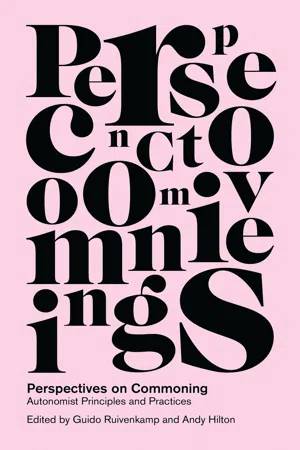
eBook - ePub
Perspectives on Commoning
Autonomist Principles and Practices
- 352 pages
- English
- ePUB (mobile friendly)
- Available on iOS & Android
eBook - ePub
Perspectives on Commoning
Autonomist Principles and Practices
About this book
Information
Chapter 1
The prefigurative power of the common(s)
Introduction
If we want to grasp how capitalist structures and relations are resisted from and by ‘the common’ and/or ‘commons’, we need to ascribe a certain power to it/them. This power, moreover, must be substantially and essentially different from capitalist forms of power. First and foremost, it needs a conceptualisation ‘from below’. The objective of this contribution is to provide such a conceptualisation, for which purpose three central concepts are employed: ‘prefiguration’, ‘potentia’ and ‘power-to’.
First, I define and conceptualise the notion of ‘prefiguration’. Prefiguration or ‘prefigurative politics’ is an experimental political practice in which the ends of one’s actions are mirrored in the means applied in their realisation. These ends are thereby conceived as inherent in the practice itself and their immediate realisation is aimed at. In other words, from a prefigurative perspective on political practices, the oppositional relations between means and ends and between a ‘future ideal’ and the ‘here and now’ are problematised. However, as I will argue, this concept of prefiguration needs further politicisation outside the context of contemporary anarchist theory. What is more, this concept could also be useful to our endeavour of conceptualising a power from below and offers us a valuable perspective on various conceptualisations of resistance as it occurs today. Second, two closely related yet significantly different concepts of power from below are defined and compared. To begin with, I look at Antonio Negri’s notion of ‘potentia’ or ‘constituent power’. Departing from the Spinozist opposition between potentia and potestas, Negri’s conceptualisation of the former as a historical and non-dialectical understanding of power will be reconstructed. Then this concept is related to his contemporary work on ‘the multitude’, and finally reconceptualised as a prefigurative form of power. I describe potentia/constituent power as an active potential that creates an ‘outside’, but ‘inside’ the capitalist relations and structures it seeks to confront.
Next, I turn to John Holloway, another contemporary autonomist thinker, who is often related to and compared with Negri but who departs from a significantly different ontological background. His conceptualisation of power from below, which he terms as ‘power-to’, is also reconstructed. As opposed to ‘power-over’, power-to is presented as an alienated capacity, a potential that seeks actualisation but is limited by a power ‘from above’. Holloway argues that power-to breaks through this alienated form of itself and thus creates spatial-temporal ‘cracks’ in the texture of capitalist relations and structures. Power-to is equally termed as a prefigurative power, which constructs a ‘beyond’ and sheds light on a future to come.
After that, Holloway’s concept of power-to and Negri’s potentia are juxtaposed, along the lines of the conceptualisation of prefiguration. In presenting both as prefigurative understandings of power, I investigate the consequences and implications these divergent conceptions have for our understanding of current forms of resistance against capitalist structures. Finally, these differences are further concretised through a comparison between (Hardt and) Negri’s concept of ‘the common’ and Holloway’s reference to ‘commons’. This also allows us to grasp the prefigurative characteristics of (the production of) the common and/or commons in its/their antagonist relationship to capitalist structures and relations.
Prefigurative politics: mirroring means and ends
Resistance to capital comes in many forms. Diverse and heterogeneous as they may be – from relatively spontaneous expressions of public space occupation and mass street protest to ‘direct action’ networks and ‘civil society’ projects seeking to implement alternative forms of cooperation and production – many of these resistances share, to a greater or lesser extent, a form of political action in which means and ends are not strictly divergent, but strongly reflected in each other. This conception of political action, which is commonly referred to as ‘prefiguration’, is a useful tool that enables us to make intelligible a broad diversity of contemporary political practices.
Prefiguration as a notion is applied in contemporary anarchist literature both as a descriptive term, by means of which the practices of (predominantly anarchist and/or alter-globalist) activist movements are portrayed, and as a normative concept, on the basis of which an ethico-political agenda is defined. Most commonly, these two applications of the term coexist or converge, even completely. The anarchist anthropologist David Graeber, in an interview on ‘Occupy Wall Street’, in which he took part, describes this ‘prefigurative’ movement in the following manner:
It’s very similar to the globalization movement. You see the same criticisms in the press. It’s a bunch of kids who don’t know economics and only know what they’re against. But there’s a reason for that. It’s pre-figurative, so to speak. You’re creating a vision of the sort of society you want to have in miniature. And it’s a way of juxtaposing yourself against these powerful, undemocratic forces you’re protesting. If you make demands, you’re saying, in a way, that you’re asking the people in power and the existing institutions to do something different. And one reason people have been hesitant to do that is they see these institutions as the problem. (Quoted in Klein, 2011)
Hence, ‘prefiguration’ first of all addresses a methodological problem. One wishes to alter certain political and/or economic structures, but at the same time one may regard the means most commonly applied for this purpose (e.g. the positions of power and the existing institutions) to be a part, or even the cause, of the very problems themselves. The possibility (or necessity) of changing the world by means of the state and other hierarchical structures has long been debated within radical political movements. Can radical change be realised directly, or should it be enforced by the use of (state) power, a seizure of which would precede this process of transformation? As the moral philosopher Benjamin Franks suggests, the latter view implies an instrumentalist approach to radical strategy, in which the means of emancipatory struggles are subordinated to their objectives. According to this consequentialist view of political practice, Franks argues,
The ultimate end, the seizure of state power or ‘revolution’, justifies particular types of political behaviour. Actions are judged by whether they assist or hinder the revolutionary goal. Likewise the model for a centralised party structure is also advanced on the same consequentialist grounds. The end … justifies the means, even if the methods are autocratic. (Franks, 2003: 23)
A prefigurative view of political practice leads to a critical reconceptualisation of the relationship between means and ends here. However, as much as it refuses to reduce the former to the latter, a prefigurative perspective equally rejects a one-sidedly means-oriented depiction of political struggle. According to Franks, a deontologist understanding of politics, in which the act is evaluated exclusively on the basis of one’s means and intentions, ‘maintains this problematic division between means and ends, only this time the emphasis is on the former’ (Franks, 2003: 25, 114). In a prefigurative practice, however, political means and ends are considered to be mirrored. The means embody the objectives of a certain political practice, and its ends comply with the processes that lead to their realisation; or the ends comprise a realisation of the means. It is not merely or even primarily the consistency between means and ends that matters, but rather the way in which they mutually reflect each other in political practice. In other words, rather than a mere accordance between means and ends, in a prefigurative account of political action the relation between these two is itself problematised.
This prefigurative view of political struggle in practice has two further consequences. First, it means that both the means and the ends, in their mutual relatedness, are formulated, tested and evaluated throughout the political process. Prefiguration is a process rather than the implementation of a pre-set strategy (Maeckelbergh, 2009: 94). Second, and as a result, this process is inherently experimental and experiential – one continuously and contemporaneously develops and redefines an image of both the objective of one’s political actions and the means applied in these actions. This implies that prefigurative practices are characterised by a strong immediacy and sense of urgency. Prefigurative actors seem to experience the urge to live their social and political ideals in the ‘here and now’. In his ethnography on ‘Direct Action’, for instance, Graeber (2009: 210, 527) describes the strategies applied by alter-globalist movements as the creation of a ‘micro-utopia’, or ‘acting as if one is already free’. Similarly, the alter-globalist activist and anthropologist Marianne Maeckelbergh (2009: 67) states that ‘practising prefiguration means removing the temporal distinction between the struggle in the present toward a goal in the future’. More than a mere strategy, in other words, prefiguration is most commonly considered as a way to reach beyond the experiential distinction between longer-term revolutionary goals and the urge to free ourselves in the present. Indeed, as Uri Gordon (2008: 39) states:
Anarchists often explain their actions and modes of organisation as intended not only to help bring about generalised social transformation, but also to liberate themselves to the greatest degree possible. On such a reading, the motivation for anarchists to engage in a prefigurative politics lies simply in their desire to inhabit liberated social relations.
Hence, although in a prefigurative practice one aims at long-distant, idealistic (or, sometimes, even ‘utopian’) political goals, these are fully oriented to the context of everyday life. Prefiguration, in other words, is the attempt to create the ‘other world’ we deem possible in the here and now. In that sense (and only in that sense), no distinction can be drawn between a future ideal and its experimental – yet direct – realisation. Of course, prefiguration never fully embodies that which is prefigured, but nevertheless – as will become clear in my reading of Antonio Negri – as an ‘active potentiality’ it cannot, in fact, be understood outside the context of its practical realisation.
Toward a politicisation of prefiguration
The concept of ‘prefiguration’ or ‘prefigurative politics’ was initially derived from studies of the civil rights movements in the 1960s and 1970s (e.g. Breines, 1982; Polletta, 2002). Today, however, it is most predominantly used in anarchist or autonomist theory – often (but not exclusively) in reference to political movements that consciously identify with these theoretical currents. Anti-fascist and squatters’ movements in Europe and the USA, the Zapatistas in southern Mexico, the Landless Farmers in Brazil and the alter-globalisation movement (which experienced a partial revival in the form of ‘Occupy’) have been extensively referred to as the most obvious examples of prefigurative practices (Franks, 2003, 2006; Gordon, 2008; Graeber, 2009; Maeckelbergh, 2009; Day, 2010). The political objectives of these movements – such as democracy, ‘horizontalism’ or equality – are realised prefiguratively, in the forms of their actions and organisational structures. There is a need, however, to further politicise this concept by extending it from this predominantly anarchist discourse to a broader description of current political movements and practices. Three considerations urge us to develop such a politicisation.
First of all, the recent global waves of political upheavals and revolts – the ‘Occupy’ movements in the US and Europe, the square occupations by ‘Indignados’ in Spain and the massive protests in Greece, the ‘Arab Spring’ (e.g. the occupation of Tahrir Square; see van de Sande, 2013), the various mass occupations and street protests that may be economically grouped as occurring in ‘emerging markets’ (Brazil, Turkey, Bulgaria) – demand that we rethink our approach to political struggle and resistance in general. As critically engaged theorists, we should put more effort into providing the methodological and normative tools that will enable us to place ourselves in these movements’ positions, or rather that allow these movements to speak for themselves in critical political theory.
Second, although we routinely make sense of specific political practices by ascribing certain ‘outcomes’, ‘intentions’, ‘means’ and ‘ends’ to them, this assumes an abstraction that prevents us from doing justice to these practices from their own viewpoint. Understanding the internal dynamics and rationale of a particular practice of resistance, in other words, cannot take place from a generalising, retrospective point of view. Instead, we are in need of methodological approaches that help us to understand how means, ends, objectives and outcomes correlate and interplay with one another in political practice itself. The concept of ‘prefiguration’, I claim, gives rise to such an alternative approach, and therefore deserves a broader application. When taken out of its contemporary, predominantly anarchist context, ‘prefiguration’ may be a suitable tool by which to understand practices of politics and resistance more broadly.
Third, political struggle is necessarily first and foremost a struggle for, about or against power. Intuitively, a prefigurative understanding of power appears rather self-contradictory, as power is most commonly conceptualised precisely in terms of a means–ends distinction. Most of the sources referred to above do, in fact, elaborate on the relationship between power and prefiguration, but only to problematise the internal power relations within a political movement or organisation. Instead, my objective here will be to develop applications of ‘prefiguration’ in an analysis of political power as such. The central question here is not merely how to deal with power prefiguratively, but rather how to formulate a conception of power that is prefigurative – to conceptualise, in other words, prefiguration as power.1
Two concepts of power ‘from below’ spring to mind here: those of ‘potentia’ or ‘constituent power’ in the thought of (Michael Hardt and) Antonio Negri and of ‘power-to’ in the...
Table of contents
- Cover
- About the editors
- Title
- Copyright
- Contents
- Glossary
- Preface
- Introduction
- 1 The Prefigurative Power of the Common(s)
- 2 Realising the Common: The Assembly as an Organising Structure
- 3 Instituting the Common: The Perspective of the Multitude
- 4 Insolvency/Autonomy: What is the Meaning of Autonomy in the Semiocapitalist Age?
- 5 The Conditions of the Common: A Stieglerian Critique of Hardt and Negri’s Thesis on Cognitive Capitalism as a Prefiguration of Communism
- 6 Grounding Social Revolution: Elements for a Systems Theory of Commoning
- 7 Commodification and the Social Commons: Smallholder Autonomy and ‘Rurban’ Relations in Turkey
- 8 The Square as the Place of the Commons
- 9 Transition towards a Food Commons Regime: Re-commoning Food to Crowd-feed the World
- 10 Seeds: From Commodities towards Commons
- 11 Peer-commonist Produced Livelihoods
- Index
Trusted by 375,005 students
Access to over 1.5 million titles for a fair monthly price.
Study more efficiently using our study tools.
Frequently asked questions
Yes, you can cancel anytime from the Subscription tab in your account settings on the Perlego website. Your subscription will stay active until the end of your current billing period. Learn how to cancel your subscription
No, books cannot be downloaded as external files, such as PDFs, for use outside of Perlego. However, you can download books within the Perlego app for offline reading on mobile or tablet. Learn how to download books offline
Perlego offers two plans: Essential and Complete
- Essential is ideal for learners and professionals who enjoy exploring a wide range of subjects. Access the Essential Library with 800,000+ trusted titles and best-sellers across business, personal growth, and the humanities. Includes unlimited reading time and Standard Read Aloud voice.
- Complete: Perfect for advanced learners and researchers needing full, unrestricted access. Unlock 1.5M+ books across hundreds of subjects, including academic and specialized titles. The Complete Plan also includes advanced features like Premium Read Aloud and Research Assistant.
We are an online textbook subscription service, where you can get access to an entire online library for less than the price of a single book per month. With over 1.5 million books across 990+ topics, we’ve got you covered! Learn about our mission
Look out for the read-aloud symbol on your next book to see if you can listen to it. The read-aloud tool reads text aloud for you, highlighting the text as it is being read. You can pause it, speed it up and slow it down. Learn more about Read Aloud
Yes! You can use the Perlego app on both iOS and Android devices to read anytime, anywhere — even offline. Perfect for commutes or when you’re on the go.
Please note we cannot support devices running on iOS 13 and Android 7 or earlier. Learn more about using the app
Please note we cannot support devices running on iOS 13 and Android 7 or earlier. Learn more about using the app
Yes, you can access Perspectives on Commoning by Guido Ruivenkamp, Andy Hilton, Guido Ruivenkamp,Andy Hilton in PDF and/or ePUB format, as well as other popular books in Philosophy & Higher Education. We have over 1.5 million books available in our catalogue for you to explore.