Timely and unique, this innovative volume provides a critical examination of the role of civil society and its relation to the state throughout left-led Latin America. Featuring a broad range of case studies from across the region, from the Bolivian Constitution to participative budgeting in Brazil to the communal councils in Venezuela, the book examines to what extent these new initiatives are redefining state-civil society relations. Does the return of an active state in Latin America imply the incorporation of civil society representatives in decision-making processes? Is the new left delivering on the promise of participatory democracy and a redefinition of citizenship, or are we witnessing a new democratic deficit?
A wide-ranging analysis of a vital issue, both for Latin America and beyond.
eBook - ePub
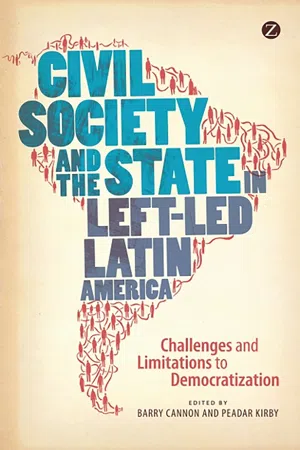
Civil Society and the State in Left-Led Latin America
Challenges and Limitations to Democratization
- English
- ePUB (mobile friendly)
- Available on iOS & Android
eBook - ePub
Civil Society and the State in Left-Led Latin America
Challenges and Limitations to Democratization
About this book
Information
SECTION ONE
State–civil society relations: case studies
2 | Reconfiguring the state/society complex in Venezuela1
Centred around an analysis of the Venezuelan government’s notion of ‘protagonistic revolutionary democracy’, this chapter explores the transformation of the state/society complex in Venezuela and Latin America and the Caribbean (LAC) through the Bolivarian Alliance for the Peoples of Our America – People’s Trade Agreement (Alianza Bolivariana para los Pueblos de Nuestra América – Tratado de Comercio de los Pueblos, ALBA-TCP). I argue that revolutionary democracy is the definitional foundation of the envisioned ‘twenty-first-century socialism’ that, in contrast to ‘really existing socialism’, in which the state/society relations were coordinated by a paternalistic and authoritarian structure of political power (Gill 2008: 26), combines pluralist representative democracy with (Marxist) direct democracy and (C. B. Macpherson’s) participatory democracy. With Venezuela’s oil geopolitics at the core, I illustrate the regionalization of direct democracy and participatory democracy (which are the essence of revolutionary democracy) while indicating how the ALBA-TCP, as an explicit alternative to globalized neoliberalism and its institutions and practices, transforms the political and economic geographies in LAC within the context of the global crisis of capitalism. In this process, a counter-hegemonic, pluri-scalar governance regime is being constructed2 that promotes the democratization of LAC politics.
‘Protagonistic revolutionary democracy’ and ‘twenty-first-century socialism’
In its section ‘Protagonistic Revolutionary Democracy’, the Bolivarian Republic of Venezuela General Strands of the Nation’s Economic and Social Development Plan 2007–2013 postulates that: ‘[t]he public and private spaces are considered complementary and not separate and counterposed as in liberal ideology’ (RBV 2007: 17). This articulated notion of the inextricability of state and society is grounded in the premodern use of ‘civil society’ as synonymous with ‘political society’, and in Karl Marx’s critique of the public/private distinction that will have to be ‘transcended in a form of communal self-government’ (Femia 2001: 137). To Marx, ‘human emancipation’ required the dissolution of the separation of ‘social force’ from ‘political power’ (Marx 1967: 241). Accordingly, the Bolivarian Revolution seeks the construction of the ‘communal state’ through the dialectical interaction between the ‘organized society’ and what I term the ‘state-in-revolution’. This concept is grounded in an understanding of revolution as a mass-based, open-ended ‘fundamental transformation of the state and social structure’ (Stahler-Sholk 2001), and involves a ‘significant restructuring of the social configuration of power’ (Walker 1985: 27). Hence, by state-in-revolution I mean the emancipatory activation of state power – that is, the state-promoted organization of the popular classes and the reconfiguration of state power by progressive forces within the state as well as from outside. This follows the logic of Doreen Massey’s concept of ‘power-geometries’, which is consciously deployed by the Bolivarian government (RBV 2007) to point to the fact that there are unequal geographies of power (that power is exercised relationally in processes of social interaction and that space is constructed through power relations). Accordingly, as power will never be abolished, the aim of progressive politics is to recognize the existence and significance of unequal and therefore undemocratic power-geometries as a precondition for emancipatory political action (Massey 2009). Subsequently, ‘organized society’, as the Bolivarian revolutionary concept antithetical to the liberal-bourgeois concept of ‘civil society’, challenges the historical association of civil society with liberal individualism and a capitalist market society; it is constituted by popular, mass-based organization and the collective exercise of power through councils and movements within, or in the construction of, anti- and non-capitalist social relations and spaces (Muhr 2008a: 29; RBV 2010a, 2010b). Thus, ‘organized society’ reclaims the political and collective character of civil society that had been ‘abolished’ by bourgeois ‘emancipation’ and liberal individualization, from which the separation of the economic and the political is derived (Marx 1967). Paradoxically, however, globalization – manifest in a global governance regime composed of inextricably intertwined public (state) and powerful private actors, such as multi-/trans-national corporations (MNCs/TNCs) and international non-government organizations (INGOs) – has meant the empirical decline of the liberal state/society distinction and its connotation of an independent civil society as a constraint or counterweight to the state, and now is more of analytical and symbolic rather than practical value, for which reason it is more useful to speak of a state/society complex (Cox 1981; Cutler 1997; Gill 2008).
Venezuela’s Bolivarian government considers the reduction of popular participation to the vote as ‘negating the people the possibility of directly acting upon the alienating social relations that impoverish them’ (MINCI 2007a: 19). Therefore, derived from a critical analysis of state-centred, twentieth-century ‘really existing socialism’, direct democracy and new forms of participation are identified as key to any liberating project in order to emancipate labour from the relations of submission (surplus value production; profit maximization; commoditization; division of labour), to overcome political alienation and to reabsorb the political society into civil society through the construction of a new nexus between the state and the people that permits the overcoming of consumerist alienation and the monopoly of knowing (Lanz Rodriguez 2006; RBV 2007: 24; see Harvey 2006: 1–38). The proposed socialism of the twenty-first century is understood in a broad sense as the collective transformation of ‘currently existing society’, and in more specific terms as ‘effecting a stringent critique of the capitalist system’ and of the ‘system of private property’. This should lead towards the ‘collective structuration of production and distribution […] as a material base of a just order in accordance with the needs of the working class’ (Giordani 2009: 21). With the organized community at the core – that is, political organization in councils and other units and bodies (for example, technical water boards, urban land committees, health committees) – Venezuelan law establishes five forms of property that provide some of the structural conditions for the exercise of direct democracy: a) private property; b) public property, owned by state bodies; c) collective property, socially or privately owned, for common use and enjoyment, such as multi-family landownership; d) mixed property, created between the public, collective and private sectors for the use of resources or the execution of activities in the national interest; and e) non-transferable social property, owned by the people as a collectivity, including future generations. This may be in the form of ‘communal direct social property enterprises’ – that is, communal property assigned by the state to communities, communes or cities; or ‘communal indirect social property enterprises’ that for strategic reasons are administered by the state in the name of the community, nevertheless with the option of progressive transfer to instances of ‘Popular Power’ (Muhr 2011a: 100).
As Table 2.1 illustrates, Popular Power is one pillar of Venezuelan state power in coexistence with public power. In territorial terms, public power is divided between what is called ‘national power’ (the national government level), ‘state power’ (the federal state government level) and ‘municipal power’ (the municipal government/mayoralty level). This distribution of power is rooted in the colonial state structure, while functionally it builds on Montesquieu’s three-dimensional distribution of power – that is, the classic liberal democratic division of power into the judicial, legislative and executive branches. This, however, is augmented by two other powers of equal rank derived from Simón Bolívar’s philosophy: the first, ‘electoral power’, is exercised by the National Electoral Council, while the second, ‘citizen power’, by an ombudsman, looking after citizens’ rights, a comptroller general, concerned with public accountability of state agencies, and a public prosecutor (for details, see Muhr 2008a: 148–51; Muhr 2011a: 111–12). The important point here is that Popular Power is independent of suffrage and elections in the representative democratic sense (constituted power), and instead is governed by direct democratic policy-making – that is, the direct exercise of power by organized society (constituent power).
TABLE 2.1 Bolivarian distribution of power
PUBLIC POWER | POPULAR POWER | ||||
| Territorial distribution | Functional distribution | Territorial distribution | Functional distribution | ||
| National power [Federal] state power Municipal power | Legislative power Executive power Judicial power Citizen power Electoral power | the Central Region the Centre-West the West the East the Plains the Southern Region Communal councils Communes Communal cities Systems of communal aggregation (e.g. communal federations, communal confederations, etc.) | Communal self-government in the political, economic, social, cultural, environmental and any other area of societal development: • Planning of public policies • Communal economy • Social control • Town and country planning and management • Communal justice • Special communal jurisdiction | ||
Source: Reproduced from Muhr (2011a: 110)
Table 2.1 further shows that the territorial distribution of Popular Power entails the geopolitical restructuring of the inherited liberal, bourgeois-colonial state and its politico-territorial division (capital district; federal states; municipalities) towards the ‘communal state’. Accordingly, the communal state means a system of ‘instances and expressions of Popular Power’ (RBV 2010d) as the revolutionary materialization of social power relations, in which the ‘socialist commune’ as the ‘fundamental cell’ is composed of the organized community – communal councils, communes, socio-productive organization (endogenous development nuclei; communal direct social property enterprises; communal indirect social property enterprises; cooperatives; family productive units) and, importantly, social movements.
While today the formalization of popular power by far exceeds the norms and standards set by the Bolivarian Constitution in 1999, Popular Power has been legally consolidated by the Organic Law of Popular Power and a set of related organic laws that regulate the functional dimension of Popular Power, including the communal economic system, public and popular planning, and the communes. Through these laws, equality of legal status of both forms of power is established. In fact, public power (the formal state apparatus such as ministries) has to be the facilitator of Popular Power (political, socio-productive and other instances and expressions) (RBV 2010c: Articles 23–30). However, as public power is associated with state power, and Popular Power with organized society power (see ibid.: Article 26), the Organic Law of Popular Power has in philosophical terms not overcome the ontological state/society dichotomy. Moreover, since the instances of Popular Power have to register with a state institution (the respective ministry) in order to participate in the new structures (RBV 2010b), the power of recognition rests with the state rather than within society (Massey 2009), which reinforces the dichotomy. Nevertheless, with the repoliticization of society, the boundary between the two has become blurred as public power and Popular Power are the two pillars of the emergent state power structure. While the structural contradiction between constituted and constituent power inevitably creates a relationship that is conflictual and cooperative at the same time (Azzellini 2010), I have proposed to understand this relationship as a dialectical one in the process of transition (Muhr 2008a: 266; 2011a: 85, 168–210).
As indicated at the beginning of the chapter, I theorize protagonistic revolutionary democracy as the definitional foundation of twenty-first-century socialism, in which representative democracy, direct democracy and participatory democracy coexist. Most commonly, however, the concepts of direct and participatory are conflated, used inconsistently and/or interchangeably, as in ‘direct and participatory democracy’, by public commentators, scholars and political actors alike, including the Venezuelan government (e.g. Avritzer and Santos 2003; Dieterich 2005; Ellner 2010b; Hilmer 2010: 47; RBV 2007: 17–18). Therefore, in the following, I draw on theories of direct democracy and participatory democracy to show that direct and participatory are distinct sub-concepts of revolutionary democracy. I outline operational mechanisms of both models of democracy in Venezuela, before turning to their regionalization through the ALBA-TCP.
Direct democracy consists of the ‘twin themes’ of worker and community control (Benello and Roussopoulos 1972: 4) – that is, social control of the means of production and local political organization in councils. Derived from the experience of the Paris Commune, direct democracy would replace the liberal state by a pyramidal commune structure, with directly elected committees at the base (company, community) and delegates at the upper levels (districts, towns, national) (Marx 1942 [1871]: 498–501). As previously sketched out, this is essentially the idea and materialization of the communal state. Accordingly, the Bolivarian government’s national development plan 2007–2013 associates direct democracy with a sovereign people who can ‘by themselves run the state’; they may delegate their power, but not their sovereignty (RBV 2007: 17, 19). Four major mechanisms of direct democracy have been created in Venezuela: first, the ‘recall referendum’, through which any publicly elected office-holder can be revoked once half their term in office has elapsed; secondly, ‘social street parliamentarism’, which is a form of popular co-legislating that follows the antique philosophy of citizens’ direct participation in judicial and legislative functions, as well as Rousseau’s ‘self-government’ – that is, the people themselves make the laws that rule them (Held 2006: 45–6); thirdly, the ‘communal councils’, which are autonomous instances of Popular Power that can connect with state organs or neighbouring communities (RBV 2009), and of which approximately 31,000 existed in 2011; and, fourthly, the ‘communal direct social property enterprises’, which are related to the communal councils, although they do not have to be located within the territorial space of the council that establishes and manages them (Muhr 2011a: 116–22).
However...
Table of contents
- Cover
- About the Editors
- Title
- Copyright
- Contents
- Tables and figures
- Abbreviations
- Introduction
- Section One State–civil society relations: case studies
- Section Two Localized conflicts in a globalized age: extractivism, social policy and participation in left-led states
- Section Three The global, the national and the local: broadening participation?
- Conclusion
- About the contributors
- Bibliography
- Index
- About Zed Books
Trusted by 375,005 students
Access to over 1.5 million titles for a fair monthly price.
Study more efficiently using our study tools.
Frequently asked questions
Yes, you can cancel anytime from the Subscription tab in your account settings on the Perlego website. Your subscription will stay active until the end of your current billing period. Learn how to cancel your subscription
No, books cannot be downloaded as external files, such as PDFs, for use outside of Perlego. However, you can download books within the Perlego app for offline reading on mobile or tablet. Learn how to download books offline
Perlego offers two plans: Essential and Complete
- Essential is ideal for learners and professionals who enjoy exploring a wide range of subjects. Access the Essential Library with 800,000+ trusted titles and best-sellers across business, personal growth, and the humanities. Includes unlimited reading time and Standard Read Aloud voice.
- Complete: Perfect for advanced learners and researchers needing full, unrestricted access. Unlock 1.5M+ books across hundreds of subjects, including academic and specialized titles. The Complete Plan also includes advanced features like Premium Read Aloud and Research Assistant.
We are an online textbook subscription service, where you can get access to an entire online library for less than the price of a single book per month. With over 1.5 million books across 990+ topics, we’ve got you covered! Learn about our mission
Look out for the read-aloud symbol on your next book to see if you can listen to it. The read-aloud tool reads text aloud for you, highlighting the text as it is being read. You can pause it, speed it up and slow it down. Learn more about Read Aloud
Yes! You can use the Perlego app on both iOS and Android devices to read anytime, anywhere — even offline. Perfect for commutes or when you’re on the go.
Please note we cannot support devices running on iOS 13 and Android 7 or earlier. Learn more about using the app
Please note we cannot support devices running on iOS 13 and Android 7 or earlier. Learn more about using the app
Yes, you can access Civil Society and the State in Left-Led Latin America by Barry Cannon, Peadar Kirby, Barry Cannon,Peadar Kirby in PDF and/or ePUB format, as well as other popular books in Politics & International Relations & Politics. We have over 1.5 million books available in our catalogue for you to explore.