Throughout the world, there has been a growing wave of interest in global corporate power and the rise of a transnational capitalist class, triggered by economic and political transformations that have blurred national borders and disembedded corporate business from national domiciles. Using social network analysis, William Carroll maps the changing field of power generated by elite relations among the world's largest corporations and related political organizations.
Carroll provides an in-depth analysis that spans the three decades of the late 20th and early 21st century, when capitalist globalization attained unprecedented momentum, propelled both by the transnationalization of accumulation and by the political paradigm of transnational neoliberalism. This has been an era in which national governments have deregulated capital, international institutions such as the World Trade Organization and the World Economic Forum have gained prominence, and production and finance have become more fully transnational, increasing the structural power of capital over communities and workers.
Within this context of transformation, the book charts the making of a transnational capitalist class, reaching beyond national forms of capitalist class organization into a global field, but facing spirited opposition from below in an ongoing struggle that is also a struggle over alternative global futures.
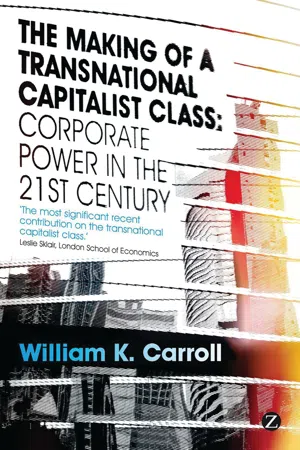
eBook - ePub
The Making of a Transnational Capitalist Class
Corporate Power in the 21st Century
- English
- ePUB (mobile friendly)
- Available on iOS & Android
eBook - ePub
The Making of a Transnational Capitalist Class
Corporate Power in the 21st Century
About this book
Information
Table of contents
- Cover
- About the author
- Praise for The Making of a Transnational Capitalist Class
- Title
- Copyright
- Contents
- Tables and figures
- Acronyms
- Acknowledgements
- Introduction
- Part One: The formation of a transnational corporate community
- Part Two: Into the twenty-first century: the changing organization of corporate power
- Part Three: A transnational historic bloc?
- Conclusion
- Notes
- Bibliography
- Index
Trusted by 375,005 students
Access to over 1.5 million titles for a fair monthly price.
Study more efficiently using our study tools.
Frequently asked questions
Yes, you can cancel anytime from the Subscription tab in your account settings on the Perlego website. Your subscription will stay active until the end of your current billing period. Learn how to cancel your subscription
No, books cannot be downloaded as external files, such as PDFs, for use outside of Perlego. However, you can download books within the Perlego app for offline reading on mobile or tablet. Learn how to download books offline
Perlego offers two plans: Essential and Complete
- Essential is ideal for learners and professionals who enjoy exploring a wide range of subjects. Access the Essential Library with 800,000+ trusted titles and best-sellers across business, personal growth, and the humanities. Includes unlimited reading time and Standard Read Aloud voice.
- Complete: Perfect for advanced learners and researchers needing full, unrestricted access. Unlock 1.5M+ books across hundreds of subjects, including academic and specialized titles. The Complete Plan also includes advanced features like Premium Read Aloud and Research Assistant.
We are an online textbook subscription service, where you can get access to an entire online library for less than the price of a single book per month. With over 1.5 million books across 990+ topics, we’ve got you covered! Learn about our mission
Look out for the read-aloud symbol on your next book to see if you can listen to it. The read-aloud tool reads text aloud for you, highlighting the text as it is being read. You can pause it, speed it up and slow it down. Learn more about Read Aloud
Yes! You can use the Perlego app on both iOS and Android devices to read anytime, anywhere — even offline. Perfect for commutes or when you’re on the go.
Please note we cannot support devices running on iOS 13 and Android 7 or earlier. Learn more about using the app
Please note we cannot support devices running on iOS 13 and Android 7 or earlier. Learn more about using the app
Yes, you can access The Making of a Transnational Capitalist Class by William K. Carroll in PDF and/or ePUB format, as well as other popular books in Social Sciences & Social Classes & Economic Disparity. We have over 1.5 million books available in our catalogue for you to explore.