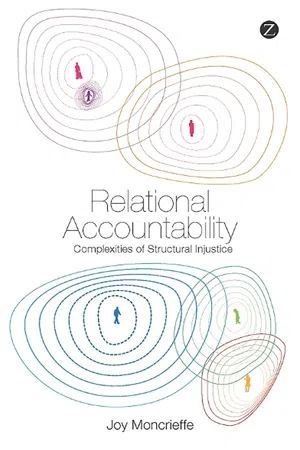
In this insightful new book, Moncrieffe argues that the traditionally narrow interpretation of accountability obscures relationships, power dynamics, structures, processes and complexities. The relational view, in contrast, seeks to understand the ways in which people perform in their roles as social actors, and how the quality of relationships influences the character of accountability.
This book will provide a grounded theoretical background to accountability, using vivid case evidence to emphasize the significance of relational approaches to accountability using empirical data (from Jamaica, Haiti, Ethiopia and Uganda). Ultimately arguing that accountability is much more than a managerial concept; rather, it is deeply social and political.
The result is a unique, coherent, perspective that will both explain and 'debunk' this central developmental concept.
- English
- ePUB (mobile friendly)
- Available on iOS & Android
eBook - ePub
About this book
Information
1 Accountability: ideas, ideals, constraints
The Athenian republics and modern representative governments
There is a common belief that the assemblies in the ancient Athenian republics exercised all the powers and that it was this impracticality, more than any other, which triggered the radical move to representative forms of administration. Manin (1997), in Principles of Representative Government, explodes this myth. He notes that the assembled peoples did not exercise all powers. Rather, there were separate, smaller bodies that were assigned substantial powers, sometimes greater than those assigned to the assemblies. These representative bodies were assigned by lot, as distinct from appointment by elections in conventional representative systems. The institution of ‘lot’ reflected core democratic values, including ‘a deep distrust of political professionalism’; ‘the equal right to speak in the Assembly’; ‘an equal share in the power exercised by the assembled people’; ‘an equal probability of exercising the functions that were performed by a smaller number of citizens’ (Manin, 1997). Elections, it was felt – though the advocates of lot could not properly explain it – would not allow for the same level of equality (Manin, 1997: 41).
The values that underpinned the early representative institutions were entirely different. In arguing for representative government, Natural Law theorists such as Grotius and Rousseau emphasized that consent was indispensable for establishing both legitimate authority and political obligation. It was under an electoral system, as opposed to a system where choice was made by lot, that consent would be secured. Therefore, by the time representative government was established, political equality and citizenship had assumed new meanings. In place of the equal right to hold office, citizens now had the equal right to consent to power. Manin makes the critical point that this latter view of citizenship has been upheld ‘as the natural way of envisioning citizenship’:
Not only do we share the viewpoint at the end of the eighteenth century but we are no longer aware that we are thereby giving precedence to a particular conception of citizenship over another. We have almost completely forgotten that even under conditions where it is not possible for everyone to participate in government, citizens can also be seen as desirous of reaching office.
Manin, 1997: 92–3
This particular, arguably denuded, version of ‘representative’ citizenship was distinct from the earlier democratic variants in other ways. First, compared with the ancient republics, where mechanisms were purposefully established to prevent the unbridled access to power by those considered to be of higher social standing, representative governments, from their inception, encouraged men of ‘higher worth’ and distinction to assume office. Manin explains that particularly in the seventeenth and eighteenth centuries, this ‘principle of distinction’, which Walter Bagehot described as ‘deference’, typified the English culture. In England, the ‘principle of distinction’ intensified with the exorbitant costs of electoral campaigns and the property pre-qualifications established for parliamentary members.1 In France, the franchise – though it was a considerable ‘democratic’ achievement for the period – was limited to active citizens, which excluded those considered too dependent on others: ‘women, servants and the very poor’ (Manin, 1997: 98). In the United States, there were protracted debates about the value and nature of property qualification, and the desired status of political representatives, particularly the extent to which representatives should be men of superior standing. While the Anti-Federalists advocated that the ‘term representative implies that the person or body chosen … should resemble those who appoint them’, they were, nevertheless, under no illusion that the government was so constituted that the ‘natural aristocracy’ would assume power. For the Anti-Federalists, natural aristocracy was not a legal entitlement or entitlement by birth; rather, it referred to persons who had achieved high status, such as through accumulating wealth or position. It was in the ‘common course of human affairs’, they reasoned, that such inequalities of wealth and status also created inequalities of influence. The Anti-Federalists were not unrealistic about inequality; they acknowledged its inevitability and pervasiveness. However, they were cautious about the potential oppressive powers of inequalities and the critical need to guard against these. Their insistence on seeking ‘likeness’ in representative systems was not rooted in a desire to hark back to the system of ‘lot’; it was meant to secure more reliable representation in which all citizens had better prospects of having their perspectives heard.
The Federalists, in their counterarguments, upheld the citizens’ rights to choose their own representatives, despite perceptions of differences in status. The republican obligation was to ensure that erudite and virtuous representatives were chosen and their passions and interests held in check; such was the responsibility of the effective representative system:
The aim of every political constitution is, or ought to be, first to obtain for rulers men who possess most wisdom to discern and most virtue to pursue the common good of the society and, in the next place, to take the most effectual precautions for keeping them virtuous whilst they continue to hold their public trust. The elective mode of obtaining rulers is the characteristic policy of republican government. The means relied on in this form of government for preventing their degeneracy are numerous and various. The most effectual one is such a limitation of the term of appointment as will maintain a proper responsibility to the people.
Madison et al., 1987: 353
Therefore, the Federalists’ emphasis was not on ensuring ‘likeness’ with the people but on instituting effectual precautions, such that those who were appointed to office could be kept virtuous. These precautions were not meant to equalize relations between the representatives and the represented in very substantive ways. Arguably, it was the widespread social movements that culminated in universal adult suffrage across countries that made real attempts to equalize representative systems. However, Manin observes that even this ‘equality’ has been partial for there is still a tendency to choose ‘natural aristocrats’ – those valued as superior within their contexts. Such ‘natural’ tendencies persist and temper the thrust of institutional change. Specifically, institutions such as elections have not had the transformative outcomes anticipated; rather, they have been colored by the societies and cultures within which they are situated.
Some broad characteristics of representative government: problems for accountability
The limitations of accountability mechanisms, including elections, will be discussed further subsequently. The immediate task is to elaborate on what Manin characterizes as the ‘metamorphoses of representative government’. There is substantial truth to O’Donnell’s (1999) argument that many representative governments have not only fallen short in the democratic element; some are profoundly illiberal and some struggle for even a modest whim of credibility in the republican component. Moreover, these developing, as well as reputedly accomplished, democracies can sustain skewed notions of citizenship, which are complicated by partial understandings and practices of accountability. Within democracies, people may, in principle, have the freedom to choose – the liberal component2 (although even this may, in practice, be circumscribed) – but they may not have real freedoms, particularly to improve the quality of their lives. Furthermore, the limited electoral choices they are allowed can, in actuality, amount to a choice among degrees and forms of oppression. Within democracies, checks and balances may exist – the republican component – but these may discount the citizens’ roles in developing countervailing powers to check and balance their representatives. The substantive responsibilities to the people, in this regard, require revised assumptions about the naturalness of inequalities and the natural responsibilities that arise from these inequalities. The democrats’ fallacy, as Aristotle describes it, is to assume that citizens’ equality in birth necessarily translates to equality in every respect. Similarly, oligarchs assume that inequality in wealth or in any other area necessarily translates to inequality in every respect. Both are erroneous exaggerations. For Aristotle, this meant that constitutions should be sufficiently mixed to allow for citizens’ equality and inequality; thus, combining democratic, oligarchic and aristocratic elements. This book takes the argument in a different direction. It contends that governments have a responsibility to tackle oppressive inequalities, for these are simply incompatible with the rights, freedoms and capabilities that ought to obtain within democracies (Dasgupta, 1993; Nussbaum, 1995; Sen, 1999; Moore, 2001; Young, 2002; Hayward, 2009).
There often are substantive variations between the ideals of democracies and what occurs in practice. This point hardly seems worth reinforcing; analytically, it would be reckless to predict outcomes based on typologies of political systems. Amartya Sen (1999), in making the link between democracy and freedom, explains that the democratic arrangement guarantees the political freedoms necessary for realization of basic capabilities, including political and social participation. It provides the fora in which views can be expressed and heard; therefore, citizens have a legitimate basis to make claims, such as of economic and social needs, and to expect attention. Furthermore, democracy has a constructive role in creating (through avenues such as discussion and exchange) values and norms that inform how needs are conceptualized and satisfied. However, he is also careful to emphasize that democracy’s achievements do not hinge exclusively on rules and procedures. Other crucial factors include the ways in which opportunities are used, the dynamism of moral arguments and value formation, the activism of opposition parties and the general quality of multiparty politics. All these reflect existing and historical structures and relations of power, which produce wide variations in the substantive content of formal, electoral democracy.
Moore’s (2001: 6) basic typology of political systems includes collapsed states, states under personal rule, minimally institutionalized states, institutionalized non-competitive states and institutionalized competitive states. His research shows that it is in institutionalized competitive democracies that people have the best prospects for making and contesting claims and for shaping their lives in order to reach their goals. Yet, Moore found no consistent relation between democracy and specific goals, such as poverty reduction. Instead, he observes that some of the best performers in poverty reduction are the former socialist but un-democratic countries, such as Cuba, China and Vietnam. Nattrass and Seekings (2001) made a similar assessment of the relation between democracy and inequality. While some democratic countries endorse and observe principles of equity in procedures and outcomes, others, such as Brazil and South Africa, have horrendous records in income and social inequalities. Chile has been successful at reducing the incidence of poverty but has sustained high levels of inequality. In these and other cases, democracy has opened institutional spaces for some measure of government by people who are living in conditions of poverty but it has not produced the anticipated egalitarian outcomes. In contrast, it is not necessarily the case that people who live in reputedly ‘collapsed states’ or under authoritarian arrangements have no capacity for agency or mechanisms for empowerment. Similarly, regime status cannot foretell the quality of civil liberties and human rights or their extension and reach.
There are a number of reasons for this unpredictability. Among them, different forms of rule can be combined within one state, which makes it difficult to establish straightforward maps between regime type and power distribution and relations. Thus, a patronage system of rule can coexist, sometimes quite snugly, with an institutionalized competitive system. It is well known, too, that political systems – particularly those undergoing or still in the early post-transition phase – will bear traces of the previous systems of rule. It is often difficult to pinpoint where authoritarian forms of rule are truly succeeded by democratic governance; elections are not sufficient to tell. Governments may be replaced without disturbing the underlying power structure. For example, Fantu Cheru (2001) suggests that although South Africa’s majority black population has gained political power since 1994, real economic power remains with select corporate and elite interests. The resulting ‘neo-liberal strategies of privatization, liberalization and deficit reduction effectively undermines the country’s anti-poverty strategy, with costly consequences in areas such as water supply and sanitation, health, education and social security.3 Therefore, there is an underworld of political wheeling and dealing that may be critical for political stability but inconsistent with goals of reducing poverty and inequality (in their various social, political and economic manifestations) and of empowerment.4
Thus, established power relations may remain embedded in institutions (formal and informal) and relationships despite regime change.5 I will revisit this theme later. For now, it is sufficient to propose that elected governments should not ignore the ways in which political systems reproduce relations that abuse citizens’ rights, cultivate and harden ‘un-freedoms’ and undermine people’s capabilities, for these are inconsistent with the ideals that, in principle, make democracy distinct. There are also strategic reasons for addressing inequalities: their perpetuation threatens and can corrupt and uproot the (perhaps already frail) democratic, liberal and republican elements that constitute modern representative governments.
Conceptualizing accountability
Briefly, the essence of modern representative government is that citizens’ interests are reflected through representation and that electoral and other constitutional provisions contain the powers that are allowed to public representatives. Accountability is the crux of the arrangement for, as Bellamy and Palumbo (2010) describe, it is through relationships of political accountability that citizens are connected to their representatives. The mechanisms designed for political accountability provide channels of communication for decision-making, impose the constraints that are necessary to ensure that representatives are responsive to citizens, authorize the executive and administrative branches of government to act, and facilitate scrutiny of the unelected officials who work within government departments (Bellamy and Palumbo, 2010: xi). Therefore, ‘political accountability is responsible for directing the political system towards the public interest and engendering the principles of social autonomy and political self-determination that are at the core of democratic politics’ (Bellamy and Palumbo, 2010: xi).
Accountability is normally thought to comprise two dimensions: ‘answerability’ and ‘enforceability’ (Schedler et al., 1999). In principle, answerability entails providing explanations for actions and justifications for the use of authority. This explanatory dimension – which may be conceptualized as ex-ante accountability (Moncrieffe, 2001) – is meant to be proactive: it is a ‘relationship intended to enhance the responsiveness of agents to those whom they are expected to serve’ (Johnson, 1974: 3). However, as Schedler et al. (1999: 15) put it: ‘accounting actors do not just call into question but also eventually punish improper behavior and, accordingly, accountable persons not only tell what they have done and why but bear the consequences for it, including eventual negative sanctions’. Indeed:
Exercises of accountability that expose misdeeds but do not impose material consequences will usually appear as weak, toothless, ‘diminished’ forms of accountability. They will be regarded as acts of window dressing rather than real restraints on power.
Within representative governments, negative/ex-post accountability refers to holding public officials and departments accountable through the law, other monitoring and sanctioning mechanisms and, ultimately, elections. Therefore, negative accountability connotes ‘answering for the use of authority, ex-post facto’. Both ex-ante and ex-post accountability, with their processes for answerability and enforceability, entail appraisal and monitoring, though the means, including the institutions, for achieving these will differ.
Criteria and conditions for ex-ante accountability
Although there is broad agreement that it is through relationships of accountability that citizens are able to demand quality repr...
Table of contents
- Cover
- About the Author
- Title
- Copyright
- Dedication
- Contents
- List of abbreviations
- Preface and acknowledgements
- Introduction
- 1: Accountability: ideas, ideals, constraints
- 2: ‘Citizenships’ and relational accountability
- 3: Power, citizenships and inequalities of accountability
- 4: Power, citizenships and distorted accountabilities
- 5: Permeating boundaries? Complexities of building accountability
- 6: Conclusion
- Bibliography
- Index
- About Zed Books
Trusted by 375,005 students
Access to over 1.5 million titles for a fair monthly price.
Study more efficiently using our study tools.
Frequently asked questions
Yes, you can cancel anytime from the Subscription tab in your account settings on the Perlego website. Your subscription will stay active until the end of your current billing period. Learn how to cancel your subscription
No, books cannot be downloaded as external files, such as PDFs, for use outside of Perlego. However, you can download books within the Perlego app for offline reading on mobile or tablet. Learn how to download books offline
Perlego offers two plans: Essential and Complete
- Essential is ideal for learners and professionals who enjoy exploring a wide range of subjects. Access the Essential Library with 800,000+ trusted titles and best-sellers across business, personal growth, and the humanities. Includes unlimited reading time and Standard Read Aloud voice.
- Complete: Perfect for advanced learners and researchers needing full, unrestricted access. Unlock 1.5M+ books across hundreds of subjects, including academic and specialized titles. The Complete Plan also includes advanced features like Premium Read Aloud and Research Assistant.
We are an online textbook subscription service, where you can get access to an entire online library for less than the price of a single book per month. With over 1.5 million books across 990+ topics, we’ve got you covered! Learn about our mission
Look out for the read-aloud symbol on your next book to see if you can listen to it. The read-aloud tool reads text aloud for you, highlighting the text as it is being read. You can pause it, speed it up and slow it down. Learn more about Read Aloud
Yes! You can use the Perlego app on both iOS and Android devices to read anytime, anywhere — even offline. Perfect for commutes or when you’re on the go.
Please note we cannot support devices running on iOS 13 and Android 7 or earlier. Learn more about using the app
Please note we cannot support devices running on iOS 13 and Android 7 or earlier. Learn more about using the app
Yes, you can access Relational Accountability by Joy Moncrieffe in PDF and/or ePUB format, as well as other popular books in Politics & International Relations & International Relations. We have over 1.5 million books available in our catalogue for you to explore.