Postcolonial approaches to understanding economies are of increasing academic and political significance as questions about the nature of globalisation, transnational flows of capital and workers and the making and re-making of territorial borders assume centre stage in debates about contemporary economies and policy.
Despite the growing academic and political urgency in understanding how 'other' cultures encounter 'the west', economics-oriented approaches within social sciences have been slow to engage with the ideas and challenges posed by postcolonial critiques. In turn, postcolonial approaches have been criticised for their simplistic treatment of 'the economic' and for not engaging with existing economic analyses of poverty and wealth creation.
Utilising examples drawn from India to Latin America, and bringing together scholars from a range of disciplines, including Geography, Economics, Development Studies, History and Women's Studies, Postcolonial Economies breaks new ground in providing a space for nascent debates about postcolonialism and its treatment of 'the economic'.
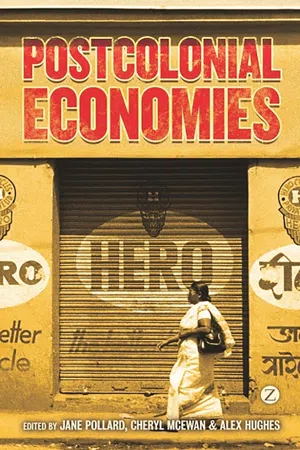
eBook - ePub
Postcolonial Economies
- English
- ePUB (mobile friendly)
- Available on iOS & Android
eBook - ePub
Postcolonial Economies
Section 1
Theorising the economic
1
Can political economy be postcolonial? A note
Dipesh Chakrabarty
I
Postcolonial criticism of the 1980s and 1990s arose from the left field – there is no right-wing postcolonial theorist to my knowledge – and was therefore often subject to a particular kind of criticism from Marxist or other left-leaning intellectuals who complained that postcolonial thinking emphasised textual criticism at the expense of political-economic analysis. The charge was never entirely true – Gayatri Spivak, for instance, always remained interested in questions to do with ‘international division of labour’ and in many other issues of development.2 Katherine Gibson and Julie Graham, writing under the name J. K. Gibson-Graham, have produced economic analyses incorporating postmodern/postcolonial insights (Gibson-Graham et al. 2001; Gibson-Graham 2006; Gibson-Graham and Roelvink 2010). Recently, Vinay Gidwani (2008) has also made significant new contributions to this body of literature.
I claim no expertise in economics or political economy. But since my early training as a historian in India took place in the 1970s when a certain kind of Marxist political economy ruled the day and when economic history had the pride of place in all discussions of colonial rule, I too began my career subscribing to the opinion – common among Marxists those days – that economic facts constituted a kind of limit for human freedom, that the economy was the ‘base’, and the everything else about any social structure followed from it. There were, of course, quite sophisticated debates around about the extent to which economic factors were determining of other factors in history, discussions about what Engels may have meant in his famous 1890 letter in which he spoke of the economy being determining only ‘in the last instance’, and many speculations about how one would recognise ‘the last instance’ if one ever ran into it. But however sophisticated the discussions may have been, they were all about saving the primacy of the economic in historical explanations. Much of our historiographical revolt in the series Subaltern Studies was against this primacy given to the economic in radical historians’ explanations of rebellions by subaltern classes. With Mao as our inspiration, we rejected what we saw as the ‘economism’ of the usual Marxist explanations and gave primacy to the political instead. Peasant insurgencies, we argued, always began by destroying the usual social and material symbols of domination possessed by the oppressive classes and these acts were about how power worked in Indian rural society (Guha 1983). Capitalist and colonial rule in India, we further argued, worked by acting on these levers of power in Indian society.3 This rejection of ‘economism’ was also reflected in the interest many Subaltern Studies scholars developed in post-structuralism and deconstruction. In my book Provincializing Europe, I tried to advance the proposition that the question of transition to capitalism in any setting was a question of translation as well, of a group of people being able to translate their life-worlds into the categories of capitalism (Chakrabarty 2000, 2007).
Our turn towards the political and the cultural/textual gave rise to the general criticism among historians of India that Subaltern Studies neglected economic history. I don’t know if we did. But it is true that while we wrote much on historico-philosophical problems of modernity and capitalism, we never did much to revitalise economic history as such. The ‘new’ economic history that developed in India in the 1990s, thereafter adopted, implicitly or explicitly, rational choice frameworks for analysis.4 This delivered the subject from the shibboleths and tyrannies of a stultified nationalist-Marxism that dominated before but the price of the liberation was the debunking of Leftist historiography in general.
I have since wondered about what it might mean to incorporate insights from postcolonial criticism into the writing of economic history. Unfortunately, I do not consider myself best suited for the task. But reading Kenneth Pomeranz’s widely acclaimed book The Great Divergence: China, Europe, and the Making of the Modern World Economy (2000) afforded me an opportunity to think about the problem and in this short essay I want to share with the reader some of my preliminary thoughts.
II
At the outset let me acknowledge how much I learnt from Kenneth Pomeranz’s superb and revolutionary book, The Great Divergence (hereafter TGD). Pomeranz’s scholarship is extraordinary, his intellect truly vigorous, his judgements astute and brave, and his heart – if one may speak of such things in an academic context – is absolutely in the right place insofar as the project of ‘de-centring Europe’ is concerned. This book deserves every bit of the praise that has been heaped on it. There is one more characteristic of Pomeranz’s scholarship that I appreciated on reading both this book and his reply to his critics in a debate that followed in the pages of The Journal of Asian Studies. Even where he has the better of his opponents in terms of facts and arguments, Pomeranz is remarkably gracious and generous in his response to opposition. This is not a small merit in the academic world I know.
Much of Pomeranz’s argument in TGD I find at least provocative and challenging even when my agreement with the book is not total. The overall project seems entirely laudable. Studies of transition to capitalism in various parts of the world often become Eurocentric through the deployment, conscious or unconscious, of the assumption that patterns of economic growth in Western Europe provide some kind of a unique model by which to judge the performance of other economies and societies. Pomeranz challenges this tendency of thought. He does so by seeking to demonstrate empirically that up until the eighteenth century there was very little to distinguish between the economic and institutional features of Western European societies and some areas of Asian world: Japan, the Yangzi delta in China and the Gujarat region of Western India. This attempt at empirical demonstration is no mean feat involving, as it did, research on many different literatures and sites at once. As the subsequent debates have shown, Pomeranz is able to hold his ground in the face of criticism by scholars who are specialists on areas where Pomeranz does not claim expertise. As a student of South Asian history, I can only admire the care with which Pomeranz sifts the sands of the economic history of the subcontinent in the Mughal and ‘early modern’ period. The book demonstrates in an exemplary manner the power of ‘historical facts’ in reversing habits of thought.
Pomeranz also mounts a challenge to those practitioners of history who see the present as the culmination of a process of historical becoming. Scholars have often written long and continuous histories of industrialisation in Europe reinforcing the commonplace idea that gradual and unique transformations over a long period prepared (Western) European societies and economies for the industrial and capitalist domination of the world that they were to enjoy from the nineteenth century on. Pomeranz throws the developmental narrative into disarray by highlighting the largely contingent nature of the discovery of fossil fuel (coal) and the forced opening up of the New World. These, in his view, were the two contingent factors that enabled Europe to remove the bottleneck of ‘land constraint’ that choked the possibilities for industrialisation in non-European societies that were otherwise on a par with Europe until about the eighteenth century.
Pomeranz thus succeeds in two of his aims: de-centre Europe and challenge historicism (or at least a certain popular version of it). By showing that industrial Europe becomes itself by dint of factors external to its geography or any perceptible, immanent logic to its historical evolution, Pomeranz avoids the problems of immanentist, internalist accounts of European becoming. These are definitely the three major methodological achievements of the book apart from the many substantial contributions it makes in its own field of early-modern economic history (these I am not able to evaluate critically though I find them thought-provoking to say the least). These gains are the dividends yielded by Pomeranz’s consciously chosen method of writing comparative, connected histories.
Pomeranz begins the book with a somewhat polemical swipe at some unnamed, ‘current “postmodern” scholars’. These scholars, he writes, ‘make it impossible to even to approach many of the most important questions in history (and in contemporary life)’ by ‘abandoning cross-cultural comparison altogether and focusing almost exclusively on exposing the contingency, particularity, and perhaps unknowability of historical moments’ (TGD, 8). I have no intention of defending these scholars who after all go unnamed in Pomeranz’s book. Besides, I also value comparisons. Even more than that, I think comparison is unavoidable in social sciences. Some scholars explicitly set out to compare. Others don’t. But our conceptions and theories, to the extent that they are social measures as well, provide scales and yardsticks whose use-value lies in their enabling us to compare. I have no quarrels therefore with comparative methods as such. But comparisons and the questions of unknowability or indeterminacy in history may not be as mutually exclusive as the quotation from Pomeranz suggests.
The problem of comparison is about the scale or the measure that helps us to compare. I want to use this opportunity to think about this question of the measuring scale as it comes up in Pomeranz’s work. What I say is not as such a criticism of Pomeranz. I am not asking for a different book from Pomeranz. He has written the book he wanted to write and he has done so superbly. I have no significant criticisms to offer on his own terms. This is more a reflection on these terms themselves with a view to exploring what we all may collectively learn from thinking about the comparative method as it is employed in this book. What I have to say may also connect back with Pomeranz’s polemic with ‘postmodernism’ (the scare-quotes are, advisedly, his).
My point of entry is a couple of moments in the text where Pomeranz discusses some of his own preferences in social theory and that particularly in areas where he explicitly negotiates some anthropological theory. Pomeranz begins the book by acknowledging that most available comparisons between ‘West and the rest’ are biased in favour of the West. But it is preferable, he writes, ‘to confront biased comparisons by trying to produce better ones’ (TGD, 8). What is important is to view ‘both sides of the comparison as “deviations” when seen through the expectations of the other, rather than leaving one as always the norm’. This, he adds, ‘will be much of his procedure’ in TGD (TGD, 8). Later, Pomeranz takes to task, rightly I think, texts that create a dichotomy:
between societies in which “commodities” and “markets” determine social relations, and exchange is conceived as the individualistic pursuit of gain, on the one hand, and those in which social relations regulate the economy, status governs consumption, and people are concerned with reciprocity, on the other. When these dichotomies are applied to history, the result tends to be a division between a Europe that became “materialist” first and the rest of the planet, which because it has not yet crossed the divide, had to have “commodities,” “materialism,” and “economic man” introduced from the outside.
(TGD, 128)
Instead he prefers, after Arjun Appadurai, the idea of ‘a continuum that runs from “fashion systems” on the one hand to “coupon” or “license” systems on the other’. ‘This formulation’, writes Pomeranz, ‘avoids placing societies in one camp or another … and so makes it clear that we have both “economy” and “culture” in all societies’ (TGD, 129).
Pomeranz thus carefully avoids having to rank societies on any evolutionary scale culminating in the coming of capitalism. But the idea of a culture/economy continuum is not unproblematic. We may have ‘economy’ and ‘culture’ in all societies but they may be present in different degrees (otherwise the continuum will become a point). The homo economicus may have been present from the beginning of human history but it seems reasonable to suggest that some societies value it more actively as a way of being than others. More importantly, surely not all societies – at least up until the eighteenth and early nineteenth centuries – explicitly made this conscious analytical distinction between ‘culture’ and ‘economy’. Nor did all societies create abstract objects of intellectual investigation such as ‘economy’ and ‘culture’. In fact, it could be safely said, that only societies with more ‘economy’ created intellectual tools for studying something called the ‘economy’. I obviously have in mind the history of Political Economy, an academic subject without which an exercise such as Pomeranz’s would be unthinkable.
The question is, are these knowledge protocols or abstract categories such as ‘land’, ‘labour’ and ‘capital’ still European/Western or Eurocentric in any sense since we all use them now and since they seem applicable to all societies? Or does their use, however unavoidable, also devolve on us the responsibility of remembering their histories as part of the politics of knowledge today? Or are they just analytical/descriptive categories giving us access to social realities that we would otherwise miss? In Pomeranz’s text, categories like ‘free’ and ‘unfree’ labour or ‘land’ work as simple analytical and descriptive terms, shorn of whatever philosophical or theological associations these words may have had even as late as the seventeenth century.
That the categories of political economy are peculiarly European in origin seems less questionable. Also, it is well known that at their origin these categories were often possessed of certain moral and/or theological import (not surprising if one remembers that economics emerges from moral philosophy in the eighteenth century).5 And since such import could never be completely rational, we would be justified in saying that these categories contained a certain degree of prejudice – that is to say, a certain element of that which was particular, prejudicial, and not universal – built into them even as they emerged as academic, analytical categories. Consider, for instance, the question of price of commodities. Analytically, price is the point where the supply and demand curves meet on paper. Historically, however, as Michael Perelman has shown in his book The Invention of Capitalism, classical political economic thought was in part an intellectual war on the habits of the poor. Adam Smith’s teacher Frances Hutcheson had this to say on the issue of price in his System of Moral Philosophy (1755): ‘If people have not acquired the habit of industry, the ...
Table of contents
- Cover
- About the editors
- Title
- Copyright Page
- Contents
- Acknowledgements
- Introduction: postcolonial economies
- Section 1: Theorising the economic
- Section 2: Postcolonial understandings of the economic
- Section 3: Postcolonial economies: policy and practice
- Notes on contributors
- Index
Trusted by 375,005 students
Access to over 1.5 million titles for a fair monthly price.
Study more efficiently using our study tools.
Frequently asked questions
Yes, you can cancel anytime from the Subscription tab in your account settings on the Perlego website. Your subscription will stay active until the end of your current billing period. Learn how to cancel your subscription
No, books cannot be downloaded as external files, such as PDFs, for use outside of Perlego. However, you can download books within the Perlego app for offline reading on mobile or tablet. Learn how to download books offline
Perlego offers two plans: Essential and Complete
- Essential is ideal for learners and professionals who enjoy exploring a wide range of subjects. Access the Essential Library with 800,000+ trusted titles and best-sellers across business, personal growth, and the humanities. Includes unlimited reading time and Standard Read Aloud voice.
- Complete: Perfect for advanced learners and researchers needing full, unrestricted access. Unlock 1.5M+ books across hundreds of subjects, including academic and specialized titles. The Complete Plan also includes advanced features like Premium Read Aloud and Research Assistant.
We are an online textbook subscription service, where you can get access to an entire online library for less than the price of a single book per month. With over 1.5 million books across 990+ topics, we’ve got you covered! Learn about our mission
Look out for the read-aloud symbol on your next book to see if you can listen to it. The read-aloud tool reads text aloud for you, highlighting the text as it is being read. You can pause it, speed it up and slow it down. Learn more about Read Aloud
Yes! You can use the Perlego app on both iOS and Android devices to read anytime, anywhere — even offline. Perfect for commutes or when you’re on the go.
Please note we cannot support devices running on iOS 13 and Android 7 or earlier. Learn more about using the app
Please note we cannot support devices running on iOS 13 and Android 7 or earlier. Learn more about using the app
Yes, you can access Postcolonial Economies by Jane Pollard, Cheryl McEwan, Alex Hughes, Jane Pollard,Cheryl McEwan,Alex Hughes in PDF and/or ePUB format, as well as other popular books in Economics & Economic History. We have over 1.5 million books available in our catalogue for you to explore.