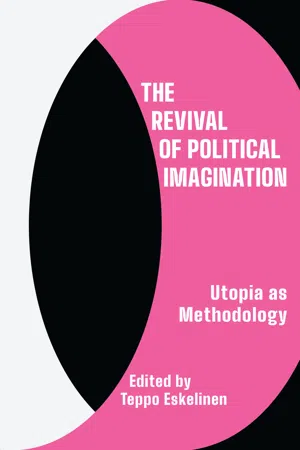
The Revival of Political Imagination offers a unique examination of the methodological aspects of utopia. Discussing utopia as a tool for social criticism, method and imaginative spaces - rather than in terms of its content - this volume analyses the function of utopias, to develop utopias as methodology and to show how instrumental utopian modes of thought can be in such diverse fields such as education, labour, and housing.
Including discussions of traditional and contemporary utopias, as well as various forms of expression of utopian hope, from literature to social science and cultural practices, The Revival of Political Imagination is both analytical and practical in its elucidation of how political theory can function to foster our imaginative skills.
- 208 pages
- English
- ePUB (mobile friendly)
- Available on iOS & Android
eBook - ePub
About this book
Information
PART I
DIAGNOSIS
1 | INTRODUCTION: UTOPIAS AND THE REVIVAL OF IMAGINATION
Teppo Eskelinen, Keijo Lakkala and Maria Laakso
Societal utopias have so frequently been pronounced to be dead, that declaring their demise has become something of a cliché. The general mentality of the 1990s led to the majority of laymen and intellectuals alike to assume this assertion as common sense. According to a widely assumed idea, utopias became obsolete as humanity ascended from the era of totalitarian ideologies to the era of liberal capitalist democracies. In this new order characterized by liberty, no human being is forced to adapt to any grand utopian vision imposed by others. Utopias have a long history, for sure – from antiquity on, with the term coined by Thomas More in 1516. But in our era, society would be different.
In this context, it is difficult to avoid mentioning Francis Fukuyama. In 1989, the then deputy director of the US State Department’s policy planning staff published an article which achieved symbolic status: ‘The End of History?’ Based on Alexandre Kojève’s reading of Hegel’s philosophy of history and inspired by the collapse of the Soviet bloc, the article proclaimed that history in the sense of fundamental contradictions was over (Fukuyama 1989, 8).
Yet the novelty of Fukuyama’s ideas should not be overstated. The exhaustion of utopian energies and political ideas was noted already three decades earlier by Daniel M. Bell (1960). In political theory texts published in the 1980s, the anti-utopian ‘postmodern’ sentiment of late stage capitalist societies was quite visible. Jürgen Habermas in ‘The New Obscurity’ (1986) argued, that the modern time consciousness based on the ideas of progress and revolution had become narrower, along with the horizon of the future (Habermas 1986, 2). Jean-François Lyotard analyzed postmodernism as the intellectual condition in which metanarratives of modernism, including utopianism, have been left behind (Lyotard 1984). Two years before Fukuyama’s article, Krishan Kumar already asked: ‘Can there be anything more commonplace than the pronouncement that, in the twentieth century, utopia is dead – and beyond any hope of resurrection?’ (Kumar 1987, 30).
Fukuyama’s position might be simplifying to the point of ridiculousness, but it signals a sign of the times. This is the societal condition in which it is almost impossible to think of alternatives to liberal democratic capitalism. To abridge Slavoj Žižek (2009, 53):
Though it is easy to make fun of Fukuyama’s notion of the End of History, the majority today is Fukuyamaist. Liberal-democratic capitalism is accepted as the finally found formula of the best possible society; all one can do is to render it more just, tolerant and so on.
A pressing question given this condition is, then, what does the belief in this ‘finally found formula’ do to key political skills, such as reflection, public criticism and political imagination? Can politics retain a sense of meaning if we believe that it has, more or less, arrived at its destination? Any plausible answer will be hardly short of terrifying. An immediate question then arises: Can the skill to imagine other kinds of societies be saved; and if it can, how?
The Specificity of Absolutist Utopias
It is natural to begin the rehabilitation of utopian thought by analyzing the intellectual mechanisms feeding into its demise. Indeed, the withering away of utopias is not only a common mentality, but the subject (and partially also an outcome) of thorough theorizing. There is no shortage of sophisticated sociology warning us about the dangers of utopian thought. Most importantly, the popular anti-utopian sentiment discussed above is based on the interpretation of utopias as necessarily absolutist utopias. This interpretation is a very particular one, and hardly exhaustive. It approaches utopias as static models, the implementation of which can only take place in the manner of imposing a blueprint upon society. On this basis, it is easy to interpret utopias as signifying nothing but totalitarianism, as opposed to liberty.
Absolutist interpretations of utopias can take a variety of forms. Aspects of absolutist utopias emphasized by different authors are moral monism, holistic methodology and utopias as closed systems.
The critique of utopian thought as moral monism, as opposed to plurality and versatility, is particularly associated with Isaiah Berlin (Berlin 1997a,b). In Berlin’s (1997a, 5) words, utopias assume an objective and coherent, and unavoidably dogmatic, system of ‘moral truths’. In such a system, for every genuine moral question there can be only one correct answer, there is a reliable method for finding the correct moral answers, and all correct answers to moral questions are compatible with each other (Berlin 1997a, 5). Yet a perfect whole, ‘the ultimate solution’ (Berlin 1997a, 11) to moral questions, or a ‘perfect social harmony’ (Berlin 1997b, 191), are conceptually incoherent ideas. A choice between different values is always necessary. ‘We are doomed to choose, and every choice may entail an irreparable loss’ (Berlin 1997a, 11). No society can realize all values coherently. This, according to Berlin, renders utopias impossible.
The interpretation of utopias as based on a holistic methodology leading to totalitarianism derives chiefly from the work of Karl Popper. According to Popper, the utopian desire for impossible perfections and this striving for perfection will inevitably cause violence and repression. For Popper, utopianism is a view according to which ‘rational political action must be based upon a more or less clear and detailed description or blueprint of our ideal state, and also upon a plan or blueprint of the historical path that leads towards this goal’ (Popper 1963, 358). The concept of utopia is thereby associated with social blueprints and further with totalitarianism (e.g. Schapiro 1972, 85; Popper 1963, 357–360). The rational organization of the ideal society that Popper calls utopian engineering is inevitably in the hands of few and therefore inclined to violence and totalitarian control (Popper 1963).
A third interpretation in absolutist fashion is to see utopias as closed and static systems. Ralf Dahrendorf (1958, 116) argued, that one structural characteristic of utopias is their uniformity, based on a universal consensus on values and institutional arrangements, and the absence of disagreement and conflict.
Utopias are perfect – be it perfectly agreeable or perfectly disagreeable – and consequently there is nothing to quarrel about. Strikes and revolutions are as conspicuously absent from utopian societies as are parliaments in which organized groups advance their conflicting claims for power. (Dahrendorf 1958, 116)
Utopias might have ‘a nebulous past’ (Dahrendorf 1958, 116), but they do not have a future. Utopias ‘are suddenly there, and there to stay, suspended in mid-time or, rather, somewhere beyond the ordinary notions of time’ (Dahrendorf 1958, 116).
Many other theorists have landed on interpretations similar to those of these canonical authors. John Gray in Black Mass: Apocalyptic Religion and the Death of Utopia (2007, 2) claims, that the whole of Western history has been terrorized by utopian projects: ‘entire societies have been destroyed and the world changed forever’. J. L. Talmon (1952, 252) defines utopia as the ‘complete harmony of interests, sustained without any resort to force, although brought about by force’. Hans Achterhuis argues, that as utopias are seen as perfections, utopia sees itself as legitimizing all violence that could potentially be needed in this realization (Achterhuis 2002, 160–161). All in all, the intellectual discourse on utopian thought has been dominated by thinkers who ‘describe utopianism as a one-way ticket to totalitarianism’ (Oudenamspen 2016, 43).
This strong association of utopias with totalitarianism can be understood as an intellectual reflection of the traumas of the twentieth century; ‘mankind’s darkest hour so far’. The rise of totalitarian regimes, two World Wars, atomic bombings, the Holocaust and the Cold War have left the world in a state of ‘cosmic pessimism’, to paraphrase Krishan Kumar (1987, 380). When imagining alternative societies, quite a few people have in mind something along the lines of George Orwell’s Nineteen Eighty-Four (1949, 390): ‘If you want a picture of the future, imagine a boot stamping on a human face — forever’.
Yet this fear has already become clearly overstated. The accounts of utopias discussed above have, for a good reason, been called ‘dystopic liberalism’ (Thaler 2018), or works by ‘liberalists of fear’ (Shklar 1989), in reference to their systematic preoccupation (or should we say obsession) with political evil. Saving humanity from totalitarianism has become an obstacle to political progress and imagination, a just...
Table of contents
- Cover
- Title Page
- Copyright Page
- Table Of Contents
- Notes on Contributors
- Acknowledgments
- PART I: DIAGNOSIS
- 1 Introduction: Utopias and the Revival of Imagination
- 2 Disruptive Utopianism: Opening the Present
- 3 The Privatization and Recollectivization of Hope
- PART II: CASE STUDIES AND UTOPIAN METHODOLOGIES
- 4 Quilombist Utopias: An Ethnographic Reflection
- 5 Social Dreaming and Uses of Narrativity, Tellability and Experientiality in Literary Dystopia
- 6 Utopian Education: May the Hope Be with You
- PART III: PERSPECTIVES ON UTOPIAS
- 7 The Significance of Humor and Laughter for Utopian Thought
- 8 Architectural Utopias as Methods for Experimenting with the (Im)Possible
- 9 Democracy as Utopia: On Locating Radical Roots
- Index
Trusted by 375,005 students
Access to over 1.5 million titles for a fair monthly price.
Study more efficiently using our study tools.
Frequently asked questions
Yes, you can cancel anytime from the Subscription tab in your account settings on the Perlego website. Your subscription will stay active until the end of your current billing period. Learn how to cancel your subscription
No, books cannot be downloaded as external files, such as PDFs, for use outside of Perlego. However, you can download books within the Perlego app for offline reading on mobile or tablet. Learn how to download books offline
Perlego offers two plans: Essential and Complete
- Essential is ideal for learners and professionals who enjoy exploring a wide range of subjects. Access the Essential Library with 800,000+ trusted titles and best-sellers across business, personal growth, and the humanities. Includes unlimited reading time and Standard Read Aloud voice.
- Complete: Perfect for advanced learners and researchers needing full, unrestricted access. Unlock 1.5M+ books across hundreds of subjects, including academic and specialized titles. The Complete Plan also includes advanced features like Premium Read Aloud and Research Assistant.
We are an online textbook subscription service, where you can get access to an entire online library for less than the price of a single book per month. With over 1.5 million books across 990+ topics, we’ve got you covered! Learn about our mission
Look out for the read-aloud symbol on your next book to see if you can listen to it. The read-aloud tool reads text aloud for you, highlighting the text as it is being read. You can pause it, speed it up and slow it down. Learn more about Read Aloud
Yes! You can use the Perlego app on both iOS and Android devices to read anytime, anywhere — even offline. Perfect for commutes or when you’re on the go.
Please note we cannot support devices running on iOS 13 and Android 7 or earlier. Learn more about using the app
Please note we cannot support devices running on iOS 13 and Android 7 or earlier. Learn more about using the app
Yes, you can access The Revival of Political Imagination by Teppo Eskelinen in PDF and/or ePUB format, as well as other popular books in Scienze sociali & Storia e teoria politica. We have over 1.5 million books available in our catalogue for you to explore.