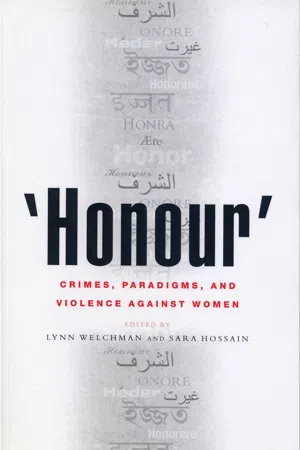
This volume brings together the practical insights and experiences of individuals and organisations working in diverse regions and contexts to combat 'crimes of honour'. Authors examine strategies of response to such manifestations of violence against women, focusing largely on 'honour killings' and interference with the right to choice in marriage, and the related use and legal treatment of the defence of 'honour' and 'provocation' in different countries of Europe, the Middle East, Latin America and South Asia. This timely volume is distinctive in approach and content, highlighting activist and practice-orientated academic perspectives from both the South and the North.
The authors give voice to the struggle to locate 'crimes of honour' firmly within the international framework of violence against women and human rights, rather than positioning these abuses as specific to particular cultures or communities. The first of its kind, this book serves as a resource in addressing 'honour crimes' and, more broadly, violence against women, and will be of interest to a multi-disciplinary academic audience as well as to lawyers, policy-makers and activists.
eBook - ePub
Honour'
Crimes, Paradigms, and Violence Against Women
- English
- ePUB (mobile friendly)
- Available on iOS & Android
eBook - ePub
Honour'
Crimes, Paradigms, and Violence Against Women
About this book
Information
1
United Nations approaches to ‘crimes of honour’
JANE CONNORS
Over the last fifteen to twenty years, the approach within the United Nations (UN) to violence against women has been transformed from one centred purely on the advancement of women, crime control and criminal justice and addressed predominantly within the UN entities concerned with those issues, to one which incorporates a human rights perspective. Critical to this transformation have been the efforts of non-governmental organisations (NGOs) within UN forums, particularly the cycle of world conferences, to recognise all forms of violence against women occurring in all settings as an issue of human rights.
This chapter provides an overview of the approach to violence against women by the UN, indicating how specific forms of violence against women have been addressed within its framework. It describes developments in this area since the Fourth World Conference on Women held in Beijing in September 1995,1 and traces the emergence within the UN of efforts to address ‘crimes of honour’ as a particular concern.
United Nations work on violence against women
With isolated exceptions, policy within the UN relating to violence against women initially concentrated on such violence within the family. The 1975 World Plan of Action adopted by the First World Conference on Women in Mexico did not refer to violence explicitly, but contained language relating to the dignity, equality and security of family and the need for the provision of assistance in the solution of family conflict. The Copenhagen Conference held in 1980, midway through the International Women’s Decade, adopted a resolution on ‘battered women and the family’ and referred to violence in the home in its final report. However, it was not until the 1985 Nairobi World Conference, marking the end of the Decade, and especially at its non-governmental forum, that violence against women truly emerged as a serious international concern. The outcome document of that Conference, the Forward-looking Strategies for the Advancement of Women, linked the promotion and the maintenance of peace to the eradication of violence against women in both public and private spheres and identified a number of strategies to address violence against women in the family, in armed conflict, and against women subject to detention or penal law. It also called for measures to address the concerns of women victims of trafficking and involuntary prostitution.2
The impetus provided by the Nairobi Conference resulted in the first General Assembly resolution on domestic violence,3 which, although not directed specifically at women, formed the background to the 1986 UN Expert Group Meeting on Violence against Women in the Family, and the 1989 study of the same name (Connors, 1989). These activities heightened the attention of the UN system and its member states to the issue of violence against women generally, thereby allowing the further contexts and manifestations of violence against women to surface. As the multifarious settings and manifestations of violence against women were revealed, and its association with gender roles increasingly appreciated, the approach to the issue shifted. Whereas earlier, violence against women in the family had been prioritised as an area of concern, this form of violence was now viewed as only one, albeit large, part of the phenomenon of violence against women. Further, the gender-based nature of violence against women and its linkage to the subordination of women to men, stereotypical patterns of behaviour, inequality between women and men and discrimination, led to its categorisation as a human rights concern, thereby allowing for a broader policy response to the issue within the UN and its associated entities.
At the forefront of efforts to identify violence against women as a human rights issue was the Committee on the Elimination of Discrimination Against Women, the UN treaty body established to monitor the 1979 Convention on the Elimination of All Forms of Discrimination Against Women (‘the treaty’ or ‘the Convention’).4 This treaty, now ratified or acceded to by 178 States Parties,5 sets out the legal obligations to eliminate discrimination against women and ensure they enjoyed no discrimination of political, economic, social, cultural and civil rights in the public and private spheres.
Despite attempts by delegations to include obligations relating to violence against women in the Convention during its drafting in the early 1970s (Rehof, 1993: 91–92), no reference beyond trafficking in women and the exploitation of prostitution of women (Article 6), is made to violence against women in the treaty. As reports were submitted by States Parties to the Committee in accordance with their obligations under the Convention (Article 18), and NGOs also provided information on the situation of implementation of the Convention in various countries (for example, by submitting parallel/shadow reports), it became clear that violence against women was a central obstacle to the elimination of discrimination against women, and their achievement of equality with men. In response, the Committee adopted successive ‘general recommendations’,6 within its competence under Article 21 of the Convention, based on the examination of reports and information received from States Parties. This series of general recommendations made clear that all forms of gender-based violence against women fall within the meaning of discrimination against women on the grounds of sex, as provided by the treaty. The first of these, General Recommendation 12 on violence against women, called for States Parties’ reports to include information on the legislation in force to protect women against the incidence of all kinds of violence in everyday life (including sexual violence, abuses in the family, sexual harassment in the workplace), other measures adopted to eradicate this violence, the existence of support services for victims and statistical data on the incidence of all kinds of violence against women and on women who are the victims of violence.7 General Recommendation 14 expressed concern at the continuation of the practice of female circumcision and other traditional practices harmful to the health of women, and recommended that states take appropriate and effective measures with a view to eradicating these practices, and include information on such measures in their reports to the Committee.8
The more substantive and detailed General Recommendation 19 on violence against women, prepared by the Committee as one of its contributions to the 1993 World Conference on Human Rights, indicates that gender-based violence is a form of discrimination that seriously inhibits women’s ability to enjoy rights and freedoms on a basis of equality with men, identifying those rights and freedoms which are compromised by such violence.9 Gender-based violence against women is defined as violence that is directed against a woman because she is a woman or that affects women disproportionately.10 Such violence includes acts that inflict physical, mental or sexual harm or suffering, threats of such acts, coercion and other deprivations of liberty. Importantly, the general recommendation identifies the nature of state responsibility to eliminate violence against women and indicates that while the specific provisions of the Convention may not expressly mention violence, it predicates accountability for public acts of violence committed by the state and those connected with the state, as well as some acts committed by non-state actors.11 It also makes clear that ‘States may also be responsible for private acts if they fail to act with due diligence to prevent violations of rights or to investigate and punish acts of violence, and for providing compensation’ (para. 9).
The Committee’s linkage of gender-based violence against women to the international legal norm of non-discrimination on the basis of sex had a profound effect on parallel developments relating to violence against women within the political bodies of the UN. These included the development of a Declaration on Violence Against Women, prepared by the Commission on the Status of Women, and adopted by the General Assembly in 1993.12 This Declaration defines ‘gender-based violence against women’ in terms of both site and manifestation, includes violence that takes place in both public and private life (Article 2), and sets out steps that states and entities of the UN should take to address it (Article 4). Importantly, it makes clear that states should not invoke any custom, tradition or religious consideration to avoid their obligations with respect to the elimination of gender-based violence against women, and should exercise due diligence to prevent, investigate and, in accordance with national legislation, punish acts of violence against women, whether those acts are perpetrated by the state or private persons (Article 4). Although there is no explicit indication in the Declaration that gender-based violence against women is a violation of human rights, Article 3 elaborates upon the human rights women are entitled to enjoy.
The final adoption of the Declaration was preceded by the Vienna World Conference on Human Rights in June 1993.13 Coming on the heels of the Committee on the Elimination of Discrimination Against Women’s General Recommendation 19, and the discussions surrounding the Declaration, the Conference also coincided with revelations of many incidents of gender-based violence in the former Yugoslavia. Women’s NGOs from around the world had also focused on the Conference as a forum to air the international community’s historical disregard of women’s lack of enjoyment of human rights, and particularly its failure to recognise gender-based violence as a central human rights concern. An unprecedented number of women’s human rights NGOs attended the Conference, and many activities, especially at the parallel non-governmental forum, concerned violence against women. Particularly memorable was a one-day tribunal where individual victims of diverse forms of violence gave testimony of their experiences and the frequent non-existent or weak state response.
In the outcome document of the Vienna Conference,14 the international community went a significant distance to redress the disregard of women’s limited enjoyment of human rights and asserted a vision of a world order which included the human rights of women. In particular, violence against women in some circumstances, such as armed conflict, was described as a violation of human rights and deserving of effective response and serious response from all parts of the UN.15 The Vienna Conference welcomed the consideration of the creation of the first gender-specific human rights extra-conventional mechanism since the foundation of the UN in 1945, the Special Rapporteur on violence against women, its causes and consequences, and encouraged the GA to adopt the Declaration on Violence Against Women. The Conference also provided the first sign of encouragement at the political level for the development of a petition procedure to the Convention on the Elimination of All Forms of Discrimination, when it called on the Commission on the Status of Women and the Committee to examine quickly the possibility of introducing the right of petition through the preparation of an Optional Protocol to the Convention.16
By making clear that violations of the human rights of women, and especially gender-based violence against women, were a concern of all of the institutions of the UN, particularly those traditionally dubbed as the ‘mainstream’ human rights institutions, and not just a concern of the women-specific institutions within the UN, the World Conference set the stage for remarkable results. Some of these, such as the gender-sensitivity, especially with regard to gender-based violence, of the International War Crimes Tribunal with respect to events in the former Yugoslavia17 and the Tribunal that was to be created with regard t...
Table of contents
- Cover
- Title
- Copyright
- Contents
- Acknowledgements
- Dedication
- Preface: Violence against women and ‘crimes of honour’
- Introduction: ‘Honour’, rights and wrongs
- 1. United Nations approaches to ‘crimes of honour’
- 2. ‘Crimes of honour’, value and meaning
- 3. The role of ‘community discourse’ in combating ‘crimes of honour’: preliminary assessment and prospects
- 4. ‘Honour killings’ and the law in Pakistan
- 5. Murders of women in Lebanon: ‘crimes of honour’ between reality and the law
- 6. ‘Crimes of honour’ as violence against women in Egypt
- 7. Researching women’s victimisation in Palestine: a socio-legal analysis
- 8. Culture, national minority and the state: working against the ‘crime of family honour’ within the Palestinian community in Israel
- 9. Changing the rules? Developments on ‘crimes of honour’ in Jordan
- 10. Honour-based violence among the Kurds: the case of Iraqi Kurdistan
- 11. ‘Crimes of honour’ in the Italian Penal Code: an analysis of history and reform
- 12. The ‘legitimate defence of honour’, or murder with impunity? A critical study of legislation and case law in Latin America
- 13. ‘There is no “honour” in domestic violence, only shame!’ Women’s struggles against ‘honour’ crimes in the UK
- 14. Of consent and contradiction: forced marriages in Bangladesh
- 15. From fathers to husbands: of love, death and marriage in North India
- 16. Tackling forced marriages in the Nordic countries: between women’s rights and immigration control
- References
- About the contributors
- Index
Trusted by 375,005 students
Access to over 1.5 million titles for a fair monthly price.
Study more efficiently using our study tools.
Frequently asked questions
Yes, you can cancel anytime from the Subscription tab in your account settings on the Perlego website. Your subscription will stay active until the end of your current billing period. Learn how to cancel your subscription
No, books cannot be downloaded as external files, such as PDFs, for use outside of Perlego. However, you can download books within the Perlego app for offline reading on mobile or tablet. Learn how to download books offline
Perlego offers two plans: Essential and Complete
- Essential is ideal for learners and professionals who enjoy exploring a wide range of subjects. Access the Essential Library with 800,000+ trusted titles and best-sellers across business, personal growth, and the humanities. Includes unlimited reading time and Standard Read Aloud voice.
- Complete: Perfect for advanced learners and researchers needing full, unrestricted access. Unlock 1.5M+ books across hundreds of subjects, including academic and specialized titles. The Complete Plan also includes advanced features like Premium Read Aloud and Research Assistant.
We are an online textbook subscription service, where you can get access to an entire online library for less than the price of a single book per month. With over 1.5 million books across 990+ topics, we’ve got you covered! Learn about our mission
Look out for the read-aloud symbol on your next book to see if you can listen to it. The read-aloud tool reads text aloud for you, highlighting the text as it is being read. You can pause it, speed it up and slow it down. Learn more about Read Aloud
Yes! You can use the Perlego app on both iOS and Android devices to read anytime, anywhere — even offline. Perfect for commutes or when you’re on the go.
Please note we cannot support devices running on iOS 13 and Android 7 or earlier. Learn more about using the app
Please note we cannot support devices running on iOS 13 and Android 7 or earlier. Learn more about using the app
Yes, you can access Honour' by Lynn Welchman, Sara Hossain, Lynn Welchman,Sara Hossain in PDF and/or ePUB format, as well as other popular books in Social Sciences & Gender Studies. We have over 1.5 million books available in our catalogue for you to explore.