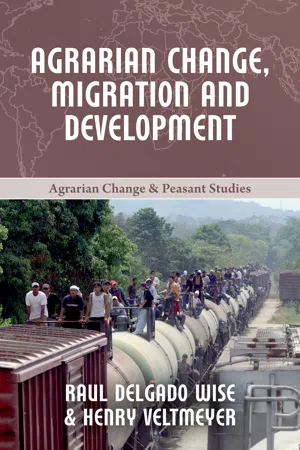
The focus and concern of Agrarian Change, Migration and Development is the problem of labour migraton. Veltmeyer and Wise explore the dynamics and development implications of the migration processes set in motion by the capitalist mode of production. The dynamics of these processes are both international — in regard to the international or cross-border flows of labour migrants — and internal to countries that have undergone, or are undergoing, a process of agrarian change and social transformation.Veltmeyer and Wise examine what they call the "migration-development nexus" from both a political economy and a sociological perspective, highlighting current trends, the global scale and the human dimension of the labour migration process, with particular reference to the increasing south-north flows of migrants who are forced to abandon their communities and ways of life by the globalizing forces of capitalist development.While it may appear that these migrants are free to choose to abandon their communities, and in many cases their families, in the search for greater economic opportunities and a better way of life, the authors show with devastating logic that the decisions made by so many migrants are rooted in the workings of the world capitalist system, which converts them into a pool of surplus labour to be pulled into and out of the system as required by capitalists in their endless search for private profit.
- English
- ePUB (mobile friendly)
- Available on iOS & Android
eBook - ePub
Agrarian Change, Migration and Development
About this book
Information
Subtopic
Global Development StudiesIndex
Social SciencesChapter 1
Rethinking Migration in the Neoliberal Era
There are five basic theoretical and methodological approaches to understanding the migration-development nexus, each associated with a theory regarding the development dynamics of migration.
One approach—positivism (as it is known in social science discourse)—is used by many migration economists but can be traced back to the sociologist Emile Durkheim. It is to search for and establish a correlation between the decisions made and actions taken by individual migrants and the objectively given conditions of these decisions and actions. In this approach the underlying motivation and decision to migrate are explained in terms of the “social facts” (conditions that are external to individuals and coercive in their effects)—a combination of “push” and “pull” factors. An example of this approach can be found in a study by Dana Rowlands (2004) on the impact of poverty and environmental degradation on south-north migration flows, and the gender dimension of these flows. Typically, as in this study, there is no reference to any system dynamics.
A second approach—constructivism—(used by many sociologists)—seeks to take into account subjective factors such as motivation and social awareness (subjective interpretations by individuals of their own reality), which are manifest not in theoretical or political discourse but in the migrant's own words and thoughts. This approach is exemplified in a study by Tsafack and Calkins (2004), which reports on the changed socioeconomic status of migrants, as well as gender relations and the gender composition of migrant streams, but focuses on the subjective dimension of the decisions taken by particular individuals to migrate. These decisions are explained, not in terms of conditions that are “external to individuals and coercive in their effects”—conditions rooted in the economic or social structure of society—but in terms of an individual's social consciousness. In this study, and others of this genre, decisions of an individual or family to migrate are understood in terms of reports given by the migrants themselves.
A third approach to labour migration is based on an orthodox neoclassical theory of international trade, although as Nayyar (1994: 31–38) reminds us, this theory is mostly about the movement of goods and not very much about the movement of capital or labour across national boundaries. Insofar as exponents of this neoclassical trade theory concern themselves with international factor movements, the focus is almost exclusively on capital mobility, with labour mobility, at best, a corollary and at worst totally ignored.
Orthodox trade theory starts from David Ricardo's notion of “comparative advantage,” which seeks to explain the pattern of trade between countries in terms of differences in factor endowments. In the conventional two-country–commodity-factor model used to construct this theory, the labour-abundant country's export of labour-intensive goods constitutes a “virtual” export of labour, while the capital-abundant country's export of capital-intensive goods is an implicit (but again not actual) export of capital. However, if instead of goods, one were to think of factors of production moving from countries where they are relatively abundant to where they are relatively scarce, the basis for trade in goods would narrow and vanish over time. Therefore, theoretically, the movement of capital from rich to poor countries and the movement of labour from poor to rich countries are perfectly substitutable. This approach has proven to be overly abstract and rather fruitless in terms of guiding empirical research into migration and development dynamics.
A more productive approach, which the authors of this book use, is to analyze the motivations underlying the decision to migrate in terms of conditions and forces generated in the capitalist development process, i.e., the political economy of national and international development viewed from a critical perspective (critical development studies, in the discourse of this political economy approach). Within this framework the fundamental concern is with the structural dynamics of labour migration and the capital-labour relation in the capitalist development process. The assumption is that the dynamics of labour migration are intimately related to the evolution of capitalism as an economic and social system.
Fifth, the gender and development approach to understanding and analyzing the dynamics of intra- and international migration is focused on the gender dimensions of migration. One of the most striking features of migration research over the past decade is a growing concern with the gender dimensions of the migration and capitalist development processes. This concern in part reflects the emergence of feminism in the 1980s and the centrality of gender in the study of development and development practice.1 However, it also reflects the emergence of a women-centred approach towards migration in academe and the dissemination of a series of global reports published by a number of international organizations within the U.N. system.2 This change in focus, according to Piper (2005) reflects two important events: (i) scholars have succeeded in bringing female migration out of the shadows in many disciplines; (ii) migration is now viewed as a gendered phenomenon that requires more sophisticated theoretical and analytical tools than sex (gender) as a dichotomous variable. Theoretical formulations of gender as relational, and as spatially and temporally contextual, have begun to inform gendered analyses of migration (Donato et al. 2006).3
The identification of the gender ramifications of migratory processes has resulted in greater attention paid by policymakers and scholars alike than hitherto. There are a number of reasons why it is important to understand the economic and social ramifications of migratory processes. Among these, gender differentiated population movements deserve particular attention because they act like a mirror for the way in which gender divisions of labour are incorporated into spatially uneven processes of economic development. In addition, an analysis based on gender highlights the social dimensions of migration. On the other hand, these cross-border movements – whether by women/men on their own or jointly with their spouses – have the potential to reconfigure gender relations and power inequalities. Migration can provide new opportunities for women and men to improve their lives, escape oppressive social relations and support those who are left behind. But it can also expose people to new vulnerabilities as the result of their precarious legal status, abusive working conditions, exposure to certain health risks, etc. (UNRISD 2005).
As pointed out by Piper (2005) in her review (Gender and Migration) for the Global Commission on International Migration, when migration involves economic betterment for the individual concerned—obtaining a job in another country and earning a wage that may be much higher in real terms than what was available at home—the successful migrant may be subject to deep gender, ethnic and racial discrimination in the host country. Although the bulk of both female and male labour migrants occupy the lowest jobs in the hierarchy of work in the destination countries due to their migration status and skill level, gender inequalities frequently combine with those of race/ethnicity and of being a non-national to make many migrant women triply disadvantaged and most likely to be over-represented in marginal, unregulated and poorly paid jobs.
Furthermore—although this applies to men as well as women, albeit less so—qualifications may not be recognized, skills may be eroded by working in jobs that are below acquired skill levels, access to social rights may be heavily constrained, and the migrant may be subject to sexual and racial harassment. At the same time several studies have explored the contradictory class positioning in which some labour migrants find themselves (Piper 2005). This results from the simultaneous experience of upward and downward mobility in migration, which is not necessarily the same for men and women. Discrimination, loss of status and erosion of skills in destination areas may be combined with upward mobility at home, as remittances are invested in small businesses, housing and children's education. However, women circulate differently than men and their modes of entry tend to be different, which affects their place within the labour market and access to social services. In both North America and Western Europe, where “family reunification” is an important mode of entry, migrant women often enter as wives and dependents of men who sponsor their migration, and they are usually less likely than men to be admitted on economic and humanitarian grounds. Piper notes that the effects of gender stratification do not end there. Many immigrant women engage in paid work, but like their native-born counterparts, confront a gender-stratified labour market in which they frequently find themselves at or near the bottom. Also, legal residency, gender and race all can be used as stratifying, exclusionary criteria, while gender, class and race-biased policies, regulations and practices further increase the risk to migrants’ human security and rights (Piper 2005: 2).
Piper concludes from her review of the literature that although policies governing the different categories of migrant workers are expressed in gender-neutral terms, in reality they affect men and women differently for three principal reasons: first, the concentration of men and women in different migratory flows based on gender segregated labour markets; second, gendered socioeconomic power structures; and finally, sociocultural definitions of appropriate roles in the origin as well as destination countries.
The Migration-Development Nexus
Within the framework of these alternative approaches, diverse theories have been elaborated in regard to the dynamics of both internal/international migration and the migration-development nexus. The most widely disseminated theory, modernization, is that international labour migration is an extension of the rural-urban migration dynamic; that is, it is a response to the workings of diverse push and pull factors in the development process, the major dimensions of which are industrialization (the transition from an agriculture-based economic system to a system based on capitalism and modern industry), modernization (the transition from a traditional communalist culture of social solidarity to a modern culture of achievement orientation, possessive individualism, materialism and consumerism) and urbanization (a demographic shift from the countryside to the cities as the locus of a modern way of life). Within the framework of this development process, potential migrants, it is argued, are subject to diverse pressures, both pro and con, that play into a final decision to migrate. Push factors include landlessness and rural poverty—the inability to make a living on the farm or in agriculture in a context of agrarian crisis. Pull factors include the prospect of economic opportunities and a more sustainable livelihood, hopes for improved social conditions and a better life for the family, and—particularly in regard to the rural youth, many of whom are unemployed or have few prospects—a modern way of life based on individual achievement, materialism and consumerism.
The major alternative to this modernization theory of migration is based on what we might term the political economy of (capitalist) development. From this political economy perspective, migration is seen as a conditioned response to the process of productive and social transformation brought about by the capitalist development of the forces of production. The fundamental theory is that the evolution of capitalism is predicated on the exploitation of an unlimited supply of surplus generated in a process of agrarian transformation—the capitalist development of agriculture.
The earliest theories of economic growth and development recognized that migration has consequences for living standards and well-being in both origin and destination countries, even as the earliest scholars of migration recognized that living conditions in both influence conditions to migrate. This distinction between “push” and “pull” factors has been a central feature of academic and policy discussions in the mainstream tradition of migration studies. Another feature has been a debate as to whether emigration is beneficial or detrimental to the development prospects of poor countries, or whether it tends to primarily benefit developed countries (De Haas 2008). The literature is divided on this question, although it is widely recognized that historically developed countries have substantively benefitted from and prospered because of immigration, while in many cases emigration has been a major drain on the poor sending countries, which in effect subsidize and finance (with human resources) the development of the rich countries. Not only have poor countries greatly contributed to the economic development of rich countries, by providing them highly qualified and skilled labour while assuming the reproduction costs of this labour, but as a result the poor sending countries are often deprived of their most productive human resources. In a very real sense people are exported to the benefit of both the migrating individuals and the recipient country, at a cost borne entirely by the migrant-sending countries. It is argued that a benefit that accrues to these countries of origin are the remittances sent home by migrants, which can be used to alleviate poverty and even, according to World Bank economists, be used for productive investment with development outcomes (Fajnzylber and López 2007). However, as we will see in Chapter 6, this is essentially a myth.
In the policy literature, discussions about the migration-development nexus tend to revolve around two questions: why people migrate and how migration trends evolve when sending countries prosper and living conditions improve. More recently, as pointed out by Piper (2005) and by Donato and colleagues (2006), there has been a shift towards a concern with the gender dimensions of the migration and capitalist development processes. Research into the first question is of interest primarily to immigration policymakers concerned with high demand for visas and spillover effects into illegal channels. The second body of research focuses on whether countries are better or worse off when their citizens move abroad. This research is of interest primarily to development policymakers concerned with the well-being of poor countries and to policymakers in the migrant-sending countries. The third body of research, based on a concern for understanding the gender dimensions of the migration process, serves as a guide by a number of international organizations within the U.N. system to policy and practice. The reports published by these organizations are also used by governments (particularly in the migrant-receiving countries) in their elaboration of migration policies. The growing importance of migration as an issue of national policy—in regard to refugee claims, the labour market, public perceptions and issues of national security—has stimulated the production of these reports and dramatically increased their usefulness for academic researchers, policymakers and politicians.
Individual Motivations as the “Root Cause” of Migration
The usual argument is that individuals migrate because they expect to materially improve their lives and that migration pressures diminish as countries prosper and living conditions improve. But this argument fails to capture the complexity of individual decisions and the forces at play in these decisions, forces that in a very real way determine or lead to the decisions to migrate. We argue that the decision to migrate is not voluntary but forced, i.e., individual decisions are underpinned, if not determined, by structural conditions (such as poverty) and forces that operate on these individuals, as well as policies that directly or indirectly generate or liberate these forces. In the context of these forces, individuals who “choose,” or are forced, to migrate—especially the rural unemployed youth, those “who neither work nor study,” might very well be “pulled” by the attractions of the city (opportunity for a better life, “modern lifestyle,” etc.), but to explain the actions of individuals in terms of pull factors demonstrates a failure to understand the real forces at play or the consequences of forced migration. One of these consequences is that in underdeveloped or peripheral countries, which bear the reproduction costs of the labour force, the most dynamic and productive members of society—the young, the highly educated and the highly ambitious—continue to depart. And in many cases—ranging from Ecuador, El Salvador, Egypt and Lebanon to Mexico, Morocco and the Philippines—decades of sustained emigration have barely moderated poverty (provided a sort of safety-valve) but have not led to sustainable development or measurably reduced the outflow of migrants (Castles and Delgado Wise 2008).
Poverty and opportunity by themselves cannot explain individual decis...
Table of contents
- Cover Page
- Advance Praise for Agrarian Change, Migration and Development
- Title Page
- Copyright Page
- Contents
- Series Editors’ Foreword
- Interchurch Organization for Development Cooperation Statement
- Acknowledgements
- Introduction
- 1. Rethinking Migration in the Neoliberal Era
- 2. Migration Dynamics of Agrarian Change
- 3. Global Capital, Migrant Labour and the Nation-State
- 4. The Political Economy of International Labour Migration
- 5. The Social Dimension of Migration, or the Underside of Development
- 6. Rethinking the Migration-Development Nexus
- Index
- Back Cover
Trusted by 375,005 students
Access to over 1.5 million titles for a fair monthly price.
Study more efficiently using our study tools.
Frequently asked questions
Yes, you can cancel anytime from the Subscription tab in your account settings on the Perlego website. Your subscription will stay active until the end of your current billing period. Learn how to cancel your subscription
No, books cannot be downloaded as external files, such as PDFs, for use outside of Perlego. However, you can download books within the Perlego app for offline reading on mobile or tablet. Learn how to download books offline
Perlego offers two plans: Essential and Complete
- Essential is ideal for learners and professionals who enjoy exploring a wide range of subjects. Access the Essential Library with 800,000+ trusted titles and best-sellers across business, personal growth, and the humanities. Includes unlimited reading time and Standard Read Aloud voice.
- Complete: Perfect for advanced learners and researchers needing full, unrestricted access. Unlock 1.5M+ books across hundreds of subjects, including academic and specialized titles. The Complete Plan also includes advanced features like Premium Read Aloud and Research Assistant.
We are an online textbook subscription service, where you can get access to an entire online library for less than the price of a single book per month. With over 1.5 million books across 990+ topics, we’ve got you covered! Learn about our mission
Look out for the read-aloud symbol on your next book to see if you can listen to it. The read-aloud tool reads text aloud for you, highlighting the text as it is being read. You can pause it, speed it up and slow it down. Learn more about Read Aloud
Yes! You can use the Perlego app on both iOS and Android devices to read anytime, anywhere — even offline. Perfect for commutes or when you’re on the go.
Please note we cannot support devices running on iOS 13 and Android 7 or earlier. Learn more about using the app
Please note we cannot support devices running on iOS 13 and Android 7 or earlier. Learn more about using the app
Yes, you can access Agrarian Change, Migration and Development by Henry Veltmeyer in PDF and/or ePUB format, as well as other popular books in Social Sciences & Global Development Studies. We have over 1.5 million books available in our catalogue for you to explore.