The subject of food security and land issues in Africa has become one of increased importance and contention over recent years. In particular, the focus has shifted to the role new global South donors - especially India, China and Brazil - are playing in shaping African agriculture through their increased involvement and investment in the continent.
Approaching the topic through the framework of South-South co-operation, this highly original volume presents a critical analysis of the ways in which Chinese, Indian and Brazilian engagements in African agriculture are structured and implemented. Do these investments have the potential to create new opportunities to improve local living standards, transfer new technology and knowhow to African producers, and reverse the persistent productivity decline in African agriculture? Or will they simply aggravate the problem of food insecurity by accelerating the process of land alienation and displacement of local people from their land?
Topical and comprehensive, Agricultural Development and Food Security in Africa offers fresh insight into a set of relationships that will shape both Africa and the world over the coming decades.
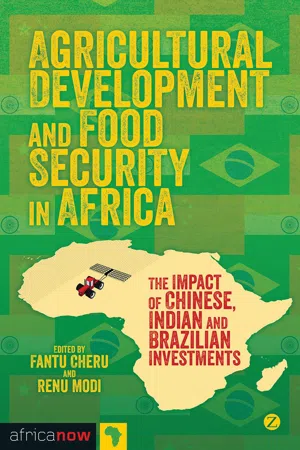
eBook - ePub
Agricultural Development and Food Security in Africa
The Impact of Chinese, Indian and Brazilian Investments
- English
- ePUB (mobile friendly)
- Available on iOS & Android
eBook - ePub
Agricultural Development and Food Security in Africa
The Impact of Chinese, Indian and Brazilian Investments
PART I Overview
1 | Catalysing an agricultural revolution in Africa: what role for foreign direct investment?
Fantu Cheru, Renu Modi and Sanusha Naidu
Introduction
Today, food insecurity is one of the most urgent problems facing sub-Saharan Africa, where more than half the population is dependent on subsistence farming as their only source of livelihood. However, it must be stated at the outset that the countries of Africa are diverse and asymmetrical in terms of area, population, and endowment of natural resources such as cultivable land and water, and therefore the agricultural potential of different countries varies. Despite this, this chapter attempts to focus on general trends in the agricultural sector, and, most notably, on trends in subsistence agriculture. Subsistence farming is under massive threat from population growth, land scarcity and worsening ecological degradation as a result of climate change. Continued underinvestment by national governments in agricultural research, technology and infrastructure further aggravates the productivity decline in African agriculture. Consequently, Africa is one of the regions in the world where a ‘green revolution’ in agriculture has failed to materialise, despite the importance of agriculture to the majority of Africans.
Since the early 2000s in particular, however, the issue of transforming African agriculture has featured prominently on the policy agenda of national governments, the African Union and external development partners. First, there is a growing resolve by African leaders to take decisive steps to address the many obstacles to growth and structural change in the agricultural sector and the larger economy as a whole. The Comprehensive Africa Agriculture Development Programme (CAADP), which was formulated in 2003, is now the basic reference point for African governments for improving agricultural productivity and reducing hunger on the continent (African Union 2003; 2006).
Second, there has also been increasing interest from Africa’s official development partners, philanthropic foundations and private international investors in reversing Africa’s productivity decline in agriculture, ensuring food security and using agricultural transformation as the foundation for Africa’s industrialisation. Emerging from the dialogue process with Africa that began with the Kananaskis Group of Eight (G8) summit in 2002, the Global Food Security Initiative was launched at the L’Aquila G8 summit in 2009, with initial pledges of US$22 billion over the two following years. Subsequently, the Group of Twenty (G20) initiated a trust fund, the Global Agriculture and Food Security Program (GAFSP), administered by the World Bank, to support public and private sector agricultural investments in Africa in order to operationalise the L’Aquila Food Security Initiative. So far, the GAFSP has allocated a total of US$223 million to CAADP-aligned investment programmes in Ethiopia, Niger, Rwanda, Togo and Sierra Leone. This support is being tracked to ensure that the overall effort is optimised and the momentum is sustained.
In addition to the collective initiatives by G8 members, many countries are increasing their bilateral support for the agricultural sector in Africa. The current US administration under President Obama has scaled up assistance to African agriculture through its Feed the Future programme, while Japan is undertaking a major reorientation of its aid from Asia to Africa, with agriculture, and particularly rice technology, a major element. The traditional Western development partners are now joined by emerging countries such as Brazil, India and China, which are increasingly engaged in the development of African agriculture. Each of these new partners has a perceived comparative advantage: China in infrastructure development and rural-based special economic zones; India in green revolution and skill-intensive learning in agriculture; and Brazil in high-technology farming and agro-processing coupled with social protection measures to combat food insecurity and poverty.
CAADP has also shown considerable potential to catalyse and leverage partnerships with the private sector. The activity of the African Agricultural Growth and Investment Task Force, in which the African Union Commission (AUC) plays a leading role, is a case in point. The task force is linked to the Alliance for a Green Revolution in Africa, headed by former UN Secretary-General Kofi Annan, and the New Vision for Agriculture initiative of the World Economic Forum, and its aim is to expand partnerships, catalyse investment and integrate best practices in international private sector support for agriculture in Africa. These private sector and philanthropic initiatives are leading the way in transforming smallholder farming through the application of yield-enhancing technology and through improved provision of vital infrastructure such as roads. The AUC’s engagement with this task force has been informed by the need to broaden the mobilisation of investment resources for CAADP-aligned agricultural plans, programmes and projects.
One particular development in recent years has been the increasing presence in the African agricultural sector of foreign investors from the emerging countries of Asia and the Middle East. With the rapid economic turnaround of the continent since the early 2000s, foreign direct investment (FDI) from non-Western countries, particularly from Asia, has been growing steadily: China, India and Brazil are forging ahead in developing economic relationships with Africa in order to exploit its untapped strategic resources such as oil and gas and to capture the growing African consumer market. This new interest in Africa by investors from emerging economies also includes gaining access to Africa’s ample arable land to grow food as well as produce biofuel. The scramble for African land intensified particularly after the global food and energy crisis of 2008, when prices for basic food and energy skyrocketed. Although some critics from civil society organisations have characterised this as ‘land grabbing’ and a new form of neocolonialism, such characterisations are too simplistic and overlook the potential catalytic role of FDI in transforming African agriculture within a transparent policy regime and institutional framework that take into consideration the interests of local communities.
The existing literature on the impact of FDI on food security offers contradictory evidence. While the proponents of FDI take the position that FDI can help as a catalyst for increased agricultural productivity (Mihalache-O’Keef and Li 2011) in food deficit countries, others suggest that FDI penetration can lead to food insecurity by concentrating production on export crops and agrofuels, and accentuating the process of land alienation on a wider scale (Shiva and Bedi 2002; Oakland Institute 2011a; Matondi et al. 2011).
The aim of this book is to evaluate the extent to which FDI from China, India and Brazil is contributing to the transfer of modern agricultural technology to Africa, improving rural infrastructure such as roads and irrigation, building indigenous research and knowledge capacity in modern agriculture, and helping African host governments overcome the financing gap through increased access to finance (both public and private) in order to enable them to invest in strategic areas and unlock the productive potential of African agriculture. In the ‘framework of cooperation’ agreements signed separately between African heads of state and the leadership of China (under the Forum on China–Africa Cooperation or FOCAC process), India (under the India–Africa Forum Summit – IAFS-I and IAFS-II) and Brazil (under the India, Brazil and South Africa or IBSA umbrella), cooperation in agriculture has been assigned a prominent role. By focusing on the four vectors of finance, technology, infrastructure and know-how, this book assesses the actual contributions of FDI to the modernisation of African agriculture. In so doing, it takes a less polarised approach to foreign investments in Africa’s agriculture.
Transforming African agriculture: new opportunities
CAADP is the basic continental framework guiding the process of agricultural development in Africa. As noted in Box 1.1 below, CAADP focuses on four ‘pillars’ as well as recognising the importance of addressing a range of cross-cutting issues and of integrating livestock, fisheries and forestry into the agricultural planning processes. Among the many priority issues identified by CAADP for transforming African agriculture, we highlight four interventions that could unlock the agricultural sector’s potential.
Box 1.1 CAADP priorities
Pillar 1: Extending the area under sustainable land management and reliable water control systems.
Pillar 2: Improving rural infrastructure and trade-related capacities for market access.
Pillar 3: Increasing food supply, reducing hunger and improving responses to food emergency crises.
Pillar 4: Improving agriculture research, technology dissemination and adoption.
Cross-cutting issue 1: Capacity strengthening for agriculture and agribusiness; academic and professional training.
Cross-cutting issue 2: Information for agricultural strategy formulation and implementation.
Companion document: Integrating livestock, forestry and fisheries subsectors into CAADP.
Increasing land under cultivation (Pillar 1) It is estimated that 60 per cent of cultivable land in Africa is not under production. This provides considerable scope for increasing agricultural production, both for staples as well as for exports (McKinsey Global Institute 2010; UNECA 2009a). Instituting a radical land reform programme, starting with a comprehensive review of archaic tenure systems and allowing for different types of property ownership and use, is an important first step. Land tenure reform either can be initiated from the top down or, in other cases, could be led from the bottom up through small-scale experiments at the local level. By utilising diverse approaches that take into account local conditions, huge tracts of unused land could be brought under production. Of particular importance in the African context is the need to increase irrigated land and to rehabilitate large areas of degraded land through soil and water conservation measures.
Besides the need to transfer new technology to the peasant sector, new modalities of ownership and land use would help to attract FDI in agriculture through joint land-lease ventures. These land-lease arrangements should not be permitted if they displace communities that are already using the land for production (African Union/AfDB/UNECA 2010).
Linking farmers to markets through innovation in the value chain (Pillar 2) While the majority of African farmers produce for subsistence, considerable scope exists to help them begin more lucrative farming by producing high-value products for local, regional and global markets. This could be done in three ways. First, there is capacity building for farmers – by providing extension services and new demonstration centres – and expanding access to credit, seeds, fertilisers and affordable technology to enable them to produce high-value products. The second is to link the farmers to the market through regional value chains (World Bank 2007). This requires the development of small- and medium-scale rural industries such as agro-processing, packaging, agricultural input, cold storage, marketing, clearing, freight handling at ports and quality assurance and certification, all of which are vital in gaining access to global and regional markets. The third is by attracting FDI in agriculture, with well-defined upstream and downstream links that spawn new manufacturing and service sectors related to agriculture (Gibbon and Ponte 2005; World Bank 2007: 118–34; UNECA 2009a).
Increasing yields of staple foods (Pillar 3) High rates of population growth, increasing urbanisation and declining agricultural output due to climate change, coupled with high global food prices, are putting pressure on governments to increase yields of staple foods (NEPAD 2009). This is particularly challenging for Africa, where basic investment in critical infrastructure, technology and agricultural research is inadequate, and the use of yield-enhancing practices (fertilisers and pesticides, mechanisation and irrigation) is very low compared with the situation in other developing regions (UNECA 2009a). As an example, on average African farmers use only 22 kilograms of fertiliser per hectare of arable land (10 kilograms per hectare in sub-Saharan Africa). This is only 15 per cent (or 7 per cent) of the 144 kilograms per hectare used in Asia. The number of tractors per 1,000 hectares of arable land is three times greater in Asia and eight times greater in Latin America than in Africa.
An emphasis on food production for local consumption ...
Table of contents
- Cover
- About the editors
- Title
- Copyright
- Contents
- Tables, boxes and figures
- Abbreviations
- Preface
- Introduction: peasants, the state and foreign direct investment in African agriculture
- Part I Overview
- Part II India
- Part III Brazil
- Part IV China
- Notes
- About the contriburors
- References
- Index
Trusted by 375,005 students
Access to over 1.5 million titles for a fair monthly price.
Study more efficiently using our study tools.
Frequently asked questions
Yes, you can cancel anytime from the Subscription tab in your account settings on the Perlego website. Your subscription will stay active until the end of your current billing period. Learn how to cancel your subscription
No, books cannot be downloaded as external files, such as PDFs, for use outside of Perlego. However, you can download books within the Perlego app for offline reading on mobile or tablet. Learn how to download books offline
Perlego offers two plans: Essential and Complete
- Essential is ideal for learners and professionals who enjoy exploring a wide range of subjects. Access the Essential Library with 800,000+ trusted titles and best-sellers across business, personal growth, and the humanities. Includes unlimited reading time and Standard Read Aloud voice.
- Complete: Perfect for advanced learners and researchers needing full, unrestricted access. Unlock 1.5M+ books across hundreds of subjects, including academic and specialized titles. The Complete Plan also includes advanced features like Premium Read Aloud and Research Assistant.
We are an online textbook subscription service, where you can get access to an entire online library for less than the price of a single book per month. With over 1.5 million books across 990+ topics, we’ve got you covered! Learn about our mission
Look out for the read-aloud symbol on your next book to see if you can listen to it. The read-aloud tool reads text aloud for you, highlighting the text as it is being read. You can pause it, speed it up and slow it down. Learn more about Read Aloud
Yes! You can use the Perlego app on both iOS and Android devices to read anytime, anywhere — even offline. Perfect for commutes or when you’re on the go.
Please note we cannot support devices running on iOS 13 and Android 7 or earlier. Learn more about using the app
Please note we cannot support devices running on iOS 13 and Android 7 or earlier. Learn more about using the app
Yes, you can access Agricultural Development and Food Security in Africa by Renu Modi, Fantu Cheru, Renu Modi,Fantu Cheru in PDF and/or ePUB format, as well as other popular books in Economics & Political Economy. We have over 1.5 million books available in our catalogue for you to explore.