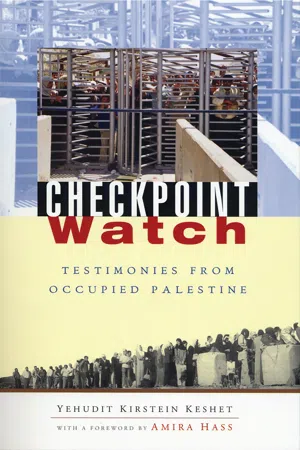
This book is a critical exploration of Israel's curfew-closure policy in the Occupied Palestinian Territories through the eyes of CheckpointWatch, an organization of Israeli women monitoring human rights abuses. The book combines observers' daily reports from the checkpoints and along the Separation Wall, with analysis of the bureaucracy that supports the ongoing occupation. Keshet demonstrates the link between Israeli bureaucracy and the closure system as integral to a wider project of ethnic cleansing.
As co-founder of the group, Keshet critically reviews the organisation's transformation from a feminist, radical protest movement to one both reclaimed by, and reclaiming, the consensus. Illustrating the nature of Israeli mainstream discourse as both anodyne and cruel, the book also analyses Israeli media representation of Checkpoint Watch and human rights activism in general. Keshet contends that the dilemmas of these Israeli women, torn between opposition to the Occupation and their loyalty to the state, reflects political divisions within Israel society as a whole.
- English
- ePUB (mobile friendly)
- Available on iOS & Android
eBook - ePub
About this book
Information
Index
1948 war, 6, 108, 152
A-Ram, 67, 101
A-Ram checkpoint, 62, 157
absentees, term used for Palestinians, 3, 155
Abu Dayyeh, Maha, 101
Abu Dis, 71, 96–100; cut off from Jerusalem, 95; wicket, 162
Abu Dis checkpoint, 158
accountability, of Israeli military, 65
Achoti (My Sister), 46
agency, 125; denied, 63
Agmon, H., 69
‘agricultural’ gates, 94, 158
alleviations, 159
Alterman, N., 117
Alternative Information Centre, 133
ambulances, denial of access to, 81–2, 96–7, 117
Amor, Shimon, 140
Anata checkpoint, 157
Anbata checkpoint, 157
Androni, Ghassan, 4
Anglo-Saxons, use of term, 139
Annexation Wall, 7, 24, 25, 86, 89–104, 116, 152, 156, 160, 161, 162; changes in route of, 90; effect of, on health care of Palestinians, 90; opposition to, 45, 89, 123; symbolic aspect of, 103
Arab, used as insult, 2–3
Arabic language, use of, 60; by CheckpointWatchers, 124
Arabs: represented as threat to Israel, 151; seen as indistinguishable mass, 144
Ariel settlement, 161
army service, as rite of passage for Israelis, 64
arrest: and harassment of CheckpointWatchers, 38; arbitrary, of Palestinians, 59
Arutz Sheva (Channel Seven), 133
Ashkenazi Jews, 46, 123
Association for Civil Rights in Israel, 90, 143
Atara checkpoint, 157
Avneri, Uri, 6, 133
Awwarta checkpoint, 157
Azariyeh checkpoint, 157
Back, Hagit, 110
banality of evil, 75–80
Bantustans, creation of, 27
Bar, Iris, 114
Barag, Hanna, 136
Barak, Ehud, 64, 109, 123
Barr, Shula, 115
barricades, internal, 152
Barta’a checkpoint, 157
Beit Furiq, 76
Beit Furiq checkpoint, 125, 158
Beit Iba checkpoint, 77, 83–4
Beit She-an, 98
Beit Sourik, 91
Beit-El, 21
Ben Shemen, 2
Beth Hanina, 101
B...
Table of contents
- Cover
- About the Book
- About the Author
- Title Page
- Copyright
- Contents
- Maps
- Acknowledgements
- Foreword
- Introduction
- One | The context
- Two | The checkpoints
- Three | The observers
- Appendices
- References
- Index
Trusted by 375,005 students
Access to over 1.5 million titles for a fair monthly price.
Study more efficiently using our study tools.
Frequently asked questions
Yes, you can cancel anytime from the Subscription tab in your account settings on the Perlego website. Your subscription will stay active until the end of your current billing period. Learn how to cancel your subscription
No, books cannot be downloaded as external files, such as PDFs, for use outside of Perlego. However, you can download books within the Perlego app for offline reading on mobile or tablet. Learn how to download books offline
Perlego offers two plans: Essential and Complete
- Essential is ideal for learners and professionals who enjoy exploring a wide range of subjects. Access the Essential Library with 800,000+ trusted titles and best-sellers across business, personal growth, and the humanities. Includes unlimited reading time and Standard Read Aloud voice.
- Complete: Perfect for advanced learners and researchers needing full, unrestricted access. Unlock 1.5M+ books across hundreds of subjects, including academic and specialized titles. The Complete Plan also includes advanced features like Premium Read Aloud and Research Assistant.
We are an online textbook subscription service, where you can get access to an entire online library for less than the price of a single book per month. With over 1.5 million books across 990+ topics, we’ve got you covered! Learn about our mission
Look out for the read-aloud symbol on your next book to see if you can listen to it. The read-aloud tool reads text aloud for you, highlighting the text as it is being read. You can pause it, speed it up and slow it down. Learn more about Read Aloud
Yes! You can use the Perlego app on both iOS and Android devices to read anytime, anywhere — even offline. Perfect for commutes or when you’re on the go.
Please note we cannot support devices running on iOS 13 and Android 7 or earlier. Learn more about using the app
Please note we cannot support devices running on iOS 13 and Android 7 or earlier. Learn more about using the app
Yes, you can access Checkpoint Watch by Judith Keshet in PDF and/or ePUB format, as well as other popular books in Politics & International Relations & Civil Rights in Politics. We have over 1.5 million books available in our catalogue for you to explore.