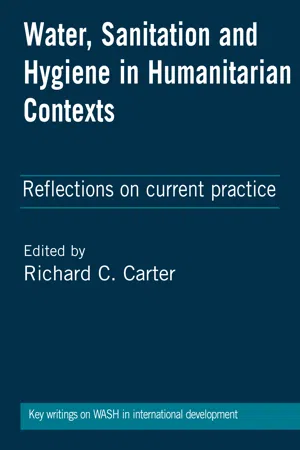
Earthquakes, tsunamis, floods, droughts, disease outbreaks as well as conflicts are all crises that result in death as well as profound disruption to those left behind, and to those communities who shelter them. Among the most urgent interventions are those to provide water, sanitation and hygiene (WASH) to affected communities. Water, Sanitation and Hygiene in Humanitarian Contexts presents contributions on the changing field of humanitarian WASH response and questions research and practice in this field. What are the research gaps in WASH response? What are the most effective means of providing clean water in different settings? How are the latest innovations in emergency sanitation performing? How can women's menstrual hygiene needs best be met in humanitarian situations? The chapters address a wide range of WASH subjects, in a variety of geographical settings and are written by experienced practitioners and researchers. The approach of the book is straightforward and practical, with little theory – the focus being on improving professional practice in the midst of humanitarian suffering.This book is written for those whose everyday work involves humanitarian response to WASH needs in emergencies and disasters, but it is also aimed at development professionals from the WASH and other sectors, including researchers and practitioners.
- English
- ePUB (mobile friendly)
- Available on iOS & Android
eBook - ePub
Water, Sanitation and Hygiene in Humanitarian Contexts
About this book
Information
Subtopic
Global Development StudiesIndex
Social SciencesCHAPTER 1
Introduction: Water, sanitation and hygiene in humanitarian contexts
Abstract
This introductory chapter explains the origins, scope and intended readership of Water, Sanitation and Hygiene in Humanitarian Contexts. It describes the human impacts of emergencies and disasters, briefly discusses some of the terms used in humanitarian work, and examines the diversity of types of emergency and disaster. The introduction then moves on to some of the specifics of water, sanitation and hygiene – WASH – in emergencies, referring extensively to the Sphere Handbook, Humanitarian Charter and Minimum Standards in Humanitarian Response. The final sections of the introduction touch on the challenges of transitioning from emergency to post-emergency, when resources and institutional capacity may be very different to the acute phase of the emergency. Lastly, the individual chapters of the book are summarized and suggestions are made as to how the book can most usefully be read.
In 2011, the world saw a massive earthquake, tsunami and nuclear meltdown in Japan; devastating drought in East Africa; extreme and costly floods in Thailand; and a damaging but under-reported typhoon in the Philippines. Since that time there has been a seemingly relentless unfolding of natural disasters – earthquakes, storms, floods and droughts – and still unresolved fighting in Central African Republic, South Sudan and Syria. At the time of writing, we are eight months into the world’s worst Ebola outbreak in West Africa. All these examples, and many others, have implications for water and sanitation services.
The impact of emergencies and disasters is inevitably greater in what have come to be called ‘fragile states’ than in those which by virtue of effective government, strong institutions and wealthier economies have greater resilience to such events. In fragile states, periods of relative stability, in which development efforts make some progress, are often punctuated by crises which may have long-lasting impacts. Effective long-term development is the best form of disaster-risk reduction, and good governance and strong institutions represent the best form of disaster preparedness.
All of these crises, disasters or emergencies – choose your term – profoundly affect individual human beings, their families, their communities, the surrounding populations, and the nations in which these events take place. They all demand rapid and effective response to physical need – of which water and sanitation is one part – and longer-term recovery and reconstruction.
This book is not and cannot be a comprehensive treatise on disaster response (let alone disaster preparedness or post-disaster recovery). Rather it sets out a number of very down-to-earth issues and actions which have been addressed and undertaken by practitioner organizations in recent years. The individual contributions in the chapters which follow this scene-setting introduction fit within wider social, economic and political contexts. They address particular aspects of WASH – water, sanitation and hygiene – and taken together they give a useful flavour of the thinking, experimentation and reflection of those who are constantly striving for greater effectiveness in humanitarian emergency response.
Who the book is for
This book is for those whose work regularly involves them in providing WASH in emergencies, but it should also be of interest to those who are mainly involved in long-term development, from WASH and other sectors. It will be of value to those studying for technical and professional qualifications in WASH and in disaster management. It demonstrates the wide range of issues which WASH professionals have to address as they attempt to respond to emergencies.
Humanitarian disasters and emergencies
Neither the phrase ‘humanitarian emergency’, nor the more pithy reference to a ‘disaster’, do justice to the effects caused by such events. Imagine for some moments what happens when an emergency unfolds, when a sudden flood or earthquake hits, when a drought sets in, or when society falls apart during conflict.
The ‘emergency’ can happen either gradually (in the case of slow-onset droughts and famines) or suddenly (rapid-onset earthquakes and floods). Individuals and families lose their homes, their possessions, and, in some cases, their lives or those of loved ones. The number of deaths is what hits the news headlines and is the popular, if blunt, measure of the severity of the emergency. ‘Thousands killed in disaster’ shocks newspaper readers, but fails to reflect the reality for those who live on. For every death there are many times as many who survive, affected physically, mentally, and socially.
Those who survive may become ‘displaced’: no longer able to live in the places they once called home. If they cross national borders, they become refugees. They may reach the relative safety of family elsewhere, of towns or cities which they do not know, or of a hastily constructed ‘camp’. Camps for internally displaced persons (IDPs) or refugees may take the form of tented cities or accommodation built in local styles and materials, but for their residents they represent more than a mere physical displacement. People are dislocated physically, socially and mentally. They are dislocated, along with all their pre-existing health needs and infirmities, and with all their individual and family frailties and strengths. Livings are disrupted, and those with least in reserve are naturally hardest hit. Social networks are upset as whole communities are displaced. People suffer loss, shock, stress and uncertainty.
These are some of the realities for those who have survived death and been displaced from their homes by the emergency. There are other emergencies, however, which do not cause displacement – sometimes it can be precisely the opposite. As I write this, the Ebola outbreak in Guinea, Sierra Leone and Liberia is continuing. For those affected, ‘lock-down’ – prevention of movement and interaction – is the pattern, rather than escape. Yet the effects for those surviving are similar – livings are disrupted, and uncertainty, suspicion, and fear abound.
Every emergency is different in its details, despite some common features across certain categories. It may be that the apparently increasing diversity of emergencies reflects our increasing understanding of their nuances, and it is certainly true that large-scale demographic changes and the evolving nature of armed conflict are resulting in more people being affected by a wider range of types of emergency than ever before. The world is becoming more complex and unpredictable.
Disasters and emergencies not only affect those they kill and those who are left behind, but the communities, societies and nations where displaced people end up. They affect national economies, sometimes retarding investment and development for many years. In the case of war or other large-scale armed conflict, it is uncommon for visible progress to be seen in the processes of healing, renewal and restoration of confidence and security until a decade or more has passed.
Those affected by a disaster may need immediate fundamentals: shelter, food, water and sanitation, clothing and household goods; they may need health services and education – the children affected by the civil war in Syria have missed out on much schooling, and the closure of schools in Sierra Leone in response to Ebola has robbed children of a full year of education. This book addresses some aspects of WASH, but it is important to set these in the wider context of need.
Definitions and diversity
As with all fields of endeavour, there is a body of jargon which we need to deal with in the interests of clear communication. First, the word ‘humanitarian’ itself, which, according to the dictionary, means ‘concerned with or seeking to improve human welfare’. In the present context, however, the word is used to refer to extraordinary events which have affected human beings, and which require urgent action – disasters or emergencies. This is in contrast to the concern for improving human welfare which is embodied in long-term sustainable development work.
According to ReliefWeb (2008) a disaster is ‘a serious disruption of the functioning of a community or a society causing widespread human, material, economic or environmental losses which exceed the ability of the affected community or society to cope using its own resources’. An emergency is ‘a sudden and usually unforeseen event that calls for immediate measures to minimize its adverse consequences’. The two terms are often used interchangeably, although some argue that a disaster is larger in scale than many emergencies; a local emergency may or may not develop into a full-blown disaster. Some put emergencies, disasters and catastrophes on a sliding scale of increasing severity. A crisis – ‘a time of extreme difficulty or danger’ – or an emergency may develop into a disaster.
Emergencies and disasters have many root causes and triggers. Various categorizations exist, with the primary categories being natural disasters (e.g. earthquake, storm, flood, drought, epidemic), technological disasters (various kinds of accidents) and ‘complex humanitarian emergencies’ – those having multiple causes and in which violence, insecurity and breakdown of law and order often compound the difficulties faced by those who are affected. Table 1.1 summarises these categories, according to the International Federation of Red Cross and Red Crescent Societies. As well as the categories of disaster listed, a number of aggravating factors are highlighted – interestingly with no reference to general population growth, which surely accounts for much of the growth in disasters over recent years.
Table 1.1 Categories of humanitarian disaster (IFRC, 2014)
Category | Sub-category | Examples |
Natural | Geophysical | Earthquakes, landslides, tsunamis, volcanic eruptions |
Hydrological | Avalanches, floods | |
Climatological | Extreme temperatures, drought, wildfires | |
Meteorological | Cyclones, storm surges | |
Biological | Disease epidemics, insect/animal plagues | |
Technological | Industrial accidents | Release of chemicals or radioactivity into the environment |
Transport accidents | Air crash, road crash | |
Complex emergencies/conflicts | War/conflict | Civil strife, cross-border fighting |
Famine | Chronic and acute food insecurity | |
Aggravating factors | Climate change | |
Unplanned urbanization | ||
Under-development/poverty | ||
Threat of pandemics |
Disasters result when people live in hazardous situations (e.g. in floodplains or seismically active zones), an event occurs (flood or earthquake in the examples given), the population is vulnerable (e.g. as a result of its physical location or its poverty) and its capacity to cope is limited (e.g. because of limited resources or weak institutions).
Wherever and however a natural or man-made disaster affects people, basic services, including those of water and sanitation, may be disrupted. Prolonged droughts may reduce stocks of water; flooding and geophysical disasters (such as earthquakes and volcanic eruptions) may damage water supply and sanitation infrastructure; industrial accidents may pollute water resources; any form of human displacement may reduce people’s access to services.
Disruption of water and sanitation services creates problems for those affected. But WASH actions also form part of the solution – when done well, they can help to safeguard health – especially by controlling outbreaks of water-related diseases such as cholera – and preserve dignity and well-being at a time when all of these are in short supply.
The importance of WASH in emergencies and disasters
Emergencies and disasters affect WASH services and practices by damaging existing infrastructure or by separating displaced populations from the services which they had enjoyed. In the case of displacement, host populations are also affected, as greater demands are placed on their services. Those who reach the relative safety of IDP and refugee camps may be there ...
Table of contents
- Cover
- Title Page
- Copyright Page
- Contents
- 1. Introduction: Water, sanitation and hygiene in humanitarian contexts
- 2. Point-of-use water treatment in emergency response
- 3. Water, sanitation, and hygiene in emergencies: summary review and recommendations for further research
- 4. Water and wastes in the context of the West African Ebola outbreak: turning uncertain science into pragmatic guidance in Sierra Leone
- 5. Menstrual hygiene management in humanitarian emergencies: gaps and recommendations
- 6. Bulk water treatment unit performance: for the cameras or the community?
- 7. Innovative designs and approaches in sanitation when responding to challenging and complex humanitarian contexts in urban areas
- 8. Biodegradable bags as emergency sanitation in urban settings: the field experience
- 9. Urban armed conflicts and water services
- 10. Sanitation for all! Free of cost in emergencies
- 11. Conclusions
Trusted by 375,005 students
Access to over 1.5 million titles for a fair monthly price.
Study more efficiently using our study tools.
Frequently asked questions
Yes, you can cancel anytime from the Subscription tab in your account settings on the Perlego website. Your subscription will stay active until the end of your current billing period. Learn how to cancel your subscription
No, books cannot be downloaded as external files, such as PDFs, for use outside of Perlego. However, you can download books within the Perlego app for offline reading on mobile or tablet. Learn how to download books offline
Perlego offers two plans: Essential and Complete
- Essential is ideal for learners and professionals who enjoy exploring a wide range of subjects. Access the Essential Library with 800,000+ trusted titles and best-sellers across business, personal growth, and the humanities. Includes unlimited reading time and Standard Read Aloud voice.
- Complete: Perfect for advanced learners and researchers needing full, unrestricted access. Unlock 1.5M+ books across hundreds of subjects, including academic and specialized titles. The Complete Plan also includes advanced features like Premium Read Aloud and Research Assistant.
We are an online textbook subscription service, where you can get access to an entire online library for less than the price of a single book per month. With over 1.5 million books across 990+ topics, we’ve got you covered! Learn about our mission
Look out for the read-aloud symbol on your next book to see if you can listen to it. The read-aloud tool reads text aloud for you, highlighting the text as it is being read. You can pause it, speed it up and slow it down. Learn more about Read Aloud
Yes! You can use the Perlego app on both iOS and Android devices to read anytime, anywhere — even offline. Perfect for commutes or when you’re on the go.
Please note we cannot support devices running on iOS 13 and Android 7 or earlier. Learn more about using the app
Please note we cannot support devices running on iOS 13 and Android 7 or earlier. Learn more about using the app
Yes, you can access Water, Sanitation and Hygiene in Humanitarian Contexts by Richard C Carter in PDF and/or ePUB format, as well as other popular books in Social Sciences & Global Development Studies. We have over 1.5 million books available in our catalogue for you to explore.