Aid workers commonly bemoan that the experience of working in the field sits uneasily with the goals they've signed up to: visiting project sites in air-conditioned Land Cruisers while the intended beneficiaries walk barefoot through the heat, or checking emails from within gated compounds while surrounding communities have no running water.
Spaces of Aid provides the first book-length analysis of what has colloquially been referred to as Aid Land. It explores in depth two high-profile case studies, the Aceh tsunami and Hurricane Katrina, in order to uncover a fascinating history of the objects and spaces that have become an endemic yet unexamined part of the delivery of humanitarian assistance.
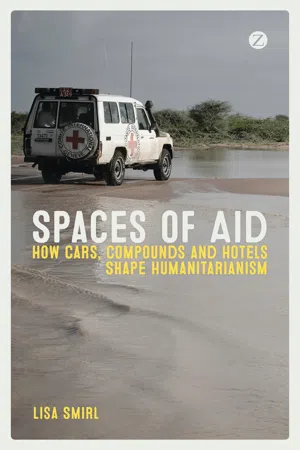
- English
- ePUB (mobile friendly)
- Available on iOS & Android
eBook - ePub
1 | STORIES FROM THE FIELD, STORIES OF ‘THE FIELD’: HOW AID WORKERS EXPERIENCE THE SPACE OF THE FIELD MISSION
This chapter starts from the perspective of the aid worker to establish, first, the overall spatial structure of the humanitarian field mission and, secondly, the spatial and material characteristics of ‘the field’ as perceived by those that are in it. Drawing on the work of Victor Turner and Arnold Van Gennep, it suggests that the act of being in the field, as a humanitarian, creates a unique and liminal space. While the term liminal has previously been used by a handful of theorists to describe international development and humanitarian work, it has generally been done in the context of post-colonial analysis, which considers the emancipatory potential of a hybrid ‘third space’ where boundaries and divisions blur and the emergence of new and potentially emancipatory subjectivities and relationships is possible (Bhabha 2004; Khan 1998; English 2005; Barlow 2007). Through an analysis of aid workers’ memoirs, this chapter challenges the third-space reading. Instead, it interprets the process as a highly structured, codified and predictable ‘rite of passage’ (Van Gennep 1960).
Within this rite of passage, the transition or liminal phase provides a useful theoretical tool with which to develop the idea that the space of the field has unique qualities and characteristics for the aid worker. Through the aid workers’ narratives, I identify recurrent material tropes and themes which (re)produce what I term the auxiliary space of the field. In particular, the metaphor of enclosure stands out in its various guises: the compound, the border and the gate. So do threshold spaces of the airport, the car and the border crossing. Taken together, they provide insight into the humanitarian imaginary: how international humanitarianism is understood, narrated and performed.
Aid work as rite of passage
Liminality or ‘third space’ in humanitarian assistance The term liminality in its contemporary usage in humanities and social science is usually attributable to the anthropologist Van Gennep (ibid.). It refers to a state in human society of being between two phases. In his original description, Van Gennep identifies a series of liminal or transitional events including pregnancy and childbirth, marriage and funerals, as well as the physical transition from one place to another. Although originally published in 1909, the concept did not gain widespread attention until the 1960s, when it was rediscovered by Victor Turner, who applied and developed the concept in a variety of anthropological settings, from the Ndembu tribe of north-western Zambia to “Western hippies” (Turner 1969). Turner developed and expanded the concept, which has subsequently been further elaborated through its use in a variety of disciplines from pilgrimage studies (Coleman 2002; Eade and Sallnow 2000; Yamba 1995) to management consultancy literature (Sturdy et al. 2006; Czarniawska and Mazza 2003). Turner himself was never extremely rigorous in his use of the term, and this ambiguity continued to plague the term in the way in which it was adopted and applied by subsequent theorists. Specifically, later theorists would concentrate their attentions on the liminal space as a unique space separated from the spaces on either side (for more on the origins and evolution of the term, see Martin 2007).
In theorizing the personage of the aid worker, liminality allows for the experience of the field to be considered as a unique and self-contained space: removed from the constraints and embedded power relations of late capitalist society. In this reading, new forms of development assistance could provide the opportunity to deconstruct historically oppressive binaries such as colonizer/colonized, teacher/student, donor/recipient, North/South by providing the opportunity for new, hybrid relationships and subjectivities to emerge (English 2005; Barlow 2007). For example, ideas of partnership or participatory development imply a fluidity of exchange and dismantling of power relations through personal interaction between the aid worker and the beneficiary.
This exchange is considered by some theorists to not only transform the beneficiary for the better, but to change the way in which the (First World) aid worker understands the (Third World) other. For example, English (2005) found that adult educators from the global North who take up positions in the global South consider themselves to be “nationless figures who inhabit a global community” and are able to “move away from the binaries that limit them, including those of geography and gender” (ibid.: 94). Similarly, Barlow (2007) found that Canadian social work students undertaking a practicum in India occupied and negotiated a third space where their beliefs, identities and preconceptions both about themselves and the other were challenged by what they saw and experienced. While there is the assertion, based on work by Bhabha (1990) and Spivak and Harasym (1990), that these spaces hold the potential for alterity and emancipation for aid worker and beneficiary alike, concrete examples are noticeably absent. Further, little (or nothing) is said about development work and liminality within the context of its more structured and common permutation: that of workers for multilateral organizations such as the UN and the World Bank and for international NGOs (INGOs) such as Médecins Sans Frontières, Oxfam or Save the Children.
While it can be said that the field is heterotopic, filled with vernacular globalizations (Bhabha 2004) and palimpsestic vistas (Tomlinson 1999), the ironies, juxtapositions, themes and tropes are remarkably similar from experience to experience. These experiences are nominally liminal, in the sense that they encompass multiple and competing allegiances, claims, identities, languages, cultures and expectations. For example, the African-American UN lawyer educating Liberian civil servants on human rights; or the British doctor in Somalia assisting women with sanitized genital suturing upon their request. However, the experiences are also highly structured and predictable.
Interviews and analysis with third-space practitioners reveal a structured cycle of interaction that occurs when experts from a host country move to a target country to provide assistance (Heron 2008). This cycle is so predictable, in fact, that it has been distilled to provide the basis for staff training modules which describe the process that the practitioner will experience through the course of his/her assignment, including initial exuberance followed by fatigue and, upon return, re-entry syndrome (Government of Canada 2009). Rather than a post-colonial third space, the experience described strongly echoes Van Gennep’s original formulation of a liminal space that is closely connected to the spaces on either side. In other words, while the field may be a liminal experience, it is only so for the aid worker, and only in the context of a processual trajectory whose beginning and end points are the aid worker’s country of origin. Neither Van Gennep nor Turner was unaware of the processual nature of the liminal state. Particularly Van Gennep considered the liminal state as part of its larger, and generative, rite of passage.
The rite of passage in the memoirs of aid workers Van Gennep describes a rite of passage as a tripartite process consisting of, first, separation from an initial or equilibrium state, followed by a liminal or marginal state, and concluding with a reaggregation with the original society (also referred to as (re)incorporation; Bowie 2006: 149). Each stage has its own set of accompanying rites (Van Gennep 1960). Of the three stages, the liminal – signifying ‘threshold’ in Latin (Turner 1969: 94) – is distinct from the other two and involves spatial, temporal and social and moral separation (Yang 2000). In contrast to ‘normal society’, the liminal state is one of anti-structure, where established hierarchies and rules are inverted or suspended and transformative processes take place. Here, work and play blur, experimentation and novelty are encouraged and carnivalesque and ludic qualities manifest themselves (Turner 1977). The initiates are considered as simultaneously sacred and polluting to society at large and must be kept separate and distinct: confined to designated spaces and identifiable by new or bizarre clothes, masks or face paints, and possibly made to adopt new homogenizing behaviours or languages. Stripped of their previously defining characteristics such as clothes, insignia or property, they may form strong and rapid bonds of solidarity with the other initiates (Turner 1969: 95). Such ties of friendship or communitas often endure throughout life (Turner 1977). Once the transformation is complete, the initiate may return to society, to be reintegrated in his/her new role. While, in the broadest sense, we are all, at some point and necessarily, liminal figures, the application of the concept to the practice of international aid work offers unique insight into the possibilities and constraints for its broader structures.
In order to bring together the process of aid work and the theoretic perspective of Van Gennep and Turner, I turned to the untapped resource of the memoirs of aid workers: first-person narratives based on personal journals, notes and recollections (on autobiography and life writing, see Smith and Watson 2001; De Man 1979; Marcus 1994). These memoirs present the personal experiences of individuals who went to the field as an employee of an aid organization and subsequently returned home to resume normal life and to tell their stories.
Through an analysis of three of the best known of these memoirs, it became evident that the views, interactions and relationships of the field, as described by the authors, constituted a rite of passage, and the space of field a liminal space. As memoirs, they are by definition subjective and for that reason their consistency is remarkable, not only with regard to the personal trajectories and experiences of the characters, but also how the spaces in which they find themselves are described and what the authors consider to be worthy of documentation. This chapter uses these memoirs to analyse the experience of international humanitarian assistance on two levels. First, it identifies, in all three texts, the narrative structure of a rite of passage. Chronologically, the authors tell the tale of coming from their country of origin; moving to the field; and returning home, irrevocably transformed in the process. The second level that will be considered is the liminal quality of the space of the field: what metaphors and tropes recur within this space and how the space affects the aid worker. In a challenge to advocates of third space the chapter argues that while the space of the field may be transformative, it is only so for the perspective of the visiting aid worker, rather than for the beneficiary.
To ensure a wide range of coverage and balance, the texts were chosen for analysis based on several criteria. The authors represent a cross-section of organizations: both United Nations and INGOs on a variety of scales. They are both men and women and all the authors use their real names and claim that their stories are based on real events. The time period ranges from 1991 to 2004. While the time span covered by the books is quite short – thirteen years in total – it captures the long decade of increased multilateral activity following the fall of the Berlin Wall. While the choice of these memoirs as the subject of analysis can be critiqued on the basis that they, through their very existence as a personal post-mortem, are biased in an anti-aid direction, they are nonetheless valid for the significant population that they represent, and the use of oral narratives was encouraged by Turner himself (1975: 167). They are also some of the most readable and best-known examples of a much wider genre of ‘aid memoirs’ that, to date, has received minimal critical attention. Equally, the books analysed in this chapter are also some of the most controversial of the genre. I learned about two of them (Minion 2004; Cain 2004) while in the field myself, where the books and their authors were regarded with a mix of disdain and jealousy. The books were madly read, circulated and then dismissed, not on the grounds that they were untrue or misrepresentative, but that they broke the code of the field.
Within international humanitarian assistance, an important structural divide exists between the physical space of headquarters, located in a (usually) First World country, and the field. The historical structure of international aid is such that traditional donor countries are primarily located in the global North. For example, Official Development Assistance (ODA) is primarily calculated by looking at the contributions from the OECD’s Development Assistance Committee (DAC) members, all of whom are located in either Europe or North America, with the exception of Japan. The field, by contrast, is where the projects or interventions are located – away from headquarters or the main office, and, by definition, in ‘less developed countries’. While headquarters define policy, the objective of their policy can be reached only by undertaking a physical voyage to the space of the beneficiaries: the field. Working in the field (sometimes referred to as a ‘mission’) is considered to be a hardship and is often remunerated accordingly.
The three books in question are all concerned with the act of the field mission which produces a narrative structure that replicates a rite of passage. Each of the memoirs follows the same format. The characters all undertake a sudden departure to far-off lands in an attempt to escape unstable, boring and/or unfulfilling lives. An unsteady (but pleasantly exciting) beginning is followed by a steady descent into increasing political, personal and institutional chaos. The characters become exhausted and frustrated with their persistent inability to have a significant or positive impact on their surroundings. They reach a crisis point where the character feels the need to make a decision regarding their future, at which point all but one of them choose to return to the First World (not necessarily home) to resume so-called normal life and to write their memoirs. In the case of one of the books – Emergency Sex (and Other Desperate Measures) – the chapters are named according to increasing levels of UN security classifications, moving from Condition Alpha (safe) to Bravo, Charlie, Delta, Echo (evacuate immediately) … and finally Return to Normal (Cain 2004).
Overview of the memoirs In A Cruel Paradise, Leanne, a nurse from Canada, receives an offer to work for Médecins Sans Frontières (MSF), an international NGO that provides “emergency medical assistance to populations in danger” (MSF n.d.). She is deployed to run a feeding centre in rural Liberia during the first Liberian civil war. After being evacuated back to Winnipeg, nine months later, owing to increased hostilities, she is almost immediately redeployed to Bosnia, where she meets Rink, a logistics officer with whom she starts a romantic relationship. Based in the Republika Srpska, their team is responsible for providing non-partisan medical supplies to hard-to-reach areas such as the infamous Bihac enclave. After being evacuated again, in June 1995 (after seven months), she rejoins Rink in Burundi, where she is in charge of renovating and managing a seventy-bed hospital in the north of the country. Dissatisfied with the MSF programme in Burundi, she and Rink hand in their resignations after only three months to join their friend working in Goma, Zaire (now DRC), “where nobody in their right mind wants to work” (Olson 1999: 153). In mid-May they leave Zaire, fearing for their lives. After a brief time in Canada, France and Holland, they join the international medical NGO Merlin and are deployed to a series of countries as short-term consultant...
Table of contents
- Cover
- About the Author
- Title
- Copyright
- Contents
- Figures
- Note to the reader
- Foreword
- Acknowledgements
- Preface
- Abbreviations
- Introduction
- 1 Stories from the field, stories of ‘the field’: how aid workers experience the space of the field mission
- 2 Exploring the humanitarian enclave
- 3 How the built environment shapes humanitarian intervention
- 4 Building home away from home: post-tsunami Aceh, and the single-family house
- 5 Playing house: rebuilding the Gulf Coast after Katrina
- Conclusion
- Bibliography
- Index
Trusted by 375,005 students
Access to over 1.5 million titles for a fair monthly price.
Study more efficiently using our study tools.
Frequently asked questions
Yes, you can cancel anytime from the Subscription tab in your account settings on the Perlego website. Your subscription will stay active until the end of your current billing period. Learn how to cancel your subscription
No, books cannot be downloaded as external files, such as PDFs, for use outside of Perlego. However, you can download books within the Perlego app for offline reading on mobile or tablet. Learn how to download books offline
Perlego offers two plans: Essential and Complete
- Essential is ideal for learners and professionals who enjoy exploring a wide range of subjects. Access the Essential Library with 800,000+ trusted titles and best-sellers across business, personal growth, and the humanities. Includes unlimited reading time and Standard Read Aloud voice.
- Complete: Perfect for advanced learners and researchers needing full, unrestricted access. Unlock 1.5M+ books across hundreds of subjects, including academic and specialized titles. The Complete Plan also includes advanced features like Premium Read Aloud and Research Assistant.
We are an online textbook subscription service, where you can get access to an entire online library for less than the price of a single book per month. With over 1.5 million books across 990+ topics, we’ve got you covered! Learn about our mission
Look out for the read-aloud symbol on your next book to see if you can listen to it. The read-aloud tool reads text aloud for you, highlighting the text as it is being read. You can pause it, speed it up and slow it down. Learn more about Read Aloud
Yes! You can use the Perlego app on both iOS and Android devices to read anytime, anywhere — even offline. Perfect for commutes or when you’re on the go.
Please note we cannot support devices running on iOS 13 and Android 7 or earlier. Learn more about using the app
Please note we cannot support devices running on iOS 13 and Android 7 or earlier. Learn more about using the app
Yes, you can access Spaces of Aid by Lisa Smirl in PDF and/or ePUB format, as well as other popular books in Economics & Development Economics. We have over 1.5 million books available in our catalogue for you to explore.