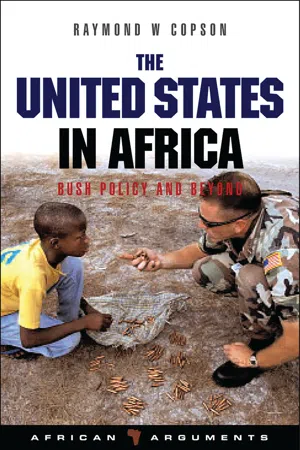
The George W. Bush administration maintains that in sub-Saharan Africa it is making major new contributions in fighting disease, promoting development, fostering democracy, and promoting peace. Yet, despite the rhetoric, is the Bush Administration really working to bring about a fairer and more just Africa?
Though aid has increased and a major AIDS initiative launched, Copson argues that US policy in Africa falls well short of meeting reasonable standards of fairness or justice. Foreign aid is losing its focus on development as political priorities come to the fore; U.S. barriers to African exports remain substantial; and the AIDS program is in danger of flagging due to unilateralism and ideological controversy. An increasingly military approach to fighting the 'Global War on Terror' in Africa and securing energy imports carries serious risks for the region. Copson concludes by assessing the prospects of a more equitable policy emerging in future administrations.
- English
- ePUB (mobile friendly)
- Available on iOS & Android
eBook - ePub
About this book
Information
1 | Introduction
Does the United States have a policy toward sub-Saharan Africa that is fair and just? What could be done to change policy in ways that would make it fairer and more just? These are the underlying questions that have inspired this short volume.
Many Bush administration1 critics might find the first question absurd on its face. Their heartfelt opposition to US policies on Iraq, the Israel–Palestine dispute, global warming, the International Criminal Court, and other issues inevitably creates a predisposition to doubt that the administration could or would pursue a just and fair policy in Africa. Key features of Africa policy, such as the administration’s long delay in mounting a meaningful response to the crisis in Darfur, US aid to warlords in Somalia, and the seeming US endorsement of the oppressive Obiang regime in oil-rich Equatorial Guinea only serve to affirm their doubts. But the issue is not so simple. Under President Bush, US economic assistance to sub-Saharan Africa has reached record levels; a large program has been launched to fight the African AIDS pandemic; and through a strategic commitment of diplomatic resources, the administration made a major contribution to ending the civil war in southern Sudan.
This volume will acknowledge these positive features of the Bush administration’s Africa policy, which have been inspired in part by the President’s response to his base in the evangelical Christian community, and in part by political pressures coming from other groups that have long sought a better future for Africa. At the same time, these steps toward a fairer and more just Africa policy have been undercut by the strong element of political realism that has always affected US policy toward the sub-Saharan region, by the influence of neoconservatives and other ideologues, and by economic self-interest.
According to the White House, the intention of the Bush administration is to ‘work with others for an African continent that lives in liberty, peace, and growing prosperity,’ but in fact, policy is falling far short of this vision – both in terms of working with others and in terms of advancing what the White House says is a ‘core value’ of the United States: ‘preserving human dignity.’2 In recent years, policy has come to be more and more influenced by two security interests, the Global War on Terror (GWOT) and the protection of oil supplies, that are pushing the United States away from a fairer and more just relationship with Africa. These security interests are real, but are not so great or compelling in the sub-Saharan region that they should be allowed to overwhelm the better aspects of policy. A particular danger is that the pursuit of GWOT in the Islamic parts of Africa, combined with the unpopularity among Muslims of US policies in the Middle East, could provoke regional conflict and instability – as well as lasting alienation from the United States.
Fairness and justice in Africa policy
A concern with justice and fairness in a book about foreign policy might seem misplaced to some readers, particularly those raised in the realist school of analysis, discussed below. It is the author’s conviction, however, that justice and fairness should always be major considerations in policy toward any region, on both moral and practical grounds. Whether one accepts the moral argument – that the United States ought to pursue justice and fairness in its relations with all countries – is a matter of personal belief. The fact that the United States has lost influence in the world under the Bush administration because it has been perceived as unfair and unjust in its foreign policy should, however, be of practical concern to all. If policymakers lose sight of the importance for the United States of being regarded as a fair and just actor on the international stage, they are not likely to be able to protect US security interests in Africa or elsewhere.
The moral argument for a fair and just policy in sub-Saharan Africa is particularly compelling because the United States has incurred moral obligations toward the region over a troubling history of more than three centuries. Although it may be that the European colonizers bear a heavier responsibility for the problems Africa faces today, the truth is that the United States must share a considerable portion of the blame. Slaves brought by force from Africa, and their descendants who continued to live in slavery until the American Civil War (1861–65), were central to the economic development of the American South and the country as a whole. The injustices meted out to America’s Africa-descended population have never been fully expiated, nor even ended. In Africa, the slave trade brought only turmoil, conflict, and impoverishment. The importation of slaves to the United States became illegal from 1808, but many were smuggled in on the eve of the Civil War as southern extremists agitated for legalizing the trade once again. The participation of Americans in the international slave trade was also made illegal and punishable by death in the early nineteenth century, but these laws were poorly enforced. American captains and crews were enthusiastic participants in the export of many thousands from West Africa to Cuba and Brazil through much of the nineteenth century, and no one was hanged for the crime until 1862, after President Lincoln had taken office.3 In that same century, Liberia was launched by well-to-do Americans, some motivated by humanitarian considerations but many others by a concern to cleanse the United States of free blacks regarded as unassimilable and a threat to plantation society in the American South. In subsequent decades, this American offshoot was sadly neglected; and in the late twentieth century, when Liberia had fallen into its time of troubles, US forces time and again stood offshore during violent upheavals, or intervened solely to rescue Americans and other foreigners – while the people of Liberia were left to suffer.
Liberia, of course, was by no means the only instance in the twentieth century in which the United States failed to act justly in its relations with Africa. The procrastination, delay, and absence of US leadership during the 1994 genocide in Rwanda is perhaps the most painful disappointment in recent memory, but there are many others. President Lyndon Johnson’s refusal to back deployment of a United Nations peacekeeping force in Rhodesia, after the white minority regime issued its Unilateral Declaration of Independence from Britain in 1965, comes to mind. So does South Africa policy during the Reagan administration, when, rather than standing forthrightly for democracy and human rights, the United States temporized with the apartheid regime under a policy of ‘constructive engagement.’
There have been bright spots in US relations with Africa, of course, but on balance these do not make up for the damage done over the years. President Carter worked diligently in support of the negotiations that brought an end to the Rhodesian conflict and ushered Zimbabwe to independence in 1980.4 In 1985, Congress passed a major African famine relief bill and provided hundreds of millions of dollars in emergency aid.5 The next year saw Congress enact sweeping sanctions against South Africa over President Reagan’s veto.6 The Clinton administration – belatedly to be sure, as was the case with other governments – came to recognize the danger that the AIDS pandemic posed to Africa’s future, and Vice-President Al Gore mobilized new funds from several agencies to fight the disease.
Despite the occasional good things that happen in US Africa policy, however, an overall sense of disappointment prevails among those who hope for a better future for the region. In case after case over the years, the United States has done less than it could to fight poverty, foster peace, and promote human rights in Africa; even though policymakers in every administration have expressed their commitment to attaining these very goals. Creating a better future for Africa is not the responsibility of the United States alone, of course. Other donor governments, international organizations, non-governmental organizations, and African leaders themselves all have great responsibilities in this difficult time for the region. But the United States has its own special obligations in sub-Saharan Africa and should act accordingly. As a world leader, it also has a special responsibility to inspire other wealthy countries to fulfill their own responsibilities toward the region.
What would be the principal characteristics of a fair and just policy toward sub-Saharan Africa? These may seem obvious, but are worth reviewing here for the sake of clarity. ‘First, do no harm,’ the guideline for physicians attributed to Hippocrates, should be the overarching concern for policymakers, such as those in the Department of Defense who are now busily expanding the US military role across the Sahel and Sahara. Second, the protection of the poor, the neglected, and women and children is the hallmark of any ethical system worthy of respect, and must also be at the heart of just and fair policy toward Africa. Efforts to promote economic opportunity, healthcare, and education are key to helping the poor, as is the removal of economic barriers (including trade barriers!) that take away their hope of a better life. Third, support for civil liberties and freedom of expression should be part of a just policy toward Africa; and, finally, such a policy must promote peace and encourage peacemakers.
Realism and neoconservatism in Africa policy
A key to understanding the limitations of US Africa policy across all the post-World War II administrations is to recognize that professional policymakers have consistently been drawn from the ‘realist’ school of international relations theory. In the realist view, Africa has little to offer the United States; and events in Africa rarely threaten the United States in any significant way – hence there is little reason to be involved there. The realist approach to foreign policy is imbibed by rising diplomats and policymakers in the international relations programs of the major universities and mainstream American think tanks. Henry Kissinger, National Security Advisor and then Secretary of State in the Nixon and Ford administrations, and Zbigniew Brzezinski, President Carter’s National Security Advisor, exemplify the type. Those who take a more idealistic approach to foreign affairs tend not to reach the corridors of power in the executive branch, but rather find themselves in academic positions or working in non-governmental organizations.
A realist pursues the national interest narrowly defined – ‘interest defined in terms of power,’ in the words of Hans Morgenthau, pioneer theorist in the realist school.7 Defining power, measuring power, and discerning which alternative policies will most effectively promote power have always been subjects of debate among realists, but there has been a general consensus among most realists most of the time that Africa has little relevance to US power. Realists see themselves as prudent and pragmatic; and prudent, pragmatic US policymakers have tended to devote their time, energies, and US resources to other regions and other priorities they see as central to preserving national security or advancing US power.
In the past, cold war pressures occasionally persuaded realists to intervene in African affairs. In 1960, for example, the United States plotted to assassinate Congo’s prime minister Patrice Lumumba, viewed as a Soviet ally,8 and Kissinger channeled aid to rebel groups in Angola in the mid-1970s to counter Soviet and later Cuban support for the government. Congress put a stop to Kissinger’s interference in Angola, but aid to Angolan rebels resumed in the Reagan years. Brzezinski was deeply concerned by Soviet and Cuban support for Ethiopia during the 1977–78 ‘Ogaden crisis,’ moving ships toward the region and forging an alliance with the Siad Barre government in Somalia. But these were episodes in the global cold war chess game rather than part of a coherent, long-term policy based on a view that Africa was in itself important to the United States. In the 1990s, with the end of the rivalry between the United States and the Soviet Union in Africa, US aid to Africa declined sharply. Only at the end of the decade, as public pressure for a US response to the AIDS pandemic and Africa’s complex humanitarian emergencies mounted, did assistance levels begin to recover.
During the 2000 campaign, candidate George W. Bush seemed to place himself squarely in the realist school in his thinking about Africa, stating in the second presidential debate that Africa is an ‘important continent. But there’s got to be priorities, and the Middle East is a priority for a lot of reasons, as is Europe and the Far East, our own hemisphere. And those are my four top priorities should I be the president.’9 Subsequent chapters will show that the realist thinking reflected in this statement has remained influential and continues to restrain the level of US engagement with Africa, despite the President’s AIDS initiative and some other positive developments. Some realists today, both in and out of government, are beginning to pay more attention to Africa because of its growing importance as a supplier in global energy markets. The impact of this attention, however, has not been favorable for Africa, since it has been reflected in a noticeable tendency among policymakers to overlook – or pay minimal attention to – human rights violations and corruption in Africa’s oil-rich countries.
The Bush administration has been noteworthy for the rise of ‘neoconservatives’ to positions of influence over foreign policy. Because of their emphases on pre-emptive intervention before threats have materialized, on transforming Middle East politics, and on using force to project American values, they have been soundly criticized by classical realists, who place such a high value on prudence and pragmatism.10 Like the realists, however, neoconservatives have generally taken little interest in Africa – although their enthusiasm for waging the Global War on Terror is reflected in the worrisome Trans Sahara Counterterrorism Initiative (TSCTI), aimed at preventing the emergence of ‘new Afghanistans’ in Africa and in moves to create a new Africa Command in the Defense Department. In theory, this program is to have a substantial economic development component, but economic assistance funds are in short supply and the military component threatens to grow disproportionately large. The neoconservative influence is also seen in the assistance given by the United States to warlords in Somalia in 2006 and the subsequent support for Ethiopia’s ouster of the Islamic Courts Union from Mogadishu, Kismayo, and other positions. These issues are discussed in a later chapter. As is the case among realists, moreover, some neoconservatives are increasingly interested in African oil. They highlight its growing importance as a way of winning support for greater military involvement in the region.
The idealist influence in Africa policy
While the realist influence has been dominant in Africa policy over the years, realists have never held complete sway. Indeed, fairly often, idealistic forces coming from outside the realist consensus have intervened to send Africa policy in unexpected directions. These directions have sometimes led to the brighter moments in US relations with Africa, such as the African famine relief and anti-apartheid legislation noted above. When this happens, realist policymakers may be forced to accept policy change in directions favored by idealists, and even to adopt the language of the idealists. Official policy statements may, in deference to the pressures from idealists, come to express commitments to preventing genocide, ending hunger,11 or resolving African conflicts, but the actions and resources ultimately devoted to these objectives typically fall short of the need. Realists always push back against the idealistic impulse, trying to force Africa policy to return to its minimalist core so that they can maximize resources for other regions and other priorities. As a result, US economic assistance resources are consistently constrained despite the repeated announcement of Africa aid initiatives to prevent famine, improve education, promote the use of the Internet, reduce malaria’s toll, or achieve other worthy objectives. Peacekeeping operations, initially endorsed by US policymakers, are rarely given the resources needed to do their jobs with full effect.
Yet, Africa policy does not spring fully formed from the Department of State, where realists predominate; nor from the White House’s National Security Council or the Department of Defense, with their mix of realists and neoconservatives. Rather, it results from a surprisingly lively and contentious Africa policymaking process in Washington and beyond, which allows idealists and others to have an impact. Representatives of advocacy and non-governmental organizations; think-tank experts; members of Congress – as well as their personal and committee staff; personnel from executive branch agencies; and lobbyists of various sorts engage in a continuous round of discussions and debates that affect Africa policy. Through much of the year, hearings, speeches, panel discussions, and other Africa-related events occur on nearly a daily basis in Washington itself, while Africa events are also taking place on college campuses, in churches, and elsewhere around the country. All of this happens because individuals as well as a host of grassroots and nationwide organizations are concerned about Africa and its future, want their voices to be heard, and expect a response from their government.
Sometimes it seems that US presidents themselves come at Africa policy from outside the realist consensus, from personal conviction and because they are politicians, aware of the sympathies and concerns of the public and key constituencies. Jimmy Carter was the first president to devote a trip exclusively to Africa, and his activism in re...
Table of contents
- Cover
- About this book
- About the author
- Title
- Copyright
- Contents
- 1 Introduction
- 2 Aid, trade and development
- 3 AIDS policy
- 4 Democracy and human rights
- 5 Conflict and peacekeeping
- 6 Threats to security
- 7 Beyond the Bush administration
- Notes
- Index
Trusted by 375,005 students
Access to over 1.5 million titles for a fair monthly price.
Study more efficiently using our study tools.
Frequently asked questions
Yes, you can cancel anytime from the Subscription tab in your account settings on the Perlego website. Your subscription will stay active until the end of your current billing period. Learn how to cancel your subscription
No, books cannot be downloaded as external files, such as PDFs, for use outside of Perlego. However, you can download books within the Perlego app for offline reading on mobile or tablet. Learn how to download books offline
Perlego offers two plans: Essential and Complete
- Essential is ideal for learners and professionals who enjoy exploring a wide range of subjects. Access the Essential Library with 800,000+ trusted titles and best-sellers across business, personal growth, and the humanities. Includes unlimited reading time and Standard Read Aloud voice.
- Complete: Perfect for advanced learners and researchers needing full, unrestricted access. Unlock 1.5M+ books across hundreds of subjects, including academic and specialized titles. The Complete Plan also includes advanced features like Premium Read Aloud and Research Assistant.
We are an online textbook subscription service, where you can get access to an entire online library for less than the price of a single book per month. With over 1.5 million books across 990+ topics, we’ve got you covered! Learn about our mission
Look out for the read-aloud symbol on your next book to see if you can listen to it. The read-aloud tool reads text aloud for you, highlighting the text as it is being read. You can pause it, speed it up and slow it down. Learn more about Read Aloud
Yes! You can use the Perlego app on both iOS and Android devices to read anytime, anywhere — even offline. Perfect for commutes or when you’re on the go.
Please note we cannot support devices running on iOS 13 and Android 7 or earlier. Learn more about using the app
Please note we cannot support devices running on iOS 13 and Android 7 or earlier. Learn more about using the app
Yes, you can access The United States in Africa by Raymond W. Copson in PDF and/or ePUB format, as well as other popular books in Politica e relazioni internazionali & Relazioni internazionali. We have over 1.5 million books available in our catalogue for you to explore.