- English
- ePUB (mobile friendly)
- Available on iOS & Android
eBook - ePub
About this book
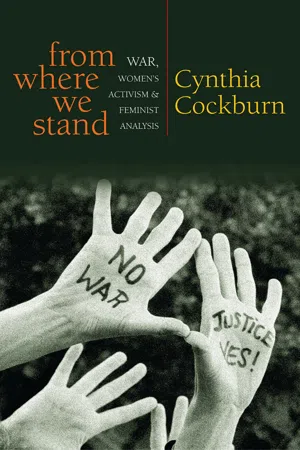
This original study examines women's activism against war in areas as far apart as Sierra Leone, India, Colombia and Palestine. It shows women on different sides of conflicts in the former Yugoslavia and Israel addressing racism and refusing enmity and describes international networks of women opposing US and Western European militarism and the so-called 'war on terror'. These movements, though diverse, are generating an antimilitarist feminism that challenges how war and militarism are understood, both in academic studies and the mainstream anti-war movement. Gender, particularly the form taken by masculinity in a violent sex/gender system, is inseparably linked to economic and ethno-national factors in the perpetuation of war.
Information
ONE
Different wars, women’s responses
§ Armed conflict takes many forms. It may be all-out war between alliances of nation states, as in the First and Second World Wars. It may, as in the Cold War, be a stand-off between over-armed superpowers, unable to unleash their weaponry for fear of destroying themselves in destroying the other. It may be asymmetrical conflict between guerrilla forces (or ‘terrorists’) and a repressive power they seek to overthrow; or a war of retribution in which states with overwhelming might terrorize a weaker enemy, as in the 2001 invasion of Afghanistan to destroy the Taliban and Al-Qaeda. It may be a nationalistic project of ethnic cleansing, or spasmodic civil strife between the armed forces of class interests.
The diversity of conflicts generates a diversity of responses. And women in countries or regions caught up in armed conflict have differing scope when it comes to organizing action for peace. In this chapter we’ll see three wars internal to states, but of rather different kinds. The first, in South America, is a three-way conflict, half a century in duration, in which the Colombian state army, guerrilla forces and rightwing paramilitaries fight a war with a class dimension. The second is a religious pogrom resulting in mass murder in the Indian state of Gujarat in 2002. Here the enemy ‘other’ is clearly seen in ethnic terms. Third, in Africa, we’ll see the collapse of Sierra Leone into a decade of anarchic violence that ended in 2002. The motives in this war were obscure, but the absence of evident class and ethnic othering permits an unusually clear view of violent masculine subcultures at work. In the three countries we’ll also see contrasted responses by women: mass mobilization in the first case, a panel of enquiry in the second and alternative diplomacy in the third.1
‘Violence came here yesterday’: the women’s movement against war in Colombia
Some of us join a movement against war when we’re jolted into an act of compassion and responsibility by something we see on TV news. But there are others among us who create such a movement because it’s the only thing left to do, because violence walked into our village, our street or our home once too often. That’s how it is in Colombia. The women’s movement against war there is women ‘coming out’ in rage, rebellion and determination against fifty years of political violence that has wrecked generations of lives. You have no need of the media to tell you about this kind of violence. It is local, intimate. You can see it inscribing one new scar after another on the bodies and minds of those you love.
Since the nineteenth century there have been only two political parties of any significance in Colombia, the Conservatives and the Liberals. They have been alternating monopolies of power, whose rivalry has divided the country as effectively and as violently as if they had been warring ethnic groups. Peasants, workers, resources and territories were divided and recruited by the Liberal and Conservative elites for their conflict. Progressive movements trying to cut through this clientilism were wiped out (González 2004).
The outbreak of two decades of struggle, termed ‘La Violencia’, began in 1948 with the assassination of a popular leftwing Liberal leader Jorge Eliécer Gaitán (Sánchez and Meertens 2001). By the 1960s a large-scale leftwing guerrilla movement was active, spurred by poverty, gross inequality, the exclusive nature of the political elite and continuous stalling by successive governments on the crucial issue of land reform. The strongest and most widely known guerrilla force was, and remains, the FARC (the Fuerzas Armadas Revolucionarias Colombianas or Revolutionary Armed Forces of Colombia, associated with the Communist Party, formed in 1964). The guerrillas built support for their social and economic programmes in areas of the country where capitalist exploitation of workers and peasants was giving rise to the greatest resentment. Unfortunately, they funded their organizations by extortion, kidnapping and (increasingly today) ‘taxes’ on the production, processing and sale of cocaine, and in doing so lost their political credibility.
The government’s armed forces, intent on finding and eradicating the guerrilla movements and suppressing popular discontent, have killed, imprisoned and tortured tens of thousands. The state’s inability to uproot the armed fighters led wealthy landowners, the business class and the drug traffickers to raise and fund their own armies, shadowy militias, now grouped under a single association of paramilitaries, the AUC (Autodefensas Unidas de Colombia, United Self-Defence Forces of Colombia). They have been active in both rural and urban areas, battling the guerrillas for control of their territories. Their strategy is to attack guerrilla bases, real or imagined, cordoning, massacring and expelling civilian communities. They contain many criminal elements, are deeply involved in narcotics, and are known to receive the tacit support of elements in the state military.
For Colombian men it’s difficult to avoid bearing arms. Poverty, lack of prospects, fear for their families and the need for ‘protection’ drive them into the dangerous embrace of one side or another. Necessarily, many Colombian men have been brutalized by their involvement in fighting. It starts early. More than 11,000 children are enrolled into guerrilla and paramilitary units (Human Rights Watch 2004a). But women fight too. According to the AUC, women constitute 12 per cent of their ranks. The estimate for FARC is as high as 40 per cent.
The government of the USA compounds the violence in Colombia. Its triple agenda is securing the region against leftwing insurgency, protecting US oil and other business interests and stemming the flow of narcotics to US markets. In 2004, the year I visited Colombia, it donated $680 million in aid, putting the country among the top five in the world in terms of receipt of US military assistance (Human Rights Watch 2004b). US Southern Command has 1,500 military personnel in the country. Its approach to the narcotics problem involves programmes of fumigation from the air that destroy, along with coca plantations, subsistence crops and people’s health. US policy favours rightwing Colombian administrations such as that of the current president, Álvaro Uribe, a hardliner heavily criticized by local and international human rights organizations. Uribe took Colombia into Bush’s Coalition for the invasion of Iraq. Since 11 September 2001, US official statements have rhetorically linked FARC with Al-Qaeda and encouraged the view that terrorism in Colombia is yet another legitimate target in the international ‘war on terror’ (Tate 2004).
The effect of war on everyday life and on women In the last ten or fifteen years, despite a series of peace negotiations between the government and several of the armed actors, the lives of ordinary Colombians have become even less secure. During the 1990s the annual number of violent deaths varied between 25,000 and 30,000, representing a national rate of 80 per 100,000 inhabitants, one of the highest in the world. An estimated 13 per cent of these were political killings of, overwhelmingly, civilians (Meertens 2001). Torture and mutilation remain commonplace and hundreds are held hostage. Sexual violence against women is endemic, used by all three armed actors to punish women for associating with ‘the wrong side’, or to punish enemy men. Most cases go unreported. But in the city of Medellín alone in the period 1995 to 2001, 3,486 instances of sexual violence were reported. In 1,785 of these the aggressor was not known to the victim and it is believed that many of them were politically motivated rapes, a retaliation by one armed group against another (Gallego Zapata 2003). Many women have been tortured and killed in an obscene and clearly misogynistic manner. Women are often kidnapped into sexual servitude and forced to do domestic labour for guerrillas or paramilitaries. Contraception is difficult to obtain, and abortion is illegal. The danger of travelling to hospital and lack of facilities in rural areas mean women must often give birth at home, with resultant deaths. Donny Meertens, a feminist academic at the National University, explains:
Whereas earlier traditional power-holders – including guerrillas in their old strongholds – could offer some protection to their local population, the present frequent power-shifting renders this nearly impossible. Protection is replaced by terror as the most easily available mechanism for obtaining popular quiescence. All armed combatants understand territoriality as a zero-sum game in which no neutral space exists, and no room for negotiated solutions is available. The civil population is caught in the paranoiac logic of ‘si no estas conmigo, estas contra mi’ (if you are not with me, you are against me) …
In a situation where it is not safe to assume any responsibility nor to make any accusation, the only way to refer to acts and perpetrators of violence is in a neutral form: violence came here yesterday, as if it were an autonomous force and not a human act. (Meertens 2001: 38)
Increasingly, in many areas, the only response left to ordinary people is to abandon their homes. Colombia has the world’s largest internal displacement crisis after Sudan. In the three years to 2005 alone, more than 3 million people, over 5 per cent of the population, were forcibly displaced because of the armed conflict (Human Rights Watch 2006). These IDPs gather in vast precarious settlements on the edge of towns and cities. They are disproportionately women. Many are heads of households. Of those, many are widows of men killed in the conflict. Maintaining the primary bonds of family and community was the women’s role, so women experience their sundering even harder than men. But they’re quicker and better than men in adapting to the new circumstances, learning how to deal with the institutions and inventing ways of keeping themselves and their families fed (Meertens 2001). The war pursues displaced Colombian women even into the cities. The armed actors control many urban areas, policing women by rape, carrying out exemplary assassinations of women leaders, dictating moral norms – even threatening girls with death for sporting pierced navels or drop-waist jeans.
Partly as a result of the conflict, the new Colombia is a nation of city-dwellers. Migration from rural areas to towns and cities began in the 1970s and today 70 per cent of the population is urban. The country has a wealth of natural resources, yet 60 per cent of Colombians live in poverty, while some are super-rich. In matters of health and hunger the country is more comparable to Africa than to the rest of Latin America. Added to the material immiseration, many women, men and children live continually with the memory of dead and ‘disappeared’ loved ones, and a terrible nostalgia for an irrecoverable place and time.
The women’s movement against war in Colombia There’s a long history of peace negotiations in Colombia. Successive presidents have swung between a maximalist concept of peace, with social and economic changes under discussion, and a minimalist agenda of agreement to disarm particular groups in exchange for electoral representation. Neither approach has succeeded. Until recently, civil society has been excluded from these official peace processes. Indeed, Colombian civil society has scarcely existed apart from those civil organizations that are fronts for armed interest groups. But in the early 1990s social mobilization for peace took off, first in warravaged areas like Urabá and Magdalena Medio. Gradually, more social sectors and more regions became involved. A Committee for the Search for Peace was formed and the Catholic Church set up a National Conciliation Commission (Rodriguez 2004). One important initiative, in 1993, was the forming of Redepaz, a National Network of Initiatives for Peace and against War, which, in October 1997, organized a national ‘Mandato’, a referendum which generated over 10 million votes for peace – more than the combined votes for all candidates in the previous presidential election. A permanent Civil Society Assembly for Peace was formed in 1998, and in 1999 mass demonstrations around the country brought out an estimated 8 million people under the slogan ‘No Más’ (No More) (ibid.).
These civil society initiatives have involved both women and men. But, recently, women’s organizations with a gender analysis of war have gained in significance. So much so that this emergence of women in organized opposition to war was described to me by Olga Amparo Sánchez, an academic feminist and anti-war activist, as the third of three big leaps forward for women in Colombia, on a par with winning the right to vote fifty years ago and achieving a reform of the Constitution in 1991. The logic of the movement lies in the reality of Colombian life. Women are raped and abused by the men of all sides of this conflict. The sustenance of everyday life, especially for indigenous women and peasant women, is made perilous or impossible by the operations of the armed actors. It’s not surprising if women are sometimes pushed by their circumstances across a threshold, the line that separates passivity and fear from courage and resistance. In many parts of the country, male leaders of human rights and peace organizations have been assassinated or disappeared. Class-based workers’ and peasants’ movements have been repressed or irredeemably corrupted. Women and women’s organizations are therefore among the few surviving bearers of any type of democratic demands. Increasingly, they are bringing together issues that used to be the domain of separate NGOs; on the one hand those of human rights and on the other those of peace. As Patricia Prieto, of the Grupo Mujer y Sociedad (Women and Society Group) said to me, in interview: ‘It’s on women’s shoulders. They are holding things together. They are the weavers and maintainers of the social fabric.’
La Ruta Pacifica de las Mujeres The largest and internationally best-known women’s organization for peace in Colombia, formed in the mid-1990s, is La Ruta Pacifica de las Mujeres por la Negociación Política de los Conflictos (Women’s Peaceful Road for the Political Negotiation of Conflicts).2 It’s an alliance of more than 300 organizations and groups of women in eight regions, among them several substantial projects such as the Casa de la Mujer (the Women’s House) in Bogotá, Vamos Mujer (Women Let’s Go) in Medellín and Mujeres que Crean (Creative Women), also in Medellín. These and other member NGOs represent and include women of many specific ‘identities’: women of the tribes of indigenous peoples of Colombia; Afro-Colombians whose presence derives from the slave trade; young women; peasant women; women of the urban poor; displaced women. Membership is also open to individuals.
The central office of La Ruta Pacifica is in the capital, Bogotá, but they also have ‘regional coordinations’ with street addresses in several other towns. The network is managed through monthly meetings of the regional coordinators. Communication is mainly by phone. Although email is used, and they have a website (<www.rutapacifica.org.co>), they can’t lean heavily on the Internet as an organizing tool because many of their constituent women and groups lack computers and Internet access.
Their principal leaflet introduces La Ruta Pacifica as:
a feminist political project, national in character, working for a negotiated end to armed conflict in Colombia and to render visible the effects of war in the lives of women. We declare ourselves to be pacifists, antimilitarists and builders of an ethic of nonviolence in which the fundamental principles are justice, peace, equality, autonomy, freedom and the recognition of otherness.
They describe their politics as follows. First and foremost, peaceful and antimilitarist resistance ‘that redeems the sacred value of life and thence of the “everyday”, of sensibility, the respect for difference, solidarity and sisterhood’. They stress dialogue at various levels, seeking local (both urban and rural) and regional dialogue within the populations close to the armed conflict, and also women’s active participation in the national processes of negotiation leading to a peaceful route out of conflict. They call for a culture of nonviolence and co-existence. They use ‘international human rights’, especially women’s human rights, as a rallying point. They demand processes of memory, truth, justice and reparation because only such processes ‘will permit the recovery of hope and the process of reconciliation in our country’.
La Ruta Pacifica are more unequivocally pacifist than most other women’s NGOs in Colombia. They call for the demilitarization of civil life and are uncompromising in their rejection of a resort to arms on whatever pretext. In Colombia almost everyone in civil society condemns the mercenary and brutal paramilitaries. Some might excuse the state’s use of force, due to its electoral legitimacy. Yet others would excuse the violent actions of the guerrillas, on grounds of their proclaimed programmes for social and economic reform. La Ruta Pacifica are women who no longer believe the armed conflict can end capitalist exploitation of the poor, and make no exceptions in the name of ‘just wars’. Their political writing, however, shows that La Ruta Pacifica’s analysis of Colombia’s wars is holistic, continuing to encompass more than the gender dimension. They link peace with the internationally defined rights of the human being, as well as those of women. They denounce the multinationals for ‘economic genocide’ and for exploiting Colombia’s rich bio-diversity and natural resources. They call on Colombian factory- and landowners to take responsibility for those causes of conflict in which they are implicated, to support economic redistribution and involve themselves in the movement for peace. They write and speak about environmental destruction and sustainable development, using the terminology of eco-feminism. They speak of the challenge of ‘constructing citizenship and democracy’ while conflict continues.
La Ruta Pacifica are also more explicitly feminist than some other women’s organizations in Colombia. They call feminism and pacifism their two ‘bulwarks’ (baluartes). They are explicit in condemning violence against women whether domestic or military, and in affirming women’s sexual and reproductive rights. ‘We say “no” to dome...
Table of contents
- Cover
- About the author
- About the book
- Title
- Copyright
- Contents
- Acknowledgements
- Dedication
- Introduction
- 1 Different wars, women’s responses
- 2 Against imperialist wars: three transnational networks
- 3 Disloyal to nation and state: antimilitarist women in Serbia
- 4 A refusal of othering: Palestinian and Israeli women
- 5 Achievements and contradictions: WILPF and the UN
- 6 Methodology of women’s protest
- 7 Towards coherence: pacifism, nationalism, racism
- 8 Choosing to be ‘women’: what war says to feminism
- 9 Gender, violence and war: what feminism says to war studies
- Bibliography
- Index
Trusted by 375,005 students
Access to over 1.5 million titles for a fair monthly price.
Study more efficiently using our study tools.
Frequently asked questions
Yes, you can cancel anytime from the Subscription tab in your account settings on the Perlego website. Your subscription will stay active until the end of your current billing period. Learn how to cancel your subscription
No, books cannot be downloaded as external files, such as PDFs, for use outside of Perlego. However, you can download books within the Perlego app for offline reading on mobile or tablet. Learn how to download books offline
Perlego offers two plans: Essential and Complete
- Essential is ideal for learners and professionals who enjoy exploring a wide range of subjects. Access the Essential Library with 800,000+ trusted titles and best-sellers across business, personal growth, and the humanities. Includes unlimited reading time and Standard Read Aloud voice.
- Complete: Perfect for advanced learners and researchers needing full, unrestricted access. Unlock 1.5M+ books across hundreds of subjects, including academic and specialized titles. The Complete Plan also includes advanced features like Premium Read Aloud and Research Assistant.
We are an online textbook subscription service, where you can get access to an entire online library for less than the price of a single book per month. With over 1.5 million books across 990+ topics, we’ve got you covered! Learn about our mission
Look out for the read-aloud symbol on your next book to see if you can listen to it. The read-aloud tool reads text aloud for you, highlighting the text as it is being read. You can pause it, speed it up and slow it down. Learn more about Read Aloud
Yes! You can use the Perlego app on both iOS and Android devices to read anytime, anywhere — even offline. Perfect for commutes or when you’re on the go.
Please note we cannot support devices running on iOS 13 and Android 7 or earlier. Learn more about using the app
Please note we cannot support devices running on iOS 13 and Android 7 or earlier. Learn more about using the app
Yes, you can access From Where We Stand by Cynthia Cockburn in PDF and/or ePUB format, as well as other popular books in Politics & International Relations & Peace & Global Development. We have over 1.5 million books available in our catalogue for you to explore.