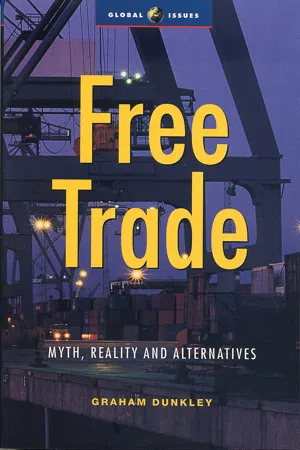
In this book Australian economist, Graham Dunkley, explains and critiques the crucial concept of free trade. A policy of free trade is central to today's world-dominating globalization project. The more euphoric globalists uncritically assume that it has universal and unequivocal benefits for all people and countries. And the perpetual negotiations of the World Trade Organization are wholly based on this presumption.
Graham Dunkley shows, however, that leading economists have always been more sceptical about free trade doctrine than the dogmatic globalizers realize. There are more holes in free trade theory than its advocates grasp. And the benefits of free trade in practice are more limited and contingent than they acknowledge.
He also argues that the World Bank's long-time push for export-led development is misguided. A more democratic world trading order is necessary and possible. And more interventionist, self-reliant trade policies are feasible, especially if a more holistic view of economic development goals is adopted.
- English
- ePUB (mobile friendly)
- Available on iOS & Android
eBook - ePub
About this book
Information

CHAPTER 1
INTRODUCTION:
TRADE, MYTH AND OBSESSION
TRADE, MYTH AND OBSESSION
The driving idea behind globalization is free-market capitalism – the more you let market forces rule and the more you open your economy to free trade and competition, the more efficient and flourishing your economy will be. Globalization [is spreading] to virtually every country in the world … has its own set of economic rules [requiring] opening, deregulating and privatizing … and its own dominant culture, which [is] homogenizing [and spreading] Americanization – from Big Macs to iMacs to Mickey Mouse – on a global scale.
Thomas Friedman (1999: 8)
For me free trade is not a policy, free trade is just economic theory.
François Loos, French trade minister,
during trade negotiations with Australia
during trade negotiations with Australia
(The Age, 20 March 2003)
Today the world is in the grip of a doctrine which preaches ‘Free Market’ solutions to all problems and which is espoused by an ‘elite consensus’ among world bodies, most governments, ‘oppositions’, business, and mainstream media, as well as by some economists, but by few others. Actually, sceptics abound but they are not in power, and, once in power, miraculously adopt orthodoxy, with the notable exception of French trade ministers (quoted above). This doctrine has various names but I call it Free Market Economic Rationalism, or variants thereof, and I designate its practitioners Free Marketeers, though in Australia they are sometimes called Eco Rats! Free Marketeers advocate free trade for international commerce, globalisation for most economic transactions (in goods, services, capital, labour, law, accounting, regulation or the like) and free markets for almost everything, domestically and globally. A new world order centred on the World Trade Organisation (WTO) is being constructed on the basis of this doctrine and its assumptions, an endeavour which I call the Global Free Trade Project, and I claim it is based more on myth than reality.
I employ the metaphor of ‘mythology’ because in the two centuries since Adam Smith the Free Trade debate has thrown up many legends which are part truth, part shibboleth. One of the great myths of the age is that free trade and related forms of globalisation can generate a new era of prosperity, a view widely espoused by non-economist businessmen, bureaucrats, politicians, journalists and other public commentators. For instance Australia-based US commentator Bruce Wolpe (The Age, 23 April 2003), who opposed the war in Iraq, has said that the tragedy of the War on Terror and the Iraq War is that they have damaged ‘the secret of the prosperity of the 1990s – free trade’. The WTO makes similar claims for Free Trade. But this statement contains three misconceptions: the 1990s did not see a major economic recovery, only minor trade liberalisation was achieved, and even mainstream economists doubt that this contributed much to the world economy. Indeed, economists have always been more circumspect in their claims for Free Trade than the more euphoric globalists, of whom US journalist Thomas Friedman (quoted above) is an extreme example. The core argument of this book is that Free Trade and related globalisation cannot bring as many benefits as claimed, and that any ‘gains from trade’ are contingent rather than certain. I agree with the French trade minister (quoted above) that the purported virtues of free trade are more theory than reality, and even the theory has some fundamental flaws. In fact, Free Trade is as much an ideology or a ‘world-view’ as a policy or a theory.
Trade: The Making of an Obsession
In earlier English the word trade meant a path or beaten track, implying a routine social function, ancient trading being mainly for basics and ‘embedded’ in other social institutions. Some historians see trade as static and state-controlled over long periods, others seeing dynamism and embryonic entrepreneurship. Either way, many see trading as socially and culturally disruptive, thus eliciting a universal desire for ‘protection’ in the literal, cushioning sense. Thus, trade is a natural, ancient activity, but so is Protection, as is the widespread pre-industrial desire to embed trading in more fundamental institutions, rendering it very much subservient to society and culture (Polanyi, 1957; Clark, 1974; see also Chapter 4).
In time trading became more adventurous, luxurious and disembedded, the early trade theorists called ‘Mercantilists’ proclaiming it essential to development, and Adam Smith declaring it needed to be free, or unencumbered by state imposts, for maximum benefits, although he did not want trading to disrupt society and did not think capital should move across borders. By the late nineteenth century brave new trading ventures were thought essential for industrial revolution, and liberalisation became fashionable until it was realised, as economic historian Paul Bairoch (1972) later discovered, that protection was better for growth in many countries. But the myth that free trade is best for growth thrives and is the key to present-day trade obsessions.
The post-war GATT-centred trading order was based on both this myth and the ‘legend of the thirties’, as I call it, that inter-war protectionism nearly ruined the world. In Chapter 4 I question these and other myths. Unexpected success at the famed Uruguay Round of GATT (1986–93) entrenched these myths, created a system of permanent trade negotiations, generated images of ‘trade determinism’, as I call the belief that trade causes growth or other ‘good’ things, and gave rise to ‘globo-euphoria’, which attributes all good things to free trade and globalisation. In a clear statement of ‘trade determinism’, former WTO director general, Renato Ruggiero (in Aga Khan, 1998: 22) has stated that ‘Trade liberalisation is not just a recipe for growth, but also for security and peace, as history has shown us.’ The WTO has credited recent economic improvements in poor countries to their greater integration into its global order, debiting the ‘ugly alternatives’ of poverty and conflict to lack of such integration (quoted p. 188, below). Free Trade economists often describe the goal of globalisation as ‘deep integration’, or the convergence of nations’ fundamental economic structures and policy systems, extending ‘far beyond trade or strictly economic criteria’ (Ruggiero in Aga Khan, 1998: 234).
Trade obsession reached an apogee at the 2002 Johannesburg Summit on Sustainable Development, when Australia and other trade-obsessed Western countries moved to include in key environmental and justice resolutions the clause: ‘while ensuring WTO consistency’, implying that we can only save the planet if the WTO approves! This clause was dropped when howled down by dissident Third World countries (TWN, September 2002, 145–6), but a strong trade determinist obsession still grips world leaders.
In-Your-Face Globalisation
Trade obsession is paralleled by an equal obsession with wider globalisation, variously defined as closer contact between societies, compression of space/time, dissolution of boundaries or integration of markets, the last of these being a definition often used by economists, who did not invent the term and are not always comfortable with it. I define globalisation as displacement of local and national factors in people’s lives by transnational ones, and I describe ‘cooperative internationalism’, my preferred form of supranationalism, as arms’ length, mutually beneficial interchange between sovereign societies.
The more iconoclastic globalists variously depict globalisation as the end of geography and the demolition of nations (Wriston); as a borderless world and an invisible cyberspace country called ‘Cyberia’ (Ohmae); or as an ‘electronic herd’ trampling through nations at will, a ‘golden straitjacket’ of strict but supposedly beneficial Free Market policies and a ‘brutal in-your-face, Schumpterian capitalism’ which leaves laggards as ‘roadkill on the global investment highway’ (Friedman, 1999: 214, 333 and passim). Curiously, these boffins think such prognostications are recommendations for globalisation and wonder why there are anti-globalisation movements!
Not all mainstream writers are so globo-euphorist, however. Economists such as Bhagwati (1998) and Krugman stoutly defend free trade but query the benefits of free investment, speculative capital and extreme economic deregulation. A former top OECD official, Louis Emmerij (2000), has criticised globalisation as private-sector driven, benefiting mainly private firms and creating many new social or equity problems. And, of course, there is an array of sub- and non-mainstream critiques of globalisation, some of them conspiratorial or ill informed, but many producing well-documented critiques, which will be touched on throughout the book.
Globalism: Three Myths
The Global Free Trade Project and the general globalisation push are posited on three assumptions which I consider inaccurate, even mythological: (1) that globalisation is now well advanced; (2) that it is inevitable or unstoppable; and (3) that it is overwhelmingly good for virtually everyone.
The first myth is widely criticised on grounds such as that global integration and centralisation of power were greater in the late nineteenth century (Streeten, 1998: 14ff); that TNCs are still largely home-based; that world prices, profits and interest rates are not sufficiently uniform to indicate advanced market integration (Pryor, 2000) and that regionalism is much stronger than globalism (Rugman, 2000). I partly agree, and cite evidence that trade and FDI are less in relation to the real economy than is usually thought (Chapter 4). The idea of global takeover by Coca-Cola, McDonald’s and Americanisation should not be ignored (see Chapter 5, esp. Box 5.1), even the World Bank (2002: 156) conceding this to be a concern, but it can be exaggerated. I have travelled in parts of India where little seems to have changed since the Raj, even in the cities, icons of the West and ‘Cyberia’ being present but largely lost in the vast squalor of Indian semi-modernity.
The second myth, that of inevitable globalism, is greatly overdrawn because, whilst there are globalising forces like improved transport and communications, the prime integrating process appears to be discretionary deregulation by governments, which today are committing what I call ‘sovereignty suicide’. Even Free Traders such as Bhagwati (1998: 360) or Krugman (1995: 328) and some populist globalists like Legrain (2002) concede the voluntary nature of deregulatory globalism, as do some more radical economists (e.g. Kitson and Michie, 2000: 13ff), while the WTO regularly warns of deregulatory backsliding and uses ‘lock-in’ devices to prevent this (Chapter 8), clearly implying that globalisation is not preordained or assured.
The third myth, that free trade and globalisation are beneficial for virtually all people in all countries at all times, is based on oversimplified research methods and questionable results, a former OECD official Emmerij (2000) hinting that the World Bank is over-optimistic to an extent which borders on dishonesty in its globo-euphorist claims (e.g. in 2002). Globalism is complex, with crosscutting impacts. There can be beneficial mechanisms, such as what I call ‘referential effects’ (‘modelling’ of good laws from other countries) and ‘regulatory effects’ (international pressure for improved standards – see Held, 1999; Braithwaite and Drahos, 2000) alongside mixed or adverse impacts ranging from ‘integrative effects’ (homogenisation of legal or administrative practices) and ‘displacement effects’ (destruction of one culture by another) to ‘disruption effects’ (social or other dislocation). Such costs of globalism are inadequately considered by globo-euphorists, although the World Bank (2002: 128–30) now obliquely acknowledges them; some of these will be touched on throughout this book.
In particular, I argue that the worst impacts are from the latter two effects – displacement and disruption. The much quoted British globo-euphorist, Philippe Legrain (2002), who claims to have discovered the ‘truth’ about globalisation, glibly decrees that it brings overwhelmingly beneficial cultural change and that ‘most people in the Third World quite like our Western “trash”’ (2002: 31ff). But it is nonsense to claim to know what several billion people want or how they are affected by major changes. My reading, from travel and some work with NGO grassroots projects in India (Dunkley, 1993), is that people’s views are mixed, with some burgeoning consumerism but with many people resistant to undue Westernisation. Most want modest improvements in areas such as income, health and education, but many also wish to preserve their own traditions, adapted where necessary. One Middle Eastern economist and advocate of greater self-reliance, Yusif A. Sayigh (1991: 206), suggests that external economic, technological, consumption, educational and cultural dependence in the Arab World is a major factor in the rise of Islamic fundamentalism.
As the well-known development economist Paul Streeten has assessed it, globalisation is good for the richer countries, asset-holders, the educated, risk-takers, profits, large firms, the private sector in general, men, purveyors of global culture and so forth, but adversely effects, for instance, poorer countries, workers, the unskilled, the public sector, small firms, women, children and local communities or cultures (Streeten, 2001). Where benefits such as increased growth or reduced poverty do appear to be assoc...
Table of contents
- Cover
- About this Book
- Title
- Copyright
- Contents
- List of Tables, Figures and Boxes
- Abbreviations Used
- Preface
- 1 Introduction: Trade, Myth and Obsession
- 2 That’s the Theory! Debating Free Trade Doctrine Forever
- 3 A Confederacy of Heretics: Two Centuries of Free Trade Dissent
- 4 What About the Practice? Trading and Free Trade in History and Reality
- 5 Development, Myths and Alternatives: A Critique of Globalising Growth
- 6 The Export Cult: The Import-Substitution Versus Export-Orientation Debate
- 7 The Self-Reliance Option: Global Myths and Alternative Development
- 8 The Free Trade Adventure: The Wto, Global Myths and Alternatives
- 9 Conclusion
- References
- Index
- About the Author
- About this Series
- Notes
Trusted by 375,005 students
Access to over 1.5 million titles for a fair monthly price.
Study more efficiently using our study tools.
Frequently asked questions
Yes, you can cancel anytime from the Subscription tab in your account settings on the Perlego website. Your subscription will stay active until the end of your current billing period. Learn how to cancel your subscription
No, books cannot be downloaded as external files, such as PDFs, for use outside of Perlego. However, you can download books within the Perlego app for offline reading on mobile or tablet. Learn how to download books offline
Perlego offers two plans: Essential and Complete
- Essential is ideal for learners and professionals who enjoy exploring a wide range of subjects. Access the Essential Library with 800,000+ trusted titles and best-sellers across business, personal growth, and the humanities. Includes unlimited reading time and Standard Read Aloud voice.
- Complete: Perfect for advanced learners and researchers needing full, unrestricted access. Unlock 1.5M+ books across hundreds of subjects, including academic and specialized titles. The Complete Plan also includes advanced features like Premium Read Aloud and Research Assistant.
We are an online textbook subscription service, where you can get access to an entire online library for less than the price of a single book per month. With over 1.5 million books across 990+ topics, we’ve got you covered! Learn about our mission
Look out for the read-aloud symbol on your next book to see if you can listen to it. The read-aloud tool reads text aloud for you, highlighting the text as it is being read. You can pause it, speed it up and slow it down. Learn more about Read Aloud
Yes! You can use the Perlego app on both iOS and Android devices to read anytime, anywhere — even offline. Perfect for commutes or when you’re on the go.
Please note we cannot support devices running on iOS 13 and Android 7 or earlier. Learn more about using the app
Please note we cannot support devices running on iOS 13 and Android 7 or earlier. Learn more about using the app
Yes, you can access Free Trade by Graham Dunkley in PDF and/or ePUB format, as well as other popular books in Economia & Economia internazionale. We have over 1.5 million books available in our catalogue for you to explore.